
Groupbased Source Authentication in VANETs You Lu Biao
Group-based Source Authentication in VANETs You Lu, Biao Zhou, Fei Jia, Mario Gerla UCLA {youlu, zhb, feijia, gerla}@cs. ucla. edu
VANET slide • VANET Scenario
The problem: authentication • VANET broadcast messages: – Beacons for safe driving, surveillance, situation etc • Problem: malicious sources can generate bogus messages – Attack models • Critical issue we address here: – Sender authentication (within group) – Not addressed here: • Non repudiation • Privacy protection, • Secret delivery to selected group (e. g. police agents, taxi cabs, coalition members), etc
Existing Authent. solutions • PKI – a bit too expensive • TESLA – cheaper, but. . slow (Toyota et al)
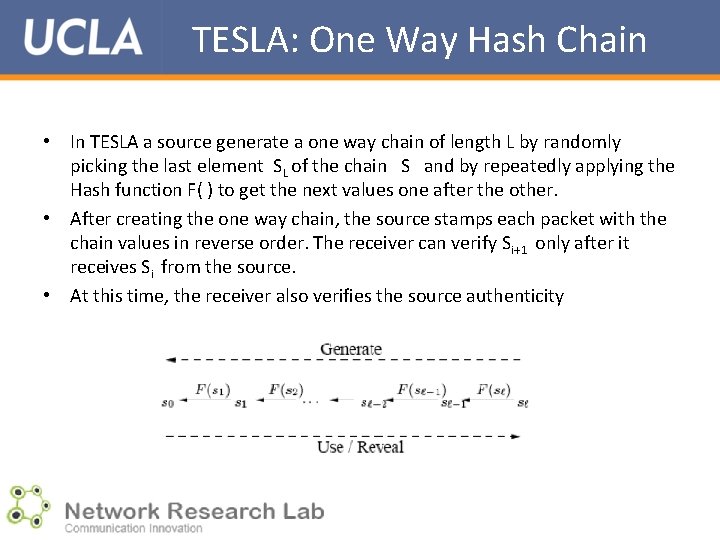
TESLA: One Way Hash Chain • In TESLA a source generate a one way chain of length L by randomly picking the last element SL of the chain S and by repeatedly applying the Hash function F( ) to get the next values one after the other. • After creating the one way chain, the source stamps each packet with the chain values in reverse order. The receiver can verify Si+1 only after it receives Si from the source. • At this time, the receiver also verifies the source authenticity

TESLA overview (cont) • TESLA (Time efficient stream loss tolerant authentication) – Assumption: 2 - time slot delay in authentication • Packet P 1 received in slot 5; K 5 received in slot 7 – Authentication of P 1: • Verify K 5 from K 4 pr K 3 (explain how) • MAC(K 5, P 1) = Verify MAC – Pros: Robust to packet loss; Data all in plain text. – Con: delayed authentication.
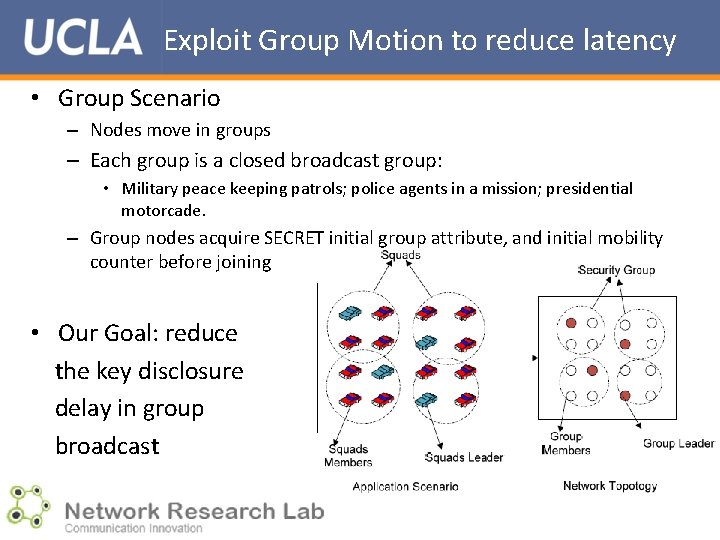
Exploit Group Motion to reduce latency • Group Scenario – Nodes move in groups – Each group is a closed broadcast group: • Military peace keeping patrols; police agents in a mission; presidential motorcade. – Group nodes acquire SECRET initial group attribute, and initial mobility counter before joining • Our Goal: reduce the key disclosure delay in group broadcast
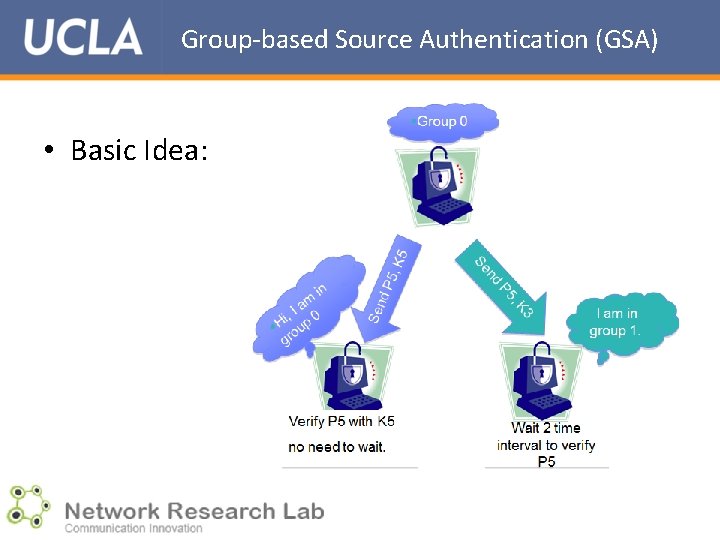
Group-based Source Authentication (GSA) • Basic Idea:
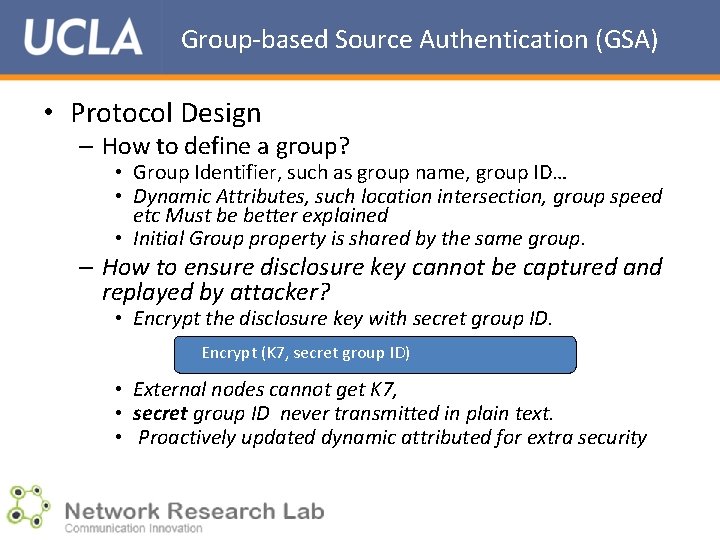
Group-based Source Authentication (GSA) • Protocol Design – How to define a group? • Group Identifier, such as group name, group ID… • Dynamic Attributes, such location intersection, group speed etc Must be better explained • Initial Group property is shared by the same group. – How to ensure disclosure key cannot be captured and replayed by attacker? • Encrypt the disclosure key with secret group ID. Encrypt (K 7, secret group ID) • External nodes cannot get K 7, • secret group ID never transmitted in plain text. • Proactively updated dynamic attributed for extra security
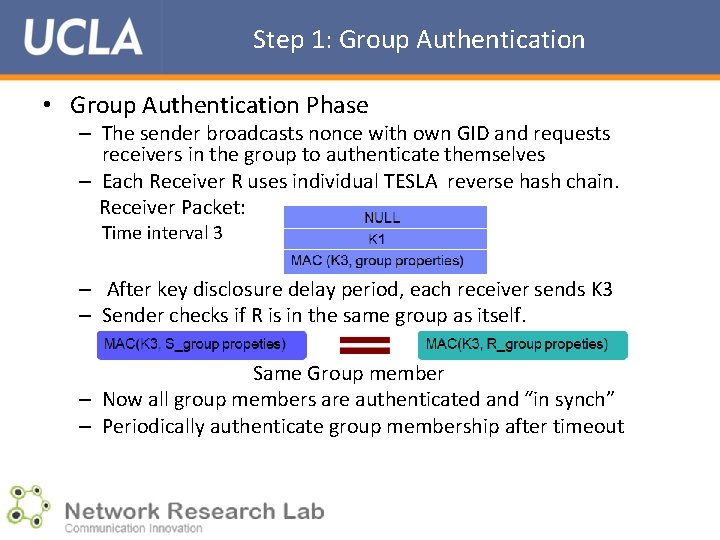
Step 1: Group Authentication • Group Authentication Phase – The sender broadcasts nonce with own GID and requests receivers in the group to authenticate themselves – Each Receiver R uses individual TESLA reverse hash chain. Receiver Packet: Time interval 3 – After key disclosure delay period, each receiver sends K 3 – Sender checks if R is in the same group as itself. Same Group member – Now all group members are authenticated and “in synch” – Periodically authenticate group membership after timeout
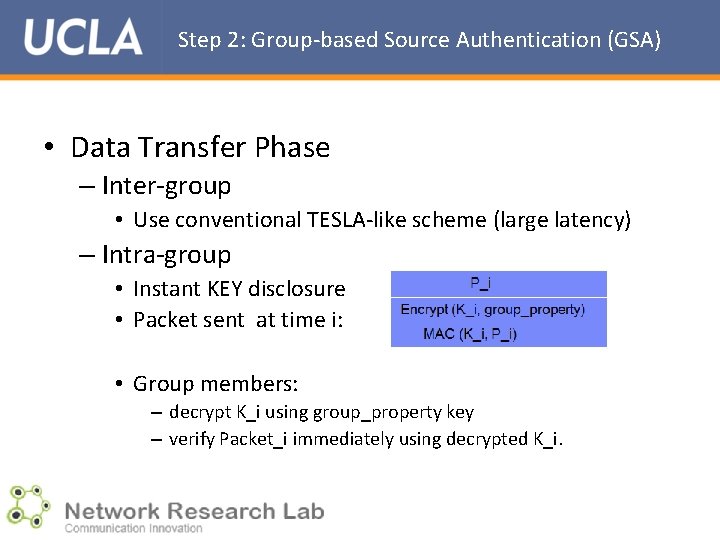
Step 2: Group-based Source Authentication (GSA) • Data Transfer Phase – Inter-group • Use conventional TESLA-like scheme (large latency) – Intra-group • Instant KEY disclosure • Packet sent at time i: • Group members: – decrypt K_i using group_property key – verify Packet_i immediately using decrypted K_i.
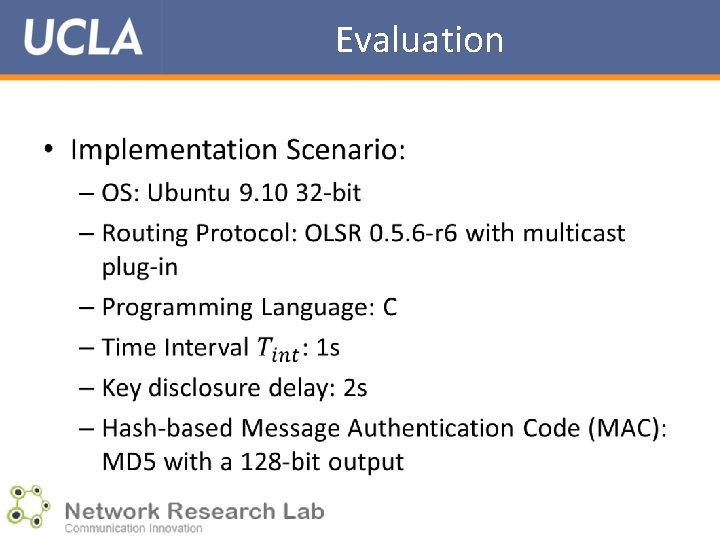
Evaluation
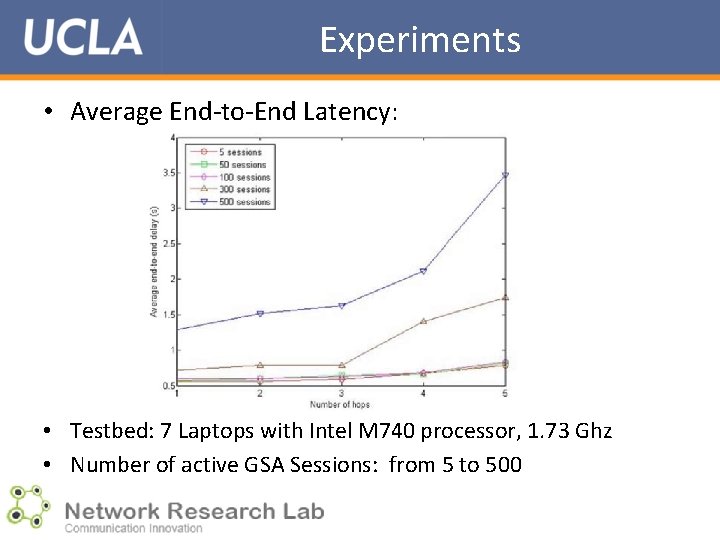
Experiments • Average End-to-End Latency: • Testbed: 7 Laptops with Intel M 740 processor, 1. 73 Ghz • Number of active GSA Sessions: from 5 to 500
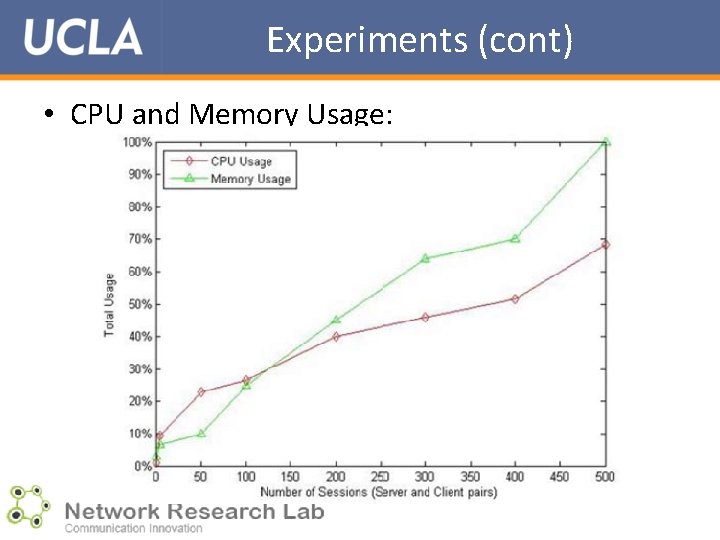
Experiments (cont) • CPU and Memory Usage:
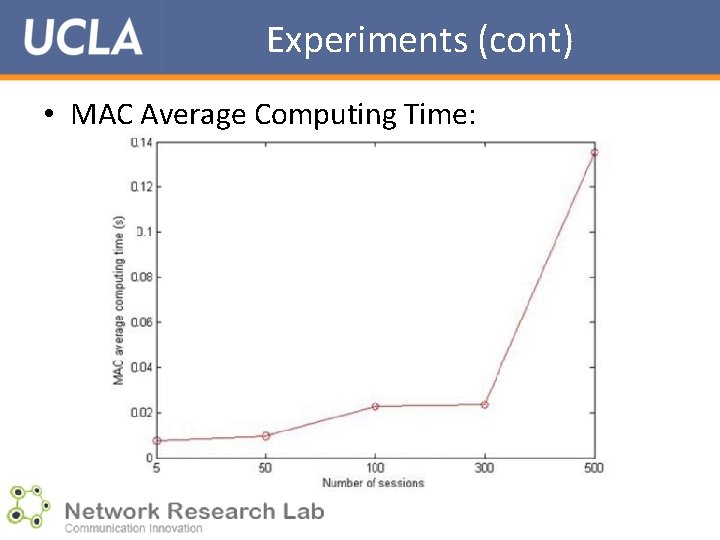
Experiments (cont) • MAC Average Computing Time:
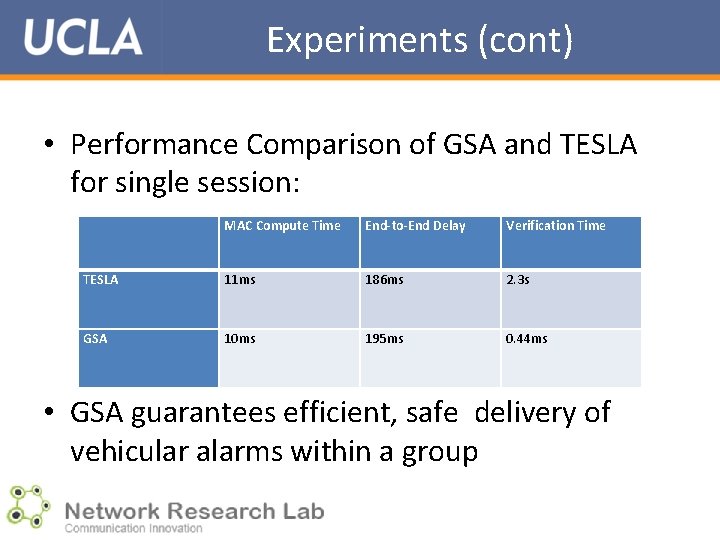
Experiments (cont) • Performance Comparison of GSA and TESLA for single session: MAC Compute Time End-to-End Delay Verification Time TESLA 11 ms 186 ms 2. 3 s GSA 10 ms 195 ms 0. 44 ms • GSA guarantees efficient, safe delivery of vehicular alarms within a group
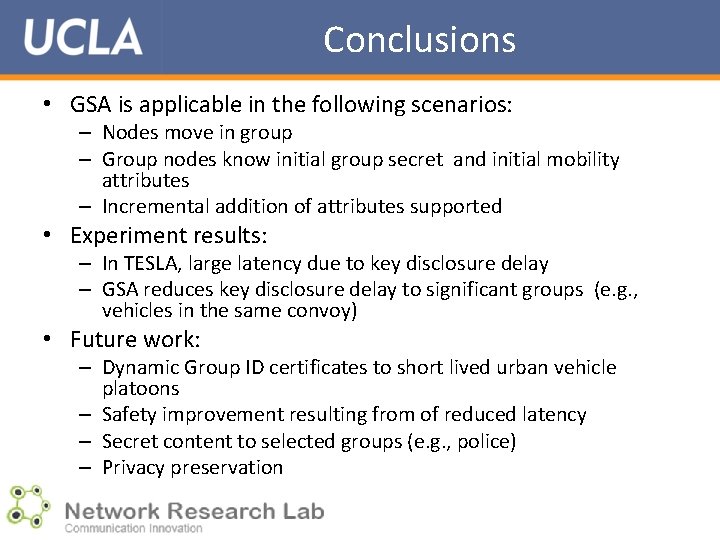
Conclusions • GSA is applicable in the following scenarios: – Nodes move in group – Group nodes know initial group secret and initial mobility attributes – Incremental addition of attributes supported • Experiment results: – In TESLA, large latency due to key disclosure delay – GSA reduces key disclosure delay to significant groups (e. g. , vehicles in the same convoy) • Future work: – Dynamic Group ID certificates to short lived urban vehicle platoons – Safety improvement resulting from of reduced latency – Secret content to selected groups (e. g. , police) – Privacy preservation
Thanks Q&A
- Slides: 18