
Groupbased M 2 M solutions Document Number IEEE

Group-based M 2 M solutions Document Number: IEEE C 802. 16 p-11/0013 Date Submitted: 2010/03/03 Source: Honggang Li, Rui Huang, Shantidev Mohant E-mail: honggang. li@intel. com Intel Corp. *<http: //standards. ieee. org/faqs/affiliation. FAQ. html> Re: 802. 16 p amendment text (Cf. C: Project 802. 16 p Amendment Working Document Content) Base Contribution: IEEE C 802. 16 p-11/xxxx Purpose: To be discussed and adopted in the AWD by the 802. 16 p M 2 M TG Notice: This document does not represent the agreed views of the IEEE 802. 16 Working Group or any of its subgroups. It represents only the views of the participants listed in the “Source(s)” field above. It is offered as a basis for discussion. It is not binding on the contributor(s), who reserve(s) the right to add, amend or withdraw material contained herein. Copyright Policy: The contributor is familiar with the IEEE-SA Copyright Policy <http: //standards. ieee. org/IPR/copyrightpolicy. html>. Patent Policy: The contributor is familiar with the IEEE-SA Patent Policy and Procedures: <http: //standards. ieee. org/guides/bylaws/sect 6 -7. html#6> and <http: //standards. ieee. org/guides/opman/sect 6. html#6. 3>. Further information is located at <http: //standards. ieee. org/board/pat-material. html> and <http: //standards. ieee. org/board/pat >. March 2011 Intel Corp. Slide 1
Abstract • This presentation discusses the candidate solutions to meet the requirements defined in SRD, based on M 2 M devices grouping. March 2011 Intel Corp. Slide 2
Functional requirements of 16 p • • • Low power consumption Large numbers of devices Small burst transmissions Security support We discuss the potential solutions to the requirements of low power consumption and large numbers of devices March 2011 Intel Corp. Slide 3
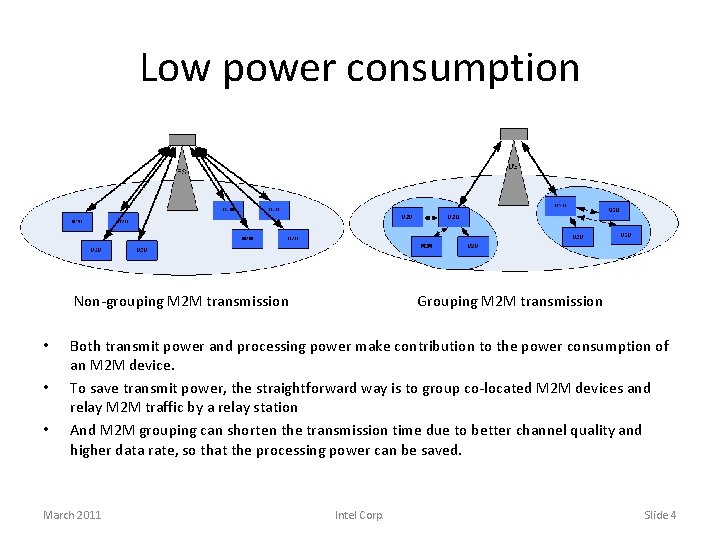
Low power consumption Non-grouping M 2 M transmission • • • Grouping M 2 M transmission Both transmit power and processing power make contribution to the power consumption of an M 2 M device. To save transmit power, the straightforward way is to group co-located M 2 M devices and relay M 2 M traffic by a relay station And M 2 M grouping can shorten the transmission time due to better channel quality and higher data rate, so that the processing power can be saved. March 2011 Intel Corp. Slide 4
Large numbers of devices • Most of M 2 M devices are cluster-type deployed, e. g. in a home, floor, warehouse etc. • A cluster of devices can share a same connection with the BS, and aggregate the transmissions to simplify the air interface design – Less requirement of random access for large numbers of devices – Less interference March 2011 Intel Corp. Slide 5
Solutions to M 2 M grouping • 16 m relay M 2 M grouping – In a group, there is a relay station between M 2 M devices and the BS, the RS can also be an M 2 M device – Because only the RS communicates with the BS, most of M 2 M devices can work in low power – The RS can support M 2 M data aggregation, so that multiple reports from M 2 M devices can be collected and packed in one PSDU or MSDU regarding if the destination addresses are the same one or not, to improve the spectral efficiency in relay link • Dual mode(het-net) relay M 2 M grouping – Similar like 16 m relay grouping, except that the access link between the RS and other M 2 M devices can be 802. 11 or other air interface • Group-based channel allocation and transmission – Some of control process can done by one of devices of the group and shared with other devices, e. g. group-based bandwidth request and channel allocation March 2011 Intel Corp. Slide 6
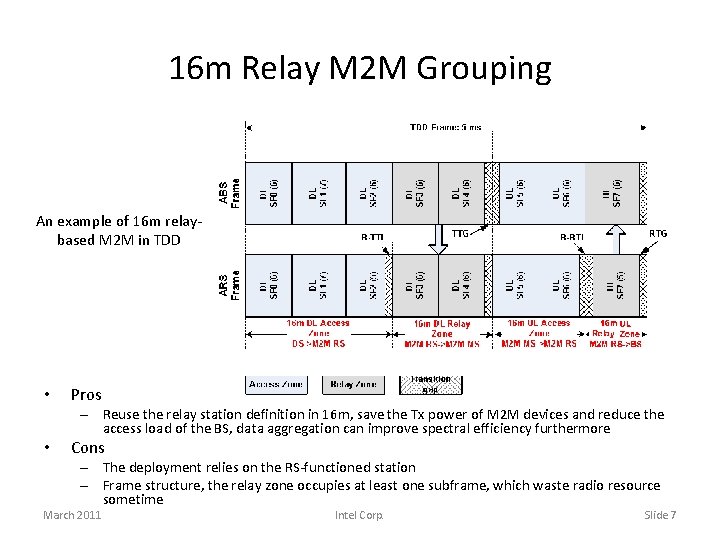
16 m Relay M 2 M Grouping An example of 16 m relaybased M 2 M in TDD • Pros – Reuse the relay station definition in 16 m, save the Tx power of M 2 M devices and reduce the access load of the BS, data aggregation can improve spectral efficiency furthermore • Cons – The deployment relies on the RS-functioned station – Frame structure, the relay zone occupies at least one subframe, which waste radio resource sometime March 2011 Intel Corp. Slide 7
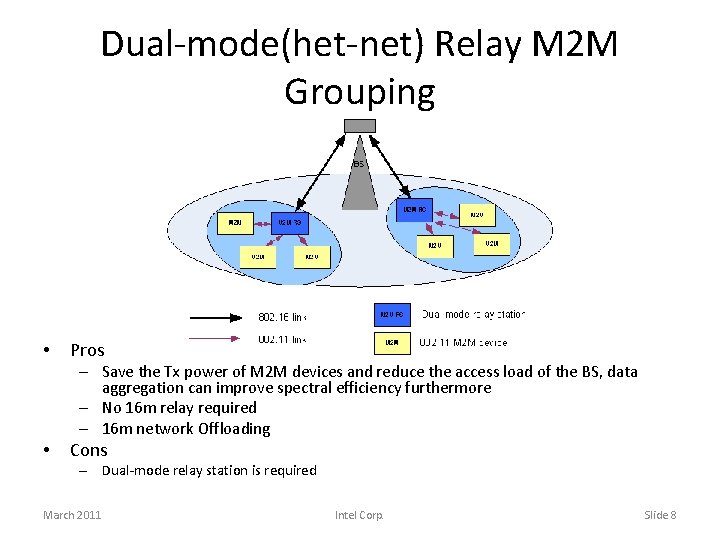
Dual-mode(het-net) Relay M 2 M Grouping • Pros – Save the Tx power of M 2 M devices and reduce the access load of the BS, data aggregation can improve spectral efficiency furthermore – No 16 m relay required – 16 m network Offloading • Cons – Dual-mode relay station is required March 2011 Intel Corp. Slide 8
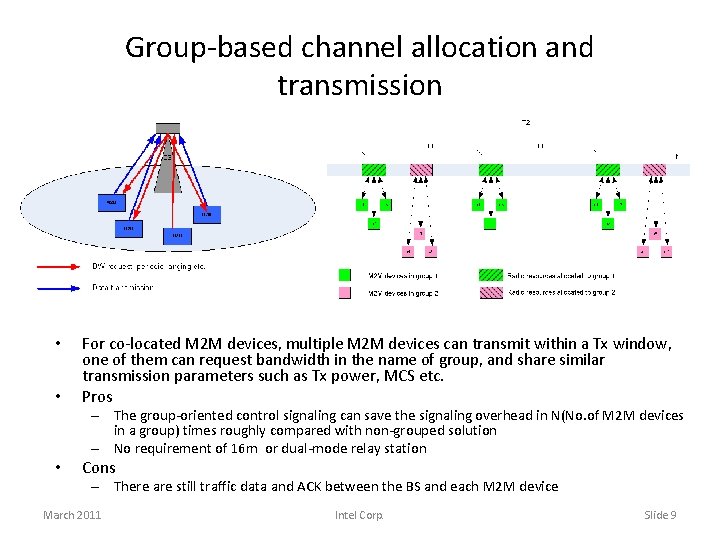
Group-based channel allocation and transmission • • For co-located M 2 M devices, multiple M 2 M devices can transmit within a Tx window, one of them can request bandwidth in the name of group, and share similar transmission parameters such as Tx power, MCS etc. Pros – The group-oriented control signaling can save the signaling overhead in N(No. of M 2 M devices in a group) times roughly compared with non-grouped solution – No requirement of 16 m or dual-mode relay station • Cons – There are still traffic data and ACK between the BS and each M 2 M device March 2011 Intel Corp. Slide 9
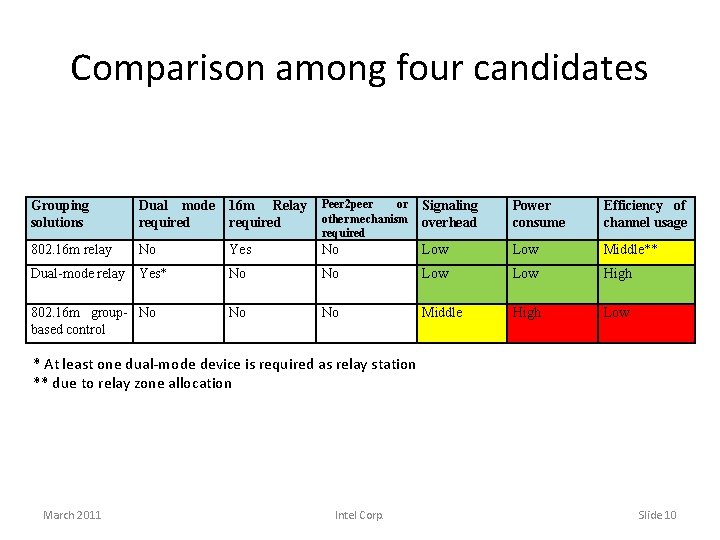
Comparison among four candidates Grouping solutions Dual mode required 16 m Relay required Peer 2 peer or other mechanism required Signaling overhead Power consume Efficiency of channel usage 802. 16 m relay No Yes No Low Middle** Dual-mode relay Yes* No No Low High 802. 16 m group- No based control No No Middle High Low * At least one dual-mode device is required as relay station ** due to relay zone allocation March 2011 Intel Corp. Slide 10
Conclusions • Three kinds of solutions are analyzed and compared, 16 m relay-based, dual-mode relay-based grouping, and Group Signaling. Dual-mode solution is better than the other two in power consumption, signaling overhead and efficiency of channel usage. • Within 802. 16 only solution, relay-based solution may be straightforward one and has minimum modifications to 16 m standard, but there should be relay zone allocated and RSfunctioned device. March 2011 Intel Corp. Slide 11
![References • [1] Jin Lee, “IEEE 802. 16 p Machine to Machine (M 2](http://slidetodoc.com/presentation_image_h2/8f1172f2892dc8fafb895a197c15221a/image-12.jpg "References • [1] Jin Lee, “IEEE 802. 16 p Machine to Machine (M 2")
References • [1] Jin Lee, “IEEE 802. 16 p Machine to Machine (M 2 M) System Requirements Document”, IEEE 802. 16 p-10/0004 r 2 March 2011 Intel Corp. Slide 12
- Slides: 12