
Group Work Practice An Introduction Group Work Working



- Slides: 24
Group Work Practice An Introduction
Group Work: Working Definition • An orientation and method of social work intervention in which smaller numbers of people who share similar interests or common problems meet regularly and engage in certain activities designed to achieve certain objectives.
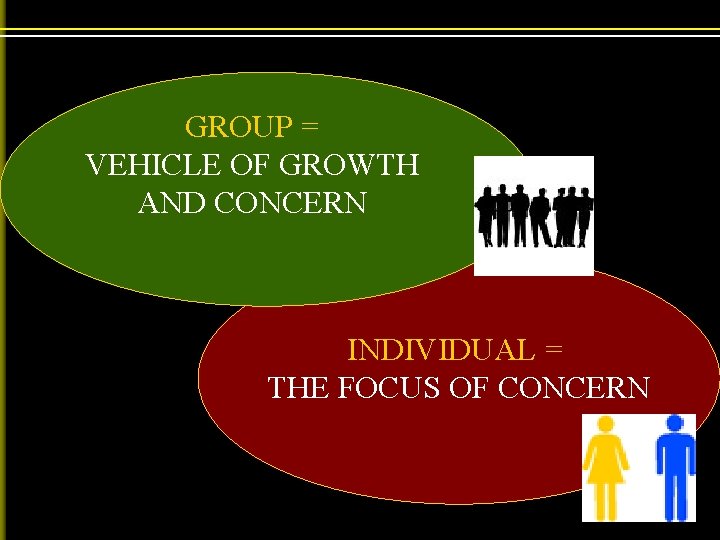
GROUP = VEHICLE OF GROWTH AND CONCERN INDIVIDUAL = THE FOCUS OF CONCERN
Group Work: • • • Involves practice with many different treatment and task groups Operates at the individual group members, whole group, and group environment levels Applies skills from generalist social work practice to a broad range of leadership and membership situations Integrates and uses specialized knowledge and skills based on a comprehensive assessment of the needs of a particular group Recognizes the interactional and situational nature of leadership
Dominant Values in American Society 1. 2. 3. 4. Judeo-Christian doctrine with emphasis on dignity and worth of people and people’s responsibility for their neighbor. Democratic values including equality and participation Puritan ethic, including men and women’s responsibility for them self and living a moral life. Social Darwinism, survival of the strongest. Worker should become familiar with a community , its policies and procedures, before beginning a group.
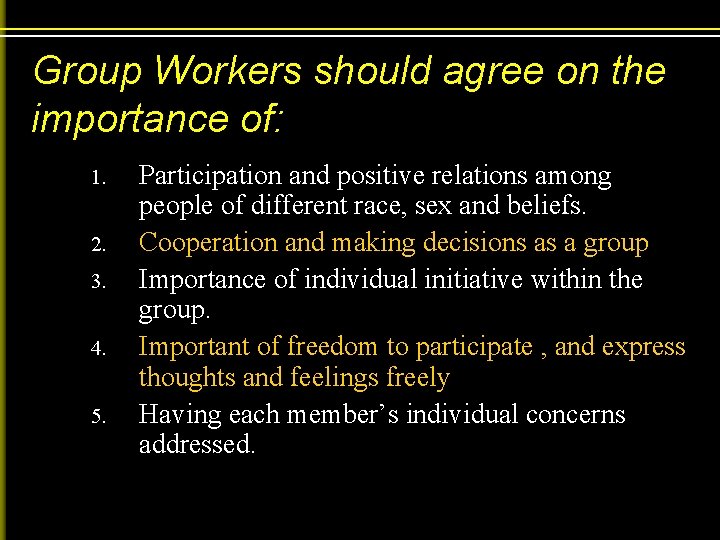
Group Workers should agree on the importance of: 1. 2. 3. 4. 5. Participation and positive relations among people of different race, sex and beliefs. Cooperation and making decisions as a group Importance of individual initiative within the group. Important of freedom to participate , and express thoughts and feelings freely Having each member’s individual concerns addressed.
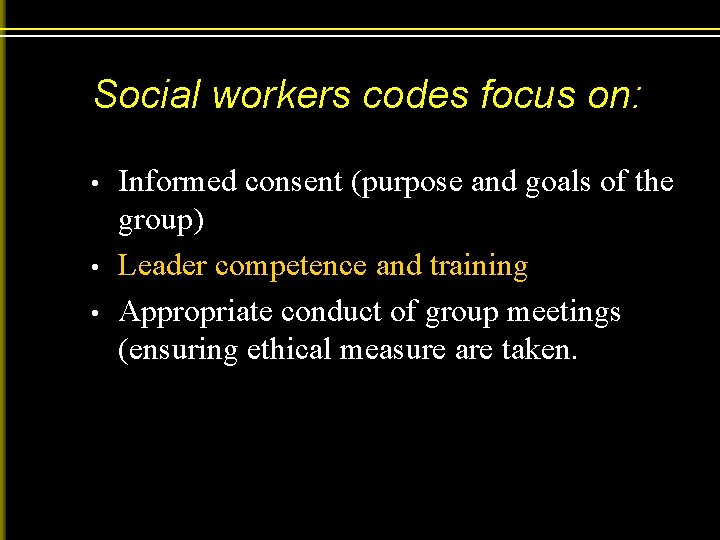
Social workers codes focus on: • • • Informed consent (purpose and goals of the group) Leader competence and training Appropriate conduct of group meetings (ensuring ethical measure are taken.
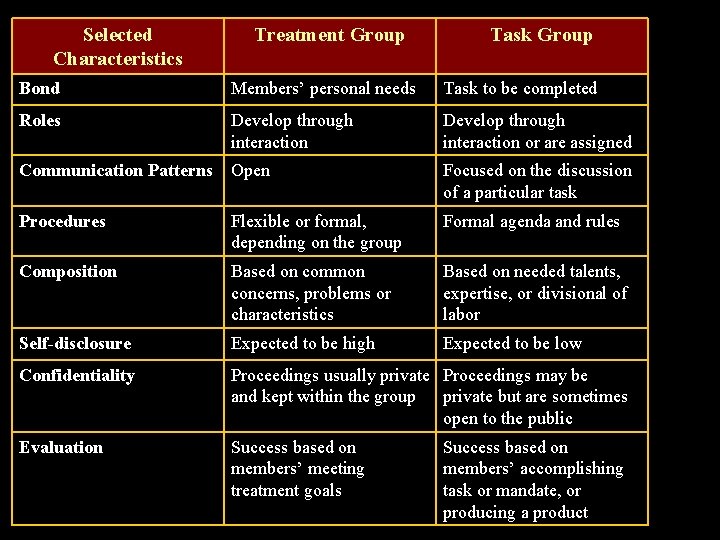
Selected Characteristics Treatment Group Task Group Bond Members’ personal needs Task to be completed Roles Develop through interaction or are assigned Communication Patterns Open Focused on the discussion of a particular task Procedures Flexible or formal, depending on the group Formal agenda and rules Composition Based on common concerns, problems or characteristics Based on needed talents, expertise, or divisional of labor Self-disclosure Expected to be high Expected to be low Confidentiality Proceedings usually private Proceedings may be and kept within the group private but are sometimes open to the public Evaluation Success based on members’ meeting treatment goals Success based on members’ accomplishing task or mandate, or producing a product
Group Treatment
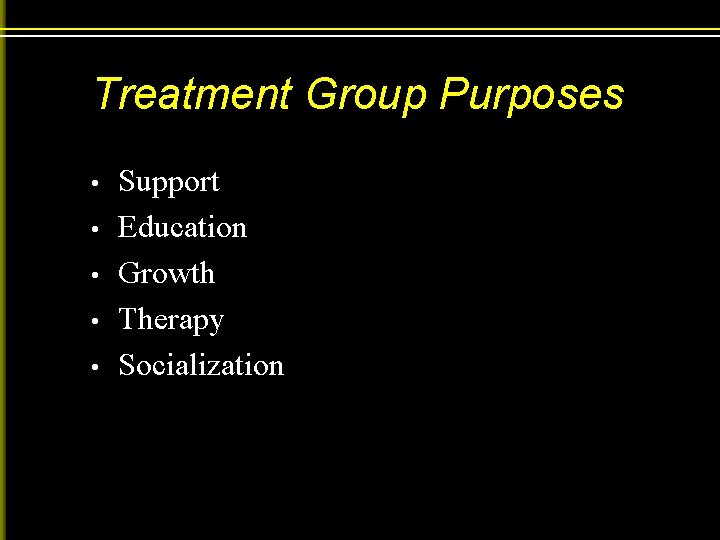
Treatment Group Purposes • • • Support Education Growth Therapy Socialization
Educational Groups • • Help members learn new information and skills. In these groups beginners can learn from advanced members. There is a low level of self-disclosure The worker provides the material.
Growth Groups • • • Promote socioemotional health rather than remediating socioemotional illness. Stress self-improvement and potential of human beings to live a full and rewarding life. Growth groups should have diverse members to broaden others’ experiences.
Therapy Groups • • • Help members change their behavior, cope with and ameliorate personal problems, or rehabilitate themselves after physical , psychological or social trauma. Members come together to solve their problems. Members help each other work on problems.
Socialization Groups • • Help members learn social skills and socially accepted behavior patterns so they can function effectively in the community. 3 common types of socialization groups: • • • Social skills groups-members learn to communicate effectively and develop satisfying social relationships Governance groups- involving residents in the daily governance of the institution Reaction groups- helpful in engaging resistant clients such as gang members and predelinquant , latency age children.
Task Groups • • • Meeting client needs Meeting organizational needs Meeting community needs
Team • • A group of staff members each with particular knowledge and skills, who share expertise with one another for a purpose. Teams often have members with different professions, such as social work, nursing, and medicine.
Treatment Conferences • • • Develop, monitor, and coordinate treatment plans for a particular client or system. They may be employees of different organization who come together to coordinate a treatment plan for a client. Treatment may be carried out by only one employee
Staff Development Groups • • Provide workers with opportunity to learn about new treatment approaches, resources and community services, to practice new skills or learn from work on clients. These improve workers’ skills so they can be more effective.
Committees and Subcommittees • Committees: • • • People appointed or elected to a group. May be temporary creations or permanent parts of an organization. An agenda is followed by the group, so members know what to expect from the meeting. Subcommittees • Report their findings and suggest any new course of action.
Cabinets and Boards • Cabinets: • • • Provide advice and expertise about policy issues to chief executive officers. They concentrate on administrative and policy issues that may effect the organization. Board of directors: • • Governing Board: legally and financially responsible for the conduct of the organization Advisory Board: provide counsel and guidance to the management of an organization
Social Action Groups • • Arise concerns of individuals in the community. Their goals are linked to the individual members of the group. A worker helps a social action group: • • • achieve its purpose help the group remain together long enough to achieve its purpose enable the group members to function together effectively.
Coalition Groups • • Groups of organizations, social action groups, or individuals that come together to exert influence. They agree to pursue common goals. They are often formed by dedicated individuals who has high visibility and respectability within the community.
Delegate Councils • • Purpose of facilitating interagency communication and cooperation, studying communitywide social issues or social problems, engaging in collective social action, and governing larger organizations. A member represents a group of people, an agency or another system, and is given authority to speak for the represented unit.