
Group Work Exam Preparation Dr Shashi Nallaya Copyright

- Slides: 19
Group Work Exam Preparation Dr. Shashi Nallaya
Copyright COMMONWEALTH OF AUSTRALIA Copyright Regulations 1969 WARNING This material has been produced and communicated to you by or on behalf of the University of South Australia pursuant to Part VB of the Copyright Act 1968 (the Act). The material in this communication may be subject to copyright under the Act. Any further reproduction or communication of this material by you may be the subject of copyright protection under the Act. Do not remove this notice.
What are exams? Exams are: • tests of your deep learning, knowledge and understanding of material. • opportunities to demonstrate how you use the information that you have learnt. • challenges/opportunities to demonstrate what you know. 3
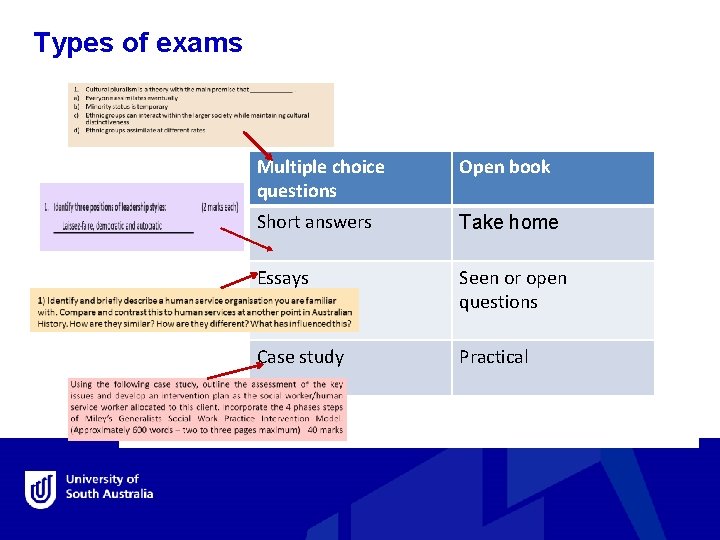
Types of exams Multiple choice questions Open book Short answers Take home Essays Seen or open questions Case study Practical
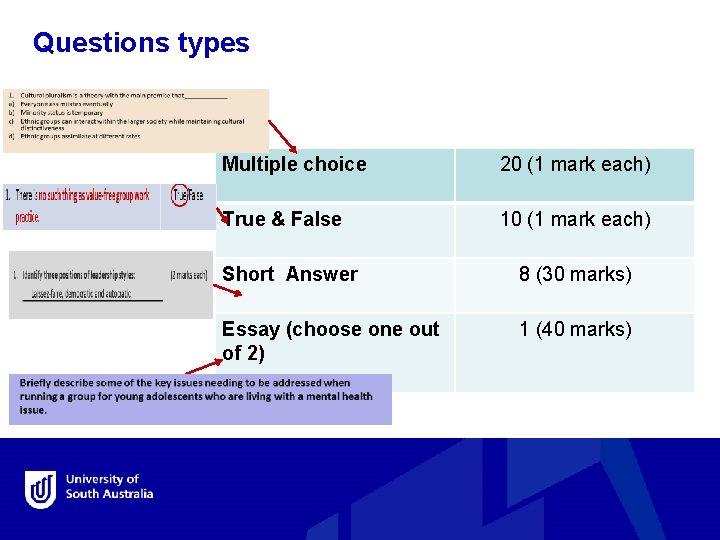
Questions types Multiple choice 20 (1 mark each) True & False 10 (1 mark each) Short Answer 8 (30 marks) Essay (choose one out of 2) 1 (40 marks)
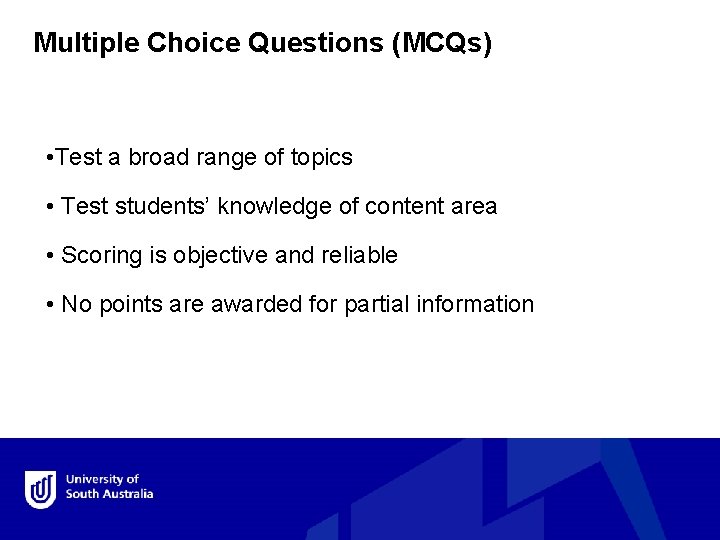
Multiple Choice Questions (MCQs) • Test a broad range of topics • Test students’ knowledge of content area • Scoring is objective and reliable • No points are awarded for partial information
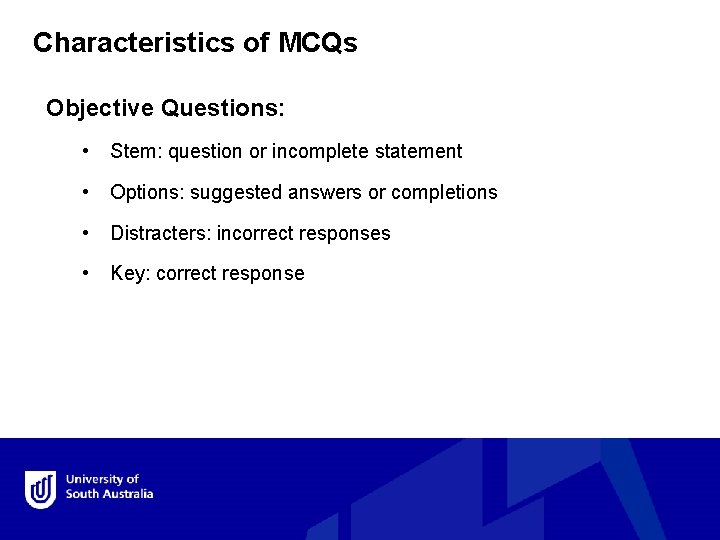
Characteristics of MCQs Objective Questions: • Stem: question or incomplete statement • Options: suggested answers or completions • Distracters: incorrect responses • Key: correct response
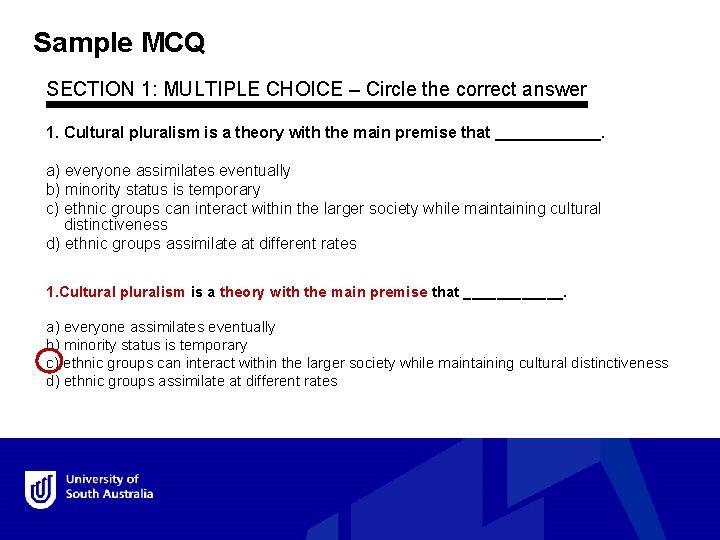
Sample MCQ SECTION 1: MULTIPLE CHOICE – Circle the correct answer 1. Cultural pluralism is a theory with the main premise that ______. a) everyone assimilates eventually b) minority status is temporary c) ethnic groups can interact within the larger society while maintaining cultural distinctiveness d) ethnic groups assimilate at different rates 1. Cultural pluralism is a theory with the main premise that ______. a) everyone assimilates eventually b) minority status is temporary c) ethnic groups can interact within the larger society while maintaining cultural distinctiveness d) ethnic groups assimilate at different rates
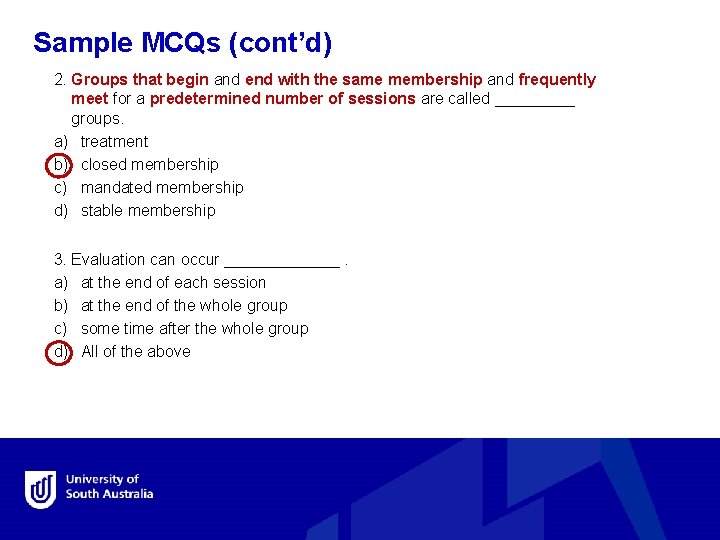
Sample MCQs (cont’d) 2. Groups that begin and end with the same membership and frequently meet for a predetermined number of sessions are called _____ groups. a) treatment b) closed membership c) mandated membership d) stable membership 3. Evaluation can occur _______. a) at the end of each session b) at the end of the whole group c) some time after the whole group d) All of the above
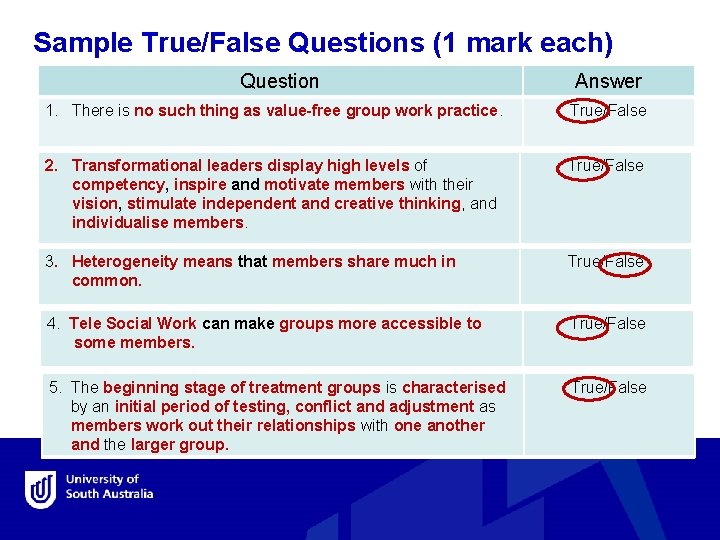
Sample True/False Questions (1 mark each) Question Answer 1. There is no such thing as value-free group work practice. True/False 2. Transformational leaders display high levels of competency, inspire and motivate members with their vision, stimulate independent and creative thinking, and individualise members. True/False 3. Heterogeneity means that members share much in common. True/False 4. Tele Social Work can make groups more accessible to some members. True/False 5. The beginning stage of treatment groups is characterised by an initial period of testing, conflict and adjustment as members work out their relationships with one another and the larger group. True/False
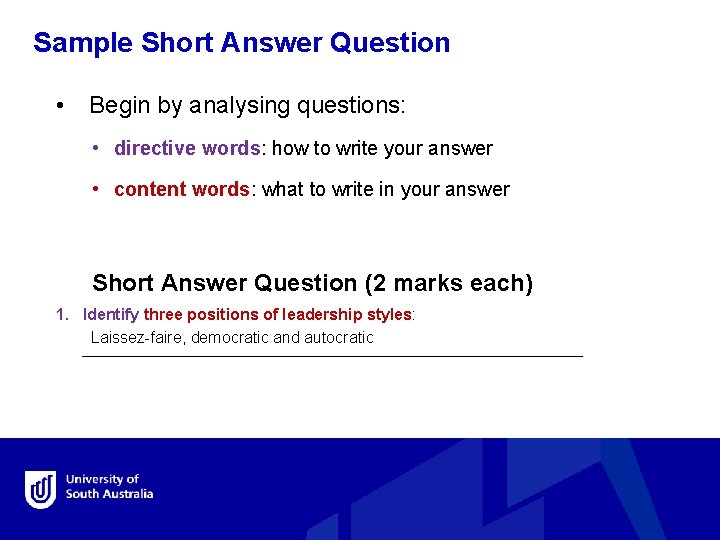
Sample Short Answer Question • Begin by analysing questions: • directive words: how to write your answer • content words: what to write in your answer Short Answer Question (2 marks each) 1. Identify three positions of leadership styles: Laissez-faire, democratic and autocratic
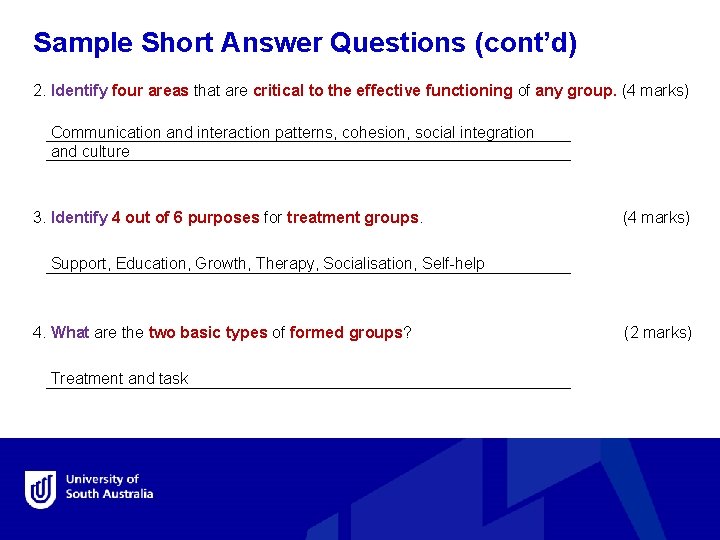
Sample Short Answer Questions (cont’d) 2. Identify four areas that are critical to the effective functioning of any group. (4 marks) Communication and interaction patterns, cohesion, social integration and culture 3. Identify 4 out of 6 purposes for treatment groups. (4 marks) Support, Education, Growth, Therapy, Socialisation, Self-help 4. What are the two basic types of formed groups? (2 marks) Treatment and task
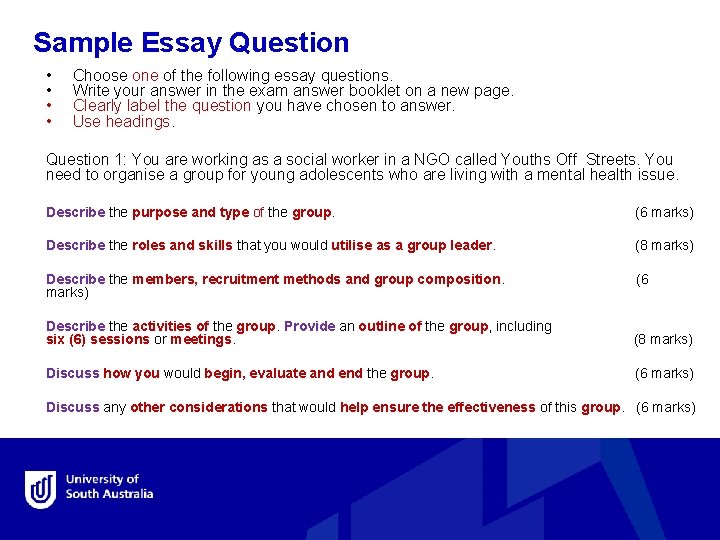
Sample Essay Question • • Choose one of the following essay questions. Write your answer in the exam answer booklet on a new page. Clearly label the question you have chosen to answer. Use headings. Question 1: You are working as a social worker in a NGO called Youths Off Streets. You need to organise a group for young adolescents who are living with a mental health issue. Describe the purpose and type of the group. (6 marks) Describe the roles and skills that you would utilise as a group leader. (8 marks) Describe the members, recruitment methods and group composition. (6 marks) Describe the activities of the group. Provide an outline of the group, including six (6) sessions or meetings. (8 marks) Discuss how you would begin, evaluate and end the group. (6 marks) Discuss any other considerations that would help ensure the effectiveness of this group. (6 marks)
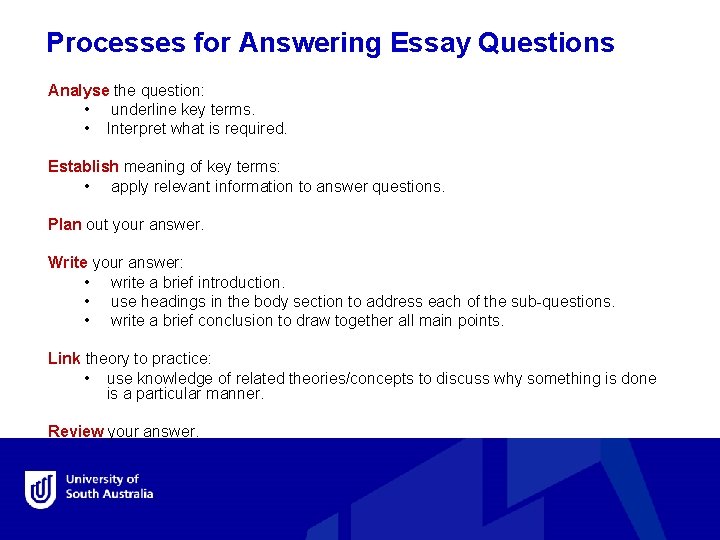
Processes for Answering Essay Questions Analyse the question: • underline key terms. • Interpret what is required. Establish meaning of key terms: • apply relevant information to answer questions. Plan out your answer. Write your answer: • write a brief introduction. • use headings in the body section to address each of the sub-questions. • write a brief conclusion to draw together all main points. Link theory to practice: • use knowledge of related theories/concepts to discuss why something is done is a particular manner. Review your answer.
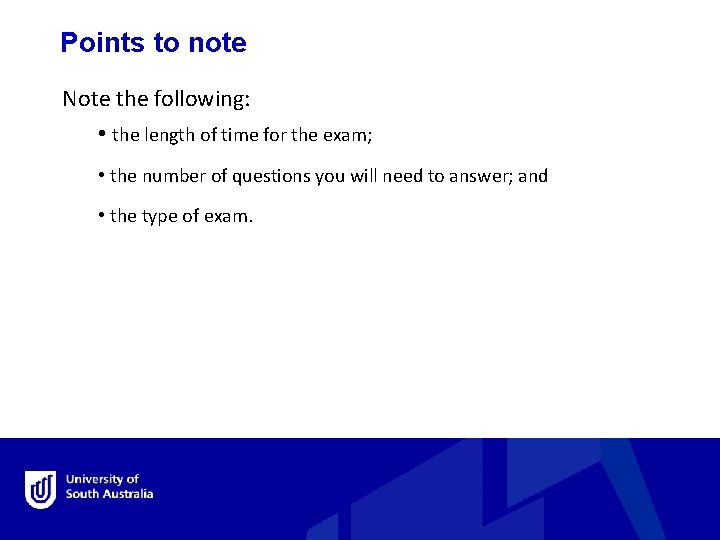
Points to note Note the following: • the length of time for the exam; • the number of questions you will need to answer; and • the type of exam.
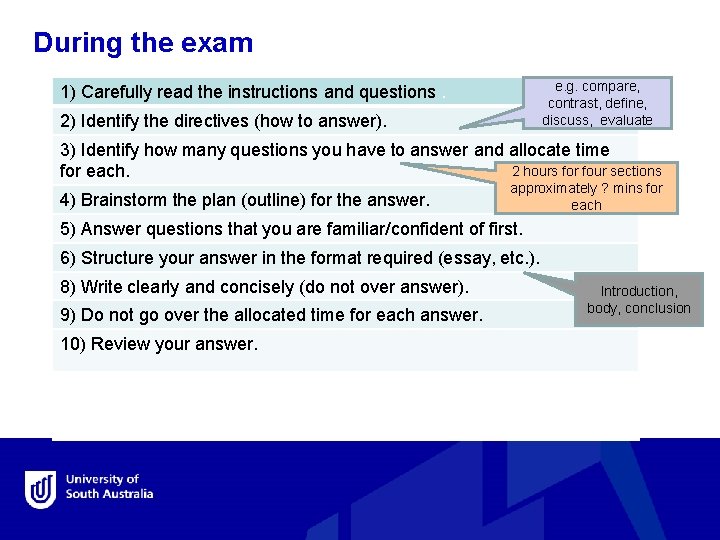
During the exam e. g. compare, contrast, define, discuss, evaluate 1) Carefully read the instructions and questions. 2) Identify the directives (how to answer). 3) Identify how many questions you have to answer and allocate time 2 hours for four sections for each. 4) Brainstorm the plan (outline) for the answer. approximately ? mins for each 5) Answer questions that you are familiar/confident of first. 6) Structure your answer in the format required (essay, etc. ). 8) Write clearly and concisely (do not over answer). 9) Do not go over the allocated time for each answer. 10) Review your answer. Introduction, body, conclusion
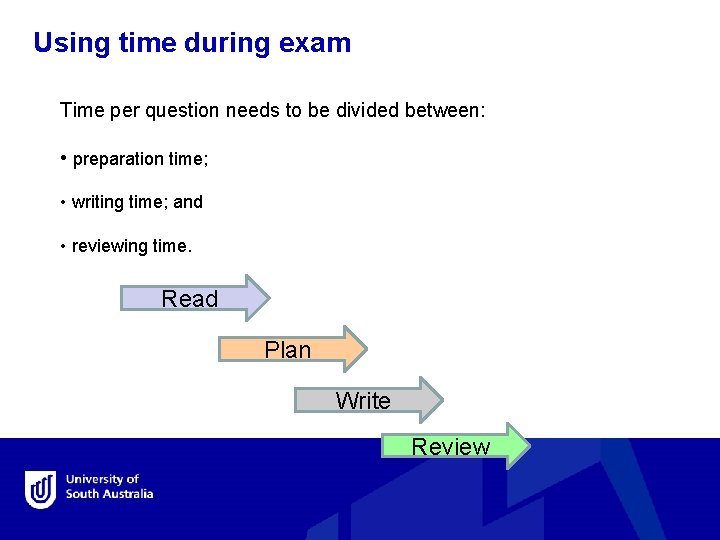
Using time during exam Time per question needs to be divided between: • preparation time; • writing time; and • reviewing time. Read Plan Write Review
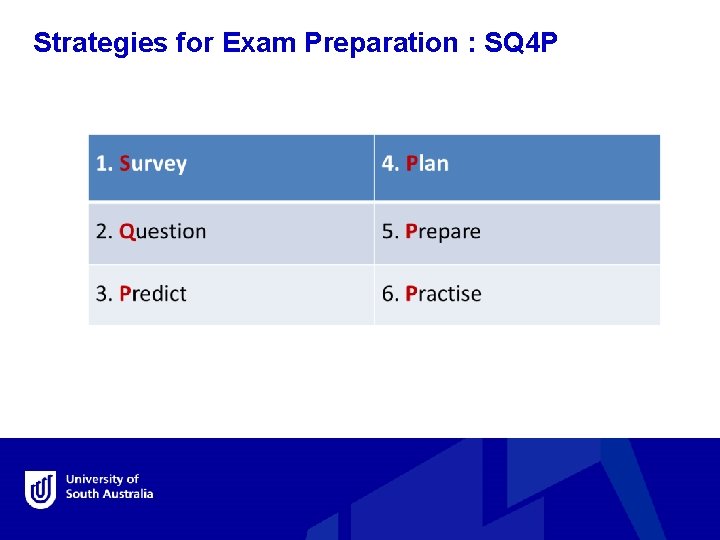
Strategies for Exam Preparation : SQ 4 P
Thank You