
Group Timelines Horizontal line represent time 1 Go






- Slides: 20
Group Timelines Horizontal line represent ‘time’ 1. Go back in time 20 - 30 years. Think of events that have affected or been affected by your fisheries (political, environmental, social etc). Events can be from local to national to global 2. Draw/write each event (with dates) on a separate card 3. Plot your cards onto the timeline 4. PRINCIPLES OF EAFM 1
4. Principles of EAFM Essential EAFM Date • Place Version 1 4. PRINCIPLES OF EAFM
Session objectives After this session you will be able to: • Understand the principles of EAFM and their link to the FAO Code of Conduct for Responsible Fisheries (CCRF) 4. PRINCIPLES OF EAFM 3
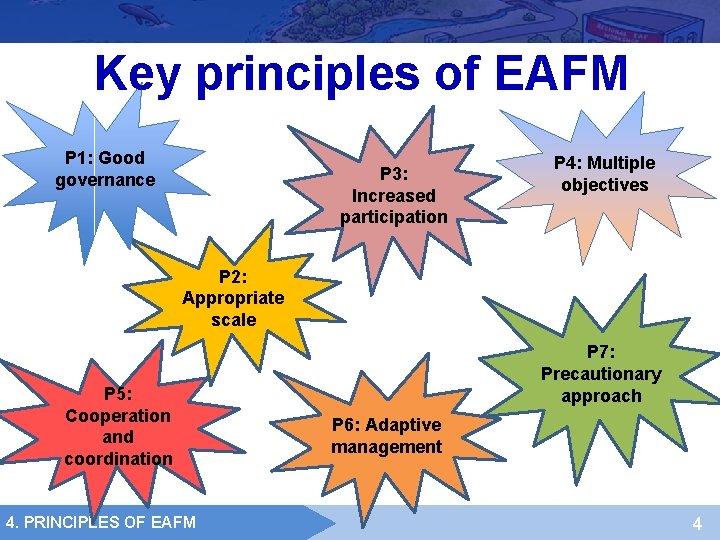
Key principles of EAFM P 1: Good governance P 3: Increased participation P 4: Multiple objectives P 2: Appropriate scale P 5: Cooperation and coordination 4. PRINCIPLES OF EAFM P 7: Precautionary approach P 6: Adaptive management 4
Principles are not new The principles of EAFM are not new but were set out in the FAO Code of Conduct for Responsible Fisheries (CCRF) • The CCRF was developed by Food and Agriculture Organization of the United Nations (FAO) • All FAO Member countries agreed to CCRF in 1995 • Your country is a Member of FAO 4. PRINCIPLES OF EAFM 5
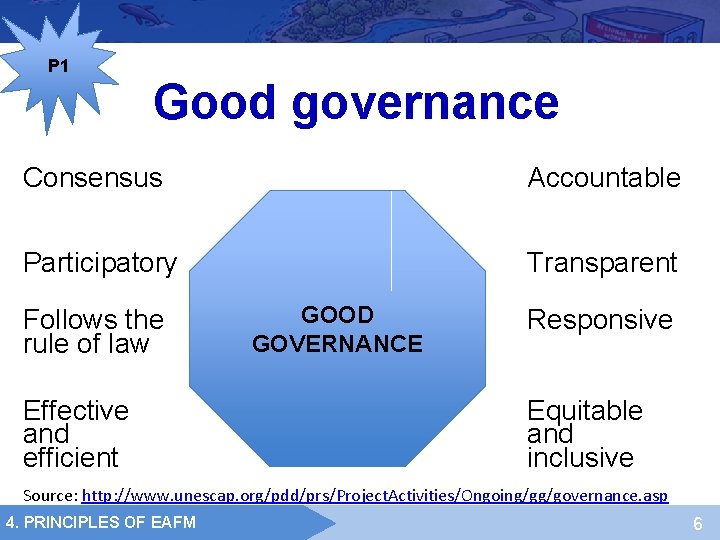
P 1 Good governance Consensus Accountable Participatory Transparent Follows the rule of law Effective and efficient GOOD GOVERNANCE Responsive Equitable and inclusive Source: http: //www. unescap. org/pdd/prs/Project. Activities/Ongoing/gg/governance. asp 4. PRINCIPLES OF EAFM 6
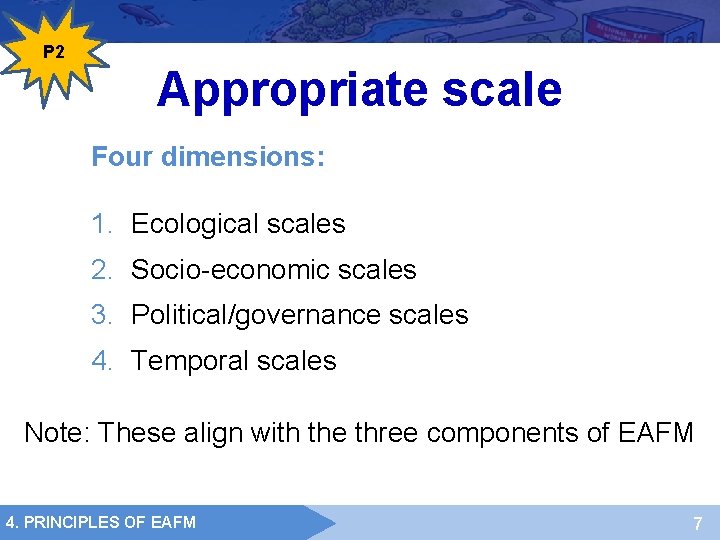
P 2 Appropriate scale Four dimensions: 1. Ecological scales 2. Socio-economic scales 3. Political/governance scales 4. Temporal scales Note: These align with the three components of EAFM 4. PRINCIPLES OF EAFM 7
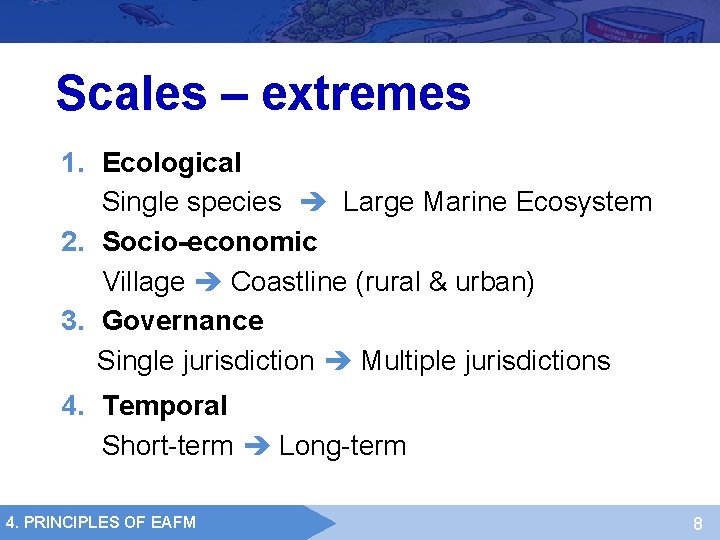
Scales – extremes 1. Ecological Single species Large Marine Ecosystem 2. Socio-economic Village Coastline (rural & urban) 3. Governance Single jurisdiction Multiple jurisdictions 4. Temporal Short-term Long-term 4. PRINCIPLES OF EAFM 8
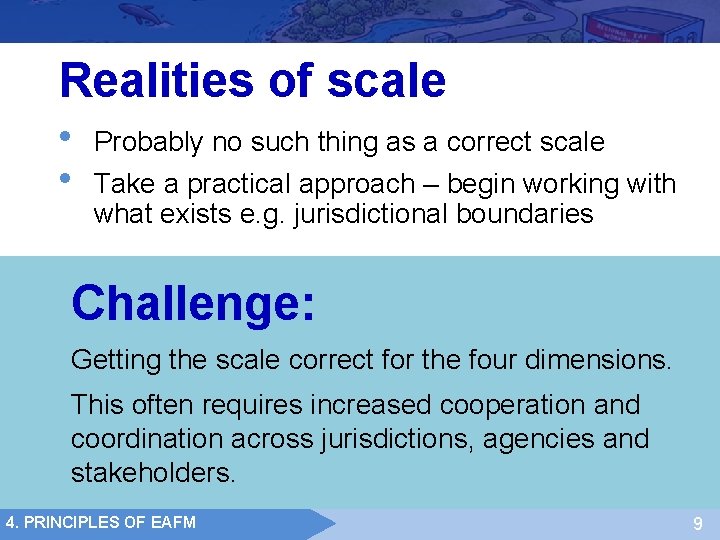
Realities of scale • • Probably no such thing as a correct scale Take a practical approach – begin working with what exists e. g. jurisdictional boundaries Challenge: Getting the scale correct for the four dimensions. This often requires increased cooperation and coordination across jurisdictions, agencies and stakeholders. 4. PRINCIPLES OF EAFM 9
Discuss In many countries, fisheries management has been devolved to the district/municipality level. In your groups, answer the question: “Is the district/municipality the correct scale to manage all fisheries? ” 4. PRINCIPLES OF EAFM 10
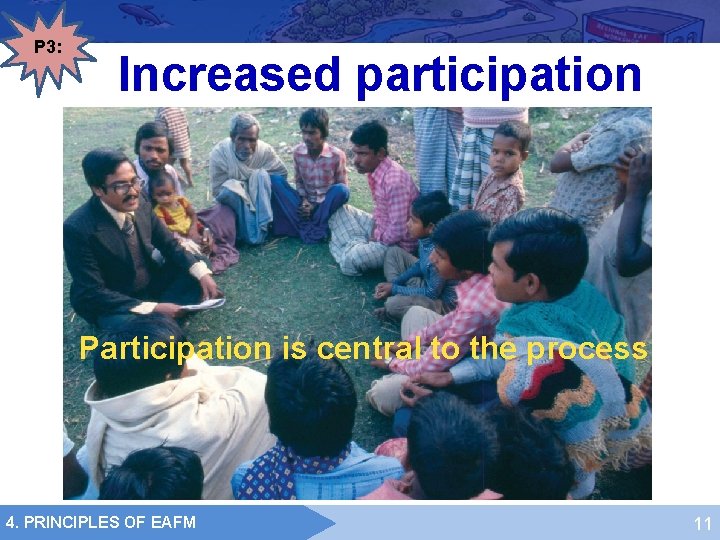
P 3: Increased participation Participation is central to the process 4. PRINCIPLES OF EAFM 11
Many stakeholders 1. Fishers and fisher associations 2. Governments (district – national) 3. Fishery related (e. g. boat owners, money lenders) 4. Compliance and enforcement 5. Other users (e. g. tourism, ports) 6. External agents (e. g. NGOs, researchers) 4. PRINCIPLES OF EAFM 12
P 4: Multiple objectives EAFM deals with interactions within the fishery sector and with other users Each sector and user group probably have their own objectives • • Need to balance these objectives Requires stakeholder engagement and negotiation 4. PRINCIPLES OF EAFM 13
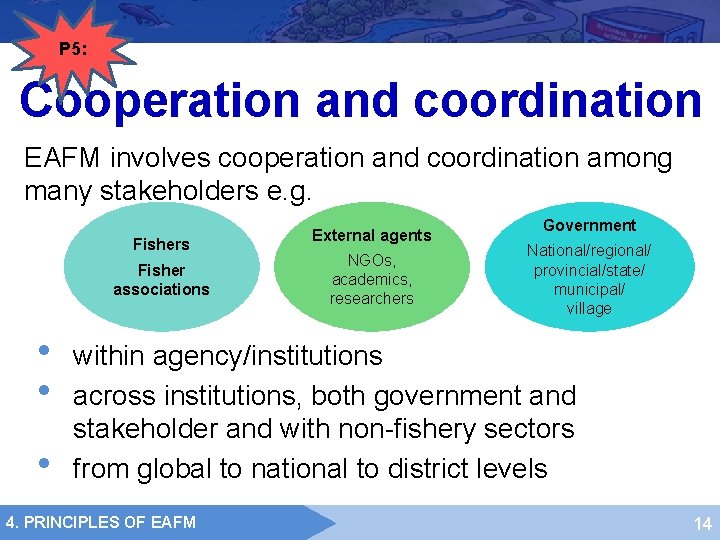
P 5: Cooperation and coordination EAFM involves cooperation and coordination among many stakeholders e. g. Fishers Fisher associations • • • External agents NGOs, academics, researchers Government National/regional/ provincial/state/ municipal/ village within agency/institutions across institutions, both government and stakeholder and with non-fishery sectors from global to national to district levels 4. PRINCIPLES OF EAFM 14
The institutions 4. PRINCIPLES OF EAFM 15
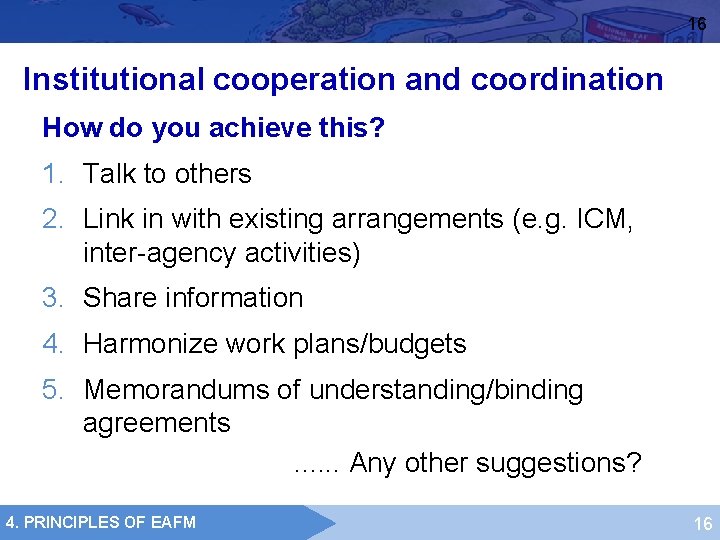
16 Institutional cooperation and coordination How do you achieve this? 1. Talk to others 2. Link in with existing arrangements (e. g. ICM, inter-agency activities) 3. Share information 4. Harmonize work plans/budgets 5. Memorandums of understanding/binding agreements. . . Any other suggestions? 4. PRINCIPLES OF EAFM 16
P 6: Adaptive management Learning while doing Evaluate Improve Discard Work Evaluate Improve Discard More uncertainty Work Evaluate Improve Discard Less uncertainty TIME 4. PRINCIPLES OF EAFM 17
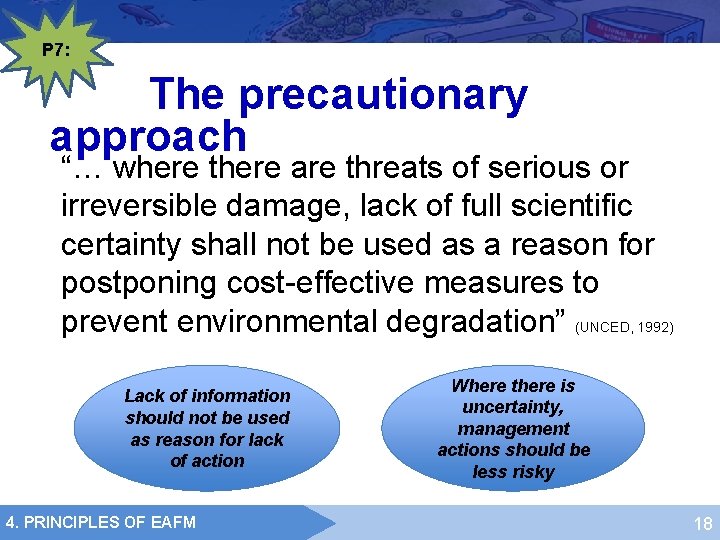
P 7: The precautionary approach “… where there are threats of serious or irreversible damage, lack of full scientific certainty shall not be used as a reason for postponing cost-effective measures to prevent environmental degradation” (UNCED, 1992) Lack of information should not be used as reason for lack of action 4. PRINCIPLES OF EAFM Where there is uncertainty, management actions should be less risky 18
THE PRECAUTIONARY APPROACH Source: Adapted from ICSF (2013) 19
Key messages • EAFM principles are not new – based on the FAO Code of Conduct for Fisheries (to which your country is a member) • EAFM has seven principles – These can be used to track EAFM implementation 4. PRINCIPLES OF EAFM 20