
group therapy ancestors cousins 1905 Joseph Pratt developed

- Slides: 11
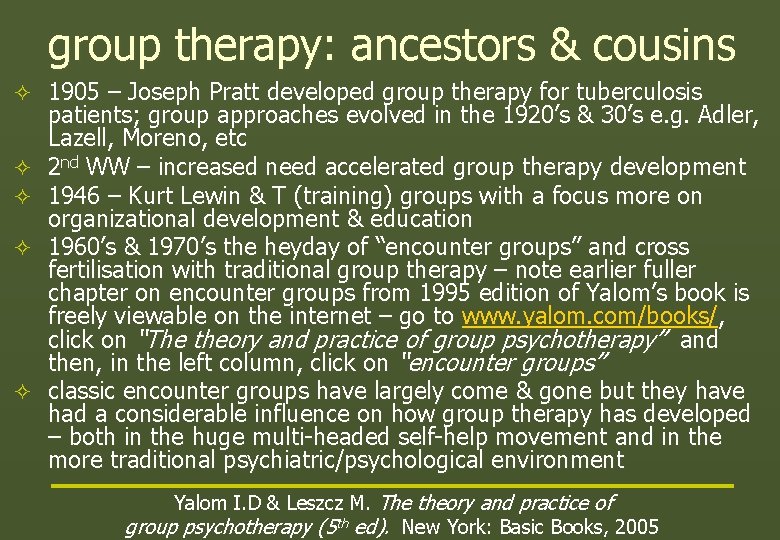
group therapy: ancestors & cousins ² ² ² 1905 – Joseph Pratt developed group therapy for tuberculosis patients; group approaches evolved in the 1920’s & 30’s e. g. Adler, Lazell, Moreno, etc 2 nd WW – increased need accelerated group therapy development 1946 – Kurt Lewin & T (training) groups with a focus more on organizational development & education 1960’s & 1970’s the heyday of “encounter groups” and cross fertilisation with traditional group therapy – note earlier fuller chapter on encounter groups from 1995 edition of Yalom’s book is freely viewable on the internet – go to www. yalom. com/books/, click on “The theory and practice of group psychotherapy” and then, in the left column, click on “encounter groups” classic encounter groups have largely come & gone but they have had a considerable influence on how group therapy has developed – both in the huge multi-headed self-help movement and in the more traditional psychiatric/psychological environment Yalom I. D & Leszcz M. The theory and practice of group psychotherapy (5 th ed). New York: Basic Books, 2005
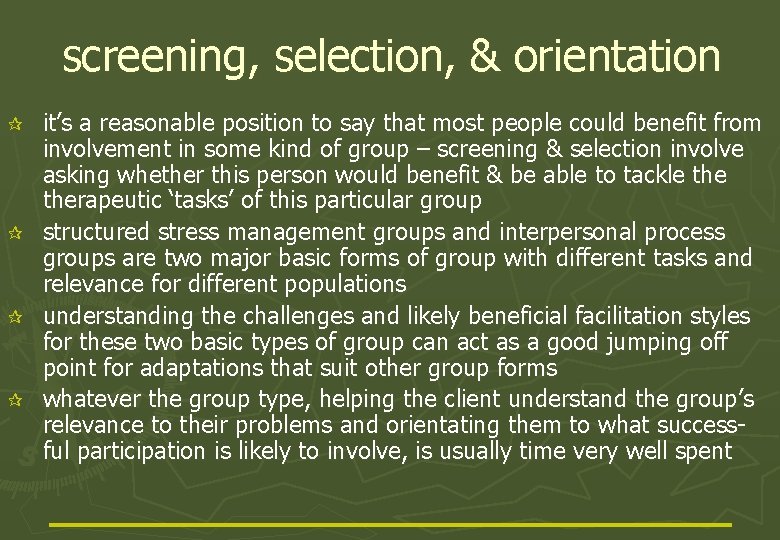
screening, selection, & orientation ¶ ¶ it’s a reasonable position to say that most people could benefit from involvement in some kind of group – screening & selection involve asking whether this person would benefit & be able to tackle therapeutic ‘tasks’ of this particular group structured stress management groups and interpersonal process groups are two major basic forms of group with different tasks and relevance for different populations understanding the challenges and likely beneficial facilitation styles for these two basic types of group can act as a good jumping off point for adaptations that suit other group forms whatever the group type, helping the client understand the group’s relevance to their problems and orientating them to what successful participation is likely to involve, is usually time very well spent
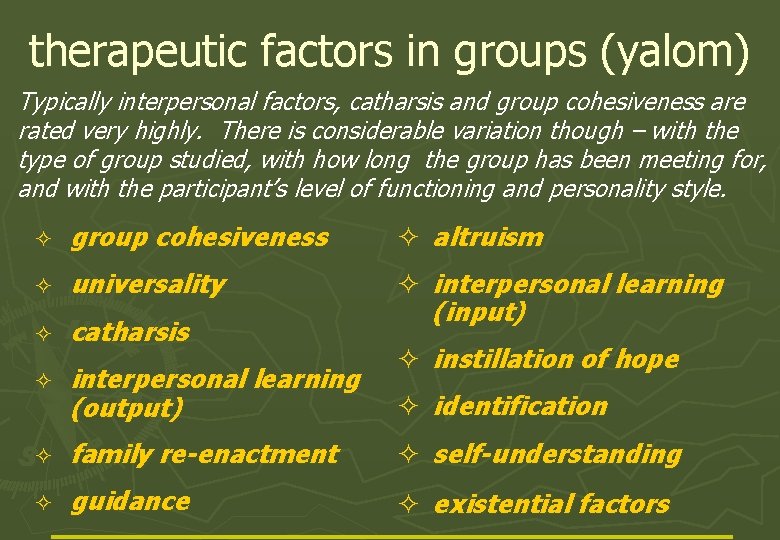
therapeutic factors in groups (yalom) Typically interpersonal factors, catharsis and group cohesiveness are rated very highly. There is considerable variation though – with the type of group studied, with how long the group has been meeting for, and with the participant’s level of functioning and personality style. ² group cohesiveness ² altruism ² universality ² catharsis ² interpersonal learning (input) ² interpersonal learning (output) ² family re-enactment ² self-understanding ² guidance ² existential factors ² instillation of hope ² identification
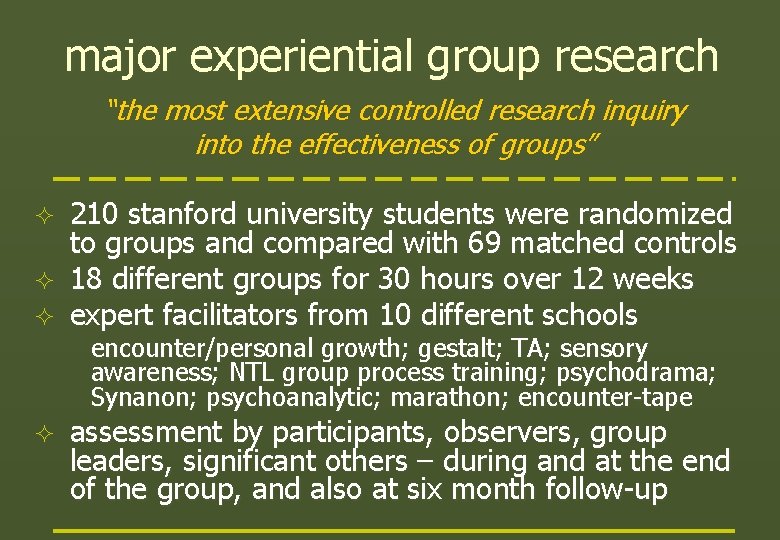
major experiential group research “the most extensive controlled research inquiry into the effectiveness of groups” 210 stanford university students were randomized to groups and compared with 69 matched controls ² 18 different groups for 30 hours over 12 weeks ² expert facilitators from 10 different schools ² encounter/personal growth; gestalt; TA; sensory awareness; NTL group process training; psychodrama; Synanon; psychoanalytic; marathon; encounter-tape ² assessment by participants, observers, group leaders, significant others – during and at the end of the group, and also at six month follow-up
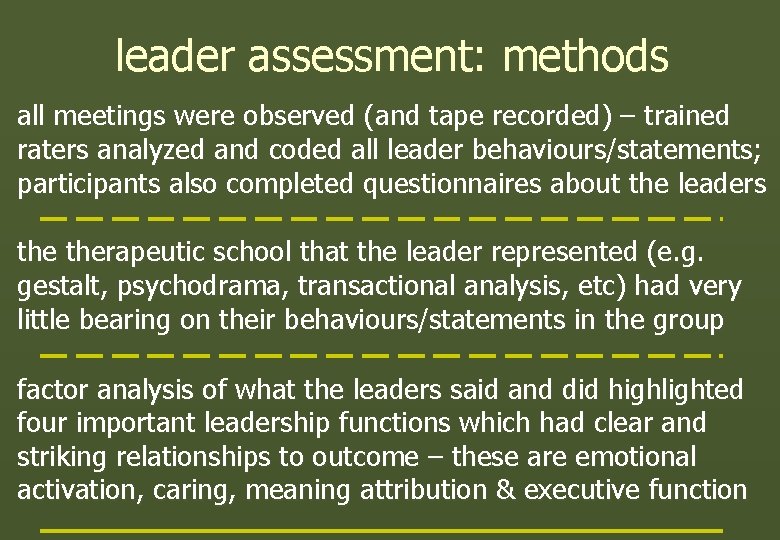
leader assessment: methods all meetings were observed (and tape recorded) – trained raters analyzed and coded all leader behaviours/statements; participants also completed questionnaires about the leaders therapeutic school that the leader represented (e. g. gestalt, psychodrama, transactional analysis, etc) had very little bearing on their behaviours/statements in the group factor analysis of what the leaders said and did highlighted four important leadership functions which had clear and striking relationships to outcome – these are emotional activation, caring, meaning attribution & executive function
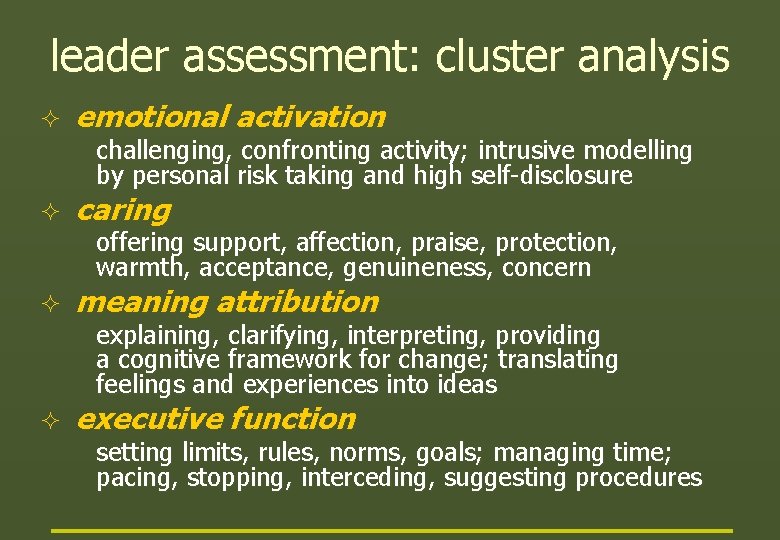
leader assessment: cluster analysis ² emotional activation ² caring ² meaning attribution ² executive function challenging, confronting activity; intrusive modelling by personal risk taking and high self-disclosure offering support, affection, praise, protection, warmth, acceptance, genuineness, concern explaining, clarifying, interpreting, providing a cognitive framework for change; translating feelings and experiences into ideas setting limits, rules, norms, goals; managing time; pacing, stopping, interceding, suggesting procedures
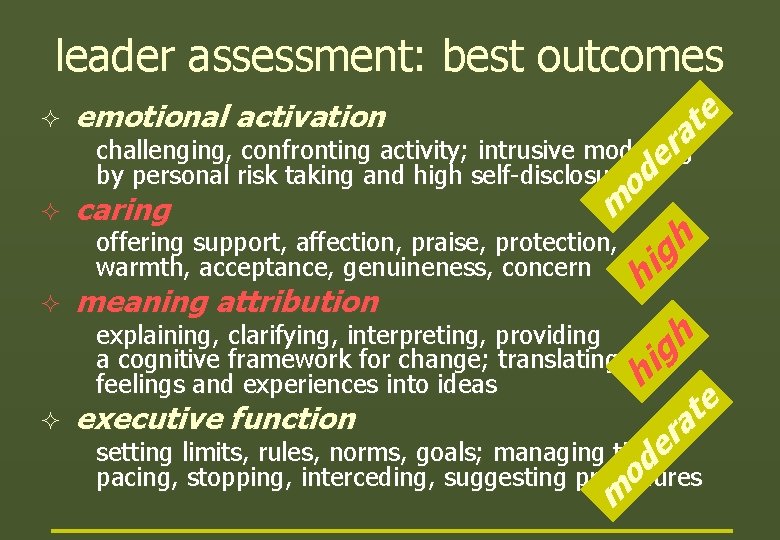
leader assessment: best outcomes ² ² e t a emotional activation r challenging, confronting activity; intrusive modelling e by personal risk taking and high self-disclosure d caring m offering support, affection, praise, protection, warmth, acceptance, genuineness, concern meaning attribution o explaining, clarifying, interpreting, providing a cognitive framework for change; translating feelings and experiences into ideas h g i h h g e t executive function a r setting limits, rules, norms, goals; managing time; e d pacing, stopping, interceding, suggesting procedures o m
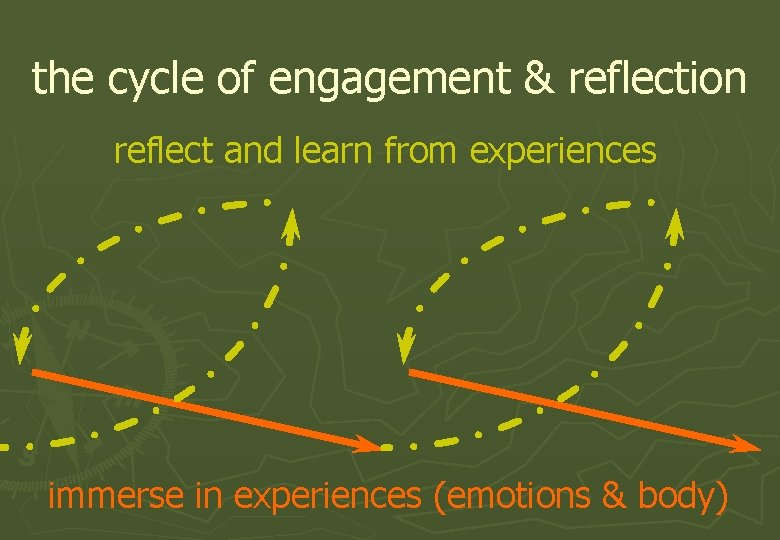
the cycle of engagement & reflection reflect and learn from experiences immerse in experiences (emotions & body)
importance of meaning attribution to benefit most, it seems crucially important to both engage emotionally & also to reflect at the end of each group meeting, participants were asked to report the most significant event of the session and the reason for its significance ¶ participants who gained most from the groups were far more likely to report incidents involving cognitive integration ¶ this finding was particularly impressive and unexpected when one considers the pervasive anti-intellectual ethos of encounter group culture 
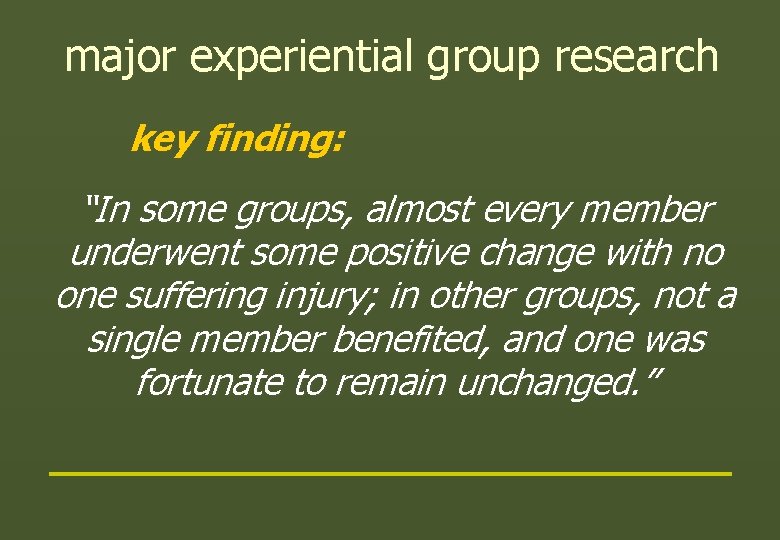
major experiential group research key finding: “In some groups, almost every member underwent some positive change with no one suffering injury; in other groups, not a single member benefited, and one was fortunate to remain unchanged. ”
the learning circle of experience Kurt Lewin’s model of experiential learning genuine, personal experience testing implications in new situations observation and reflection time forming ideas & generalizations note particular importance of here-&-now concrete experience in generating & testing out ideas, & also the importance of the feedback loop in checking whether one is really on track; ineffectiveness is often due to an imbalance between active experience & reflective observation