
Group Structure Social Structure and Sociometry Dave Seibold
Group Structure Social Structure and Sociometry Dave Seibold Professor, Department of Communication, L&S Co-Director, Graduate Program in Management Practice, Technology Management Program, Co. E COMM 106: Lecture 6 b
Network Structures -Addendum � Two Confounding Variables ◦ Group History ◦ Group Size � Limitations ◦ ◦ of Small Group Network Studies Interdiction of channels Ignorance of other positions/nodes Necessity of each member Time restrictions
Social Structures and Sociometry � Sociometry The study of the patterns of interrelations among people in groups, and the process of their measurement.
Social Structures and Sociometry � Sociometry Way of mapping preferences among group members
Social Structures and Sociometry � Sociometric questionnaire (see handout)
Social Structures and Sociometry � Sociometric questionnaire � Advantages of sociometric analyses ◦ Reveal relation of individual to group
Social Structures and Sociometry � Sociometric questionnaire � Advantages of sociometric analyses ◦ Reveal relation of individual to group ◦ Reveal (sub)structure of group
Social Structures and Sociometry � Sociometric questionnaire � Advantages of sociometric analyses ◦ Reveal relation of individual to group ◦ Reveal (sub)structure of group ◦ Reveal role(s) played by members
Social Structures and Sociometry � Sociometric questionnaire � Advantages ◦ ◦ of sociometric analyses Reveal relation of individual to group Reveal (sub)structure of group Reveal role(s) played by members Predict amount/direction of interaction
Social Structures and Sociometry � Sociometric questionnaire � Advantages of sociometric analyses � Research: high correspondence among sociometric, communication, and power mappings
Social Structures and Sociometry Research: correspondence in sociometric, communication, and power mappings 1. Sociometric stars --receive most info --communicate most --most influence
Social Structures and Sociometry Research: correspondence sociometric, communication, and power mappings 2. Leadership: network centralization related to power and perceptions of influence based on who (and which subgroups) communicated w/each other most
Large Networks: Communication and Social Structure Foci and Questions for Large Networks 1. Analysis of underlying structure -Path between nodes X and Y? -How many links in path? -What role(s) does each node play?
Large Networks: Communication and Social Structure Foci and Questions for Large Networks 2. Analysis of message flow in network -How long to move through network? -Types of messages? -Which channels?
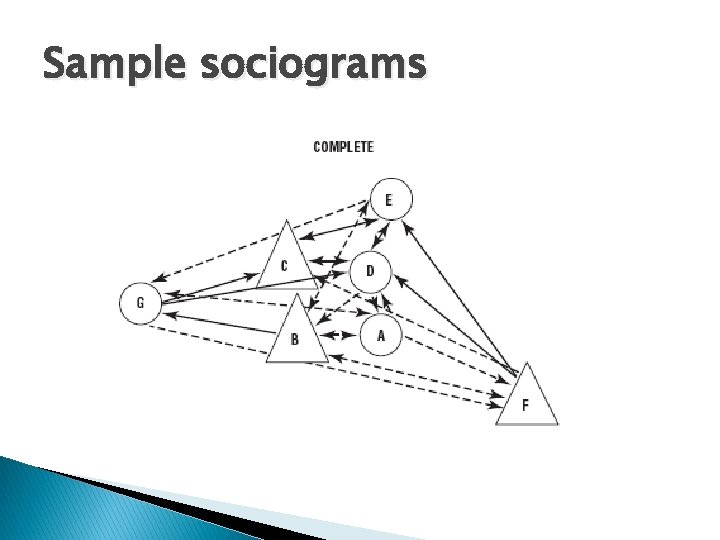
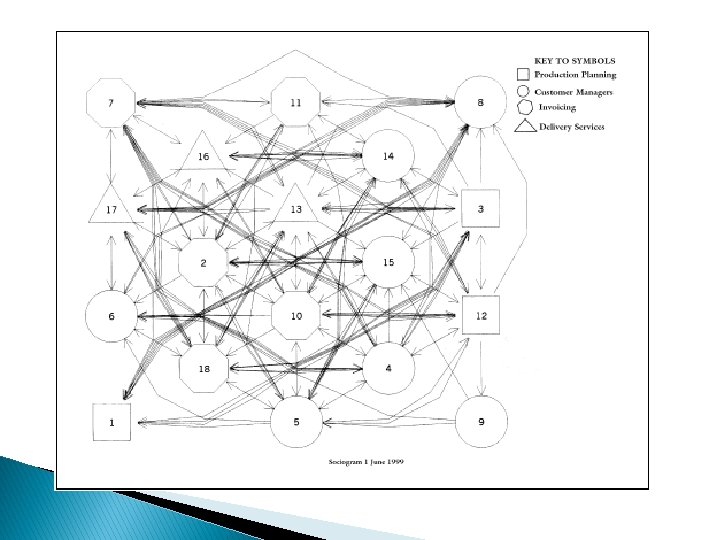
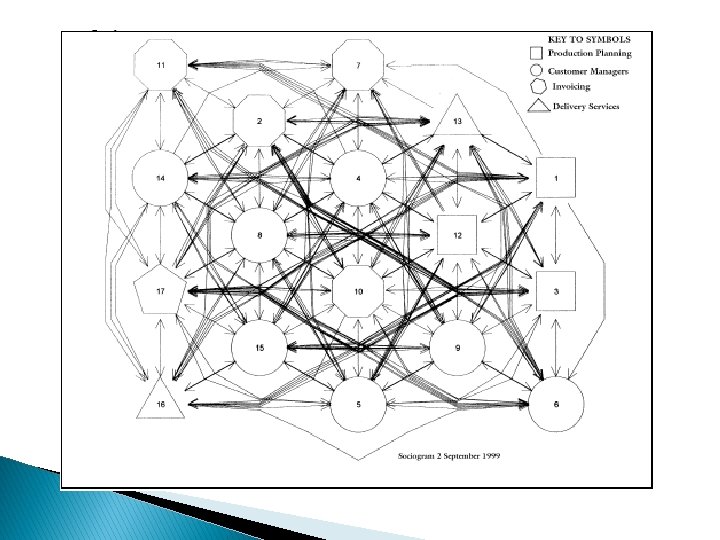
Sample sociograms
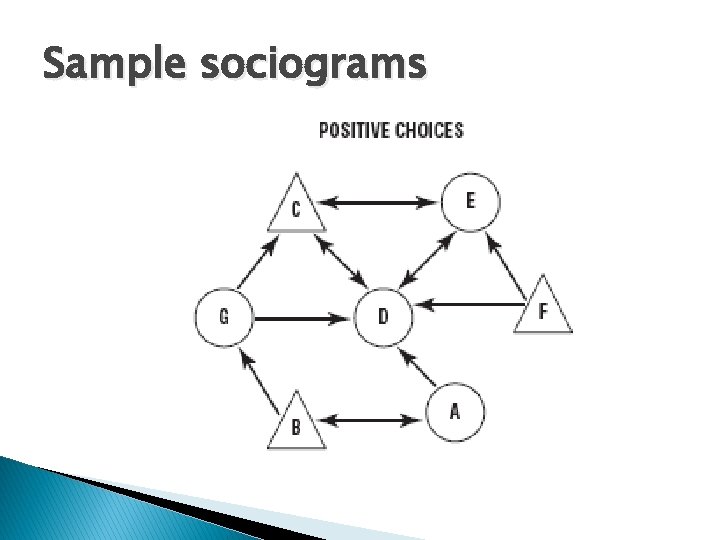
Sample sociograms
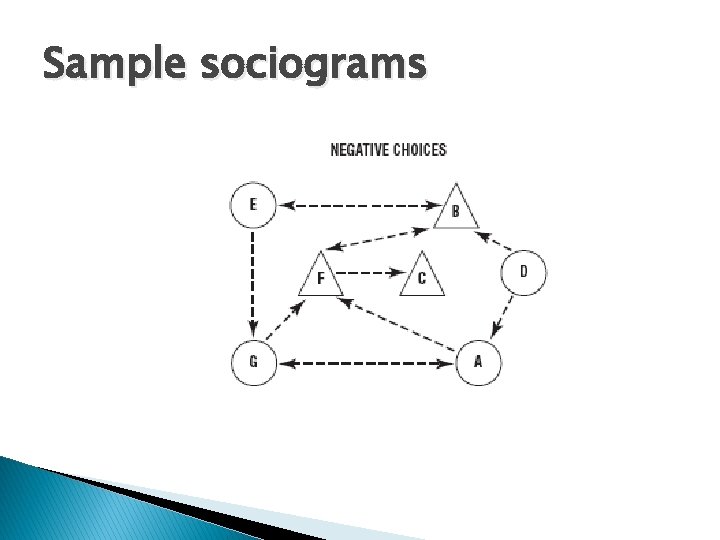
Sample sociograms

� theoretical sociatry)— � including system (alternately termed role, social atom, � spontaneity/encounter, psychodrama/enactment, � and sociometry theories; � subtheory of that system; and � assessment method and intervention
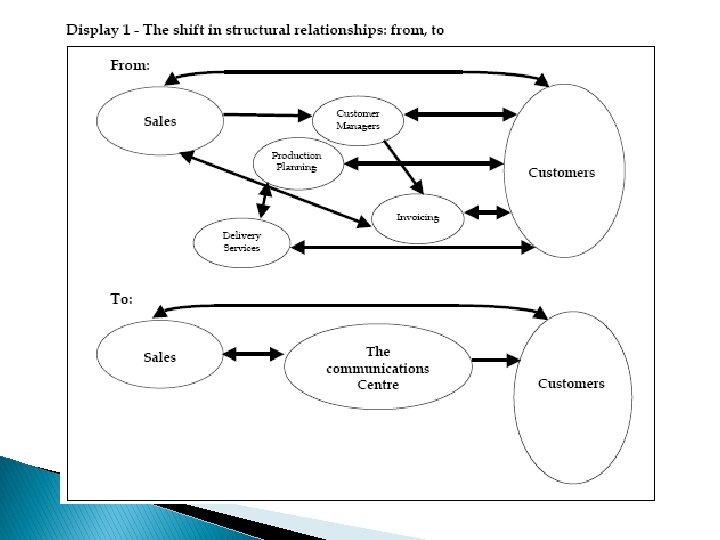
Results of using sociogram 1. Our responsibilities are clearly defined - the grey areas to be defined, especially where it’s no-one’s job, but it has to be done. 2. Communication - we share information versus chasing around trying to get it. Not expecting people to know when they haven’t been told. 3. Relationship with our manager and team leaders - ‘we can raise issues and you are available to us. You don’t let problems hang around. ’ 4. Qualities in our team - knowing that I can rely on people to help when I’m overloaded, understanding how we work and what we are like when we are stressed, how to approach us, and vice versa. And, we are a lot of people, we are busy and we rush around - so we do need some privacy and space of our own too. 5. We address the barriers of ‘getting together’ so we are no longer ‘us’ and ‘them’.
Large Networks: Communication and Social Structure Examples of Large Network Studies 2. Diffusion of Innovations
Large Networks: Communication and Social Structure Examples of Large Network Studies 3. Small World Experiments -Acquaintance nets (Gedankenexperiments)
Large Networks: Communication and Social Structure Examples of Large Network Studies 3. Small World Experiments -Acquaintance nets -Longest minimum chain? --Estimates (methods)
Large Networks: Communication and Social Structure Examples of Large Network Studies 3. Small World Experiments --Milgram study 6 degrees of separation. . .
Large Networks: Communication and Social Structure Examples of Large Network Studies 3. Small World Experiments --Milgram study 6 degrees of separation? Critiques (J. Kleinfeld, Society) Recruited ‘sociables’ (not random)
Large Networks: Communication and Social Structure 3. Small World Experiments --Milgram study Critiques (J. Kleinfeld, Society) Recruited ‘sociables’ (not random) Only 30% returned (some 9 links) Low income = more links
Large Networks: Communication and Social Structure 3. Small World Experiments --Milgram study Critiques (J. Kleinfeld, Society) Implication: May be ‘small world’ for affluent, well connected persons, but ‘lumpy oatmeal’ world for most. . .
- Slides: 30