
Group Station 1 Correct the brainpop 2 Do


Group Station 1. Correct the brainpop 2. Do the inquiry activity 3. Work on the HW questions on the back – Use the power point to help you answer these questions!
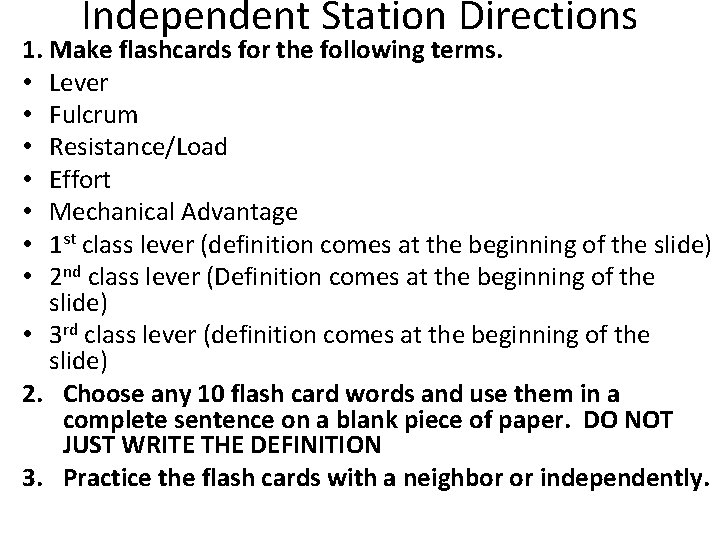
Independent Station Directions 1. Make flashcards for the following terms. • Lever • Fulcrum • Resistance/Load • Effort • Mechanical Advantage • 1 st class lever (definition comes at the beginning of the slide) • 2 nd class lever (Definition comes at the beginning of the slide) • 3 rd class lever (definition comes at the beginning of the slide) 2. Choose any 10 flash card words and use them in a complete sentence on a blank piece of paper. DO NOT JUST WRITE THE DEFINITION 3. Practice the flash cards with a neighbor or independently.
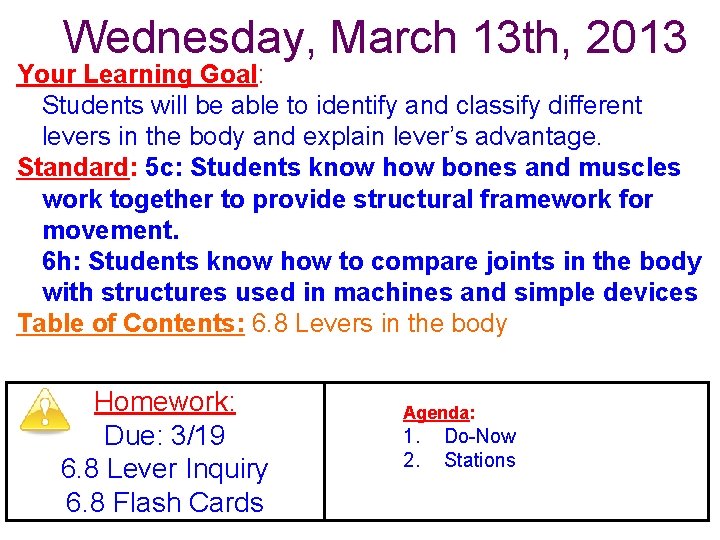
Wednesday, March 13 th, 2013 Your Learning Goal: Students will be able to identify and classify different levers in the body and explain lever’s advantage. Standard: 5 c: Students know how bones and muscles work together to provide structural framework for movement. 6 h: Students know how to compare joints in the body with structures used in machines and simple devices Table of Contents: 6. 8 Levers in the body Homework: Due: 3/19 6. 8 Lever Inquiry 6. 8 Flash Cards Agenda: 1. 2. Do-Now Stations
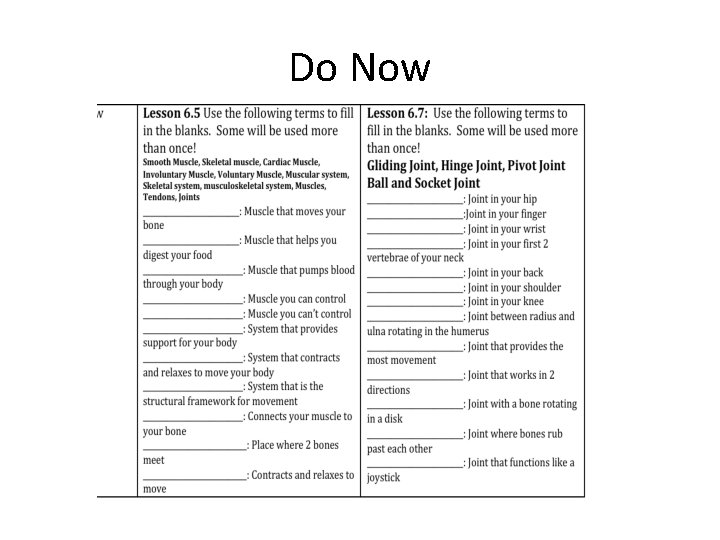
Do Now
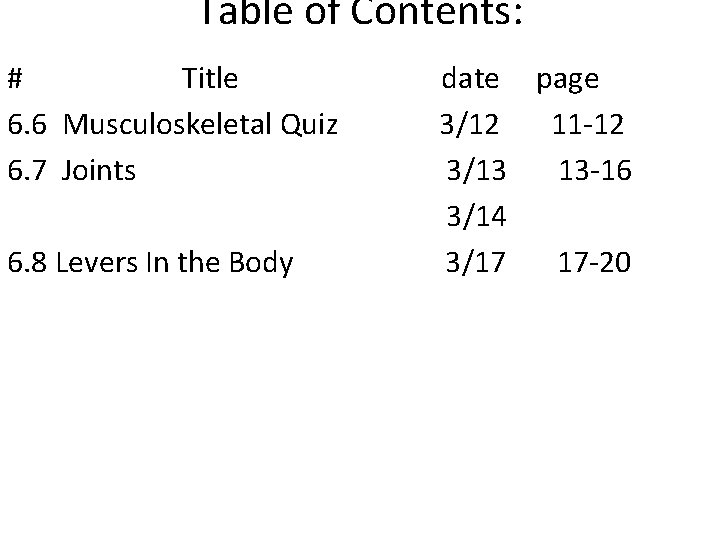
Table of Contents: # Title 6. 6 Musculoskeletal Quiz 6. 7 Joints 6. 8 Levers In the Body date page 3/12 11 -12 3/13 13 -16 3/14 3/17 17 -20
What is the musculoskeletal movement like? • Muscles and bones work together as A Lever system: Notes tomorrow!
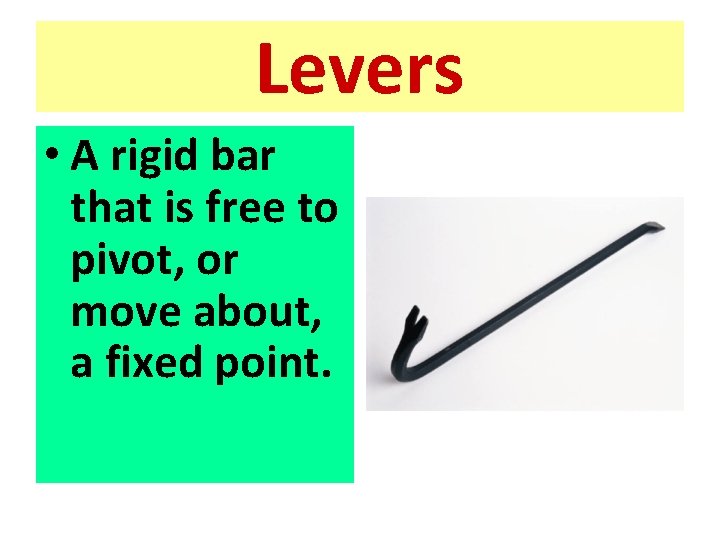
Levers • A rigid bar that is free to pivot, or move about, a fixed point.

• First the meh • Second the best • Third the worst
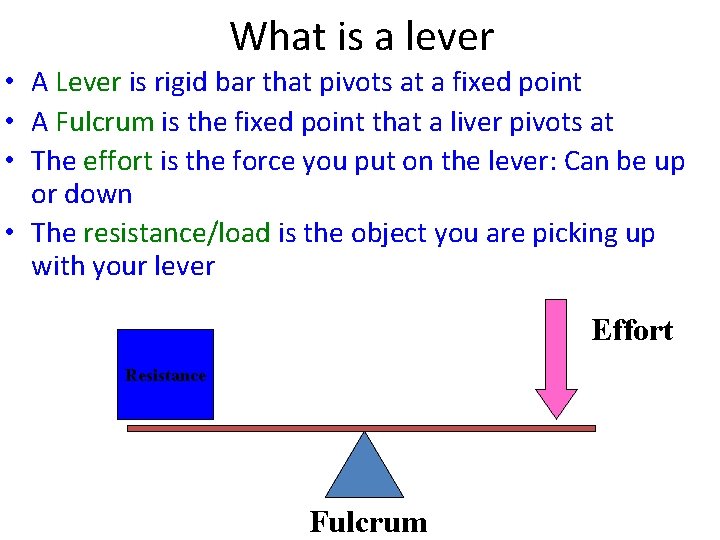
What is a lever • A Lever is rigid bar that pivots at a fixed point • A Fulcrum is the fixed point that a liver pivots at • The effort is the force you put on the lever: Can be up or down • The resistance/load is the object you are picking up with your lever Effort Resistance Fulcrum
Mechanical Advantage Mechanical A • Mechanical Advantage is how many times the force is multiplied in a lever. • Mechanical Advantage: you use less force (effort) to lift the load than without the lever • This happens when the effort is further from the fulcrum than the load is from the fulcrum • Mechanical disadvantage happens when the load is further from the fulcrum than the effort is from the fulcrum.
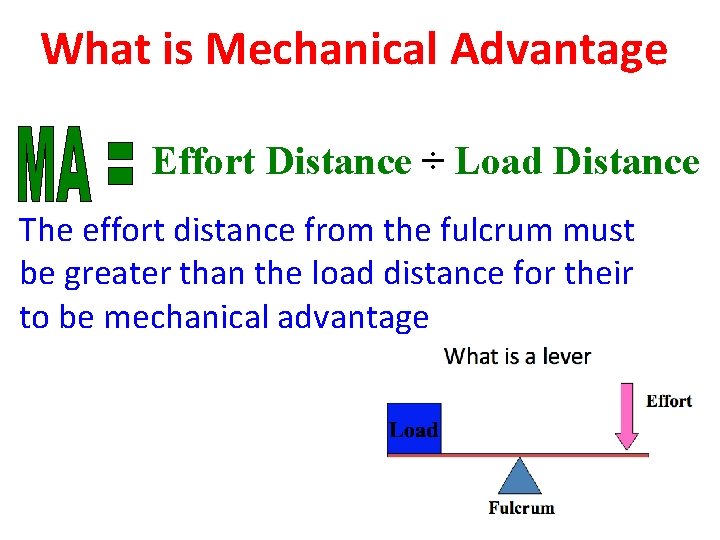
What is Mechanical Advantage Effort Distance ÷ Load Distance The effort distance from the fulcrum must be greater than the load distance for their to be mechanical advantage

What is a First Class Lever: Medium Lever

1 st class Lever Medium Lever Effort Load Fulcrum is between the effort and load. • Mechanical advantage only if the effort is further away than the load • If there is no mechanical advantage, this lever system only serves to change the direction of motion
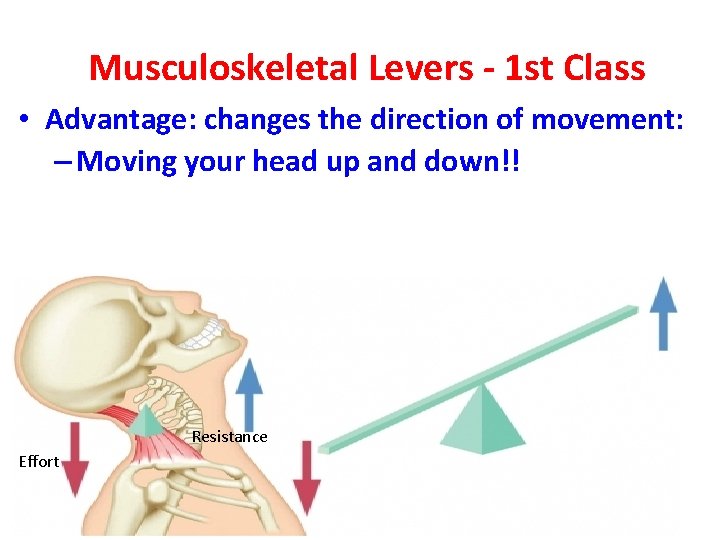
Musculoskeletal Levers - 1 st Class • Advantage: changes the direction of movement: – Moving your head up and down!! Resistance Effort
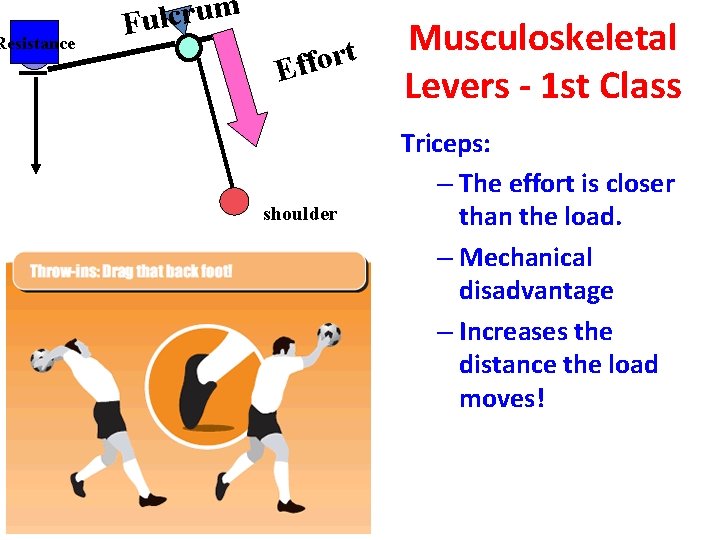
Resistance m u r c l u F t r o f f E shoulder Musculoskeletal Levers - 1 st Class Triceps: – The effort is closer than the load. – Mechanical disadvantage – Increases the distance the load moves!
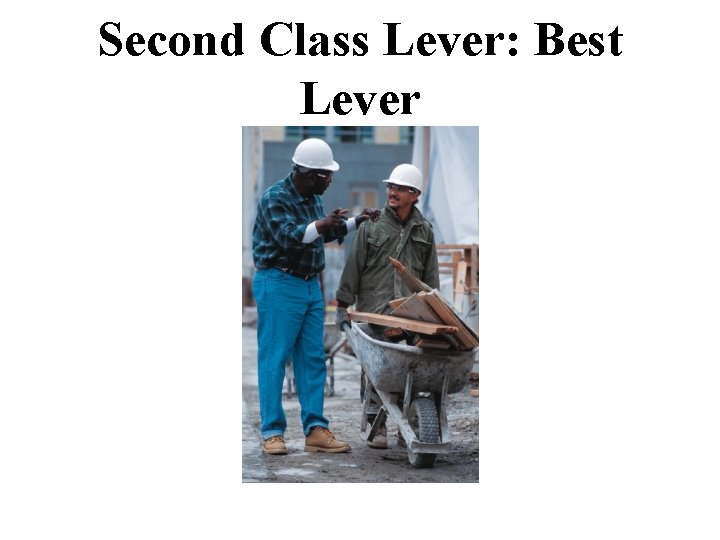
Second Class Lever: Best Lever
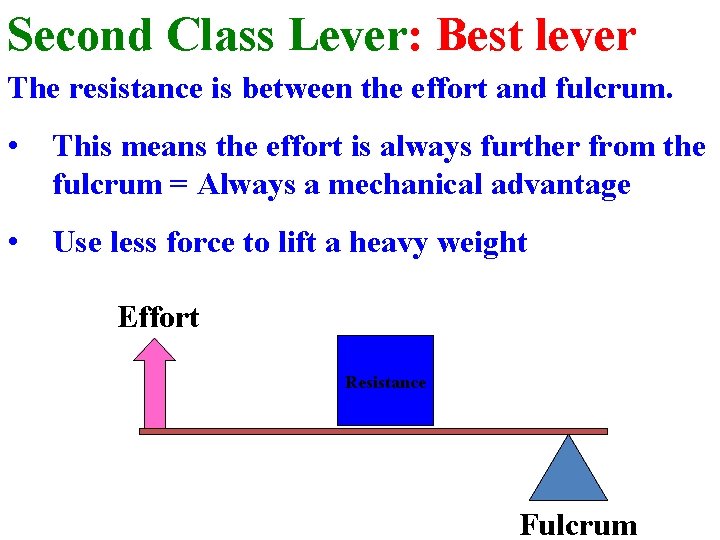
Second Class Lever: Best lever The resistance is between the effort and fulcrum. • This means the effort is always further from the fulcrum = Always a mechanical advantage • Use less force to lift a heavy weight Effort Resistance Fulcrum
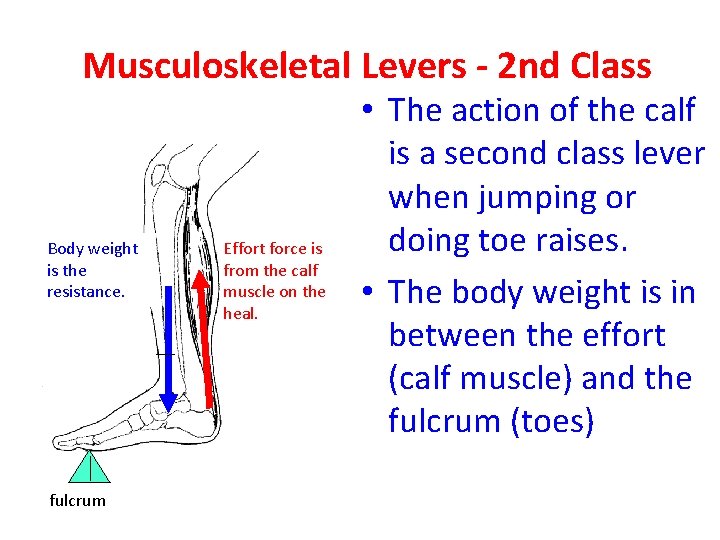
Musculoskeletal Levers - 2 nd Class Body weight is the resistance. fulcrum Effort force is from the calf muscle on the heal. • The action of the calf is a second class lever when jumping or doing toe raises. • The body weight is in between the effort (calf muscle) and the fulcrum (toes)
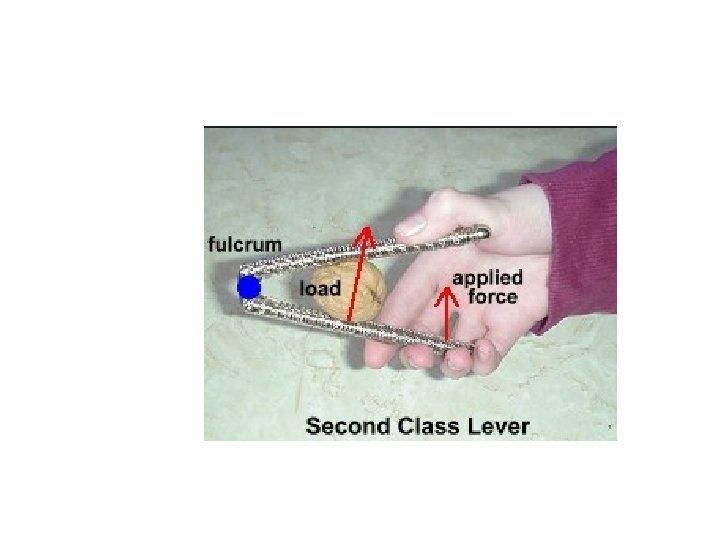
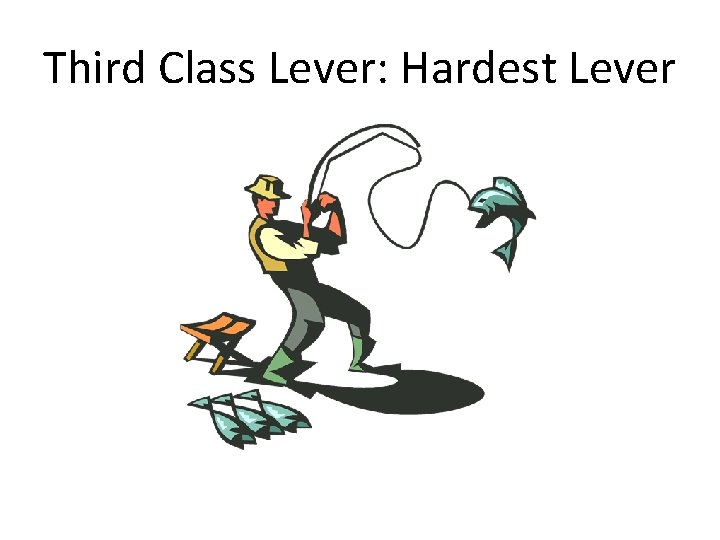
Third Class Lever: Hardest Lever
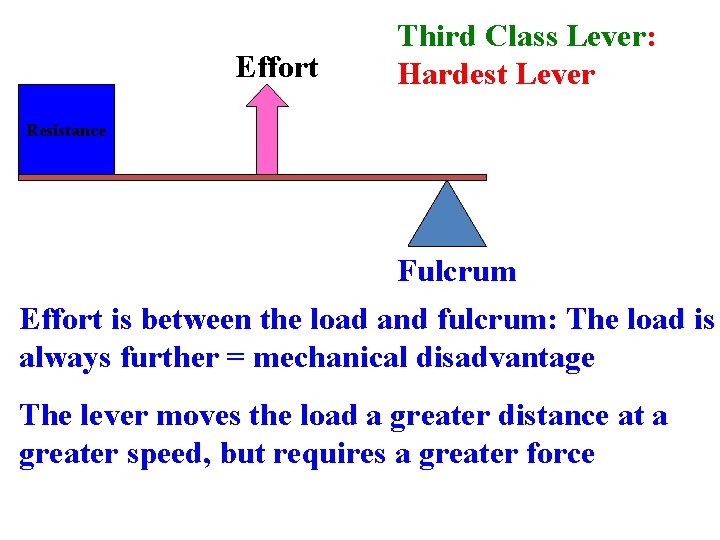
Effort Third Class Lever: Hardest Lever Resistance Fulcrum Effort is between the load and fulcrum: The load is always further = mechanical disadvantage The lever moves the load a greater distance at a greater speed, but requires a greater force
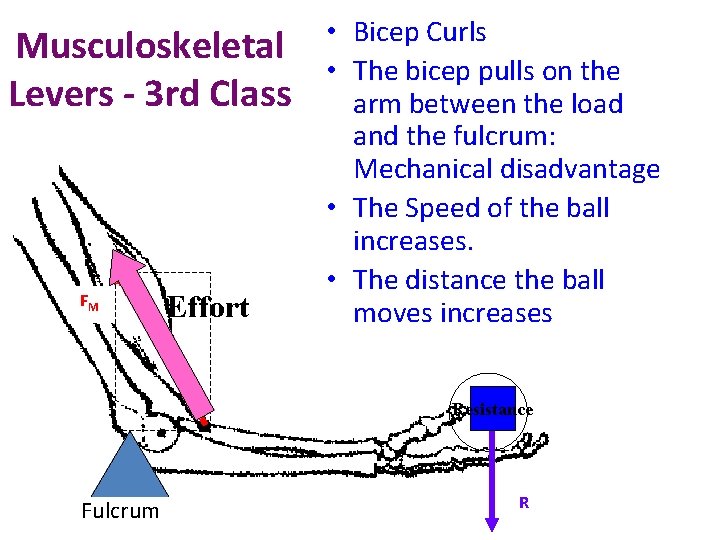
Musculoskeletal Levers - 3 rd Class FM Effort • Bicep Curls • The bicep pulls on the arm between the load and the fulcrum: Mechanical disadvantage • The Speed of the ball increases. • The distance the ball moves increases Resistance fulcrum Fulcrum R
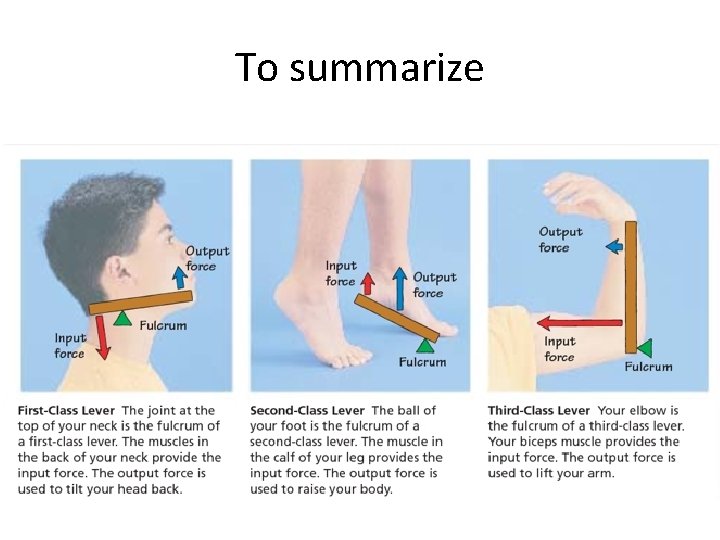
To summarize
- Slides: 24