
GROUP RESEARCH PAPER Breaking Down the Expectations Overview

GROUP RESEARCH PAPER Breaking Down the Expectations
Overview ◦ Your paper will be broken down into the following sections: v. Title Page v. Abstract v. Introduction v. Literature Review v. Methodology v. Results v. Discussion v. Conclusion v. References v. Appendices
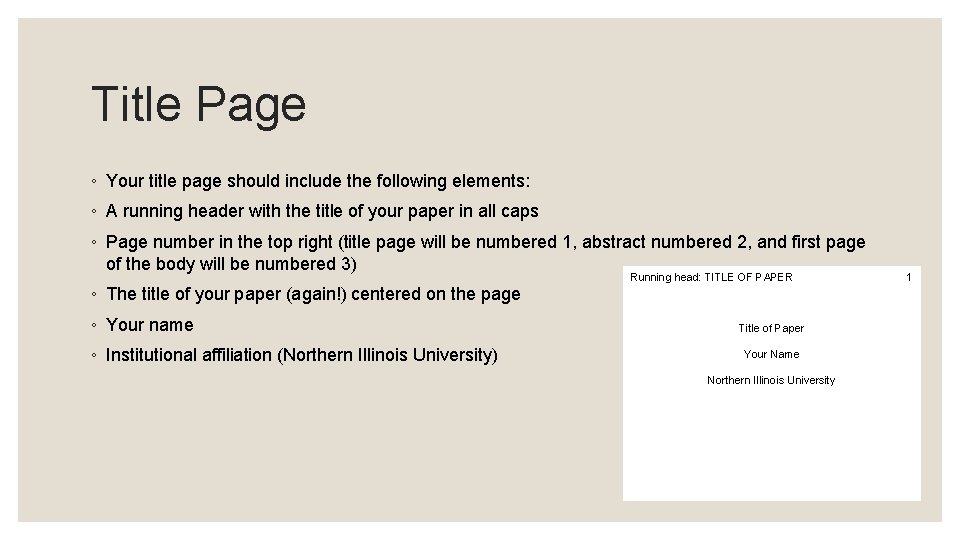
Title Page ◦ Your title page should include the following elements: ◦ A running header with the title of your paper in all caps ◦ Page number in the top right (title page will be numbered 1, abstract numbered 2, and first page of the body will be numbered 3) Running head: TITLE OF PAPER ◦ The title of your paper (again!) centered on the page ◦ Your name ◦ Institutional affiliation (Northern Illinois University) Title of Paper Your Name Northern Illinois University 1
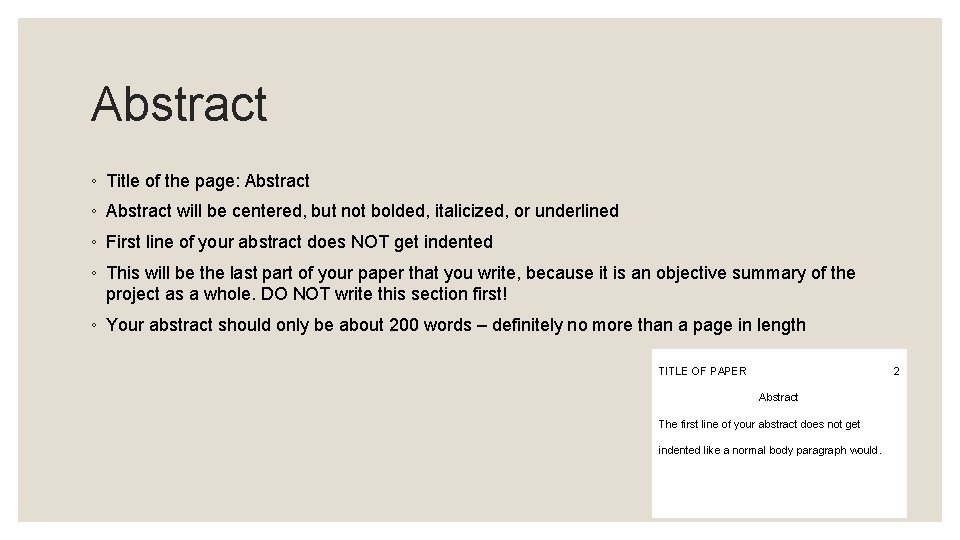
Abstract ◦ Title of the page: Abstract ◦ Abstract will be centered, but not bolded, italicized, or underlined ◦ First line of your abstract does NOT get indented ◦ This will be the last part of your paper that you write, because it is an objective summary of the project as a whole. DO NOT write this section first! ◦ Your abstract should only be about 200 words – definitely no more than a page in length TITLE OF PAPER 2 Abstract The first line of your abstract does not get indented like a normal body paragraph would.
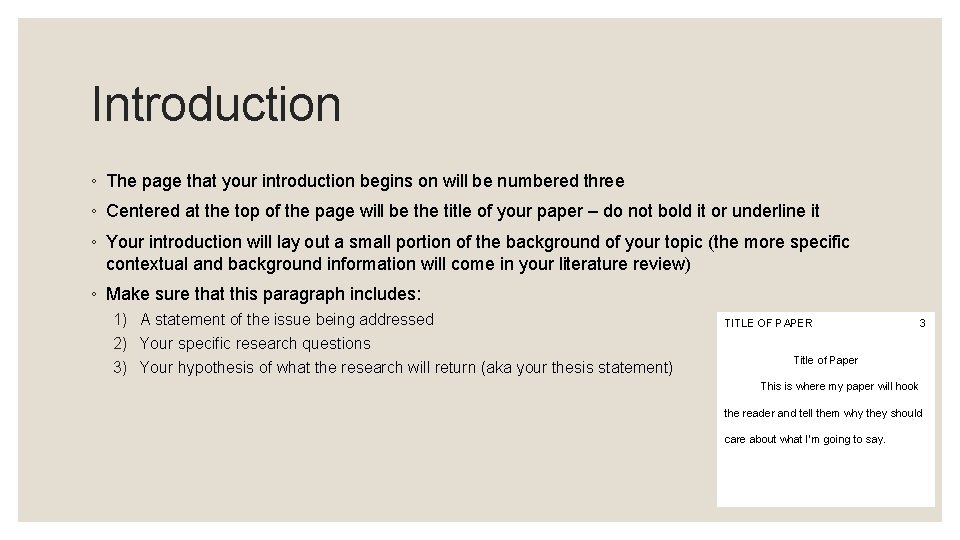
Introduction ◦ The page that your introduction begins on will be numbered three ◦ Centered at the top of the page will be the title of your paper – do not bold it or underline it ◦ Your introduction will lay out a small portion of the background of your topic (the more specific contextual and background information will come in your literature review) ◦ Make sure that this paragraph includes: 1) A statement of the issue being addressed 2) Your specific research questions 3) Your hypothesis of what the research will return (aka your thesis statement) TITLE OF PAPER 3 Title of Paper This is where my paper will hook the reader and tell them why they should care about what I’m going to say.
Literature Review ◦ This section will not get its own page, but it will get its own section heading ◦ Literature Review should be centered and bolded ◦ Your literature review is meant to reflect the overall discussion surrounding your topic ◦ It should be broken down by your subtopics that were determined in your literature review draft ◦ This is your place to talk about OTHER people’s ideas – your own ideas and research will come later, so stay objective here as you describe these concepts
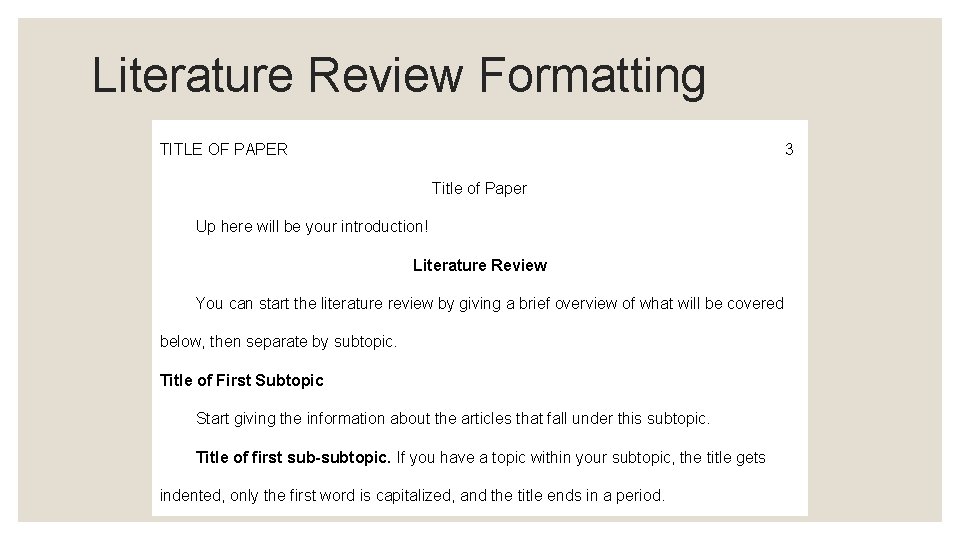
Literature Review Formatting TITLE OF PAPER 3 Title of Paper Up here will be your introduction! Literature Review You can start the literature review by giving a brief overview of what will be covered below, then separate by subtopic. Title of First Subtopic Start giving the information about the articles that fall under this subtopic. Title of first sub-subtopic. If you have a topic within your subtopic, the title gets indented, only the first word is capitalized, and the title ends in a period.
Methodology ◦ Like the literature review, this will get its own bolded and centered section heading ◦ This section is where you talk about the primary research that you went out and did for this project ◦ It is essentially a more flushed out version of the primary research plan draft ◦ For all types of primary research: ◦ Describe HOW you analyzed the data you received ◦ For surveys: ◦ Include who you surveyed, how many surveys you collected, what decisions you made about your sample and how you made these decisions, demographic information about who you sampled (if you took this type of information) ◦ For observation logs: ◦ Include the locations and times you observed, and how you recorded your observations ◦ For interviews: ◦ Include who you interviewed and other relevant information about this person, such as their expertise and other demographic information
Results ◦ Again, this section will get its own centered and bolded section header ◦ While the methodology section will simply describe what you DID to get your primary research data, the results section will describe the actual data that you collected ◦ Use direct evidence from your data to show your findings ◦ Include statistics about your surveys, quotes from your interviews, and sections of your observation logs ◦ You can include charts and graphs if needed in this section
Discussion ◦ This is perhaps the most important section of your paper, as this is where all of the ideas and concepts you have been talking about come together. It will also be largely where you are pulling from for your showcase presentation. ◦ Again, this section will get its own bolded and centered section heading ◦ If you have a proposal for change or action, make it in this section ◦ This is the place where you will interpret the results of your primary research: ◦ What does it mean that 86% of people surveyed don’t like cookies and cream ice cream? Why is this important and how does it contribute to your overall research questions and hypothesis?
Discussion ◦ This section will also allow you to put your own results in conversation with the findings in your literature review ◦ You do not want to simply categorize your discussion into “here’s what we think” and “here’s what they think. ” You will be discussing and analyzing the literature review and your results IN TANDEM with each other. They need to work off of each other, and all of your discussion should refer back to your research questions and hypothesis ◦ Key questions to keep in mind here are: ◦ How do the different perspectives of your literature review contribute to and interact with both each other and with your own research? ◦ How can you include the opposition in your paper? ◦ Think about the ways that opposition could potentially be helpful (other perspectives, ideas that you didn’t think about before, complications of research). You do not want to just ignore people who disagree with you – make their arguments work with yours!
Conclusion ◦ Again, this section will get a centered and bolded section heading ◦ Your conclusion will discuss what comes next: where could future research go from here? What were some limitations of your study that could be changed in the future? Do you want your audience to go out and do something after reading this paper? If so, what is it? ◦ Your conclusion will not be a simple restatement of everything you just talked about! That’s what your abstract is for
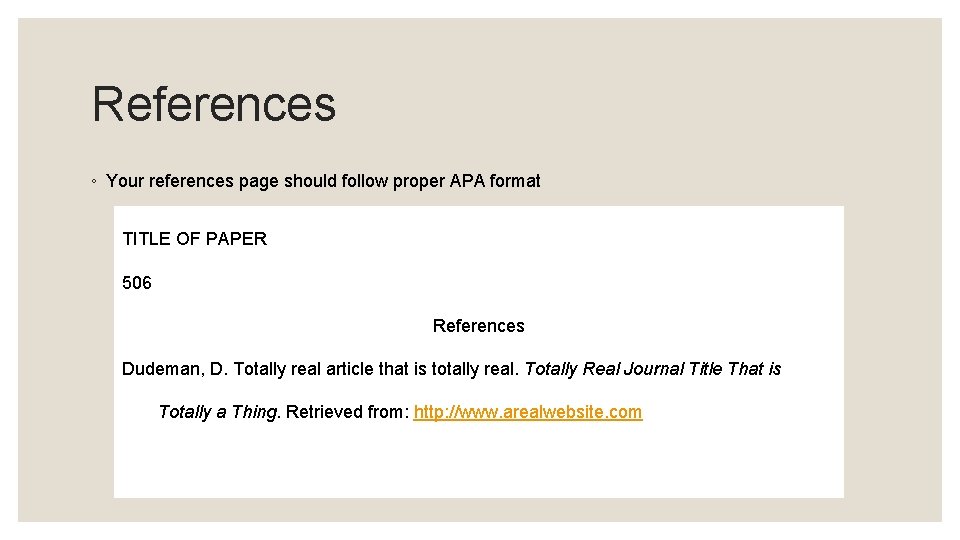
References ◦ Your references page should follow proper APA format TITLE OF PAPER 506 References Dudeman, D. Totally real article that is totally real. Totally Real Journal Title That is Totally a Thing. Retrieved from: http: //www. arealwebsite. com
Appendices ◦ This is where you will place all of your primary research materials: the survey questions that you distributed, transcripts of the interview that you did, and transcripts of your observation log notes ◦ You could also put anything in here that you felt should be included in the paper, but was too large, such as big graphs and charts
- Slides: 14