
Group Influence on Behavior Lets look at how
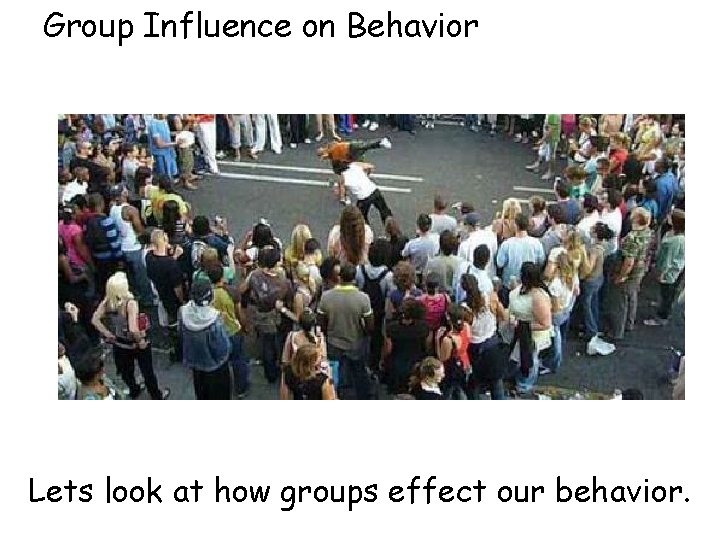
Group Influence on Behavior Lets look at how groups effect our behavior.
Aim: How can the presence or actions of others influence our behavior? (positively or negatively) AGENDA: 1. Sign Up on front board. 2. Hand in RUBRIC, RESEARCH TEMPLATE AND SKIT when you present. 3. Take notes on presentations on the graphic organizer. 4. Ask questions – you are responsible for ALL the terms!! * Note – Skits first, be sure to debrief/ explain your skit and how it illustrates your term. HOMEWORK: • Social Psych Test Friday – (Study Guide Due)
Aim: How can the presence or actions of others influence our behavior? (positively or negatively) AGENDA: 1. Hand in rubric before you present. 2. Take notes on presentations. Ask questions 3. Go over p. 35 – 36 4. P. 37 HOMEWORK: • Complete Social Psych Experiment Chart (Read pps. 278 -283, 292 -293 • Social Psych Test Friday – (Study Guide Due)

DEINDIVIDUATION
• If you could do anything in the world with complete assurance you wouldn’t get detected (invisible) or held responsible , what would you do? – Write it down on the card. NO NAMES
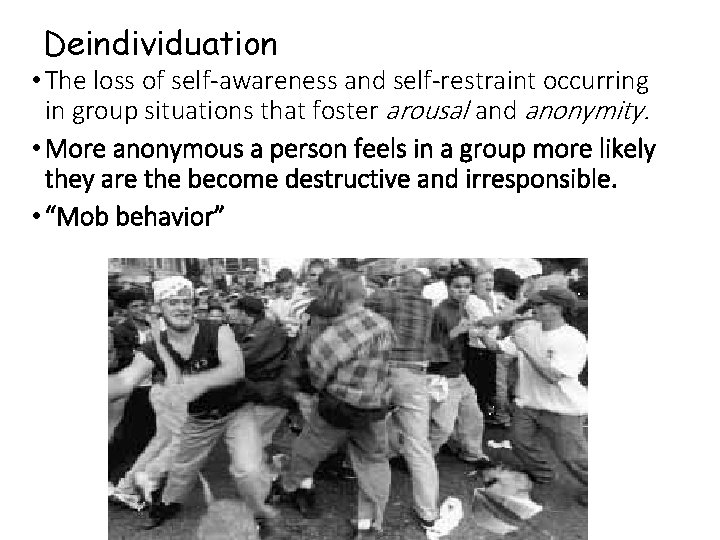
Deindividuation • The loss of self-awareness and self-restraint occurring in group situations that foster arousal and anonymity. • More anonymous a person feels in a group more likely they are the become destructive and irresponsible. • “Mob behavior”
Altruism • Helping behavior • When are you more likely to help someone? Describe situations when you would or wouldn’t help someone in need. Think of historical examples where people did/ did not help someone in need.
What would you do? • Why do the help or not help? Watch the video! • http: //www. youtube. com/watch? v=e. IG 6 EMVy 6 zs
Bystander Effect/ Diffusion of Responsibility
Bystander Effect (Apathy) • When the number of people increase, you are less likely to help • People are more likely to come to the aid of a stranger if they are alone because responsibility can’t be diffused. • Diffusion of Responsibility: tendency of group members to avoid taking responsibility for actions or decisions, assuming others will do so.
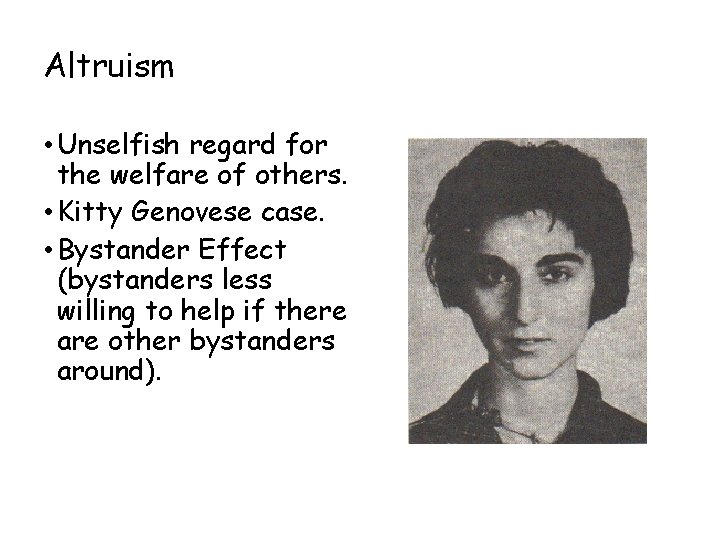
Altruism • Unselfish regard for the welfare of others. • Kitty Genovese case. • Bystander Effect (bystanders less willing to help if there are other bystanders around).

Story of Kitty Genovese • http: //www. youtube. com/watch? v=Jozm. WS 6 x. YEw
Today Show Demonstration • http: //www. youtube. com/watch? v=KIv. GIw. Lc. Iuw
School Demonstration • http: //www. youtube. com/watch? v=Jcow. GVd 6 Gq. Y
Other factors which effect altruism (Bystander Intervention) • Ambiguity • Personal characteristics of bystanders • Mood
Social Facilitation
Social Facilitation • Improved performance of tasks in the presence of others. • Occurs with simple or well learned tasks. • Not with tasks that are difficult or not yet mastered.
Do the following need to be aroused? Why or Why not/ Impact on performance? • Playing a video game • Quarterback • Lineman • Weightlifter • Gymnast • Telemarketer • Surgeon • Taking the AP Exam
Group Polarization
How do you feel about JJ compared to other schools? • Rank on a scale from 0 – 100. 0 = Poor, 100 = Excellent. • Individual Score? • Group Score?
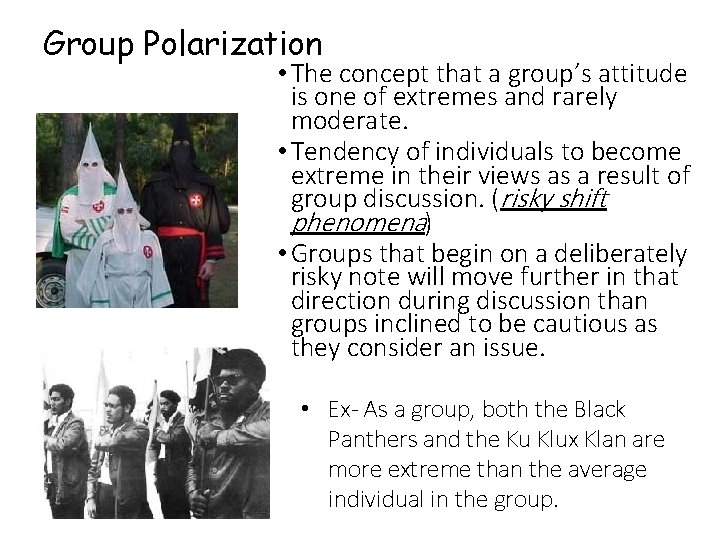
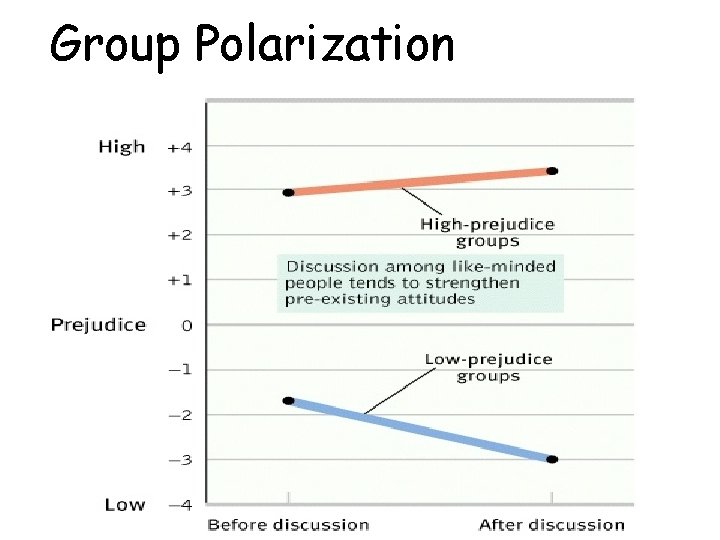
Group Polarization • The concept that a group’s attitude is one of extremes and rarely moderate. • Tendency of individuals to become extreme in their views as a result of group discussion. (risky shift phenomena) • Groups that begin on a deliberately risky note will move further in that direction during discussion than groups inclined to be cautious as they consider an issue. • Ex- As a group, both the Black Panthers and the Ku Klux Klan are more extreme than the average individual in the group.
Group Polarization
Barriers to decision making… • Size of group • Social Loafing
Social Loafing
Social Loafing • The tendency for people in a group to exert less effort when pooling efforts toward a common goal than if they were individually accountable. • Members of a work team slow down and let others do the work. Occurs when individuals are not held accountable, feel work is repetitive and uninteresting.

Group Think
We also influence ourselves The Power of the Individual can be stronger than a group.
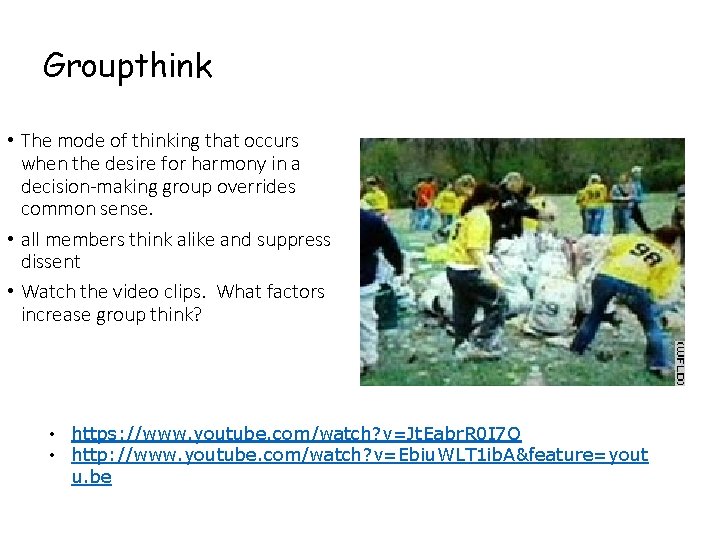
Groupthink • The mode of thinking that occurs when the desire for harmony in a decision-making group overrides common sense. • all members think alike and suppress dissent • Watch the video clips. What factors increase group think? • https: //www. youtube. com/watch? v=Jt. Eabr. R 0 I 7 Q • http: //www. youtube. com/watch? v=Ebiu. WLT 1 ib. A&feature=yout u. be
Activity: Who will survive?
Norms
What would happen if? • You cut into the middle of a line by yourself and stayed in line for at least 2 minutes? • You sang loudly on a public bus? • You positioned yourself 6 inches from an acquaintance’s nose during a conversation? • You laughed during a funeral? • How would other people behave? • How would you feel?
Norms: • Learned social rules that tell us what and what not to do • Learned from environment • Descriptive Norms = how most people act, implicit cultural standards • Injunctive Norms = specific information, rules, laws about how we are supposed to act
Descriptive, Injunctive, Implicit or Explicit 1. Extreme public affection. PDA 2. Talking with mouth full. 3. Steal food off another's plate. 4. Talk during an entire movie. 5. Steal. 6. Violating personal space. 7. Touch a stranger. 8. Listen in on a person's conversation on a cell phone. 9. Show too much skin, lack of clothing. 10. Wear undergarments outside of clothes.
HO: What is a group? • A number of persons or objects located, gathered or classified together.
Social Influence • Process by which other individuals affect our perceptions, attitudes and actions
Aim: How can the presence or actions of others influence our behavior? (positively or negatively) AGENDA: 1. Page 29/30 Check for Understanding. 2. Check HW – Chart. HOMEWORK: • Social Psych Test Tomorrow, Study Guide Due. 30 MC and FRQ.
Conformity
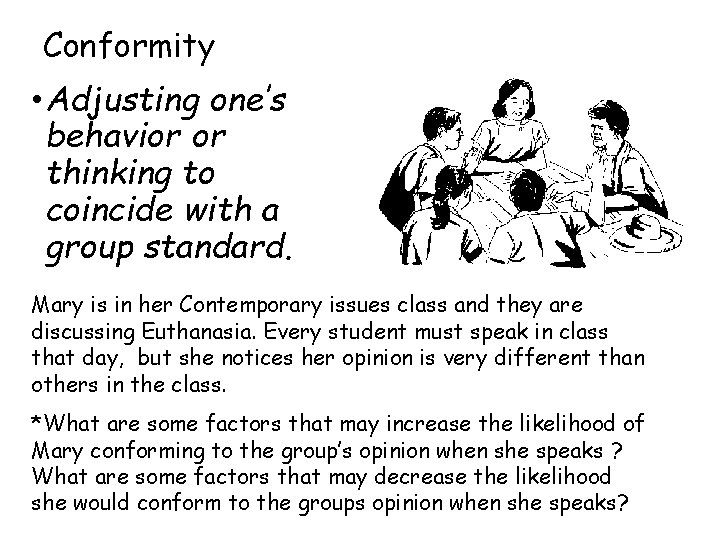
Conformity • Adjusting one’s behavior or thinking to coincide with a group standard. Mary is in her Contemporary issues class and they are discussing Euthanasia. Every student must speak in class that day, but she notices her opinion is very different than others in the class. *What are some factors that may increase the likelihood of Mary conforming to the group’s opinion when she speaks ? What are some factors that may decrease the likelihood she would conform to the groups opinion when she speaks?
Conformity • Conflict between individual and the group and people resolve conflict by yielding to the norms of the group • Uniformity does not equal conformity ***WHY DO WE CONFORM? WHAT HAPPENS WHEN WE DO NOT?
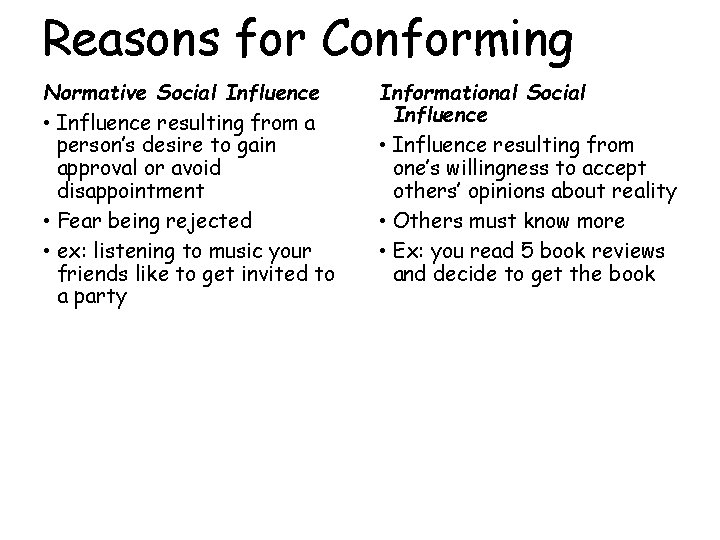
Reasons for Conforming Normative Social Influence • Influence resulting from a person’s desire to gain approval or avoid disappointment • Fear being rejected • ex: listening to music your friends like to get invited to a party Informational Social Influence • Influence resulting from one’s willingness to accept others’ opinions about reality • Others must know more • Ex: you read 5 book reviews and decide to get the book
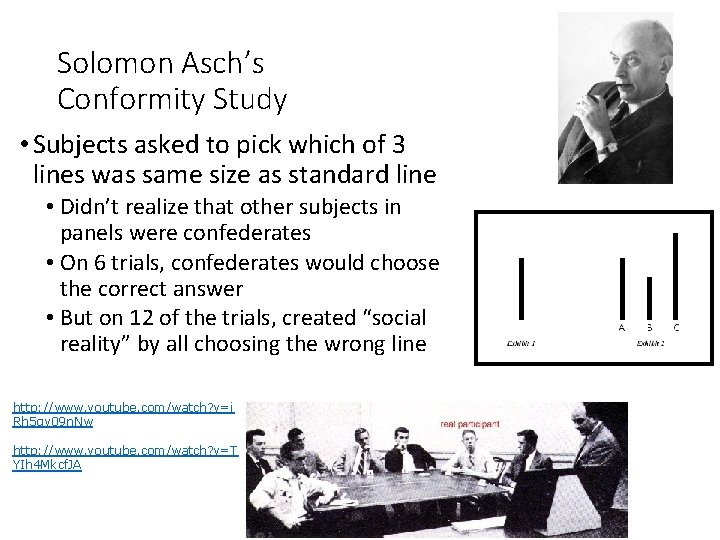
Solomon Asch’s Conformity Study • Subjects asked to pick which of 3 lines was same size as standard line • Didn’t realize that other subjects in panels were confederates • On 6 trials, confederates would choose the correct answer • But on 12 of the trials, created “social reality” by all choosing the wrong line http: //www. youtube. com/watch? v=i Rh 5 qy 09 n. Nw http: //www. youtube. com/watch? v=T YIh 4 Mkcf. JA
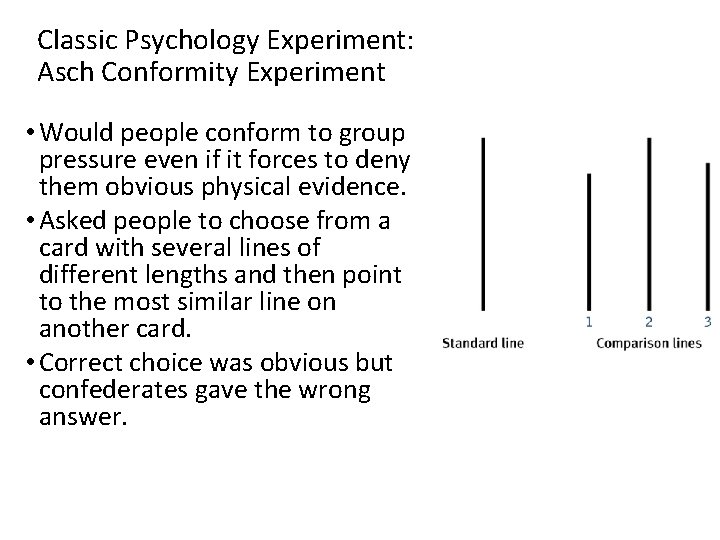
Classic Psychology Experiment: Asch Conformity Experiment • Would people conform to group pressure even if it forces to deny them obvious physical evidence. • Asked people to choose from a card with several lines of different lengths and then point to the most similar line on another card. • Correct choice was obvious but confederates gave the wrong answer.
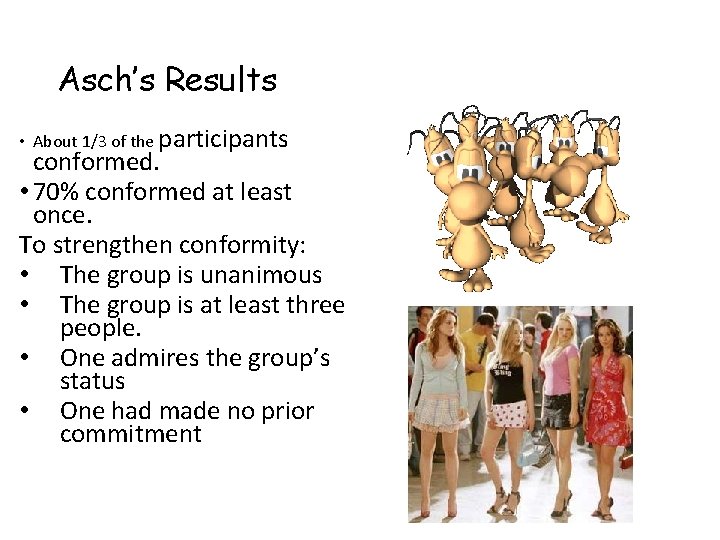
Asch’s Results • About 1/3 of the participants conformed. • 70% conformed at least once. To strengthen conformity: • The group is unanimous • The group is at least three people. • One admires the group’s status • One had made no prior commitment
Factors influencing conformity • Ambiguity • When something is less certain, rely more on other’s opinions • Group Size and Unanimity • More powerful at 3 people or more • If even one person disagrees, greatly reduces conformity (<10% in Asch study) • Social Status • Prior commitment • Culture that promotes importance of social standards • Research has shown no legitimate gender-based differences • “Minority influence” – much more rare, but can be powerful
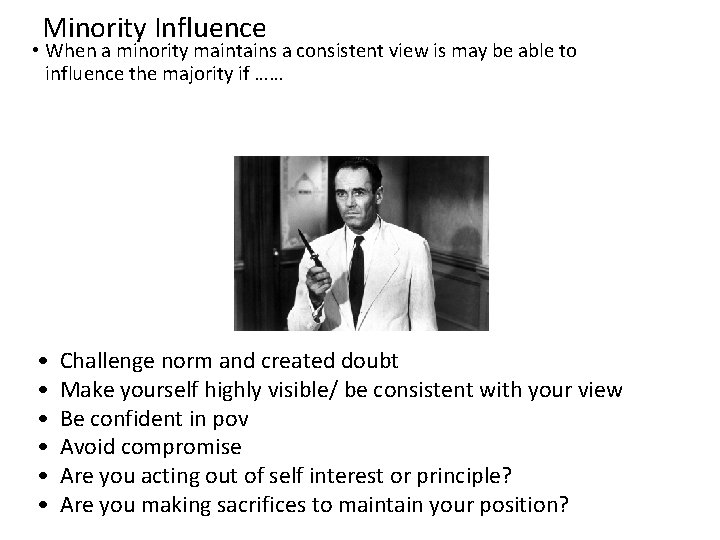
Minority Influence • When a minority maintains a consistent view is may be able to influence the majority if …… • • • Challenge norm and created doubt Make yourself highly visible/ be consistent with your view Be confident in pov Avoid compromise Are you acting out of self interest or principle? Are you making sacrifices to maintain your position?
Obedience
Obedience • Is compliance with a demand • Milgram’s experiment – Would people obey authority and violate ethical standards? • When/Why did obedience occur?
Factors that influence obedience? • Experimenter Status & Prestige (expert versus legitimate social power) • Behavior of Others • Personality Characteristics
What caused disobedience • Experimenter left the room • Victim in the room • 2 experimenters give conflicting demands
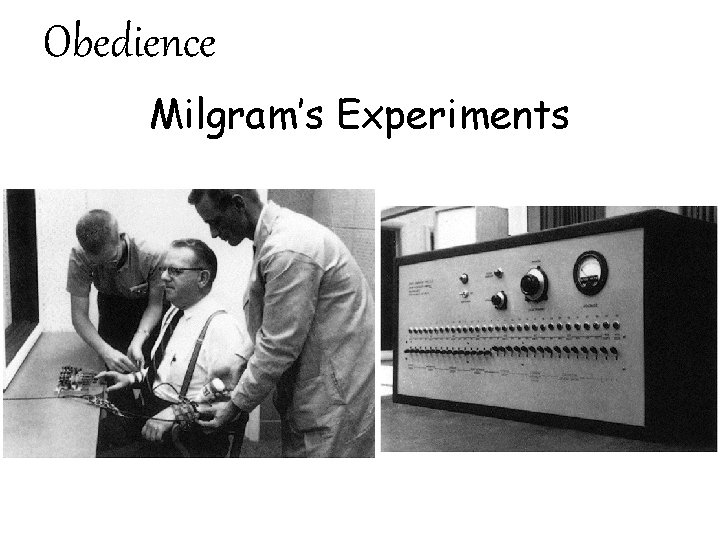
Obedience Milgram’s Experiments
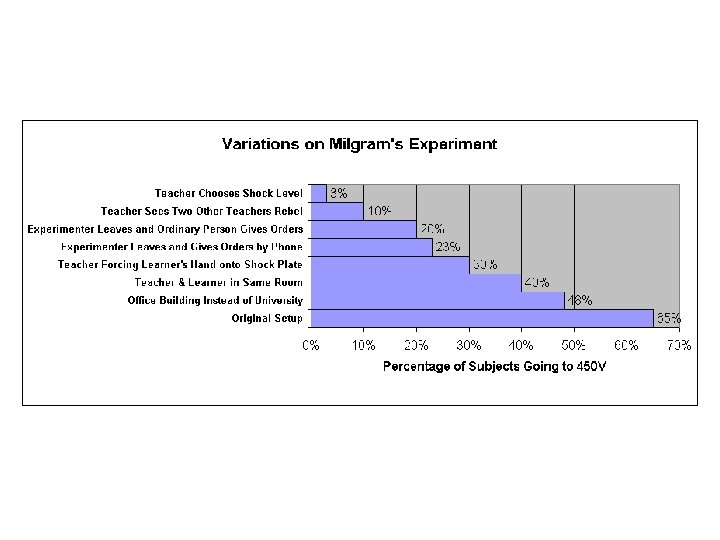
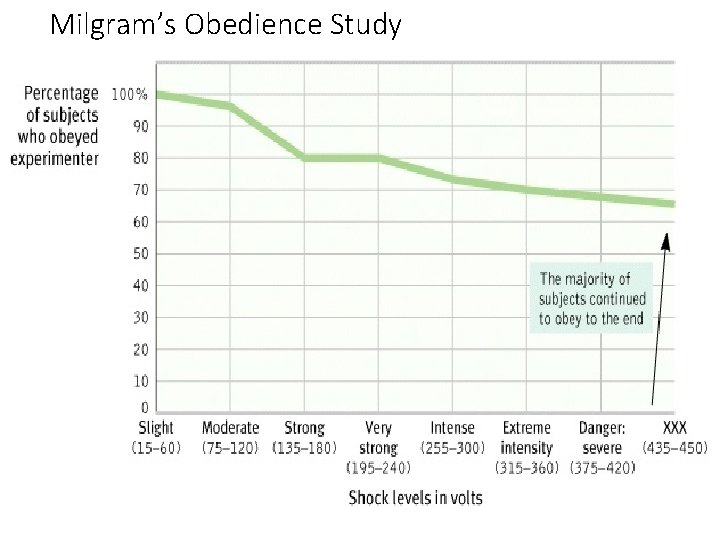
Milgram’s Obedience Study
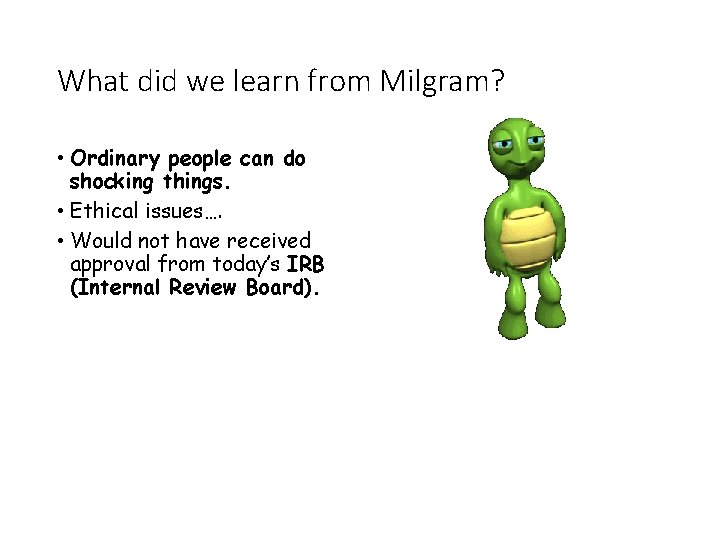
What did we learn from Milgram? • Ordinary people can do shocking things. • Ethical issues…. • Would not have received approval from today’s IRB (Internal Review Board).
Debrief: Asch, Milgram, Zimbardo Studies 1. What is the difference between conformity and obedience? What conclusions can we draw about the nature of man from Asch , Milgram, and/ or Zimbardo’s Experiment? 2. 3. Which study was about conformity? obedience? Which study had elements of both concepts?
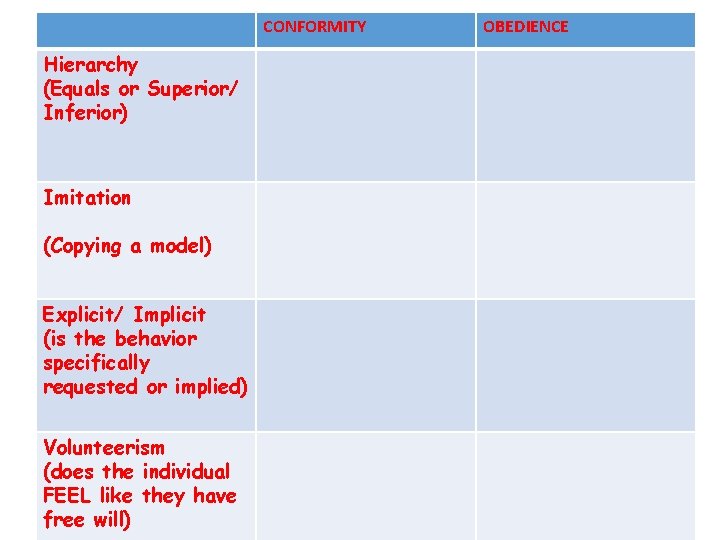
CONFORMITY Hierarchy (Equals or Superior/ Inferior) Imitation (Copying a model) Explicit/ Implicit (is the behavior specifically requested or implied) Volunteerism (does the individual FEEL like they have free will) OBEDIENCE
RSA Animate - The Truth About Dishonesty http: //www. youtube. com/watch? v=XBm. Jay_qd. Nc&safety_mode=true &persist_safety_mode=1&safe=active
Check for Understanding Group Dynamics Task: Work with person sitting next to you and complete the following…. 1. Page 29 Part I Identify as facilitation, loafing or deindividuation. 2. Page 30 Groupthink or polarization # 1 - 3 3. Page 30 True or False #1 -6 4. Page 30 Bottom would they INCREASE or DECREASE helping (altruism) behavior.
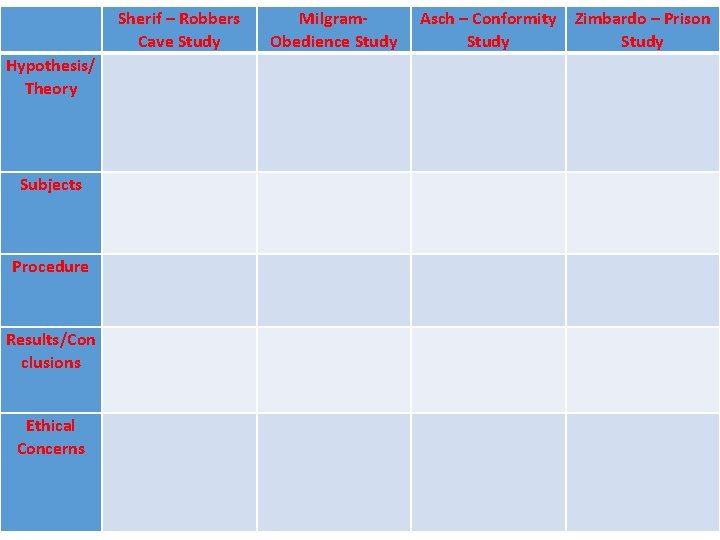
Sherif – Robbers Cave Study Milgram- Obedience Study Asch – Conformity Zimbardo – Prison Study Procedure Results/Con clusions Ethical Concerns Hypothesis/ Theory Subjects

Kahoot
- Slides: 59