
Group Influence Marvin Shaw 1981 members interact Two
Group Influence
�Marvin Shaw (1981): members interact �Two or more people who, for longer than a few moments ◦ Interact with & influence one another ◦ Perceive one another as “us” �What is a group? �Why do groups exist? Group
�Are students working in an art studio a group? �What if the students are working on independent projects? Still a group? �The line between a collection of individuals & a group can be blurred. Question
�A group consists of two or more interacting persons who… ◦ Share common goals ◦ Have a stable relationship ◦ Are somehow interdependent ◦ Perceive that they are in fact part of a group �Varying degrees of “groupness” – ranging from high functioning to fleeting. Group: Definition
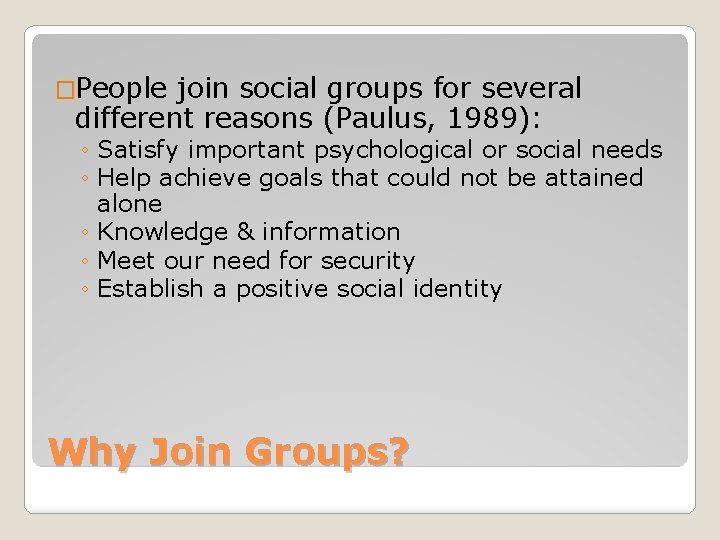
�People join social groups for several different reasons (Paulus, 1989): ◦ Satisfy important psychological or social needs ◦ Help achieve goals that could not be attained alone ◦ Knowledge & information ◦ Meet our need for security ◦ Establish a positive social identity Why Join Groups?
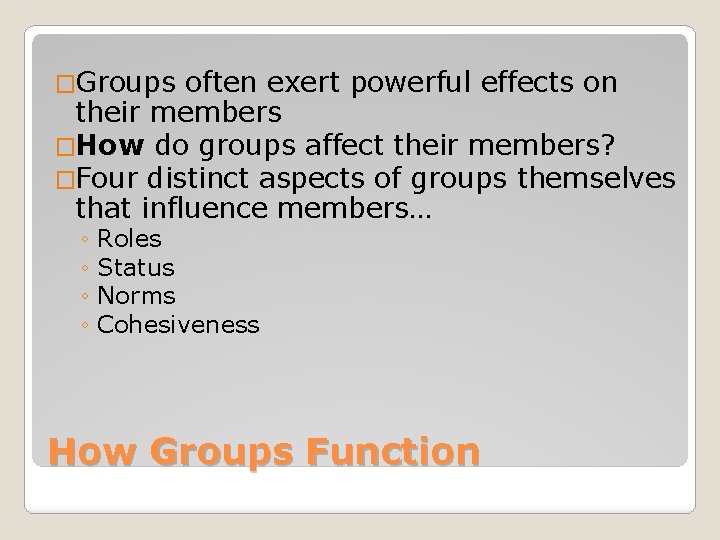
�Groups often exert powerful effects on their members �How do groups affect their members? �Four distinct aspects of groups themselves that influence members… ◦ Roles ◦ Status ◦ Norms ◦ Cohesiveness How Groups Function
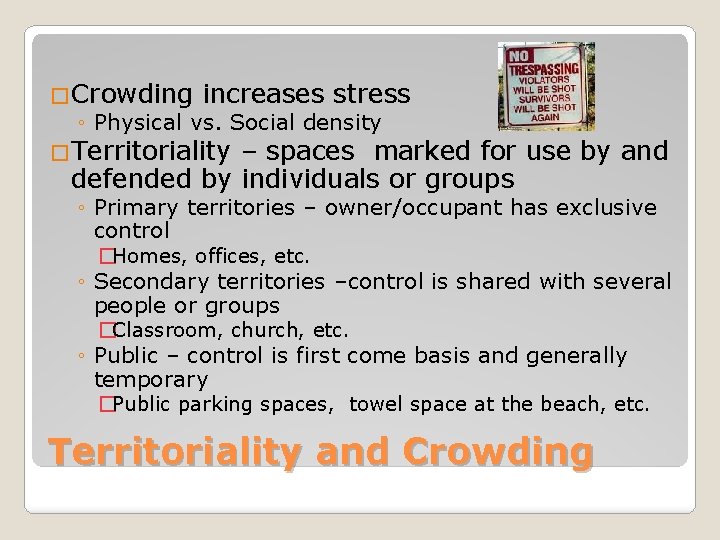
�Crowding increases stress ◦ Physical vs. Social density �Territoriality – spaces marked for use by and defended by individuals or groups ◦ Primary territories – owner/occupant has exclusive control �Homes, offices, etc. ◦ Secondary territories –control is shared with several people or groups �Classroom, church, etc. ◦ Public – control is first come basis and generally temporary �Public parking spaces, towel space at the beach, etc. Territoriality and Crowding
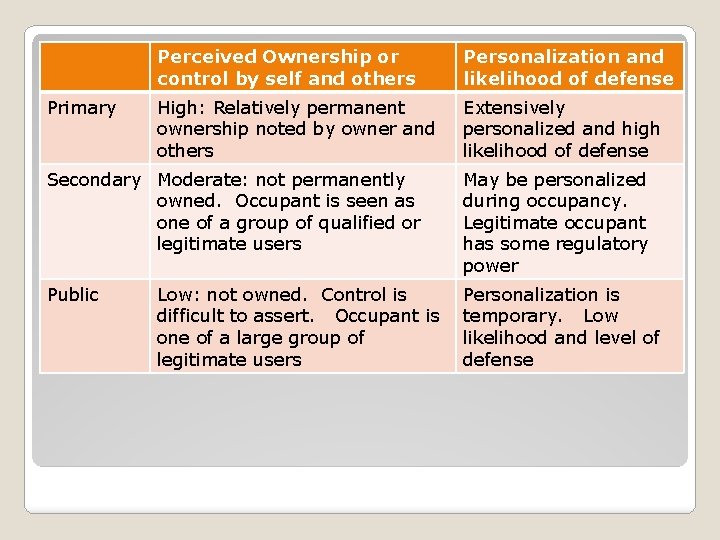
Primary Perceived Ownership or control by self and others Personalization and likelihood of defense High: Relatively permanent ownership noted by owner and others Extensively personalized and high likelihood of defense Secondary Moderate: not permanently owned. Occupant is seen as one of a group of qualified or legitimate users May be personalized during occupancy. Legitimate occupant has some regulatory power Public Personalization is temporary. Low likelihood and level of defense Low: not owned. Control is difficult to assert. Occupant is one of a large group of legitimate users
�Originally suggested that the presence of others enhanced performance of simple or well learned tasks. �Current meaning asserts the strengthening of dominant (likely) responses in the presence of others. Social Facilitation
�Why are we more alert, anxious, or excited in the presence of others? ◦ Evaluation apprehension: concern of how others are evaluating us. ◦ Driven by distraction, conflict between paying attention to others & paying attention to the task. ◦ Mere presence of others Social Facilitation
�Tendency for people to exert less effort when they pool their efforts toward a common goal than when they are individually accountable. ◦ Many hands make light work ◦ Free riders: people who benefit from the group but give little in return. Social Loafing
�People is: in groups loaf less when the task ◦ Challenging ◦ Appealing ◦ Involving ◦ Members are friends or identified with their group (rather than strangers) Social Loafing

Social Facilitation or Loafing?
�Loss of self-awareness & evaluation apprehension �Occurs in group situations that foster responsiveness to group norms, good or bad ◦ Group size: unidentifiable in a crowd ◦ Physical anonymity: unidentifiable via a cover (internet) ◦ Arousing & distracting activities: reduces inhibitions while reinforcing behavior Deindividuation
�Group-produced enhancement of members’ preexisting tendencies ◦ A strengthening of the members’ average tendency, not a split within the group. �Explaining polarization ◦ Informational influence ◦ Normative influence & social comparison Group Polarization
�"The mode of thinking that persons engage in when concurrence-seeking becomes so dominant in a cohesive in-group that it tends to override realistic appraisal of alternative courses of action" - Irving Janis (1971) �Members of the group attempt to conform opinions to what they believe to be the consensus of the group. Groupthink
�Symptoms of groupthink ◦ Overestimate in group’s might & right �Invulnerability ◦ Close-minded �Rationalization �Stereotyped view of opponent ◦ Uniformity �Conformity pressure �Self-censorship Groupthink
�Preventing groupthink: ◦ Be impartial ◦ Critically evaluate ◦ Subdivide group, then reunite (fresh perspective) ◦ Welcome critiques & feedback from the outside ◦ Call a “second-chance” meeting Groupthink
- Slides: 18