
Group Dynamics Forces influencing the interrelationships of persons
- Slides: 18
Group Dynamics Forces influencing the interrelationships of persons in a group, ultimately effecting group outcome Reference: Cole, Chapter 3 Cole, M. B. Group Dynamics in Occupational Therapy: Theoretical Basis and Practice Application of Group Intervention (4 th ed. ). © 2012 SLACK Incorporated.
Introduction to Theory-Based Groups �A basic assumption of this course is that all groups are theory based. �The OT Framework-II states that when planning groups for the purpose of evaluation or intervention within selected occupational domains, you must apply theories, models, and/or frames of reference that best fit the needs of a group of clients. Cole, M. B. Group Dynamics in Occupational Therapy: Theoretical Basis and Practice Application of Group Intervention (4 th ed. ). © 2012 SLACK Incorporated.
Topics � Introduction to theory-based groups � Group design—Writing a group protocol � Groups and OT Framework-II � Therapeutic factors � Content versus process � Norms, roles, and leadership styles � Group development � Problem behaviors � Shared leadership � Self-help groups, community and population group examples � Termination � Education and work group examples—Teams and Cole, M. B. teamwork Group Dynamics in Occupational Therapy: Theoretical Basis and Practice Application of Group Intervention (4 th ed. ). © 2012 SLACK Incorporated.
Why OTs Treat in Groups 1. 2. 3. 4. 5. 6. Common goal—More practical (e. g. , teach communication skills) Multiple feedback and support (consensual validation), encouragement for self-value and identity Promote independence (from leader), developmental progression (Mosey) Groups support growth and change in members (e. g. , assertiveness) Groups have capacity for self-direction can create own tasks (task-oriented group) or can change group environment. (Warning—Can also become counter-therapeutic) Satisfy individual needs and social demands, helping one another also helps self Cole, M. B. Group Dynamics in Occupational Therapy: Theoretical Basis and Practice Application of Group Intervention (4 th ed. ). © 2012 SLACK Incorporated.
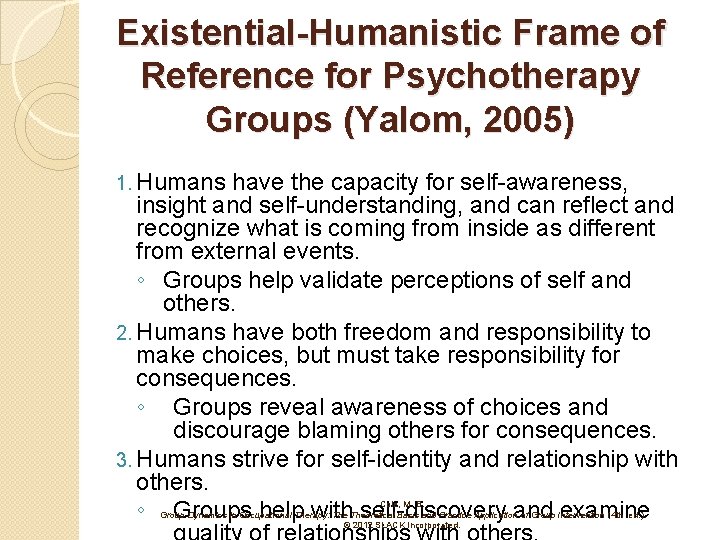
Existential-Humanistic Frame of Reference for Psychotherapy Groups (Yalom, 2005) 1. Humans have the capacity for self-awareness, insight and self-understanding, and can reflect and recognize what is coming from inside as different from external events. ◦ Groups help validate perceptions of self and others. 2. Humans have both freedom and responsibility to make choices, but must take responsibility for consequences. ◦ Groups reveal awareness of choices and discourage blaming others for consequences. 3. Humans strive for self-identity and relationship with others. ◦ Groups help with self-discovery and examine Cole, M. B. Group Dynamics in Occupational Therapy: Theoretical Basis and Practice Application of Group Intervention (4 th ed. ). © 2012 SLACK Incorporated.
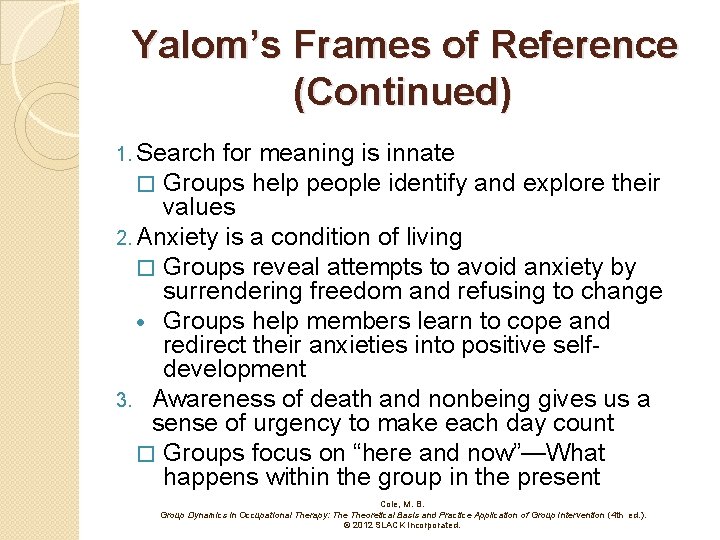
Yalom’s Frames of Reference (Continued) 1. Search for meaning is innate � Groups help people identify and explore their values 2. Anxiety is a condition of living � Groups reveal attempts to avoid anxiety by surrendering freedom and refusing to change · Groups help members learn to cope and redirect their anxieties into positive selfdevelopment 3. Awareness of death and nonbeing gives us a sense of urgency to make each day count � Groups focus on “here and now”—What happens within the group in the present Cole, M. B. Group Dynamics in Occupational Therapy: Theoretical Basis and Practice Application of Group Intervention (4 th ed. ). © 2012 SLACK Incorporated.
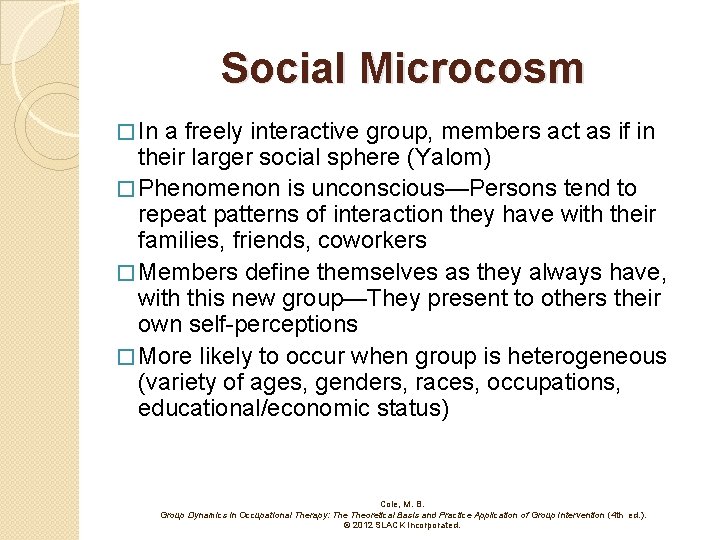
Social Microcosm � In a freely interactive group, members act as if in their larger social sphere (Yalom) � Phenomenon is unconscious—Persons tend to repeat patterns of interaction they have with their families, friends, coworkers � Members define themselves as they always have, with this new group—They present to others their own self-perceptions � More likely to occur when group is heterogeneous (variety of ages, genders, races, occupations, educational/economic status) Cole, M. B. Group Dynamics in Occupational Therapy: Theoretical Basis and Practice Application of Group Intervention (4 th ed. ). © 2012 SLACK Incorporated.
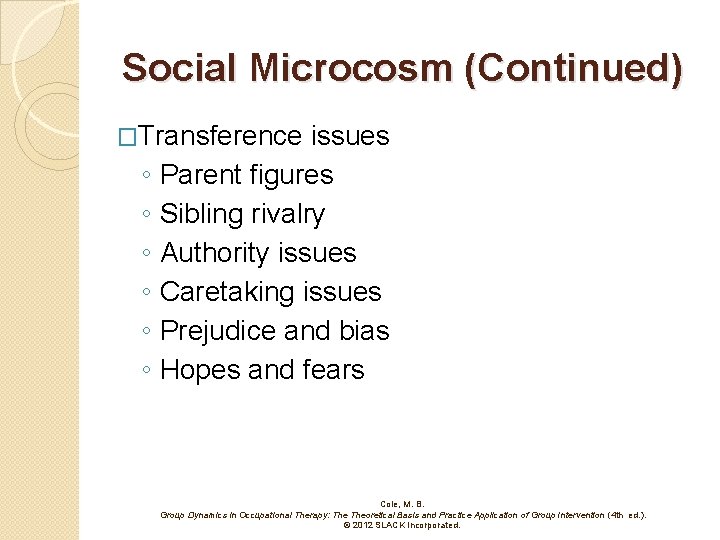
Social Microcosm (Continued) �Transference ◦ ◦ ◦ issues Parent figures Sibling rivalry Authority issues Caretaking issues Prejudice and bias Hopes and fears Cole, M. B. Group Dynamics in Occupational Therapy: Theoretical Basis and Practice Application of Group Intervention (4 th ed. ). © 2012 SLACK Incorporated.
Corrective Emotional Experience (Franz Alexander) 1. 2. 3. 4. 5. Strong expression of emotion at great risk to group member Group support enough to permit risk Reality testing of consequence in positive group environment Recognition of inappropriateness of certain interpersonal feelings and behavior or avoidance Ultimate facilitation of individual’s ability to interact with others more openly and honestly Cole, M. B. Group Dynamics in Occupational Therapy: Theoretical Basis and Practice Application of Group Intervention (4 th ed. ). © 2012 SLACK Incorporated.
Why OTs Use Structured Activities Help the group to bypass initial uneasiness and hesitancy 2. Use occupation to provide structure and facilitate interaction 3. Experience supportive social context for experimenting with new behaviors or adaptations in occupational performance 4. Demonstrate and reinforce healing nature of occupations 1. Cole, M. B. Group Dynamics in Occupational Therapy: Theoretical Basis and Practice Application of Group Intervention (4 th ed. ). © 2012 SLACK Incorporated.
Client-Centered Groups �Use principles of Carl Rogers, Abraham Maslow, and Irvin Yalom �Therapeutic use of self as a group leader (therapeutic communication skills) �Respect, genuineness, empathy �Belief that clients are capable of making good decisions and creating solutions to their problems with group support �OT as enabler (share expertise, facilitate) Cole, M. B. Group Dynamics in Occupational Therapy: Theoretical Basis and Practice Application of Group Intervention (4 th ed. ). © 2012 SLACK Incorporated.
OT Groups and Spirituality �Group processing, generalization, and application allow clients to control and direct discussion toward what is meaningful for them �Creative activities tap into emotional issues and encourage the experience of meaning (i. e. , art, music, poetry) �Shared emotional expression tends to bond the group together Cole, M. B. Group Dynamics in Occupational Therapy: Theoretical Basis and Practice Application of Group Intervention (4 th ed. ). © 2012 SLACK Incorporated.
Groups in Client-Centered Evaluation �Clients are not always aware of their occupational priorities �Group experiences can help clients to sort out their priorities (i. e. , self awareness, values clarification, etc. ) �Group experiences can reveal problems with interpersonal relationships that might not otherwise be shared �Groups help cognitively impaired clients to express their priorities nonverbally Cole, M. B. Group Dynamics in Occupational Therapy: Theoretical Basis and Practice Application of Group Intervention (4 th ed. ). © 2012 SLACK Incorporated.
Client-Centered Groups and the OT Framework II (2008) �Groups of individuals (members have similar but individual goals) �Clients are defined as individuals, organizations, or populations. �Client = individual plus family members, teachers, employers, and caregivers �Groups with similar needs/goals may be evaluated as a group. �Populations (persons with schizophrenia, persons with dementia, well-elderly) may evaluated as special needs groups for purposes of developing community programs and group interventions. Cole, M. B. Group Dynamics in Occupational Therapy: Theoretical Basis and Practice Application of Group Intervention (4 th ed. ). © 2012 SLACK Incorporated.
Complexity Theory in Health Care and Occupational Therapy Groups � Complexity theory, also called complex systems theory (Cilliers, 1998), chaos theory (Mac. Gill, 2007), and dynamical systems theory (Gray, Kennedy, & Zemke, 1996), represents the next generation of systems theory. Whiteford, Klomp, & St. Clair (2005) describe it as “the richness and variety of structure and behavior that arises from interactions between components of a system”(p. 5). � Complexity theory has been applied across a wide range of disciplines, including earthquakes, traffic patterns, the stock market, human evolution, and group dynamics. � Its use has been augmented through the use of computers to calculate statistics involving very large numbers of components and interrelationships. � Groups are good examples of exceedingly complex Cole, M. B. systems. Group Dynamics in Occupational Therapy: Theoretical Basis and Practice Application of Group Intervention (4 th ed. ). © 2012 SLACK Incorporated.
Complexity Versus Scientific Method � Beginning with Newtonian or linear thinking, which Geyer dubs the “paradigm of order, ” scientists believed in the power of human reason. They relied upon the scientific method to reveal basic objective truth, a type of thinking also referred to as “modernism. ” � Postmodernists believe that there are, in fact, multiple truths, which can only be understood through the use of qualitative research methods (e. g. , interviews, narratives, and participant observation) now widely used especially in the social sciences. � Complexity theory challenges both of these opposites, calling them “equally flawed” but nonetheless “partly true”—In fact, the world can be both orderly and disorderly, rational and irrational, predictable and unpredictable, often simultaneously. Cole, M. B. Group Dynamics in Occupational Therapy: Theoretical Basis and Practice Application of Group Intervention (4 th ed. ). © 2012 SLACK Incorporated.
Complexity and High Definition OT Groups � Complexity theory seeks to build a bridge between the two extremes (order and chaos). � Florence Clark (2010) promoted the concept of “occupational therapy in high definition, ” a metaphor that illustrates how scientific reductionism and complex holistic views co-exist in OT practice. � OT groups apply complexity theory by using both occupation-based models and frames of reference simultaneously. � Group leaders orchestrate multiple factors of interactions and environments while simultaneously working on member individual occupational goals. Cole, M. B. Group Dynamics in Occupational Therapy: Theoretical Basis and Practice Application of Group Intervention (4 th ed. ). © 2012 SLACK Incorporated.
Summary �Groups using Cole’s seven-step format are primarily client centered because this form of group facilitation insures maximum client participation and collaboration. �Additionally, groups draw upon specific occupation-based models and frames of reference when applying theory in selection of group activities, structure, and leadership. �Next time: Designing group protocol Cole, M. B. Group Dynamics in Occupational Therapy: Theoretical Basis and Practice Application of Group Intervention (4 th ed. ). © 2012 SLACK Incorporated.