
GROUP Definition According to Stephen R Robbins Group
GROUP Definition According to Stephen. R. Robbins, “Group consists of two or more individuals, interacting and interdependent, who have come together to achieve particular objectives”.
Characteristics of Group • Strong desire of association • Cohesiveness • Leadership quality • Awareness of members • Individual properties
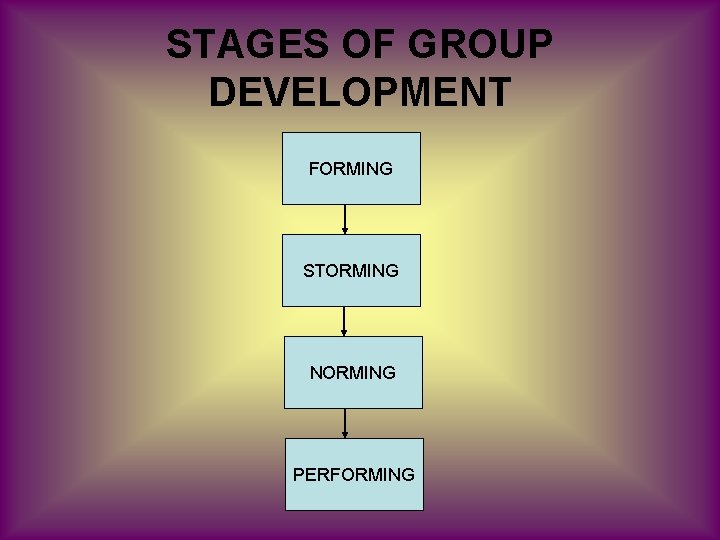
STAGES OF GROUP DEVELOPMENT FORMING STORMING NORMING PERFORMING
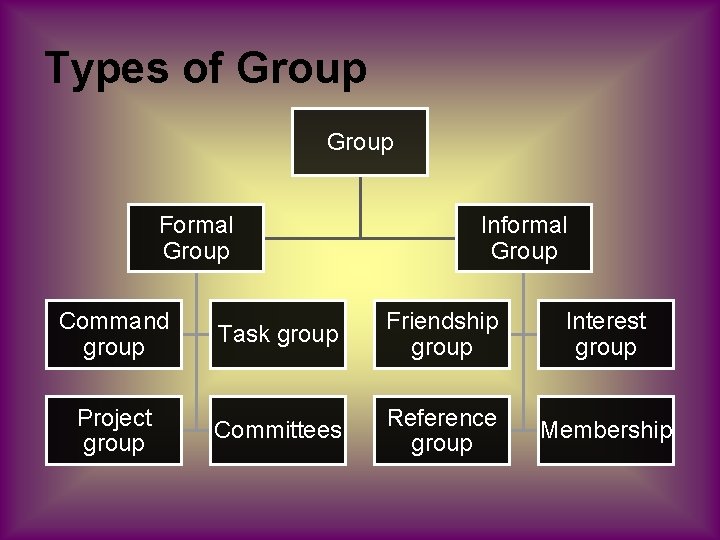
Types of Group Formal Group Informal Group Command group Task group Friendship group Interest group Project group Committees Reference group Membership
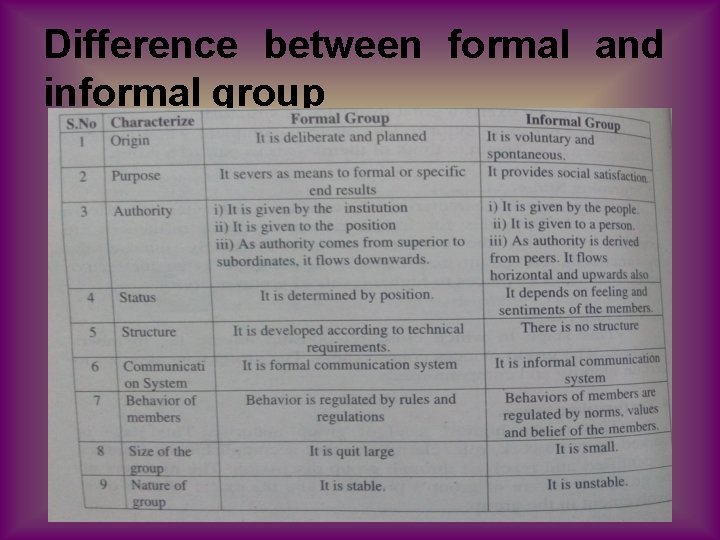
Difference between formal and informal group

GROUP DYNAMICS Definition : According to Kurt Lewin, “Group dynamics deals with internal nature of groups, how they are formed, what structure and processes they adopt, how they function and affect individual members, other groups and the organization”
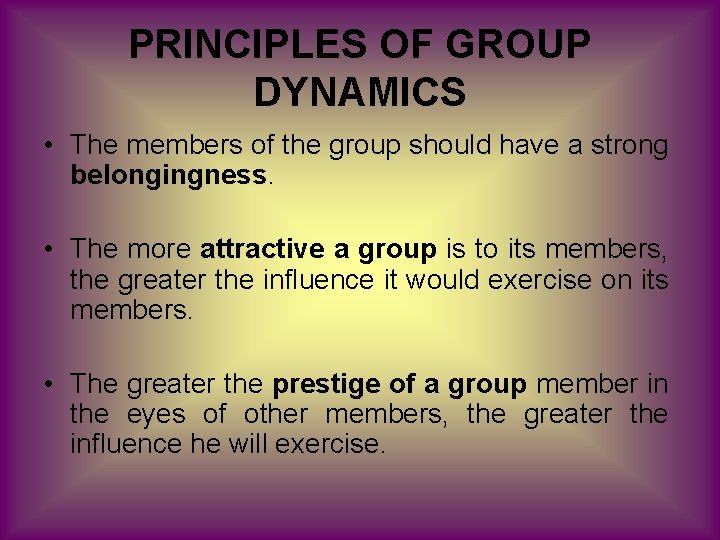
PRINCIPLES OF GROUP DYNAMICS • The members of the group should have a strong belongingness. • The more attractive a group is to its members, the greater the influence it would exercise on its members. • The greater the prestige of a group member in the eyes of other members, the greater the influence he will exercise.
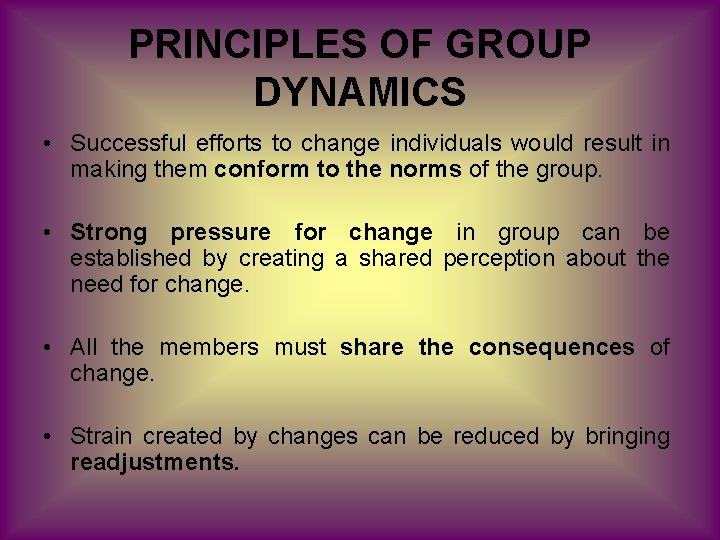
PRINCIPLES OF GROUP DYNAMICS • Successful efforts to change individuals would result in making them conform to the norms of the group. • Strong pressure for change in group can be established by creating a shared perception about the need for change. • All the members must share the consequences of change. • Strain created by changes can be reduced by bringing readjustments.
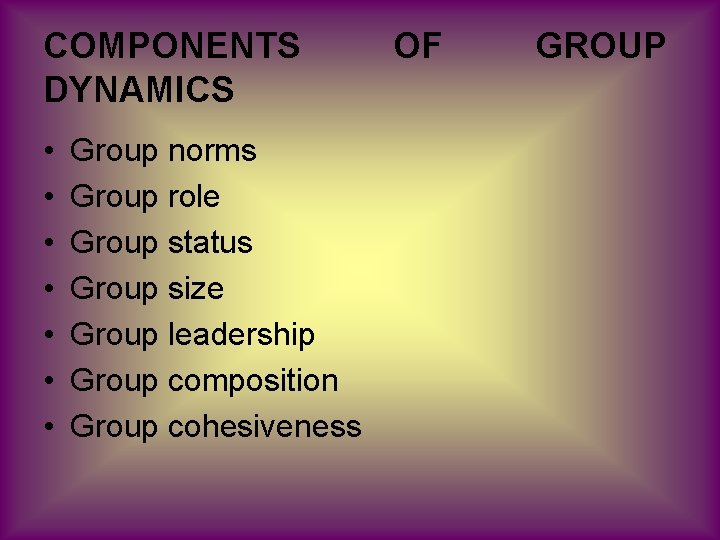
COMPONENTS DYNAMICS • • Group norms Group role Group status Group size Group leadership Group composition Group cohesiveness OF GROUP
GROUP COHESIVENESS Meaning: Cohesiveness is a degree to which group members are attracted to each other and are motivated to stay in the same group.
CHARACTERISTICS OF GROUP COHESIVENESS • Members share group goals and norms & have common interests and backgrounds. • No of members – small • Members interact frequently and communicate effectively • Members stand united against all threats • Members feel that their need would be satisfied by the group • Group should have history of past success
FACTORS DETERMINING GROUP COHESIVENESS • • Status of the group Size of the group Inter dependency Time spent together • Leadership style • External threats • Autonomy • Communication • Management behaviour • Location of the group • Previous successes • Nature of the group
GROUP NORMS Meaning: A group norm is a rule that tells the individual how to behave in a particular group.
CHARACTERISTICS OF GROUP NORMS • Norms apply only to behaviour and not to private thoughts and feelings. • The norms are the basis for predicting and controlling the behaviour of good members. • Norms are identifying the values and ethics of the group members. • Not all norms apply to everyone in the group.
FACTORS AFFECTING CONFORMITY TO GROUP NORMS • Conformity means adjusting one’s behaviour to align with the norms of the group. – More stable and cohesive. – When group goals mesh with individual goals. – Differences in two sets of goals. – Situational factors like external threats. – Personality characteristics of individuals.
ENFORCEMENT OF GROUP NORMS Reasons for giving importance to enforce norms – Group member’s behaviour – Level of education – Group’s survival – Avoid interpersonal problems
HAWTHORNE EXPERIMENTS • Hawthorne Experiment was conducted for more than 5 years at Hawthorne plant of the Western Electric Company. • Elton Mayo and the staff of Harvard Business School carried out the experiments. • These experiments changed the viewpoints of managers about towards workers.
INITIAL ASSUMPTIONS • Each worker is considered as an isolated independent unit. • It was possible to measure and influence the actions and performance of each worker. • A worker’s output depended on the physical environment. • Low output was due to ill timings, unnecessary physical motions, lack of proper incentives.

SEQUENCE OF EXPERIMENTS Illumination experiments Relay assembly test room Interview programme Bank wiring group observations

1. Illumination Experiments • Impact of illumination on productivity was tested. • Two separate groups of employees were chosen. • One group was asked to work under steady light, other group under inconsistent light. • Two groups did not have major variations in productivity.
2. Relay room experiments • Six women employees were chosen. • Physical factors like hours of work, rest intervals, temperature, incentives were modified to observe the changes. • Researches found that there is no effective relationship between any of the physical factor and productivity.
3. Interview programme • 20, 000 interviews were carried out by researches. • A questionnaire was given to employees and responses were received. • Workers explained their problems and what social factor is important according to them. .
4. Bank wiring group observations • The objective of bank wiring group observation was to examine how a group influences a worker to restrict his output. • Group had 14 workers : – 9 – wireman – 3 – solder man – 2 – inspectors • Output of wiremen determined output of solder man and it determined output of inspectors. • Group had its own social structure, communication patterns and behaviour but it does not influence performance of an individual worker in any ways. .
Findings of Hawthorne experiment • Level of production is determined by social norms and not by physiological capacities. • Non-economic rewards and sanctions affect the behavior of workers and restrict the effect of economic incentives. • Workers act as members of group and not as individuals. • Informal leaders play an important role in setting group norms • Importance of communication between ranks
Hawthorne experiments - Criticism • • • Unscientific enquiry Restricted scope Lacking in universal applicability Over emphasis on worker satisfaction Undue importance to social norms

ORGANISATIONAL CONFLCIT Meaning: Conflict is a natural disagreement resulting from individuals or groups who differ in attitudes, beliefs, values or needs.
TYPES AND SOURCES OF ORGANISATIONAL CONFLICT • Intra – personal conflict. • Inter – group conflict. • Inter – organization conflict.
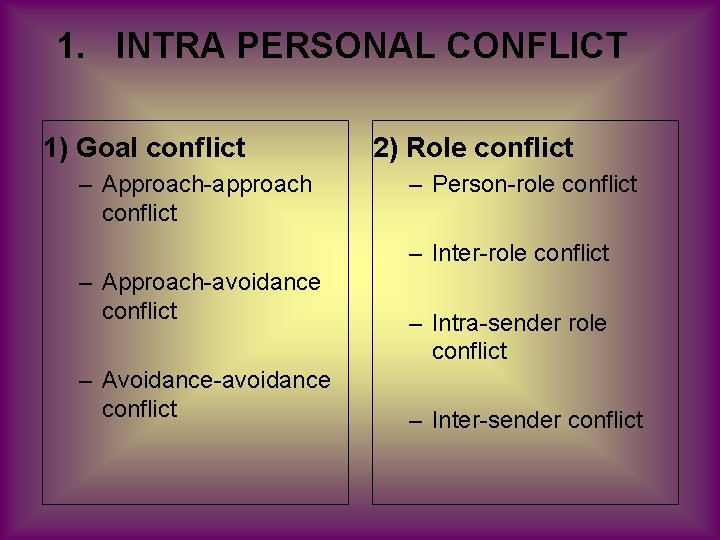
1. INTRA PERSONAL CONFLICT 1) Goal conflict – Approach-approach conflict 2) Role conflict – Person-role conflict – Inter-role conflict – Approach-avoidance conflict – Avoidance-avoidance conflict – Intra-sender role conflict – Inter-sender conflict
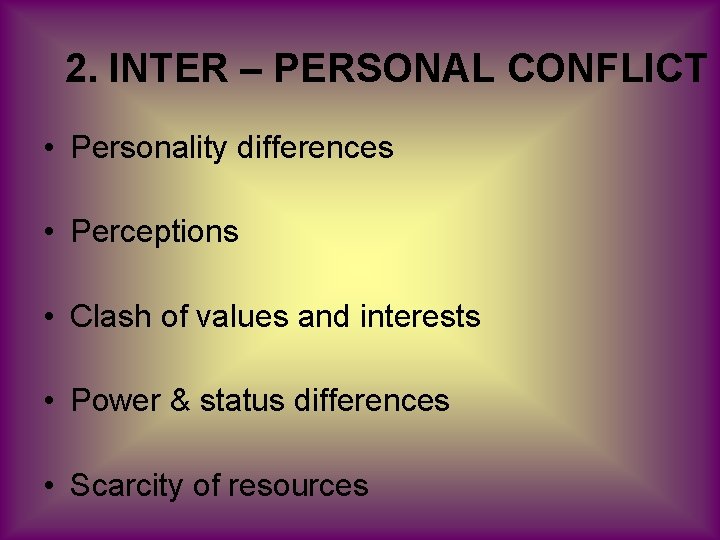
2. INTER – PERSONAL CONFLICT • Personality differences • Perceptions • Clash of values and interests • Power & status differences • Scarcity of resources

3. INTER-GROUP CONFLICT • Incompatible goals • Task interdependence • Resources sharing • Joint decision – making • Organizational ambiguities • Introduction of changes
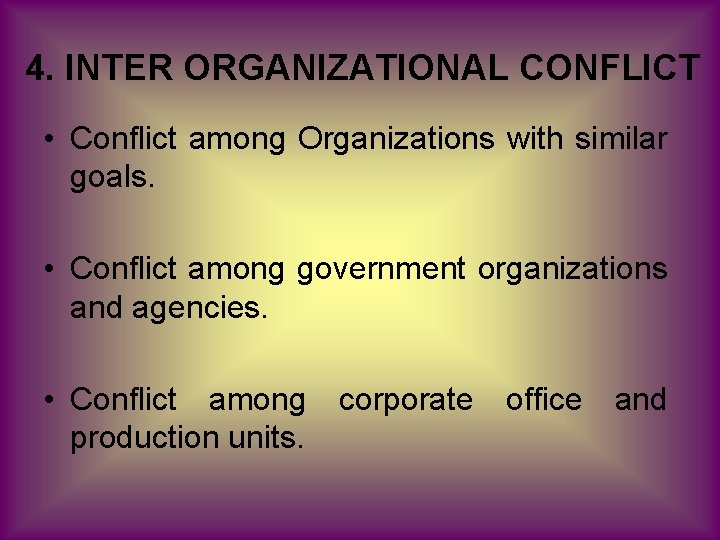
4. INTER ORGANIZATIONAL CONFLICT • Conflict among Organizations with similar goals. • Conflict among government organizations and agencies. • Conflict among corporate office and production units.
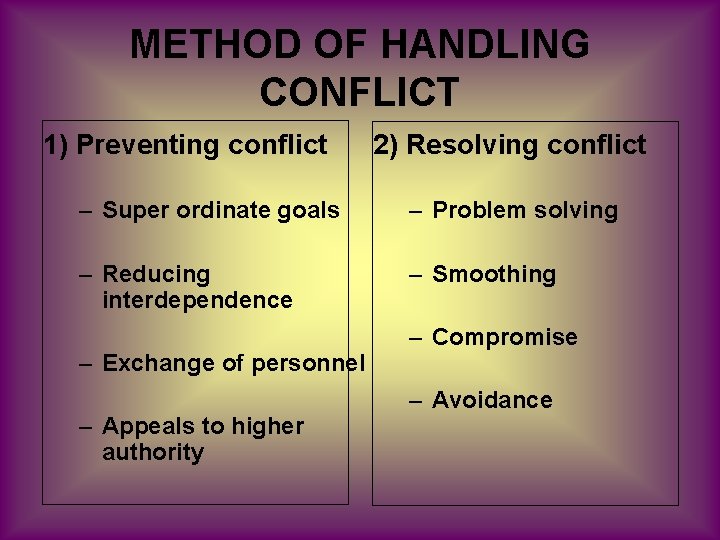
METHOD OF HANDLING CONFLICT 1) Preventing conflict 2) Resolving conflict – Super ordinate goals – Problem solving – Reducing interdependence – Smoothing – Exchange of personnel – Appeals to higher authority – Compromise – Avoidance
SOCIOMETRY Meaning Sociometry is a technique to analyze small groups in order to establish the patterns of interactions among their members. • Designed by J. L. Moreno
WHAT IS SOCIOMETRY • Sociometry enables us to measure, map and build relationships in order to be explored. • It is an essential tool for people to build mature group networks and positive relationship behaviors.
OBJECTIVES OF SOCIOMETRY • To explore intra-group relationship • To move organization from isolated business units to collaborative groups • To strengthen teams • To sort out issues of group conflict, trust and identity • To understand address unspoken aspects of everyday group life • To develop appropriate behavior for your ideal work culture • To integrate thinking, feeling and action in business relationship • To release informal leadership abilities
SUPERVISION Definition : • According to Viteles, “Supervision refers to the direct and immediate guidance and control of the subordinates in the performance of their tasks”.
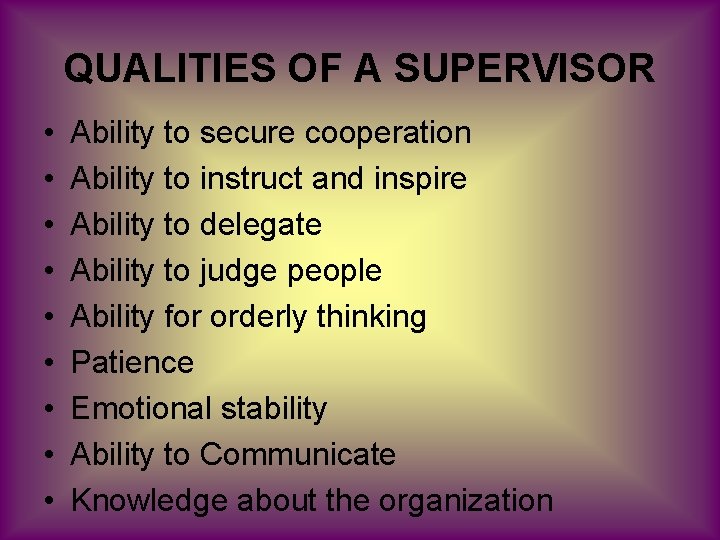
QUALITIES OF A SUPERVISOR • • • Ability to secure cooperation Ability to instruct and inspire Ability to delegate Ability to judge people Ability for orderly thinking Patience Emotional stability Ability to Communicate Knowledge about the organization
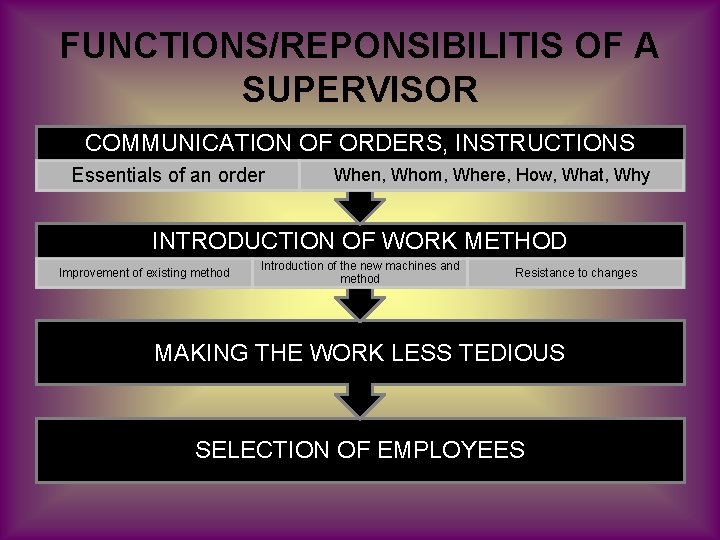
FUNCTIONS/REPONSIBILITIS OF A SUPERVISOR COMMUNICATION OF ORDERS, INSTRUCTIONS Essentials of an order When, Whom, Where, How, What, Why INTRODUCTION OF WORK METHOD Improvement of existing method Introduction of the new machines and method Resistance to changes MAKING THE WORK LESS TEDIOUS SELECTION OF EMPLOYEES
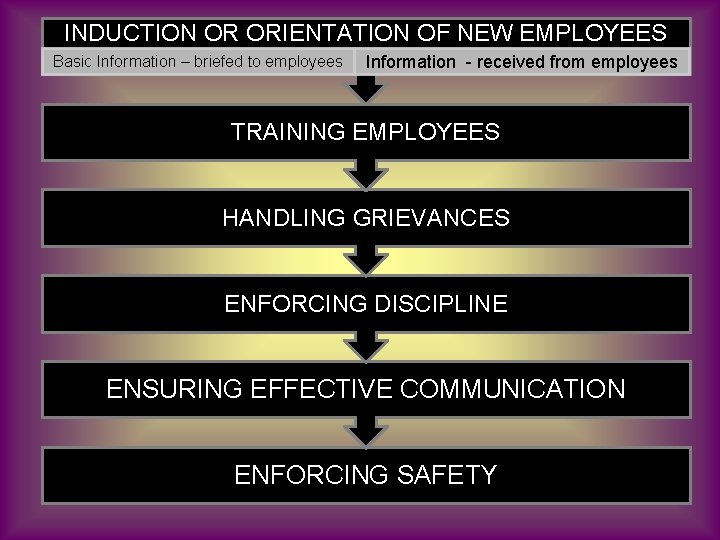
INDUCTION OR ORIENTATION OF NEW EMPLOYEES Basic Information – briefed to employees Information - received from employees TRAINING EMPLOYEES HANDLING GRIEVANCES ENFORCING DISCIPLINE ENSURING EFFECTIVE COMMUNICATION ENFORCING SAFETY
- Slides: 40