
Group Communication Groups I belong to Group Communication
Group Communication

Groups I “belong” to …
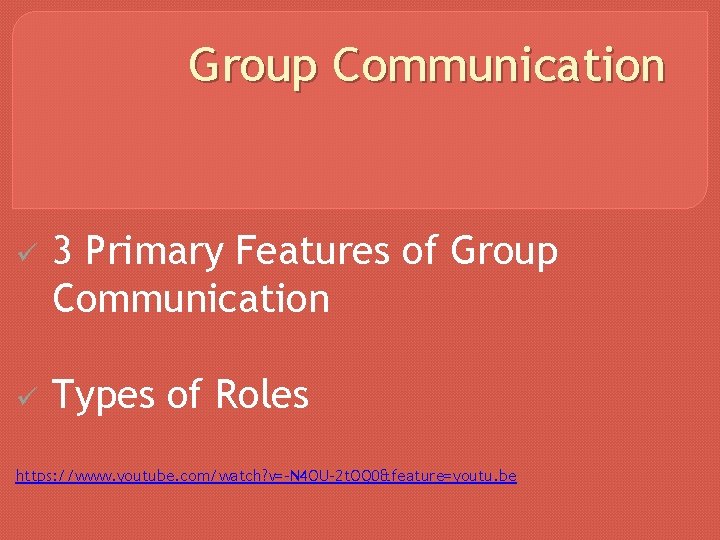
Group Communication ü 3 Primary Features of Group Communication ü Types of Roles https: //www. youtube. com/watch? v=-N 4 OU-2 t. OQ 0&feature=youtu. be
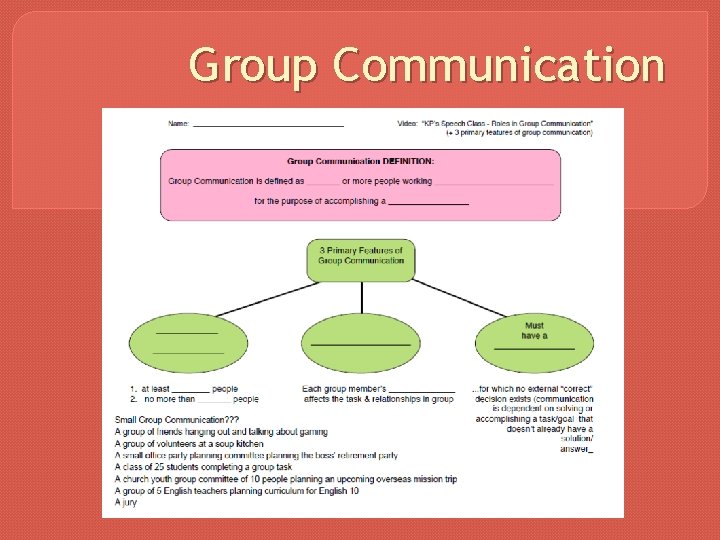
Group Communication
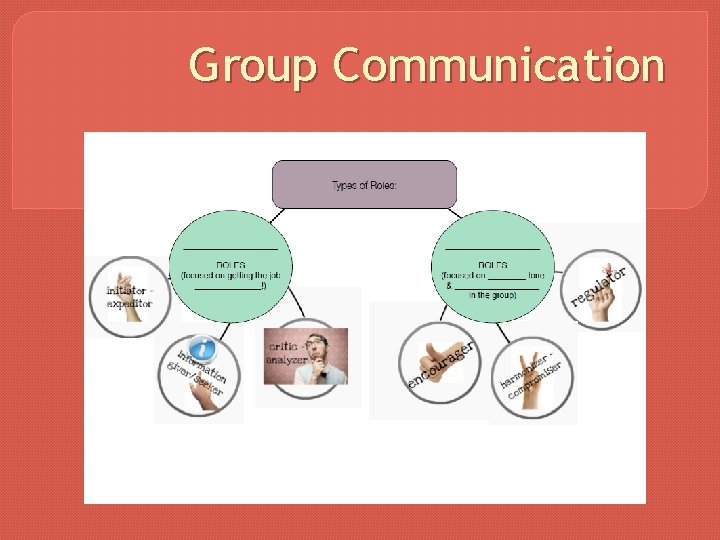
Group Communication
Group Communication
Why do humans need groups? Apollo 13 Failure not an option Square peg round hole

Did you know?
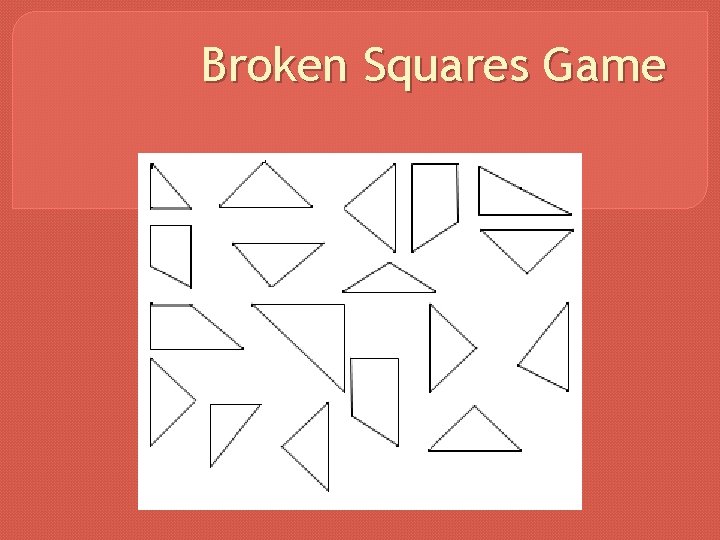
Broken Squares Game
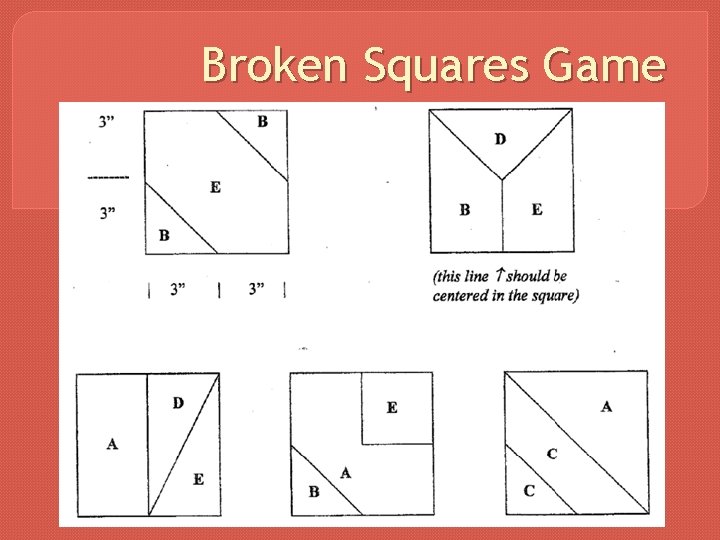
Broken Squares Game • Each group should be seated around a small table or in a small circle so they can work with the squares • A complete set of squares is made up of five separate envelopes, each having all the pieces labeled by one of the letters A, B, C, D, or E. • These five envelopes, also labeled A, B, C, D, or E, are to be given to the group, one envelope per member. They are not to be opened until the instructions are read.
Broken Squares Game As you play the game of broken squares, you will be entering a new society. However, as you enter this society there are some rules you must follow in order to make the appropriate cultural adjustment. You may not like all of these rules, but you must be careful to observe them. Your task is completed only when each participant has, before him or her, a perfect square of the same size as that of the others in your group.
Broken Squares Game Certain rules must be followed by each member of the group during this exercise: 1. There is to be no talking by any participants 2. No member may gesture with his/her hands, arms, eyes, etc. to communicate to another. 3. No member may take a piece from another member 4. No member may place any of their own pieces in another person’s square. 5. No member may place his/her pieces in the center of the table for others to take. Members may, however, give their pieces to other members.
Broken Squares Game
Broken Squares Game Debriefing: 1. How did you feel during the exercise? Why? 2. How many felt a sense of frustration? Why? 3. If the frustration is caused by the inability to communicate, how did you solve the problem? 4. Did anyone mentally dropped out when they had completed their square? Why? (For westerners with an individualistic orientation we often hear instructions as individuals. ) 5. Was there any critical point at which the group started to cooperate? What was the cause? 6. What messages are sent in the willingness to give or not give away pieces? 7. What are the difficulties you experienced in your group? 8. What is necessary to effectively work within a group or team?
Broken Squares Game Some Principles for Successful Group Cooperation: • All participants must have a thorough understanding of the problem • Each participant should understand how he or she can make a contribution toward solving the problem • All participants should be aware of the potential contributions of others in the group
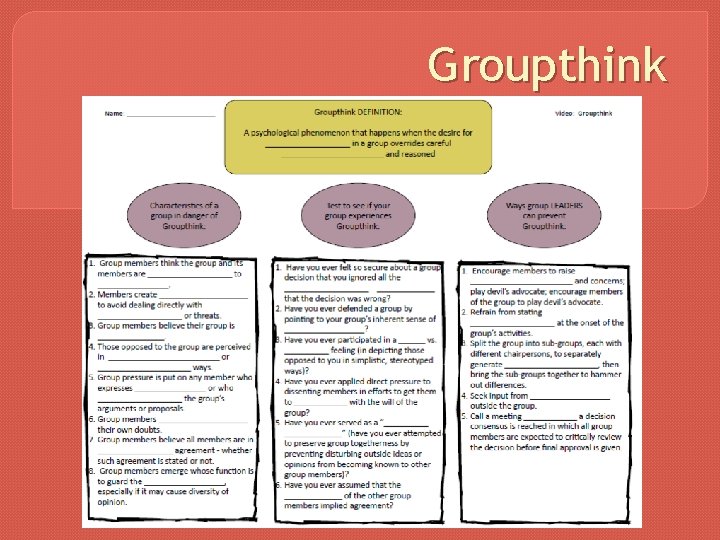
Groupthink
Groupthink ü ü ü Characteristics of a group in danger of Groupthink Test to see if your group experiences Groupthink Ways group LEADERS can prevent Groupthink https: //www. youtube. com/watch? v=L_Wt. EKb 0 BGI&feature=youtu. be

Groupthink
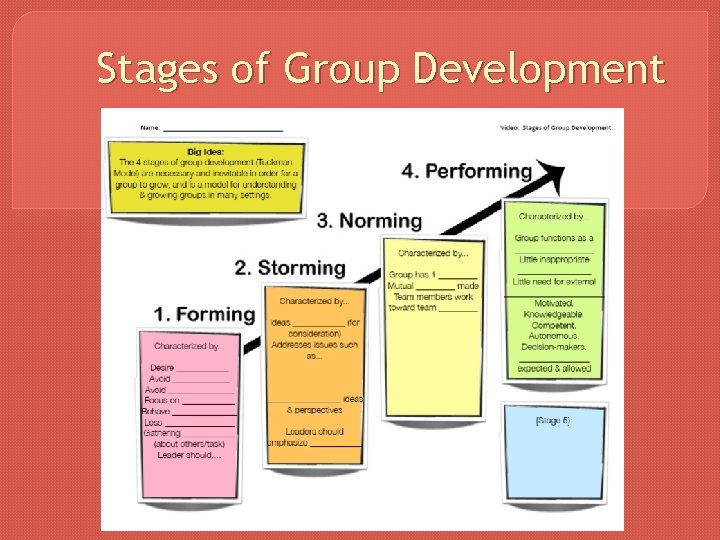
Stages of Group Development
Stages of Group Development 1. 2. 3. 4. Forming Storming Norming Performing https: //www. youtube. com/watch? v=c 3 RU 1 PYWNB 8&feature=youtu. be
Stages of Group Development

Forming, Storming, Norming, Performing
Remember the Titans: Forming, Storming, Norming, Performing 3 minutes
Remember the Titans: Forming, Storming, Norming, Performing 5 minutes
Remember the Titans: Forming, Storming, Norming, Performing 8 minutes
Leadership Styles and Committees Are great leaders born or made?
Leadership Styles and Committees
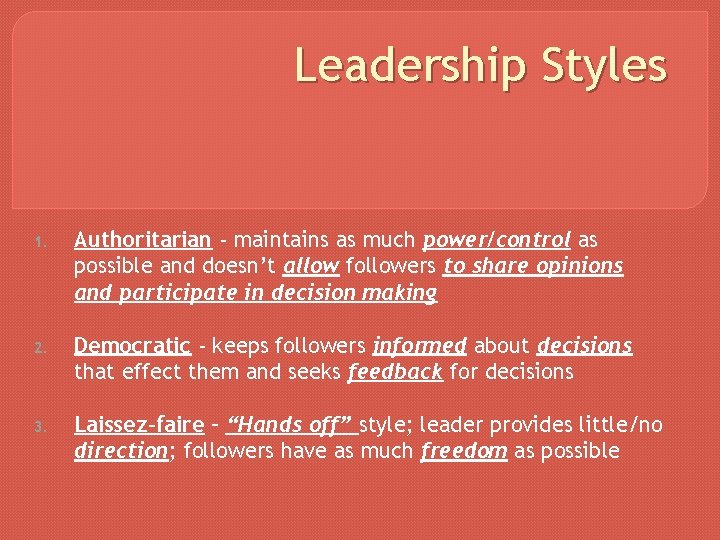
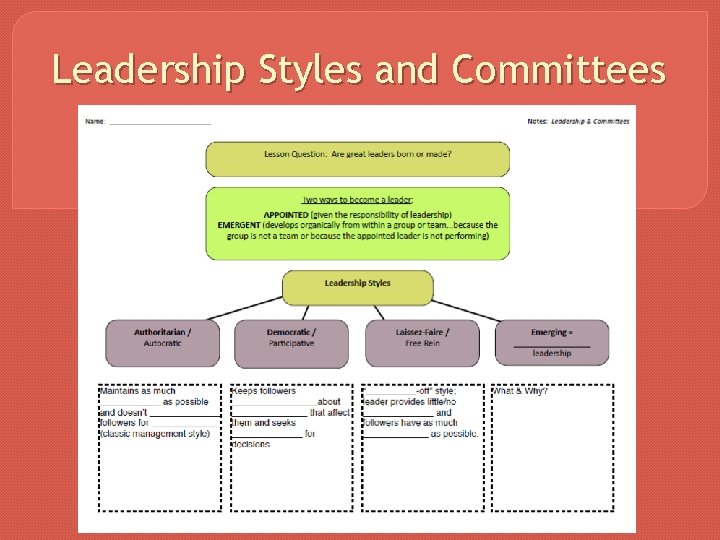
Leadership Styles 1. Authoritarian - maintains as much power/control as possible and doesn’t allow followers to share opinions and participate in decision making 2. Democratic - keeps followers informed about decisions that effect them and seeks feedback for decisions 3. Laissez-faire – “Hands off” style; leader provides little/no direction; followers have as much freedom as possible
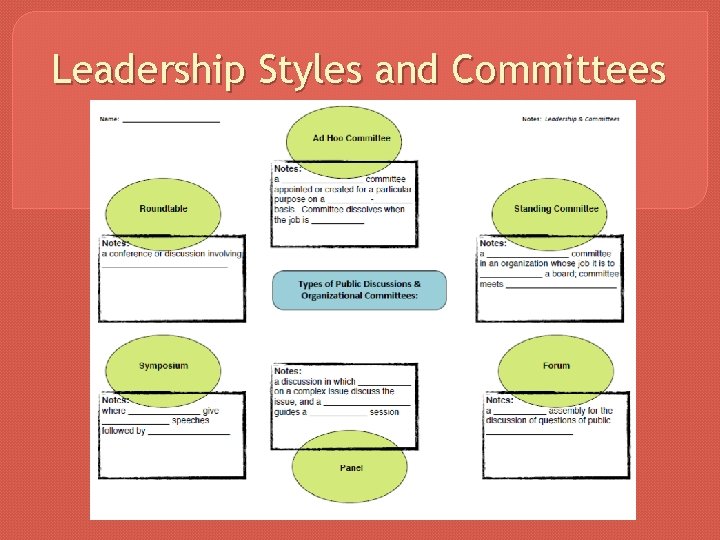
Leadership Styles and Committees
Committees ü Roundtable – a conference or discussion involving multiple participants ü Ad Hoc Committee – a temporary committee appointed or created for a particular purpose on a case by case basis. Committee dissolves when the job is completed ü Standing Committee – a permanent committee in an organization whose job it is to represent a board; committee meets once a year
Committees continued ü Forum – an open assembly for the discussion of questions of public interest ü Panel – a discussion in which people meet on a complex issue, discuss the issue, and a moderator guides a conversation session ü Symposium – where experts give informative speeches followed by discussion
John Maeda: How art, technology and design inform creative leaders The FUTURE of organizational leadership for the 21 st century is based on networking more than hierarchy http: //www. ted. com/talks/john_maeda_ how_art_technology_and_design_inform_ creative_leaders
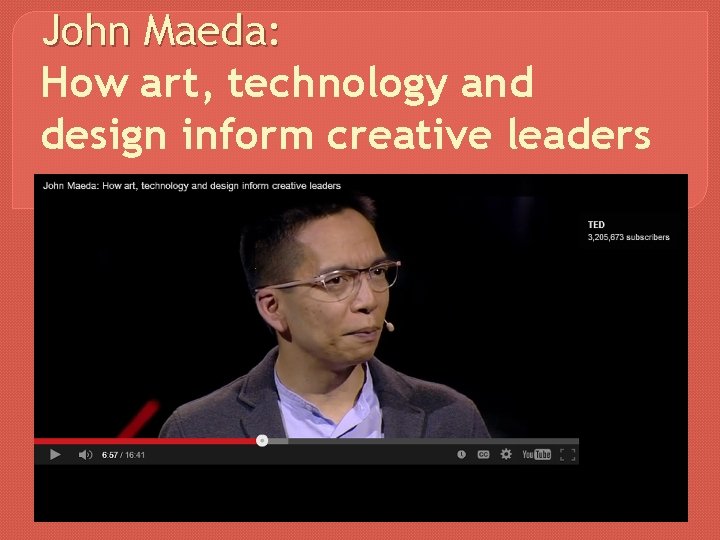
John Maeda: How art, technology and design inform creative leaders
Heterarchy Apple Google
“Finding Nemo” Group Development
- Slides: 35