
Group C Sean Isserman Chuchat Kidkul Kathy Ntalaja

- Slides: 14
Group C Sean Isserman Chuchat Kidkul Kathy Ntalaja Lin Shi
St. Louis, like many urban areas in the U. S. , has a high homicide rate while resources to manage homicides are limited. This project addresses that dilemma. There is a need for a model that can be used to predict the # and location of homicides in St. Louis city.
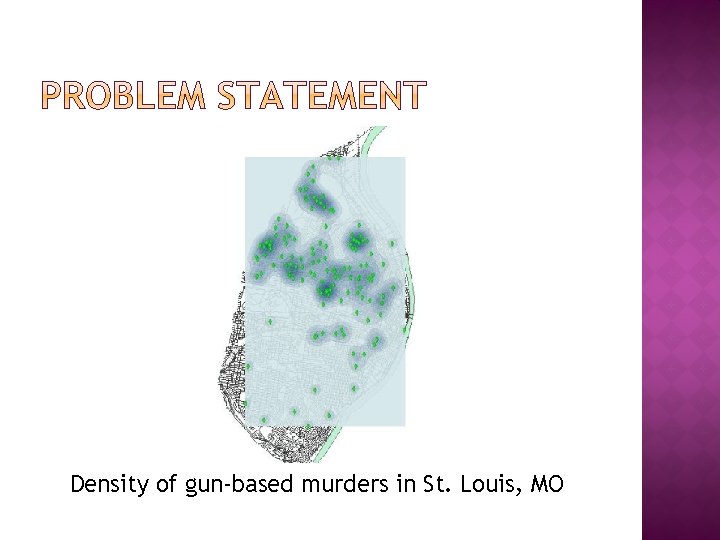
Density of gun-based murders in St. Louis, MO
Homicide as defined here includes murder and non-negligent manslaughter which is the willful killing of one human being by another. The general analyses excluded deaths caused by negligence, suicide, or accident; justifiable homicides; and attempts to murder.
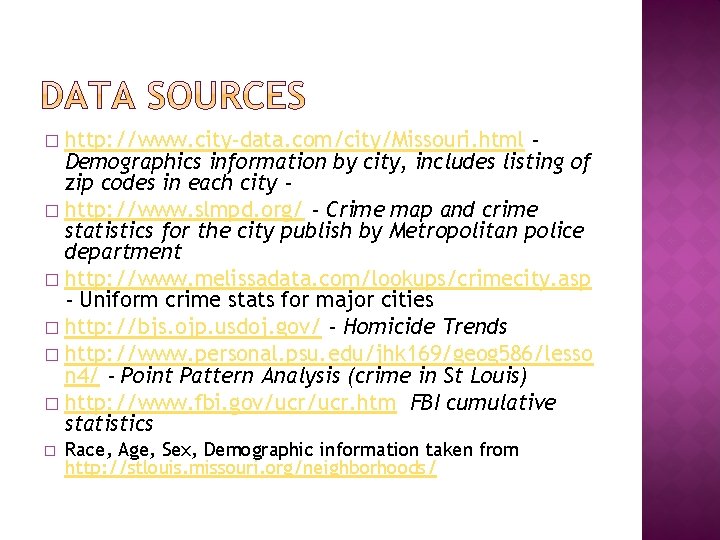
http: //www. city-data. com/city/Missouri. html Demographics information by city, includes listing of zip codes in each city � http: //www. slmpd. org/ - Crime map and crime statistics for the city publish by Metropolitan police department � http: //www. melissadata. com/lookups/crimecity. asp - Uniform crime stats for major cities � http: //bjs. ojp. usdoj. gov/ - Homicide Trends � http: //www. personal. psu. edu/jhk 169/geog 586/lesso n 4/ - Point Pattern Analysis (crime in St Louis) � http: //www. fbi. gov/ucr. htm FBI cumulative statistics � � Race, Age, Sex, Demographic information taken from http: //stlouis. missouri. org/neighborhoods/
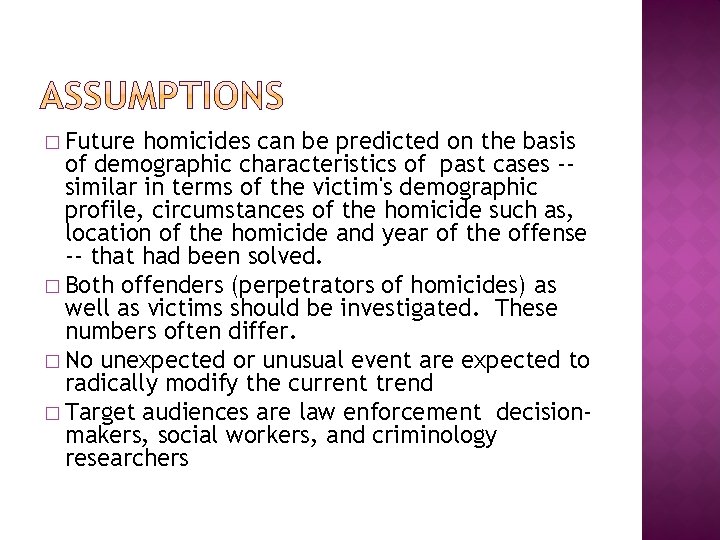
� Future homicides can be predicted on the basis of demographic characteristics of past cases -similar in terms of the victim's demographic profile, circumstances of the homicide such as, location of the homicide and year of the offense -- that had been solved. � Both offenders (perpetrators of homicides) as well as victims should be investigated. These numbers often differ. � No unexpected or unusual event are expected to radically modify the current trend � Target audiences are law enforcement decisionmakers, social workers, and criminology researchers
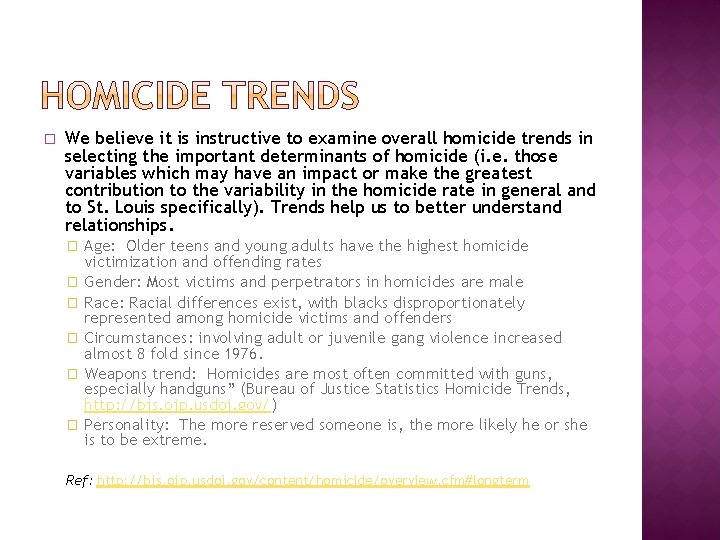
� We believe it is instructive to examine overall homicide trends in selecting the important determinants of homicide (i. e. those variables which may have an impact or make the greatest contribution to the variability in the homicide rate in general and to St. Louis specifically). Trends help us to better understand relationships. Age: Older teens and young adults have the highest homicide victimization and offending rates � Gender: Most victims and perpetrators in homicides are male � Race: Racial differences exist, with blacks disproportionately represented among homicide victims and offenders � Circumstances: involving adult or juvenile gang violence increased almost 8 fold since 1976. � Weapons trend: Homicides are most often committed with guns, especially handguns” (Bureau of Justice Statistics Homicide Trends, http: //bjs. ojp. usdoj. gov/) � Personality: The more reserved someone is, the more likely he or she is to be extreme. � Ref: http: //bjs. ojp. usdoj. gov/content/homicide/overview. cfm#longterm
� Using website data (neighborhood, year, # murders, assault with handguns) from 2005 - 2009 we graphically display the # of murders by neighborhood. � Why neighborhood? Useful to local law enforcement Further localize the data points � Our data captures 2 of the major trends previously cited as important: neighborhood (race, gender, age) and weapons (handgun assaults) � Do the crime occur because they are in a certain neighborhood or do race, gender, age play a role in the increased homicides? � Both neighborhood and assault with handguns appear to be positively correlated with # murders.
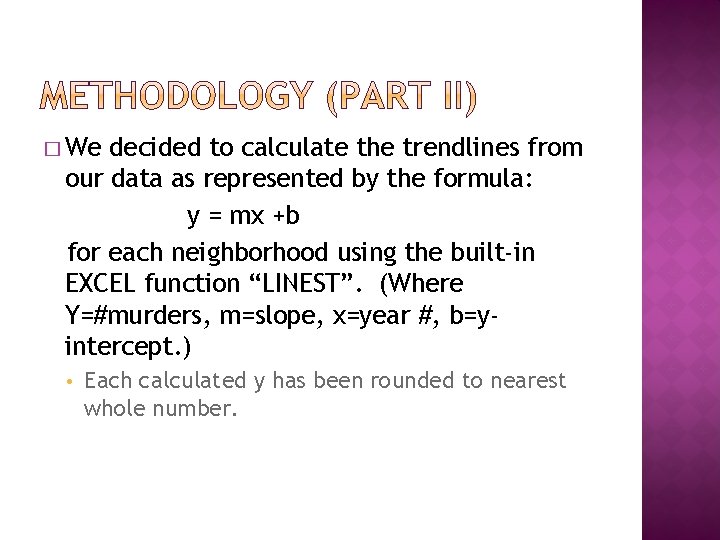
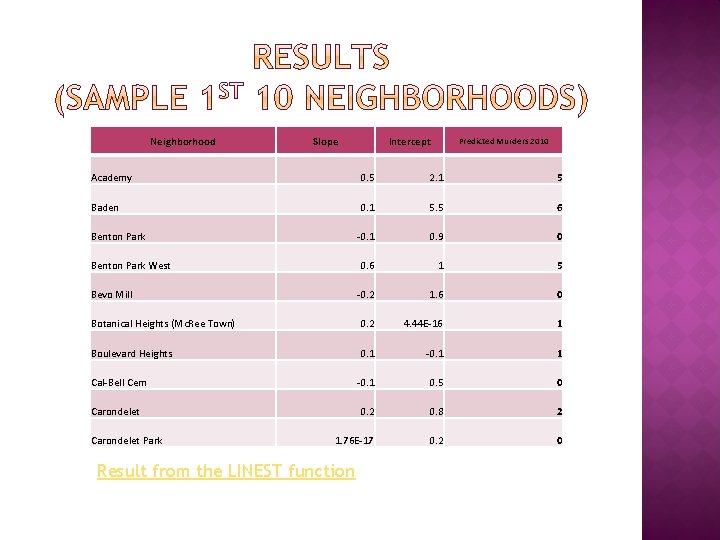
� We decided to calculate the trendlines from our data as represented by the formula: y = mx +b for each neighborhood using the built-in EXCEL function “LINEST”. (Where Y=#murders, m=slope, x=year #, b=yintercept. ) • Each calculated y has been rounded to nearest whole number.
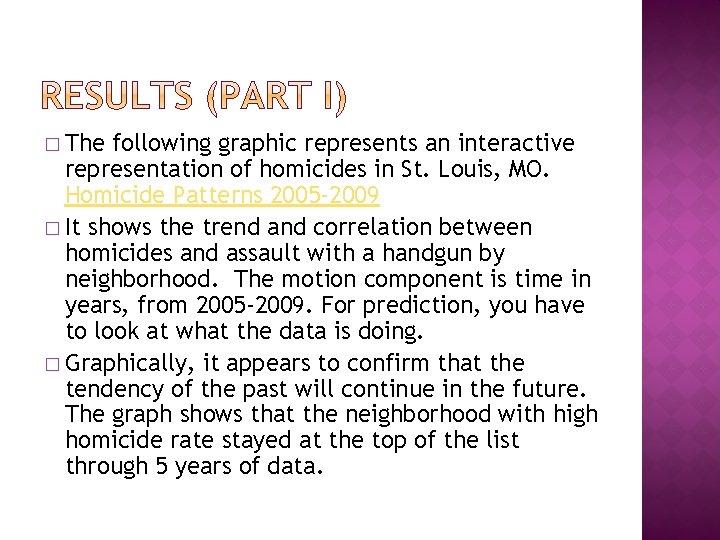
� The following graphic represents an interactive representation of homicides in St. Louis, MO. Homicide Patterns 2005 -2009 � It shows the trend and correlation between homicides and assault with a handgun by neighborhood. The motion component is time in years, from 2005 -2009. For prediction, you have to look at what the data is doing. � Graphically, it appears to confirm that the tendency of the past will continue in the future. The graph shows that the neighborhood with high homicide rate stayed at the top of the list through 5 years of data.
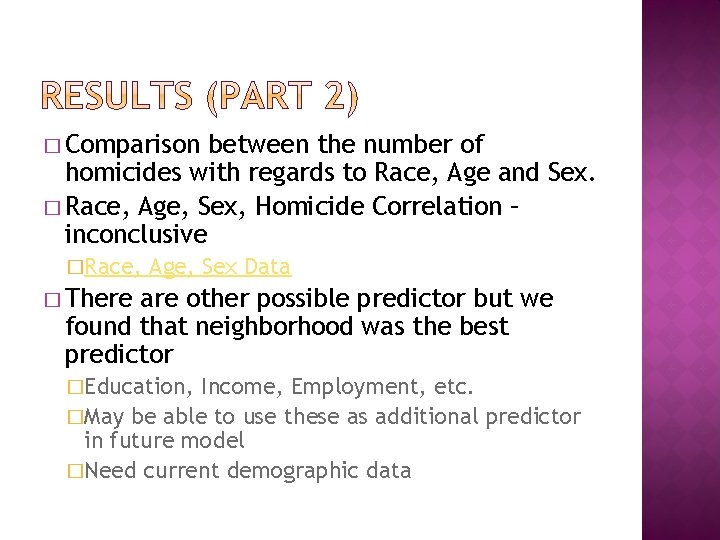
� Comparison between the number of homicides with regards to Race, Age and Sex. � Race, Age, Sex, Homicide Correlation – inconclusive �Race, Age, Sex Data � There are other possible predictor but we found that neighborhood was the best predictor �Education, Income, Employment, etc. �May be able to use these as additional predictor in future model �Need current demographic data
Neighborhood Slope Intercept Predicted Murders 2010 Academy 0. 5 2. 1 5 Baden 0. 1 5. 5 6 -0. 1 0. 9 0 0. 6 1 5 -0. 2 1. 6 0 Botanical Heights (Mc. Ree Town) 0. 2 4. 44 E-16 1 Boulevard Heights 0. 1 -0. 1 0. 5 0 0. 2 0. 8 2 1. 76 E-17 0. 2 0 Benton Park West Bevo Mill Cal-Bell Cem Carondelet Park Result from the LINEST function
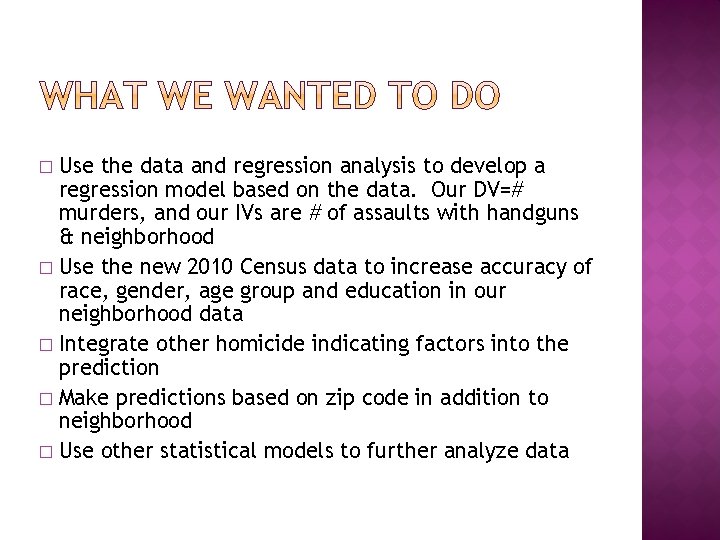
Use the data and regression analysis to develop a regression model based on the data. Our DV=# murders, and our IVs are # of assaults with handguns & neighborhood � Use the new 2010 Census data to increase accuracy of race, gender, age group and education in our neighborhood data � Integrate other homicide indicating factors into the prediction � Make predictions based on zip code in addition to neighborhood � Use other statistical models to further analyze data �
The model presented can be used to provide information to decision makers (St. Louis Chief of Police and his collaborators) that could help them make better resource allocation decisions.