
Group Assessment of Logical Thinking Roadrangka et al
- Slides: 11
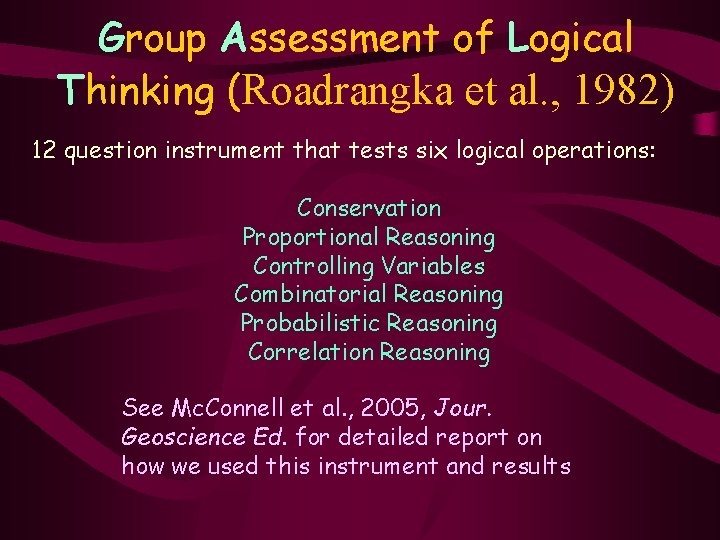
Group Assessment of Logical Thinking (Roadrangka et al. , 1982) 12 question instrument that tests six logical operations: Conservation Proportional Reasoning Controlling Variables Combinatorial Reasoning Probabilistic Reasoning Correlation Reasoning See Mc. Connell et al. , 2005, Jour. Geoscience Ed. for detailed report on how we used this instrument and results
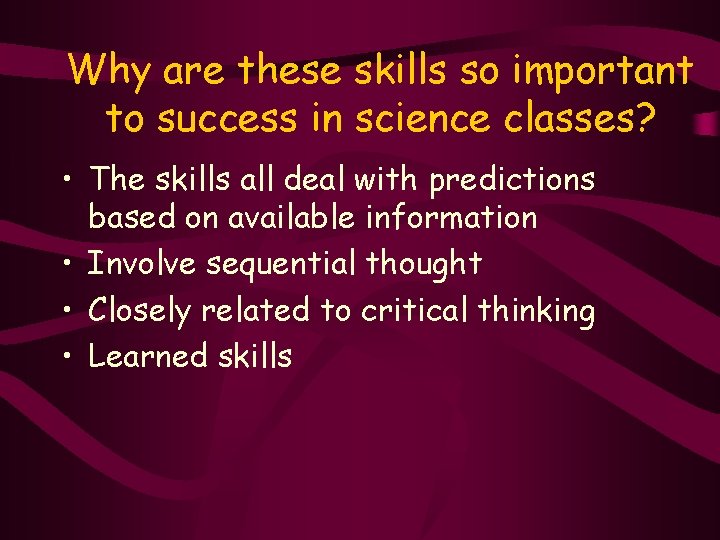
Why are these skills so important to success in science classes? • The skills all deal with predictions based on available information • Involve sequential thought • Closely related to critical thinking • Learned skills
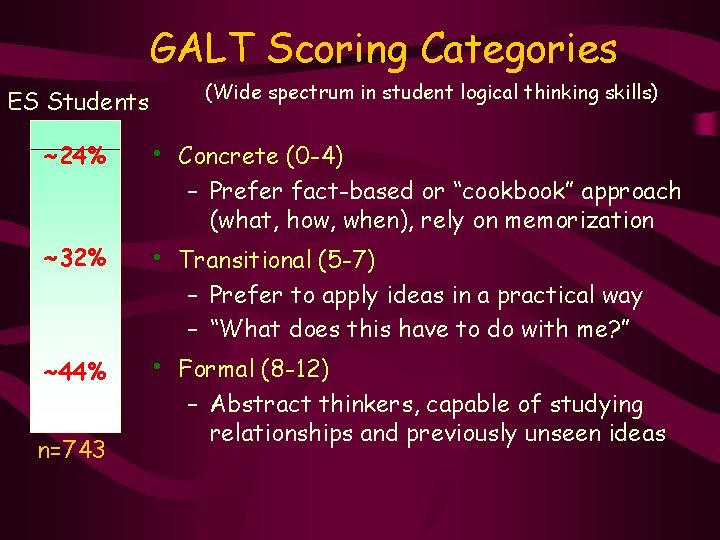
GALT Scoring Categories ES Students ~24% (Wide spectrum in student logical thinking skills) • Concrete (0 -4) – Prefer fact-based or “cookbook” approach (what, how, when), rely on memorization ~32% • Transitional (5 -7) – Prefer to apply ideas in a practical way – “What does this have to do with me? ” ~44% n=743 • Formal (8 -12) – Abstract thinkers, capable of studying relationships and previously unseen ideas
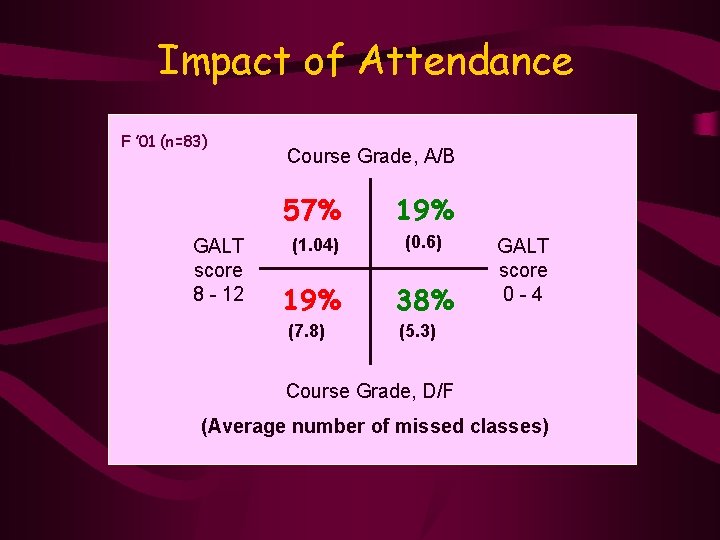
Impact of Attendance F ’ 01 (n=83) GALT score 8 - 12 Course Grade, A/B 57% 19% (1. 04) (0. 6) 19% 38% (7. 8) GALT score 0 -4 (5. 3) Course Grade, D/F (Average number of missed classes)
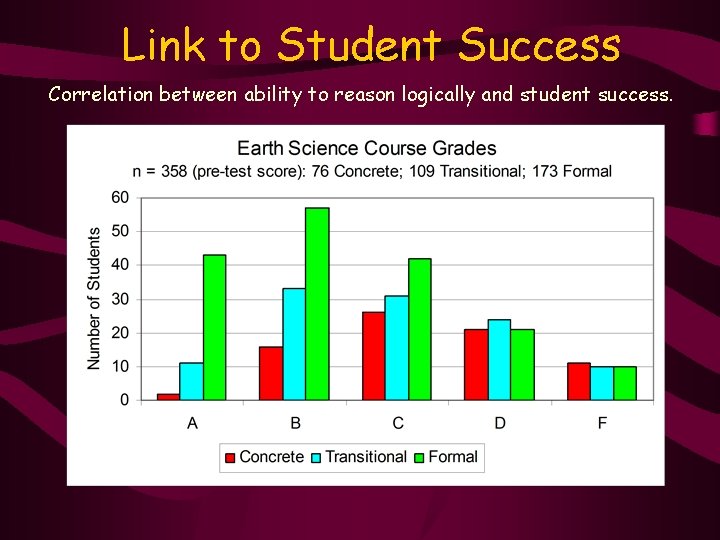
Link to Student Success Correlation between ability to reason logically and student success.
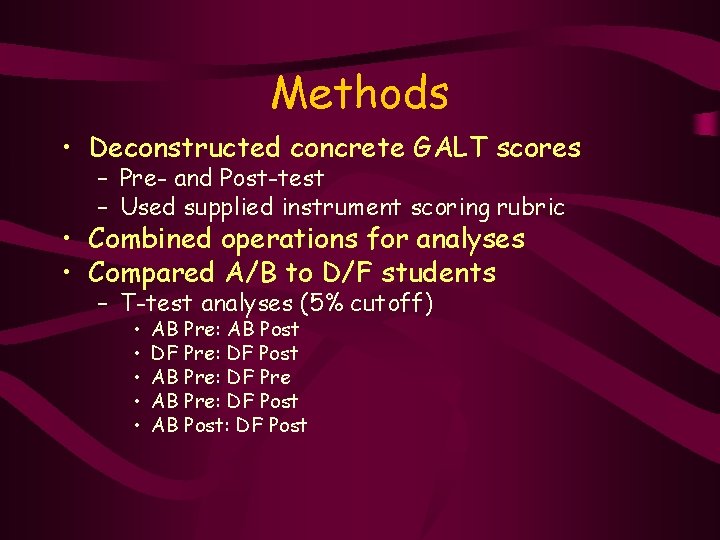
Methods • Deconstructed concrete GALT scores – Pre- and Post-test – Used supplied instrument scoring rubric • Combined operations for analyses • Compared A/B to D/F students – T-test analyses (5% cutoff) • • • AB Pre: AB Post DF Pre: DF Post AB Pre: DF Pre AB Pre: DF Post AB Post: DF Post
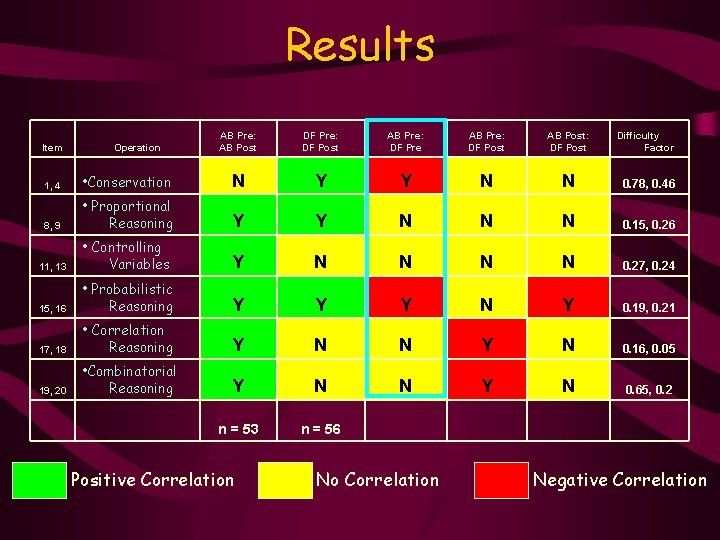
Results Item Operation AB Pre: AB Post DF Pre: DF Post AB Pre: DF Pre AB Pre: DF Post AB Post: DF Post Difficulty Factor 1, 4 • Conservation N Y Y N N 0. 78, 0. 46 8, 9 • Proportional Reasoning Y Y N N N 0. 15, 0. 26 11, 13 • Controlling Variables Y N N 0. 27, 0. 24 15, 16 • Probabilistic Reasoning Y Y Y N Y 0. 19, 0. 21 17, 18 • Correlation Reasoning Y N N Y N 0. 16, 0. 05 19, 20 • Combinatorial Reasoning Y N N Y N 0. 65, 0. 2 n = 53 n = 56 Positive Correlation No Correlation Negative Correlation
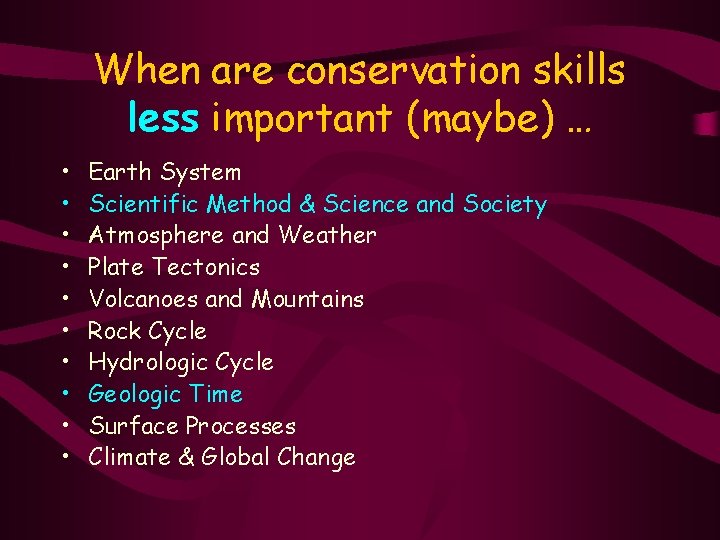
When are conservation skills less important (maybe) … • • • Earth System Scientific Method & Science and Society Atmosphere and Weather Plate Tectonics Volcanoes and Mountains Rock Cycle Hydrologic Cycle Geologic Time Surface Processes Climate & Global Change
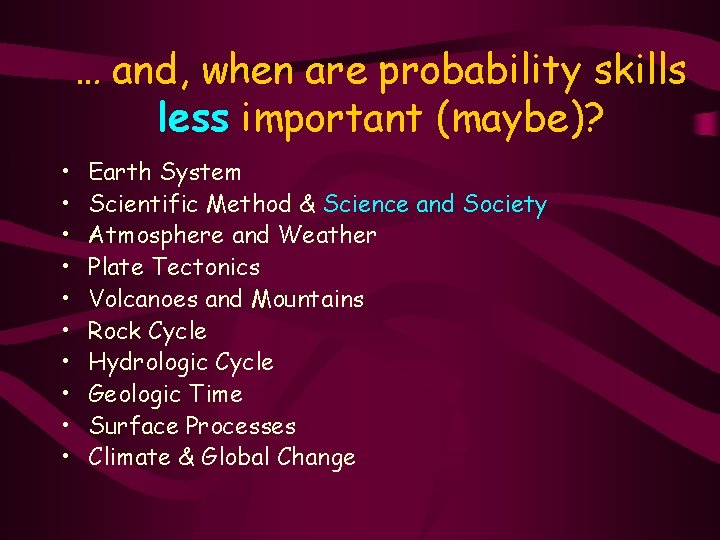
… and, when are probability skills less important (maybe)? • • • Earth System Scientific Method & Science and Society Atmosphere and Weather Plate Tectonics Volcanoes and Mountains Rock Cycle Hydrologic Cycle Geologic Time Surface Processes Climate & Global Change
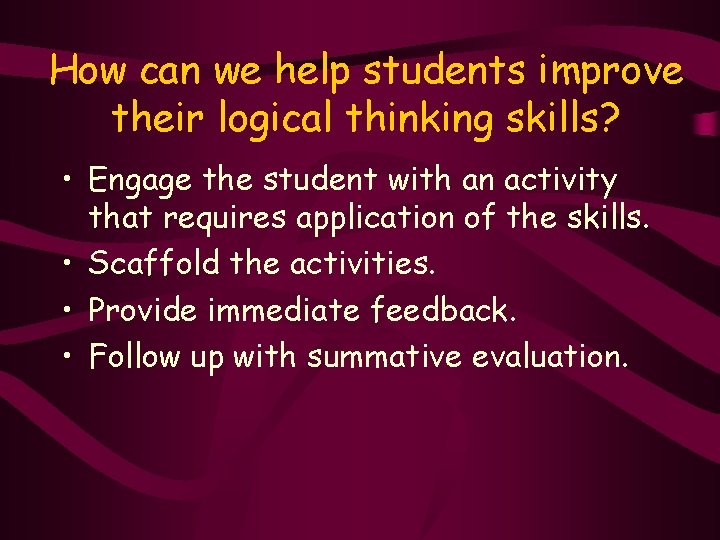
How can we help students improve their logical thinking skills? • Engage the student with an activity that requires application of the skills. • Scaffold the activities. • Provide immediate feedback. • Follow up with summative evaluation.
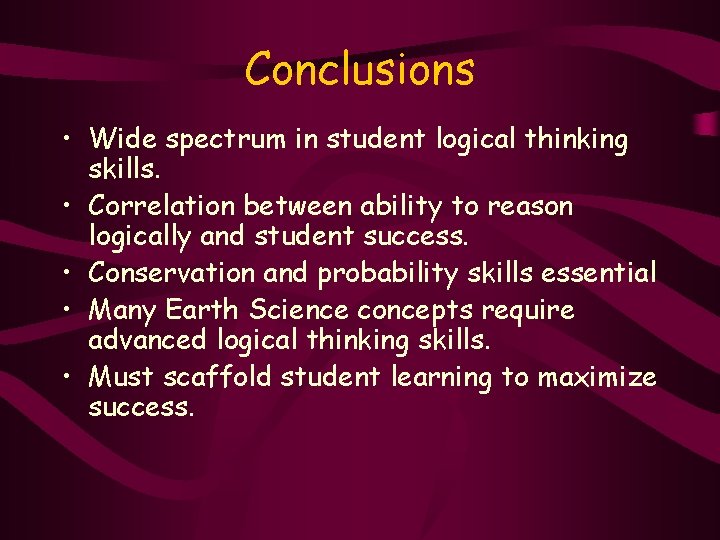
Conclusions • Wide spectrum in student logical thinking skills. • Correlation between ability to reason logically and student success. • Conservation and probability skills essential • Many Earth Science concepts require advanced logical thinking skills. • Must scaffold student learning to maximize success.