
Group 7 Reactions of Halogens and Halides Disproportionation




- Slides: 10
Group 7 Reactions of Halogens and Halides
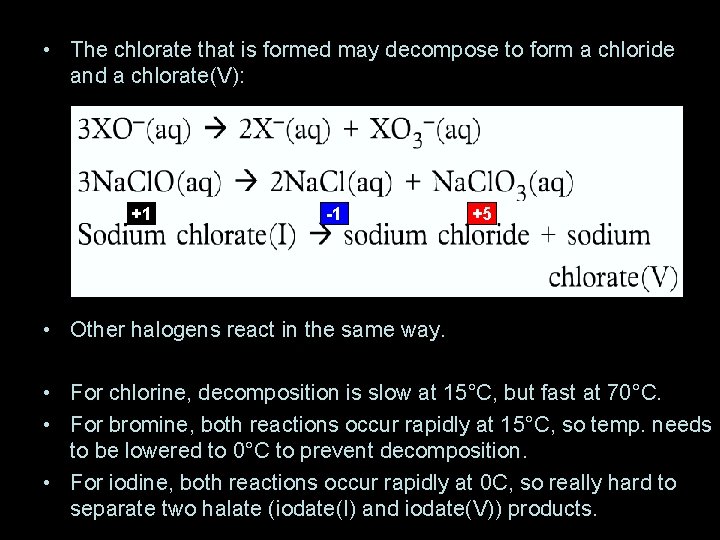
Disproportionation • What is this? • Chlorine reacts with cold (15°C) dilute alkalis to give chloride and chlorate(I) ions formed: • So reaction between chlorine and sodium hydroxide? 0 -1 +1
• The chlorate that is formed may decompose to form a chloride and a chlorate(V): +1 -1 +5 • Other halogens react in the same way. • For chlorine, decomposition is slow at 15°C, but fast at 70°C. • For bromine, both reactions occur rapidly at 15°C, so temp. needs to be lowered to 0°C to prevent decomposition. • For iodine, both reactions occur rapidly at 0 C, so really hard to separate two halate (iodate(I) and iodate(V)) products.
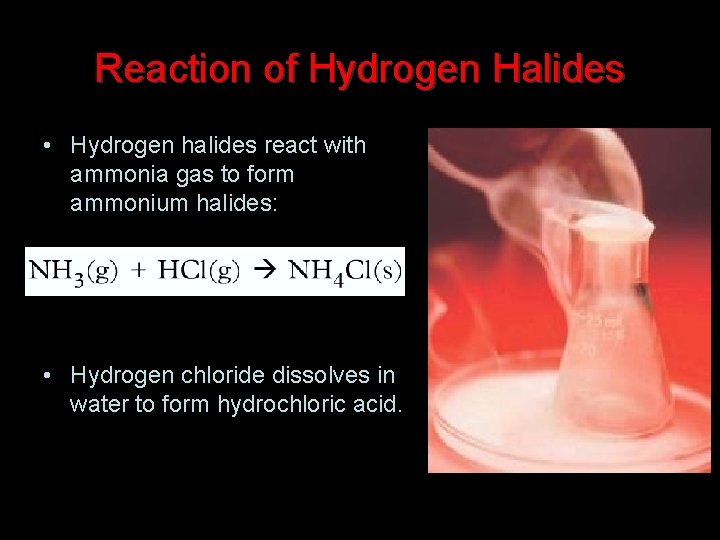
Reaction of Hydrogen Halides • Hydrogen halides react with ammonia gas to form ammonium halides: • Hydrogen chloride dissolves in water to form hydrochloric acid.
Displacement (Redox) Reactions • Potassium halides react with other halogens: • What gets reduced and what gets oxidised?
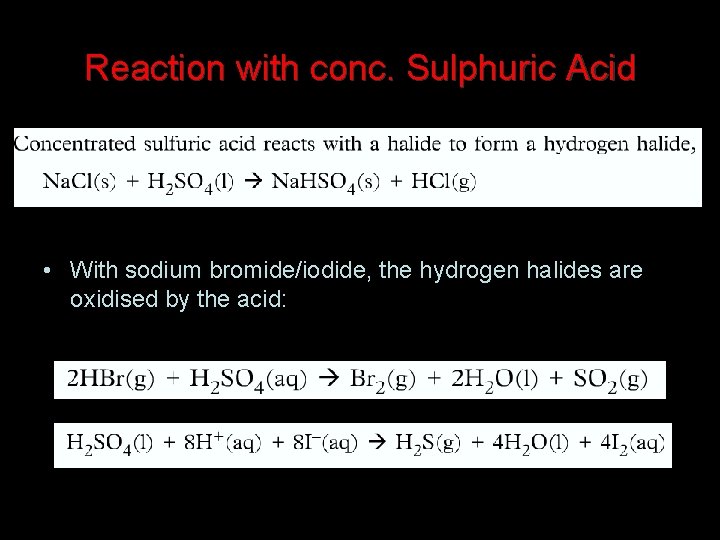
Reaction with conc. Sulphuric Acid • With sodium bromide/iodide, the hydrogen halides are oxidised by the acid:
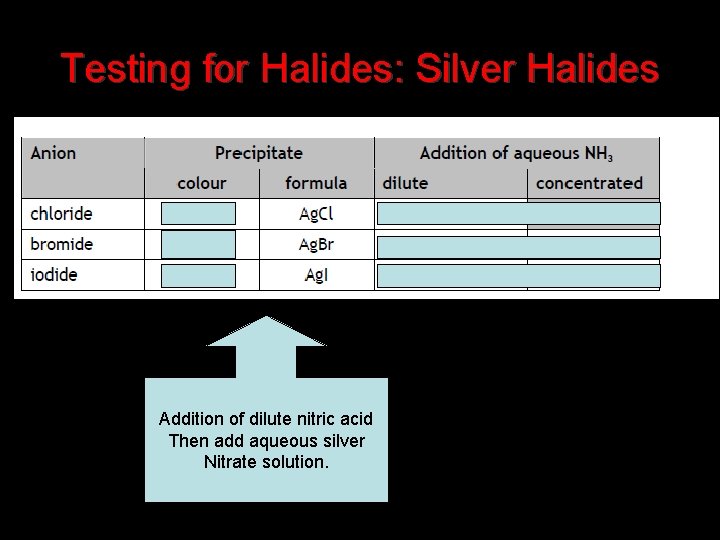
Testing for Halides: Silver Halides Addition of dilute nitric acid Then add aqueous silver Nitrate solution.
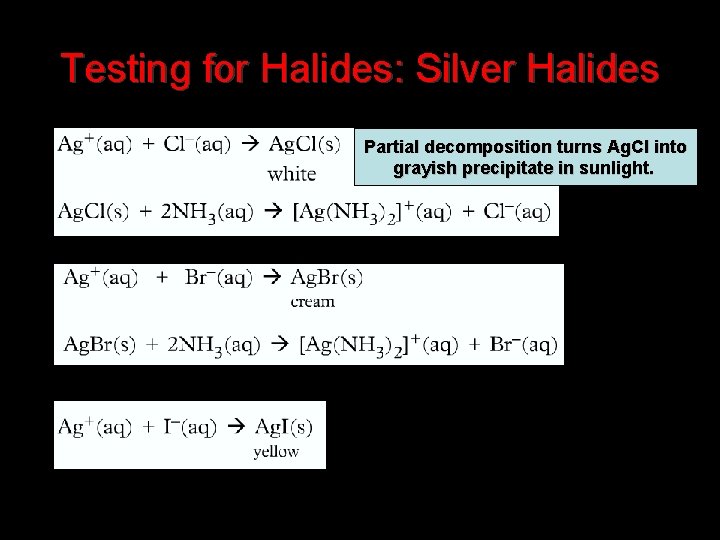
Testing for Halides: Silver Halides Partial decomposition turns Ag. Cl into grayish precipitate in sunlight.
Questions