
Group 7 Reactions and Compounds 30 October 2021
Group 7 Reactions and Compounds 30 October 2021
Reactions of the halogens and halogen compounds Objectives: • understand, in terms of changes in oxidation number, the following reactions of the halogens: oxidation reactions with Group 1 and 2 metals Understand the following reactions: • solid Group 1 halides with concentrated sulfuric acid, to illustrate the trend in reducing ability of the hydrogen halides • precipitation reactions of the aqueous anions Cl–, Br– and I– with aqueous silver nitrate solution, followed by aqueous ammonia solution • hydrogen halides with ammonia and with water (to produce acids)

• Practical

Testing for halide ions A further test involves adding aqueous ammonia, NH 3 (aq). Ag. Cl is soluble in dilute NH 3 (aq) Ag. Br is soluble in concentrated NH 3 (aq) Ag. I is insoluble in concentrated NH 3(aq)
Theory First fluorine videos
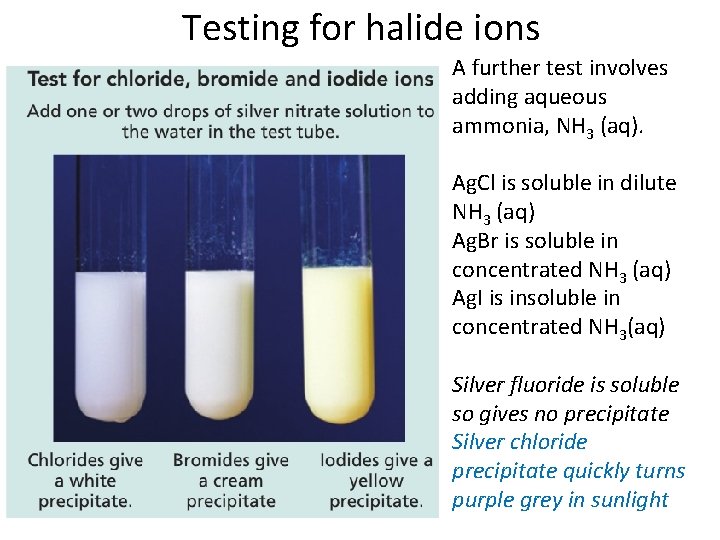
Testing for halide ions A further test involves adding aqueous ammonia, NH 3 (aq). Ag. Cl is soluble in dilute NH 3 (aq) Ag. Br is soluble in concentrated NH 3 (aq) Ag. I is insoluble in concentrated NH 3(aq) Silver fluoride is soluble so gives no precipitate Silver chloride precipitate quickly turns purple grey in sunlight
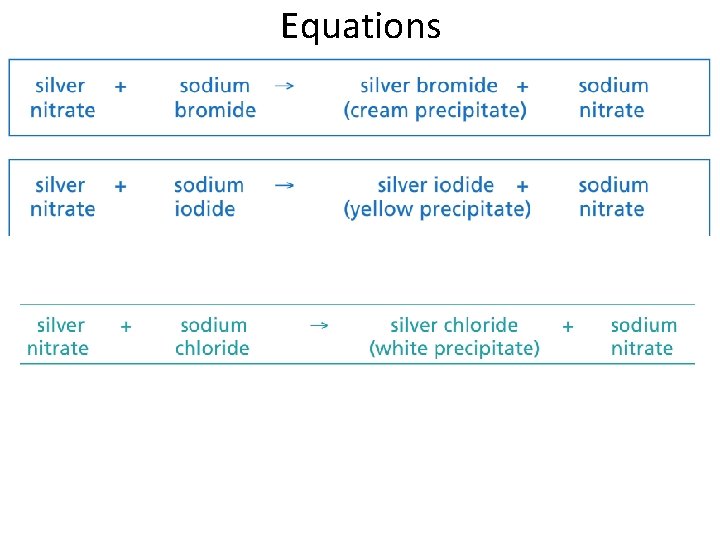
Equations
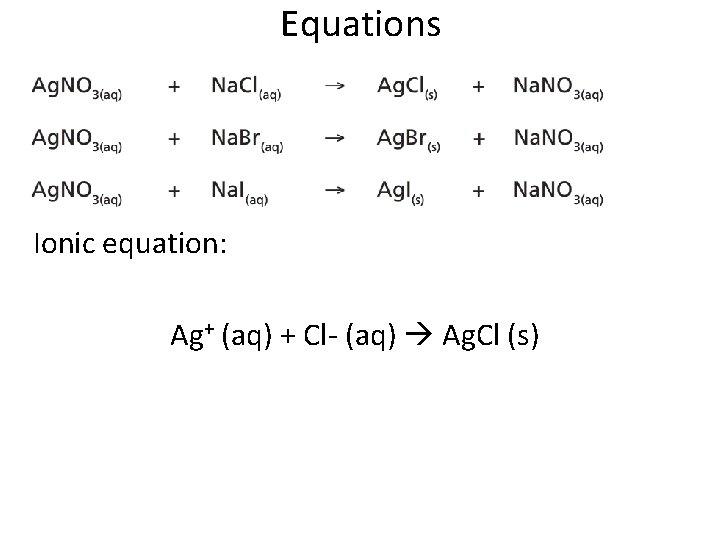
Equations Ionic equation: Ag+ (aq) + Cl- (aq) Ag. Cl (s)
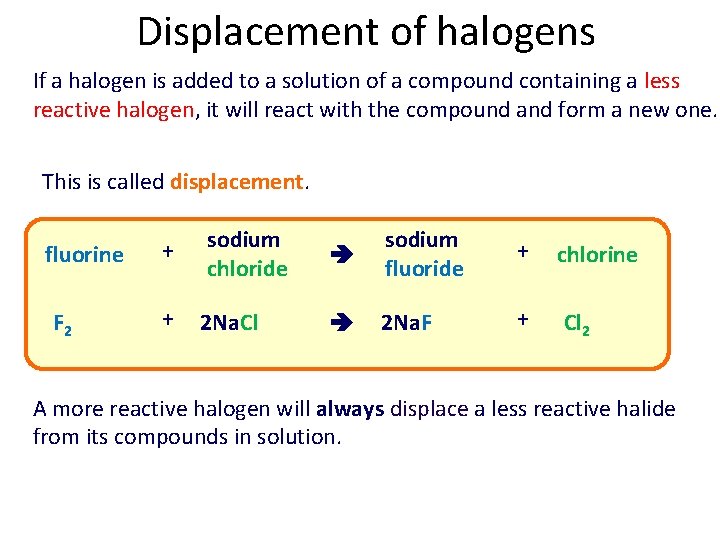
Displacement of halogens If a halogen is added to a solution of a compound containing a less reactive halogen, it will react with the compound and form a new one. This is called displacement. fluorine F 2 + sodium chloride + 2 Na. Cl sodium fluoride + chlorine 2 Na. F + Cl 2 A more reactive halogen will always displace a less reactive halide from its compounds in solution.

Displacement reactions: summary The reactions between solutions of halogens and metal halides (salts) can be summarised in a table: salt halogen potassium chloride chlorine potassium bromide 2 KCl + Br 2 bromine no reaction iodine no reaction potassium iodide 2 KCl + I 2 2 KBr + I 2 no reaction
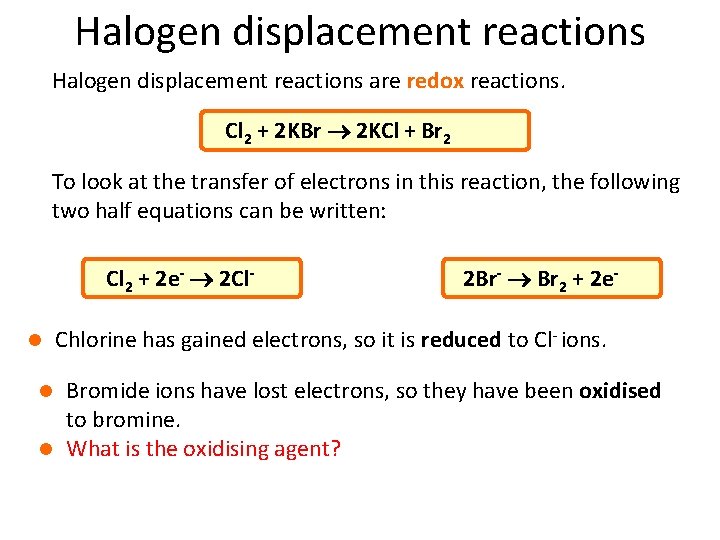
Halogen displacement reactions are redox reactions. Cl 2 + 2 KBr 2 KCl + Br 2 To look at the transfer of electrons in this reaction, the following two half equations can be written: Cl 2 + 2 e- 2 Cll 2 Br- Br 2 + 2 e- Chlorine has gained electrons, so it is reduced to Cl- ions. Bromide ions have lost electrons, so they have been oxidised to bromine. l What is the oxidising agent? l
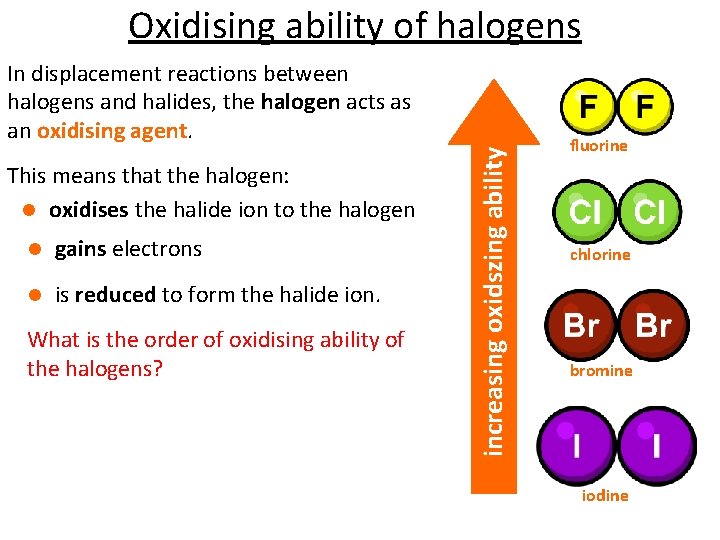
Oxidising ability of halogens This means that the halogen: l oxidises the halide ion to the halogen l gains electrons l is reduced to form the halide ion. What is the order of oxidising ability of the halogens? increasing oxidszing ability In displacement reactions between halogens and halides, the halogen acts as an oxidising agent. fluorine chlorine bromine iodine
Reactions of the halogens and halogen compounds Objectives: • understand, in terms of changes in oxidation number, the following reactions of the halogens: oxidation reactions with Group 1 and 2 metals Understand the following reactions: • solid Group 1 halides with concentrated sulfuric acid, to illustrate the trend in reducing ability of the hydrogen halides • precipitation reactions of the aqueous anions Cl–, Br– and I– with aqueous silver nitrate solution, followed by aqueous ammonia solution • hydrogen halides with ammonia and with water (to produce acids)
Reaction with group 1 and 2 metals Chlorine and bromine react with s block metals to form ionic halides. Iodine also reacts but because of the polarisability of the large iodide ion if it’s reacting with a small or highly charged cation it is essentially covalent.
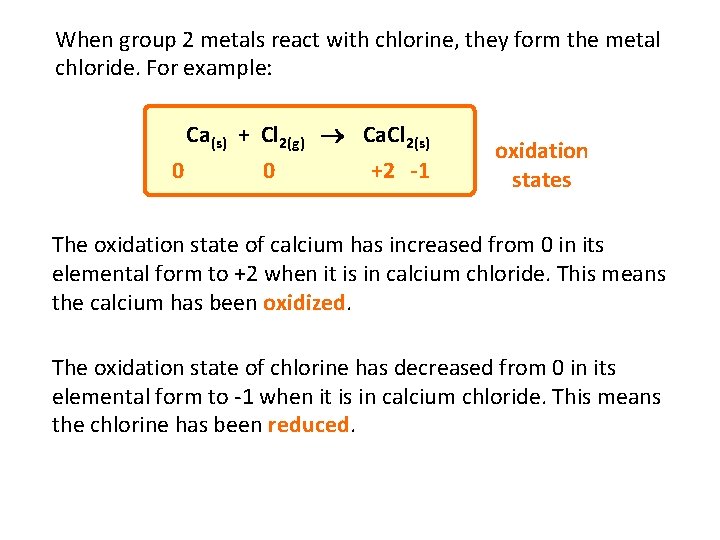
When group 2 metals react with chlorine, they form the metal chloride. For example: Ca(s) + Cl 2(g) Ca. Cl 2(s) 0 0 +2 -1 oxidation states The oxidation state of calcium has increased from 0 in its elemental form to +2 when it is in calcium chloride. This means the calcium has been oxidized. The oxidation state of chlorine has decreased from 0 in its elemental form to -1 when it is in calcium chloride. This means the chlorine has been reduced.
What about group 1?
Reactions of the halogens and halogen compounds Objectives: • understand, in terms of changes in oxidation number, the following reactions of the halogens: oxidation reactions with Group 1 and 2 metals Understand the following reactions: • solid Group 1 halides with concentrated sulfuric acid, to illustrate the trend in reducing ability of the hydrogen halides • precipitation reactions of the aqueous anions Cl–, Br– and I– with aqueous silver nitrate solution, followed by aqueous ammonia solution • hydrogen halides with ammonia and with water (to produce acids)
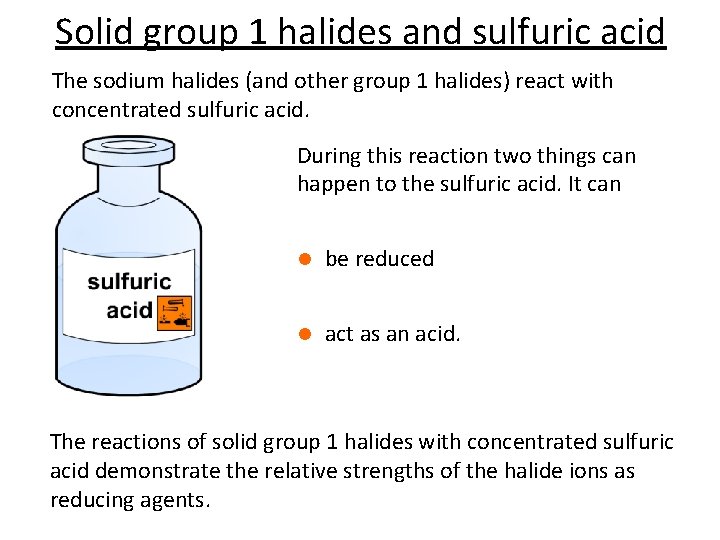
Solid group 1 halides and sulfuric acid The sodium halides (and other group 1 halides) react with concentrated sulfuric acid. During this reaction two things can happen to the sulfuric acid. It can l be reduced l act as an acid. The reactions of solid group 1 halides with concentrated sulfuric acid demonstrate the relative strengths of the halide ions as reducing agents.
• • Summary Fluoride and chloride ions won't reduce concentrated sulphuric acid. Bromide ions reduce the sulphuric acid to sulphur dioxide. In the process, the bromide ions are oxidised to bromine. Iodide ions reduce the sulphuric acid to a mixture of products including hydrogen sulphide. The iodide ions are oxidised to iodine. Reducing ability of the halide ions increases as you go down the Group.

Examples
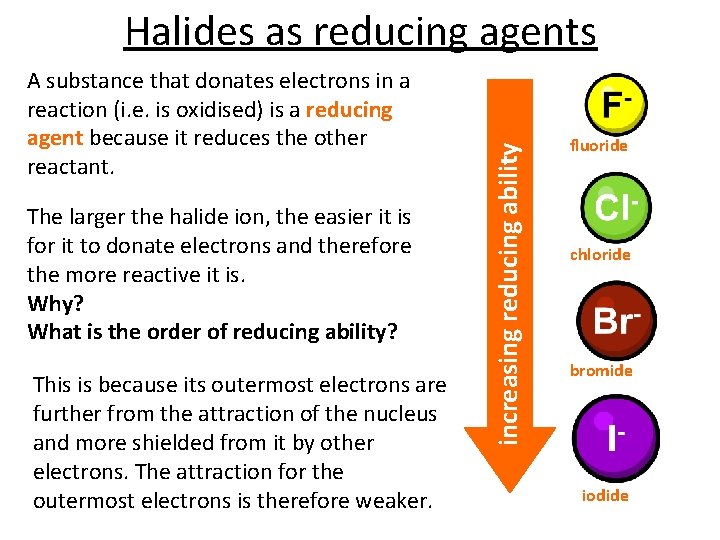
A substance that donates electrons in a reaction (i. e. is oxidised) is a reducing agent because it reduces the other reactant. The larger the halide ion, the easier it is for it to donate electrons and therefore the more reactive it is. Why? What is the order of reducing ability? This is because its outermost electrons are further from the attraction of the nucleus and more shielded from it by other electrons. The attraction for the outermost electrons is therefore weaker. increasing reducing ability Halides as reducing agents fluoride chloride bromide iodide
Reactions of the halogens and halogen compounds Objectives: • understand, in terms of changes in oxidation number, the following reactions of the halogens: oxidation reactions with Group 1 and 2 metals Understand the following reactions: • solid Group 1 halides with concentrated sulfuric acid, to illustrate the trend in reducing ability of the hydrogen halides • precipitation reactions of the aqueous anions Cl–, Br– and I– with aqueous silver nitrate solution, followed by aqueous ammonia solution • hydrogen halides with ammonia and with water (to produce acids)
Hydrogen Halides • Compounds of hydrogen with the halogens • All colourless, molecular compounds • Have general formula HX (where X is a halogen) • Contain polar bonds
Hydrogen Halides Reactions With Water Hydrogen chloride, hydrogen bromide and hydrogen iodide are similar in that they are: • Colourless gases at room temp and fume in moist air • Very soluble in water, forming acidic solutions which ionise completely in water • Strong acids, so they ionise completely in water
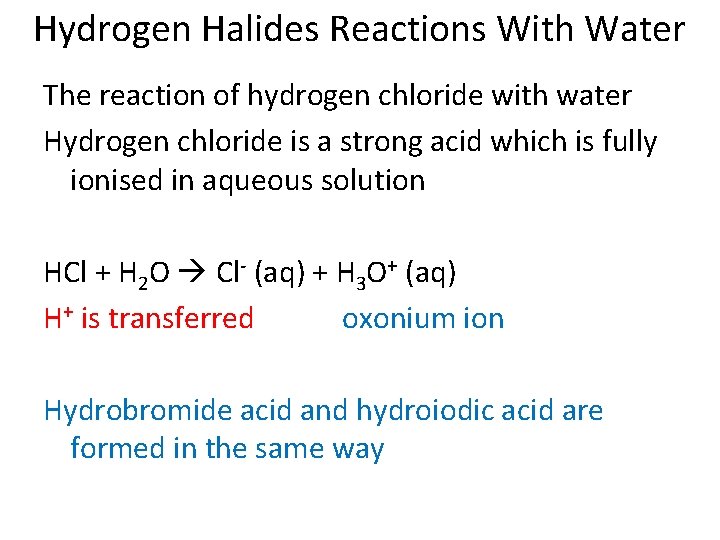
Hydrogen Halides Reactions With Water The reaction of hydrogen chloride with water Hydrogen chloride is a strong acid which is fully ionised in aqueous solution HCl + H 2 O Cl- (aq) + H 3 O+ (aq) H+ is transferred oxonium ion Hydrobromide acid and hydroiodic acid are formed in the same way
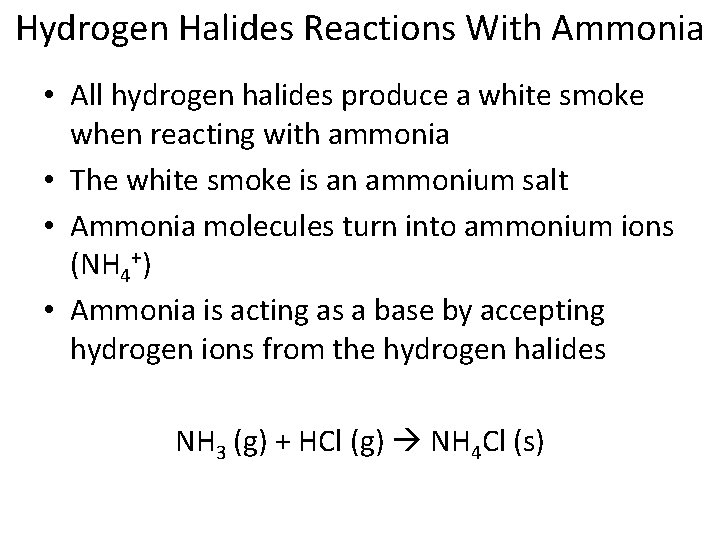
Hydrogen Halides Reactions With Ammonia • All hydrogen halides produce a white smoke when reacting with ammonia • The white smoke is an ammonium salt • Ammonia molecules turn into ammonium ions (NH 4+) • Ammonia is acting as a base by accepting hydrogen ions from the hydrogen halides NH 3 (g) + HCl (g) NH 4 Cl (s)
Reactions of the halogens and halogen compounds Objectives: • understand, in terms of changes in oxidation number, the following reactions of the halogens: oxidation reactions with Group 1 and 2 metals Understand the following reactions: • solid Group 1 halides with concentrated sulfuric acid, to illustrate the trend in reducing ability of the hydrogen halides • precipitation reactions of the aqueous anions Cl–, Br– and I– with aqueous silver nitrate solution, followed by aqueous ammonia solution • hydrogen halides with ammonia and with water (to produce acids)
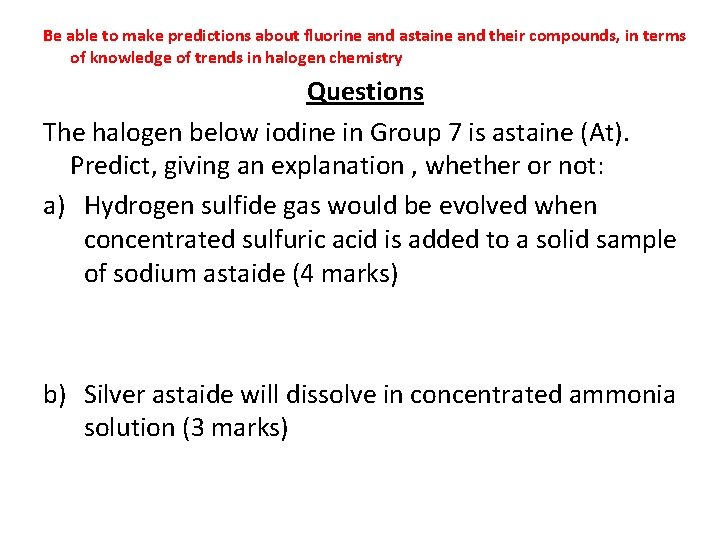
Be able to make predictions about fluorine and astaine and their compounds, in terms of knowledge of trends in halogen chemistry Questions The halogen below iodine in Group 7 is astaine (At). Predict, giving an explanation , whether or not: a) Hydrogen sulfide gas would be evolved when concentrated sulfuric acid is added to a solid sample of sodium astaide (4 marks) b) Silver astaide will dissolve in concentrated ammonia solution (3 marks)
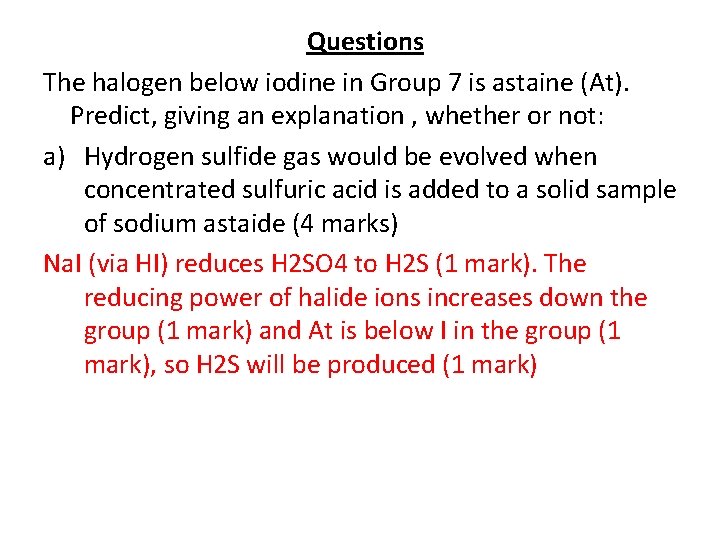
Questions The halogen below iodine in Group 7 is astaine (At). Predict, giving an explanation , whether or not: a) Hydrogen sulfide gas would be evolved when concentrated sulfuric acid is added to a solid sample of sodium astaide (4 marks) Na. I (via HI) reduces H 2 SO 4 to H 2 S (1 mark). The reducing power of halide ions increases down the group (1 mark) and At is below I in the group (1 mark), so H 2 S will be produced (1 mark)
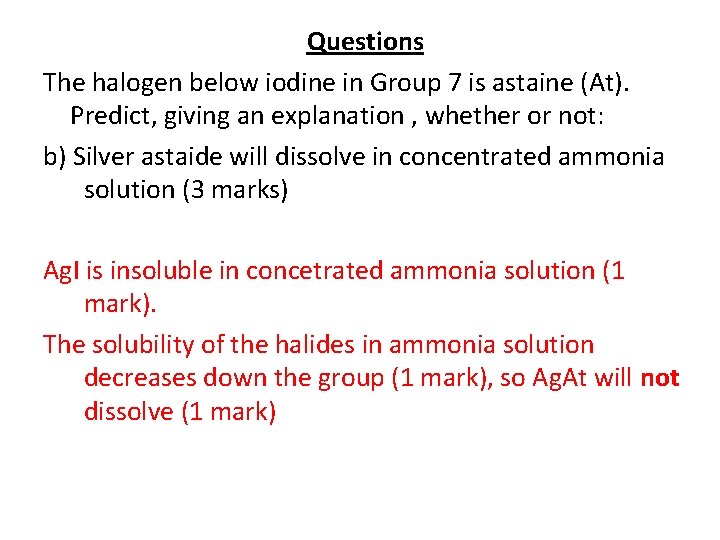
Questions The halogen below iodine in Group 7 is astaine (At). Predict, giving an explanation , whether or not: b) Silver astaide will dissolve in concentrated ammonia solution (3 marks) Ag. I is insoluble in concetrated ammonia solution (1 mark). The solubility of the halides in ammonia solution decreases down the group (1 mark), so Ag. At will not dissolve (1 mark)
Reactions of the halogens and halogen compounds Objectives: • understand, in terms of changes in oxidation number, the following reactions of the halogens: oxidation reactions with Group 1 and 2 metals Understand the following reactions: • solid Group 1 halides with concentrated sulfuric acid, to illustrate the trend in reducing ability of the hydrogen halides • precipitation reactions of the aqueous anions Cl–, Br– and I– with aqueous silver nitrate solution, followed by aqueous ammonia solution • hydrogen halides with ammonia and with water (to produce acids)
- Slides: 31