
GROUP 4 HUMAN RESOURCES DEVELOPMENT PROJECT HRDP TANZANIA

- Slides: 10
GROUP 4 HUMAN RESOURCES DEVELOPMENT PROJECT (HRDP) – TANZANIA CASE STUDY Index 1. Theory of Change 2. Assumptions and Contextual Factors 3. Design Matrix EPDET, 2011 Vilanec, The Czech Republic
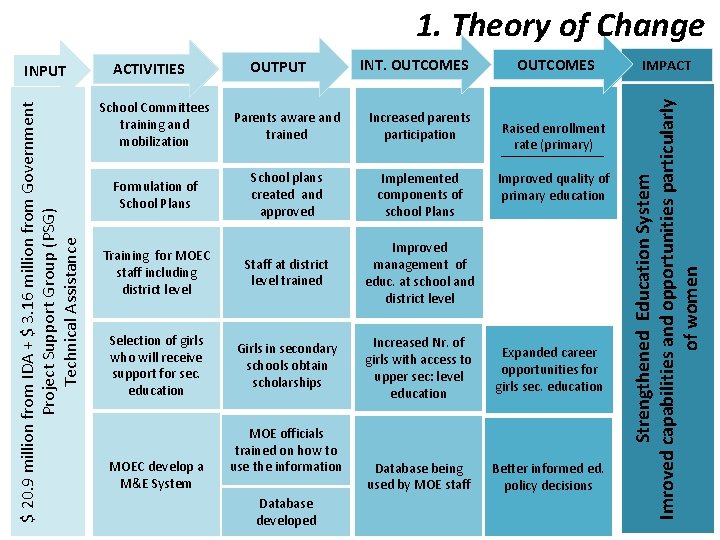
1. Theory of Change ACTIVITIES OUTPUT INT. OUTCOMES School Committees training and mobilization Parents aware and trained Increased parents participation Formulation of School Plans School plans created and approved Implemented components of school Plans Training for MOEC staff including district level Staff at district level trained Improved management of educ. at school and district level Selection of girls who will receive support for sec. education Girls in secondary schools obtain scholarships Increased Nr. of girls with access to upper sec: level education Expanded career opportunities for girls sec. education Database being used by MOE staff Better informed ed. policy decisions MOEC develop a M&E System MOE officials trained on how to use the information Database developed Raised enrollment rate (primary) Improved quality of primary education IMPACT Strengthened Education System Imroved capabilities and opportunities particularly of women $ 20. 9 million from IDA + $ 3. 16 million from Government Project Support Group (PSG) Technical Assistance INPUT
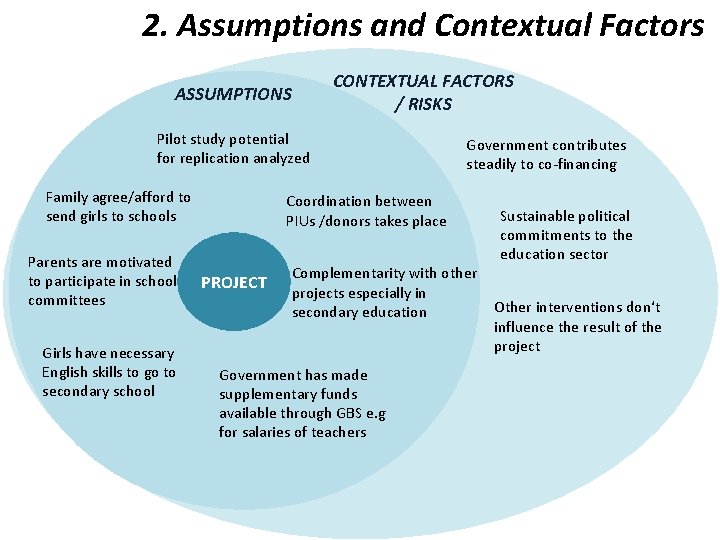
2. Assumptions and Contextual Factors CONTEXTUAL FACTORS / RISKS ASSUMPTIONS Pilot study potential for replication analyzed Family agree/afford to send girls to schools Parents are motivated to participate in school committees Girls have necessary English skills to go to secondary school Government contributes steadily to co-financing Coordination between PIUs /donors takes place PROJECT Complementarity with other projects especially in secondary education Government has made supplementary funds available through GBS e. g for salaries of teachers Sustainable political commitments to the education sector Other interventions don‘t influence the result of the project
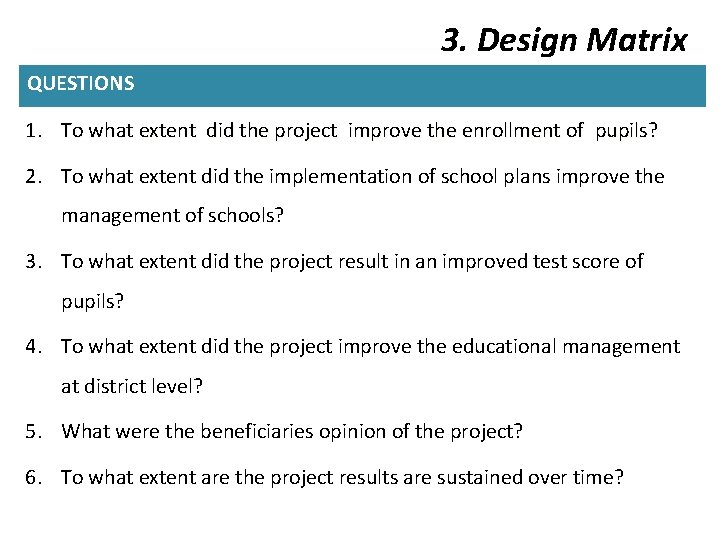
3. Design Matrix QUESTIONS 1. To what extent did the project improve the enrollment of pupils? 2. To what extent did the implementation of school plans improve the management of schools? 3. To what extent did the project result in an improved test score of pupils? 4. To what extent did the project improve the educational management at district level? 5. What were the beneficiaries opinion of the project? 6. To what extent are the project results are sustained over time?
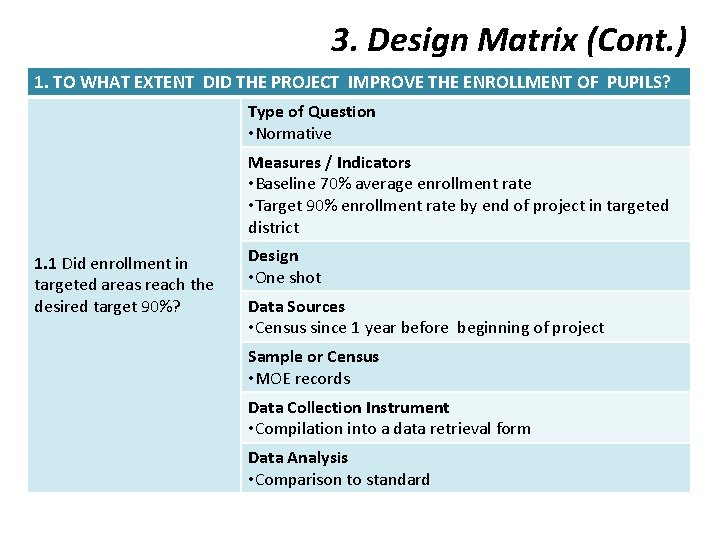
3. Design Matrix (Cont. ) 1. TO WHAT EXTENT DID THE PROJECT IMPROVE THE ENROLLMENT OF PUPILS? Type of Question • Normative Measures / Indicators • Baseline 70% average enrollment rate • Target 90% enrollment rate by end of project in targeted district 1. 1 Did enrollment in targeted areas reach the desired target 90%? Design • One shot Data Sources • Census since 1 year before beginning of project Sample or Census • MOE records Data Collection Instrument • Compilation into a data retrieval form Data Analysis • Comparison to standard
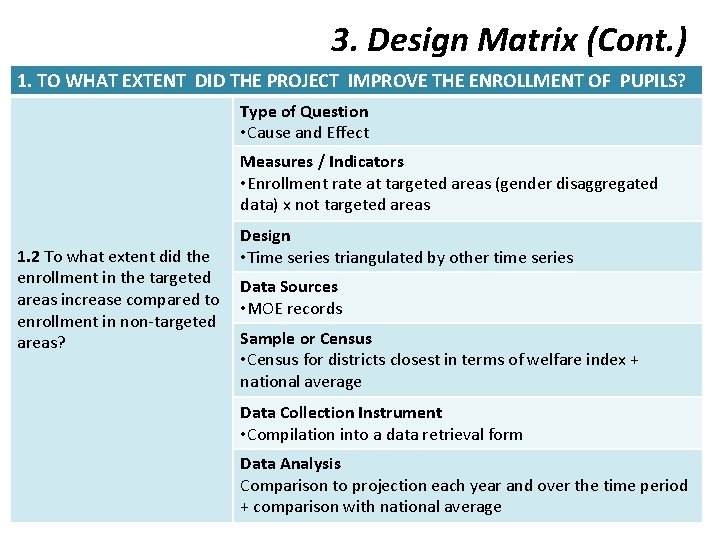
3. Design Matrix (Cont. ) 1. TO WHAT EXTENT DID THE PROJECT IMPROVE THE ENROLLMENT OF PUPILS? Type of Question • Cause and Effect Measures / Indicators • Enrollment rate at targeted areas (gender disaggregated data) x not targeted areas 1. 2 To what extent did the enrollment in the targeted areas increase compared to enrollment in non-targeted areas? Design • Time series triangulated by other time series Data Sources • MOE records Sample or Census • Census for districts closest in terms of welfare index + national average Data Collection Instrument • Compilation into a data retrieval form Data Analysis Comparison to projection each year and over the time period + comparison with national average
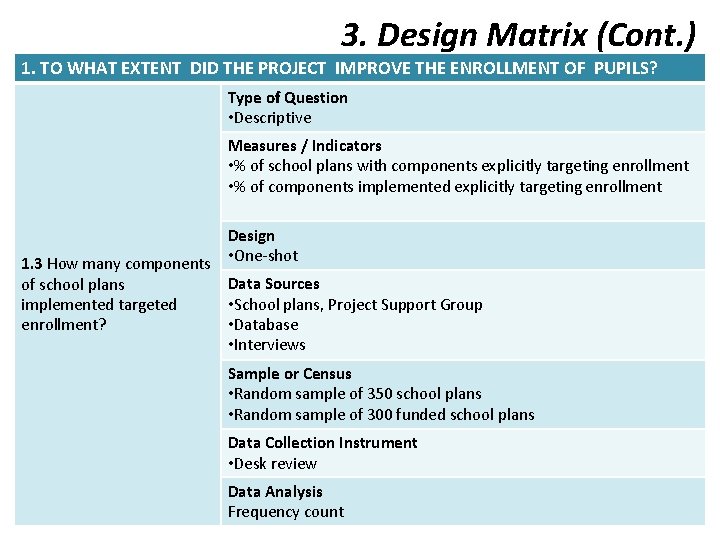
3. Design Matrix (Cont. ) 1. TO WHAT EXTENT DID THE PROJECT IMPROVE THE ENROLLMENT OF PUPILS? Type of Question • Descriptive Measures / Indicators • % of school plans with components explicitly targeting enrollment • % of components implemented explicitly targeting enrollment Design 1. 3 How many components • One-shot Data Sources of school plans • School plans, Project Support Group implemented targeted • Database enrollment? • Interviews Sample or Census • Random sample of 350 school plans • Random sample of 300 funded school plans Data Collection Instrument • Desk review Data Analysis Frequency count
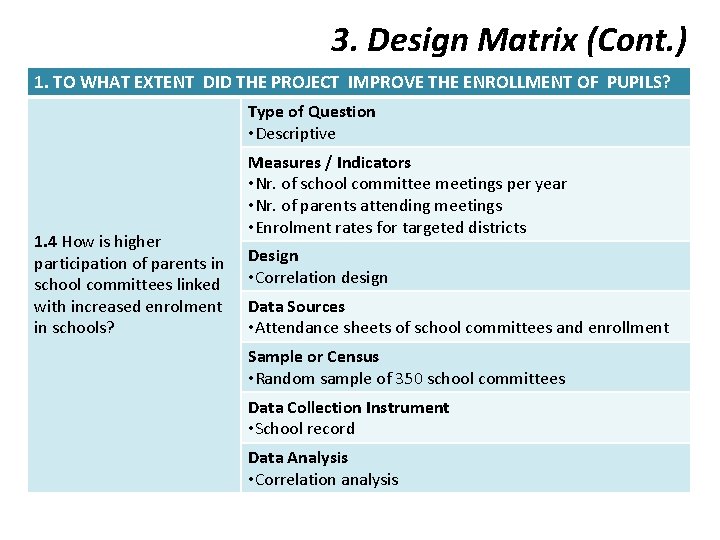
3. Design Matrix (Cont. ) 1. TO WHAT EXTENT DID THE PROJECT IMPROVE THE ENROLLMENT OF PUPILS? Type of Question • Descriptive 1. 4 How is higher participation of parents in school committees linked with increased enrolment in schools? Measures / Indicators • Nr. of school committee meetings per year • Nr. of parents attending meetings • Enrolment rates for targeted districts Design • Correlation design Data Sources • Attendance sheets of school committees and enrollment Sample or Census • Random sample of 350 school committees Data Collection Instrument • School record Data Analysis • Correlation analysis
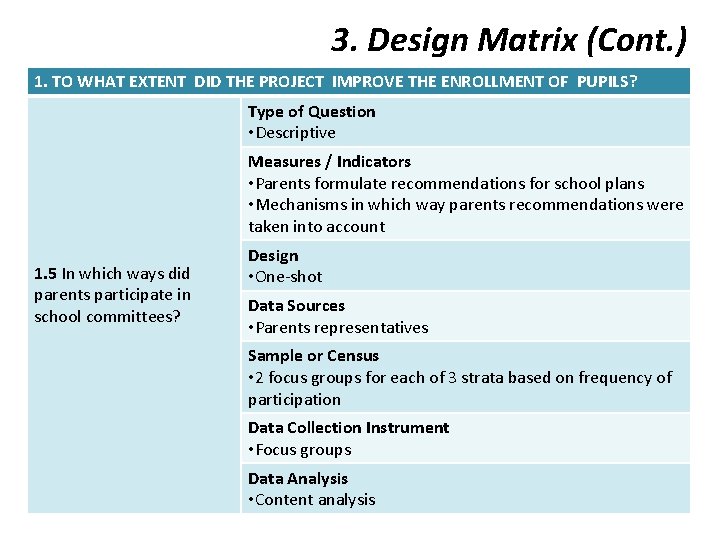
3. Design Matrix (Cont. ) 1. TO WHAT EXTENT DID THE PROJECT IMPROVE THE ENROLLMENT OF PUPILS? Type of Question • Descriptive Measures / Indicators • Parents formulate recommendations for school plans • Mechanisms in which way parents recommendations were taken into account 1. 5 In which ways did parents participate in school committees? Design • One-shot Data Sources • Parents representatives Sample or Census • 2 focus groups for each of 3 strata based on frequency of participation Data Collection Instrument • Focus groups Data Analysis • Content analysis
Thank you! Group 4: Charlotte Hjertsstrom Katka Zezulkova Matthias Bechtolsheim Ondrej Nadvornik Patricia Baptista Radka Kotinska Sarah Seus