
Group 1 Project ECE 001 08 Team Extreme
- Slides: 12
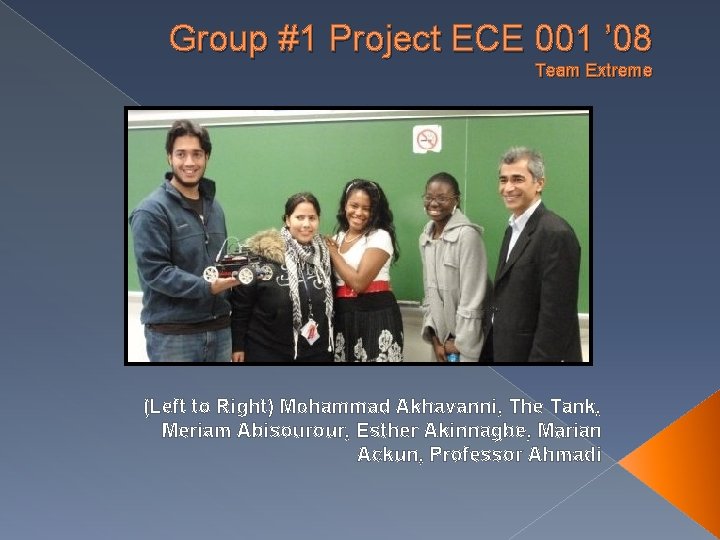
Group #1 Project ECE 001 ’ 08 Team Extreme (Left to Right) Mohammad Akhavanni, The Tank, Meriam Abisourour, Esther Akinnagbe, Marian Ackun, Professor Ahmadi
Project Objective � Project 1: To build and program a robot that will follow a solid black line, make a U-turn, and follow the line back to the start. � Project 2: To understand the mechanics of a centrifuge and perform an experiment.
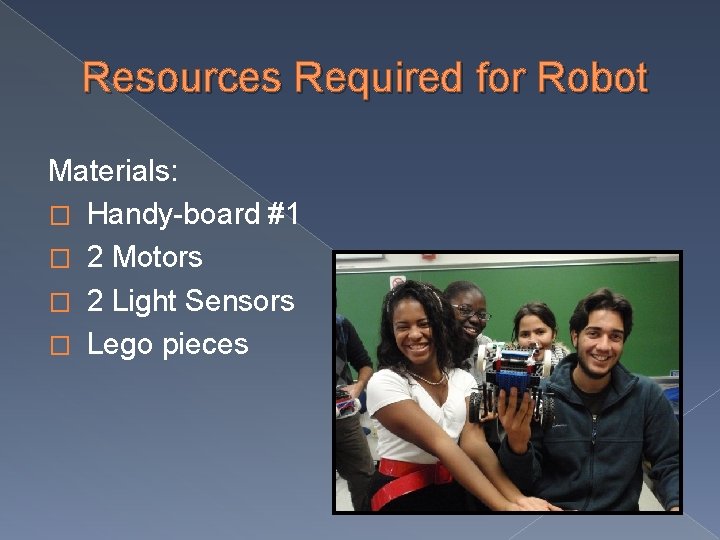
Resources Required for Robot Materials: � Handy-board #1 � 2 Motors � 2 Light Sensors � Lego pieces
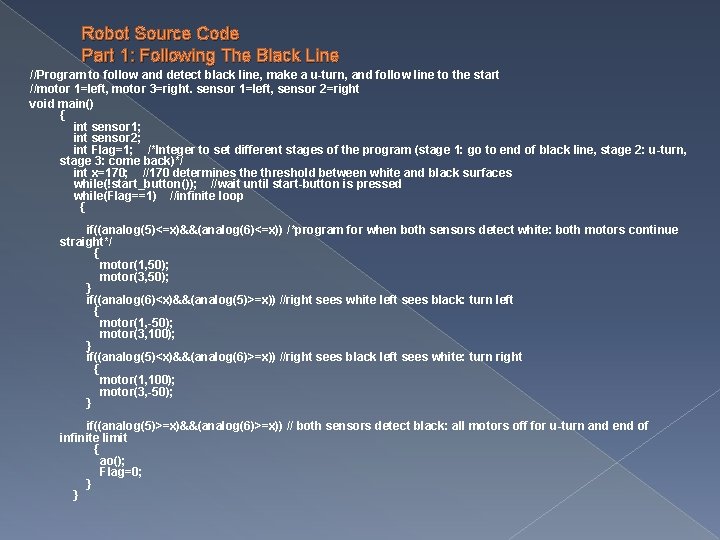
Robot Source Code Part 1: Following The Black Line //Program to follow and detect black line, make a u-turn, and follow line to the start //motor 1=left, motor 3=right. sensor 1=left, sensor 2=right void main() { int sensor 1; int sensor 2; int Flag=1; /*Integer to set different stages of the program (stage 1: go to end of black line, stage 2: u-turn, stage 3: come back)*/ int x=170; //170 determines the threshold between white and black surfaces while(!start_button()); //wait until start-button is pressed while(Flag==1) //infinite loop { if((analog(5)<=x)&&(analog(6)<=x)) /*program for when both sensors detect white: both motors continue straight*/ { motor(1, 50); motor(3, 50); } if((analog(6)<x)&&(analog(5)>=x)) //right sees white left sees black: turn left { motor(1, -50); motor(3, 100); } if((analog(5)<x)&&(analog(6)>=x)) //right sees black left sees white: turn right { motor(1, 100); motor(3, -50); } if((analog(5)>=x)&&(analog(6)>=x)) // both sensors detect black: all motors off for u-turn and end of infinite limit { ao(); Flag=0; } }
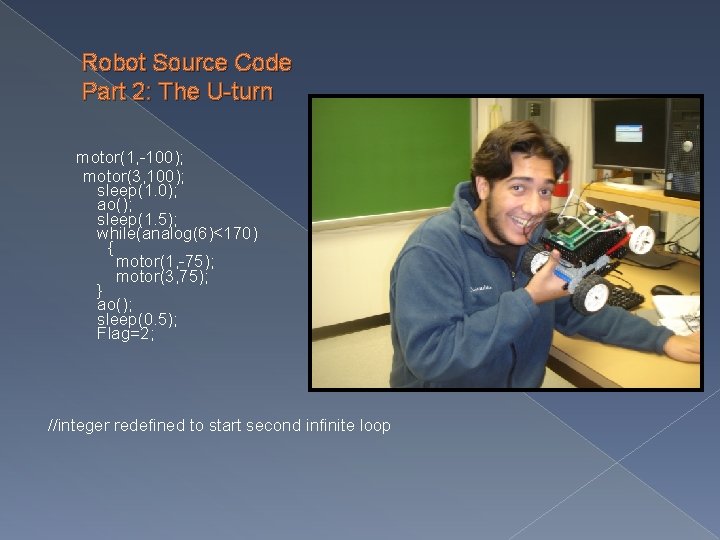
Robot Source Code Part 2: The U-turn motor(1, -100); motor(3, 100); sleep(1. 0); ao(); sleep(1. 5); while(analog(6)<170) { motor(1, -75); motor(3, 75); } ao(); sleep(0. 5); Flag=2; //integer redefined to start second infinite loop
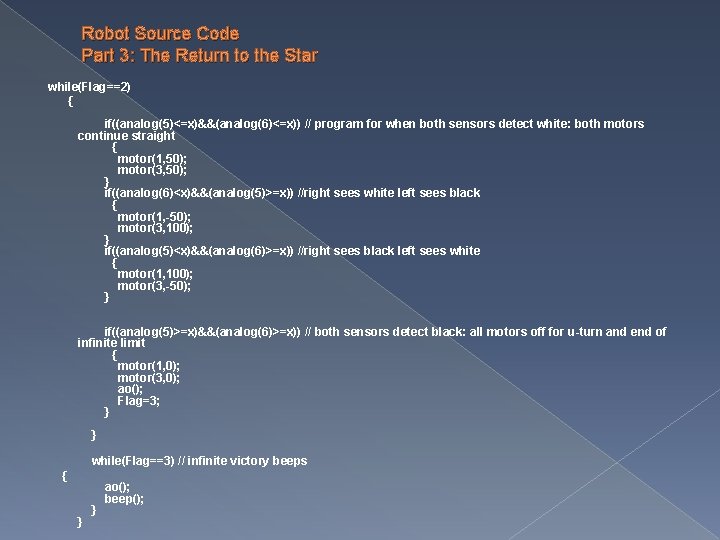
Robot Source Code Part 3: The Return to the Star while(Flag==2) { if((analog(5)<=x)&&(analog(6)<=x)) // program for when both sensors detect white: both motors continue straight { motor(1, 50); motor(3, 50); } if((analog(6)<x)&&(analog(5)>=x)) //right sees white left sees black { motor(1, -50); motor(3, 100); } if((analog(5)<x)&&(analog(6)>=x)) //right sees black left sees white { motor(1, 100); motor(3, -50); } if((analog(5)>=x)&&(analog(6)>=x)) // both sensors detect black: all motors off for u-turn and end of infinite limit { motor(1, 0); motor(3, 0); ao(); Flag=3; } } while(Flag==3) // infinite victory beeps { } } ao(); beep();
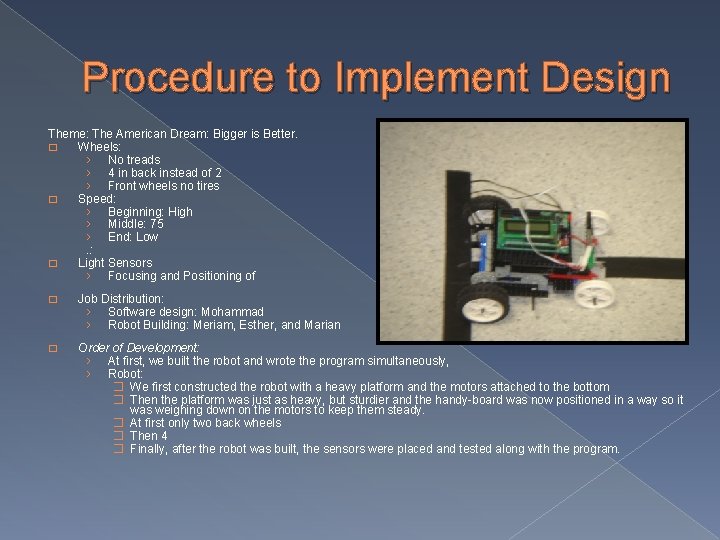
Procedure to Implement Design Theme: The American Dream: Bigger is Better. � Wheels: › No treads › 4 in back instead of 2 › Front wheels no tires � Speed: › Beginning: High › Middle: 75 › End: Low. : � Light Sensors › Focusing and Positioning of � Job Distribution: › Software design: Mohammad › Robot Building: Meriam, Esther, and Marian � Order of Development: › At first, we built the robot and wrote the program simultaneously, › Robot: � We first constructed the robot with a heavy platform and the motors attached to the bottom � Then the platform was just as heavy, but sturdier and the handy-board was now positioned in a way so it was weighing down on the motors to keep them steady. � At first only two back wheels � Then 4 � Finally, after the robot was built, the sensors were placed and tested along with the program.
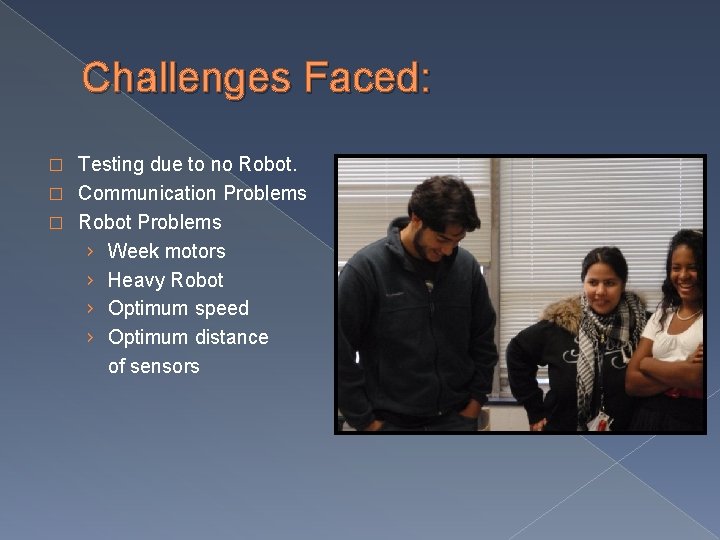
Challenges Faced: Testing due to no Robot. � Communication Problems � Robot Problems › Week motors › Heavy Robot › Optimum speed › Optimum distance of sensors �
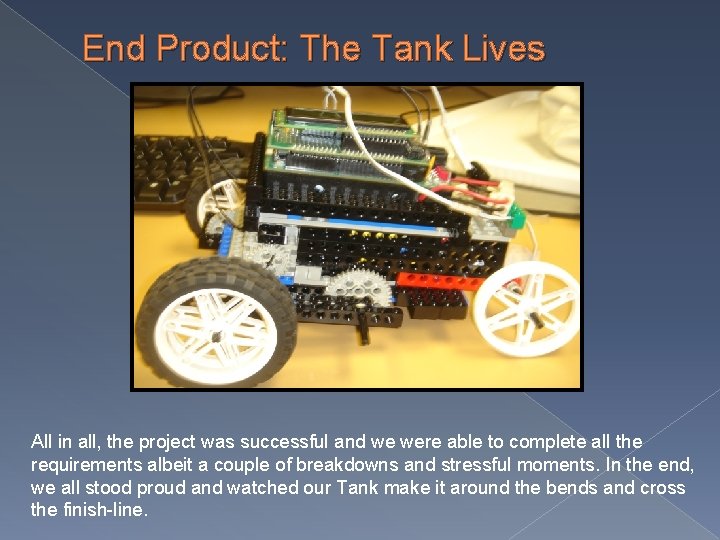
End Product: The Tank Lives All in all, the project was successful and we were able to complete all the requirements albeit a couple of breakdowns and stressful moments. In the end, we all stood proud and watched our Tank make it around the bends and cross the finish-line.
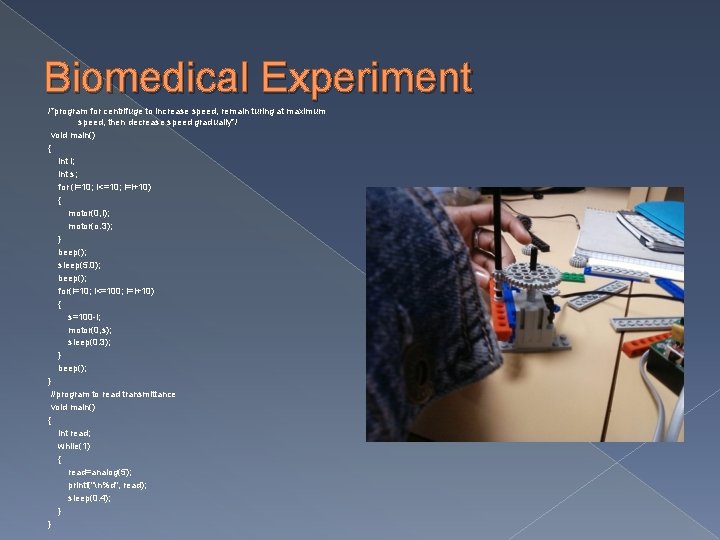
Biomedical Experiment /*program for centrifuge to increase speed, remain turing at maximum speed, then decrease speed gradually*/ void main() { int i; int s; for (i=10; i<=10; i=i+10) { motor(0, i); motor(o. 3); } beep(); sleep(5. 0); beep(); for(i=10; i<=100; i=i+10) { s=100 -i; motor(0, s); sleep(0. 3); } beep(); } //program to read transmittance void main() { int read; while(1) { read=analog(5); printf("n%d", read); sleep(0. 4); } }
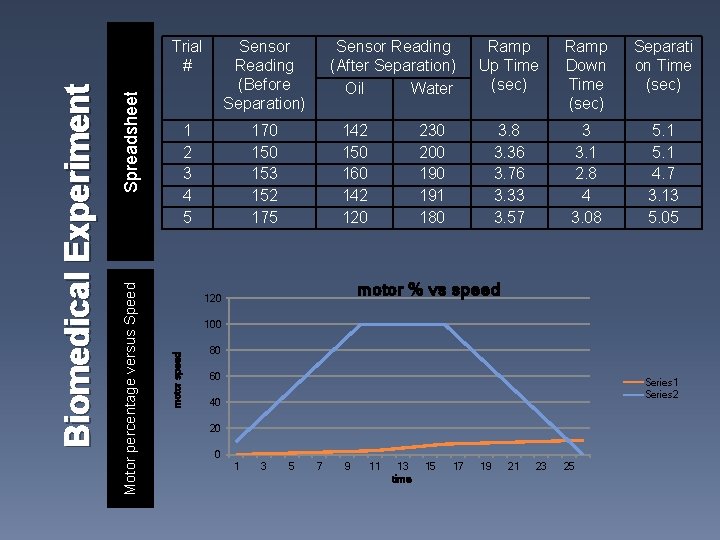
Sensor Reading (Before Separation) 1 2 3 4 5 170 153 152 175 Spreadsheet Sensor Reading (After Separation) Oil Water 142 150 160 142 120 Ramp Up Time (sec) Ramp Down Time (sec) Separati on Time (sec) 3. 8 3. 36 3. 76 3. 33 3. 57 3 3. 1 2. 8 4 3. 08 5. 1 4. 7 3. 13 5. 05 230 200 191 180 motor % vs speed 120 100 motor speed Motor percentage versus Speed Biomedical Experiment Trial # 80 60 Series 1 Series 2 40 20 0 1 3 5 7 9 11 13 time 15 17 19 21 23 25
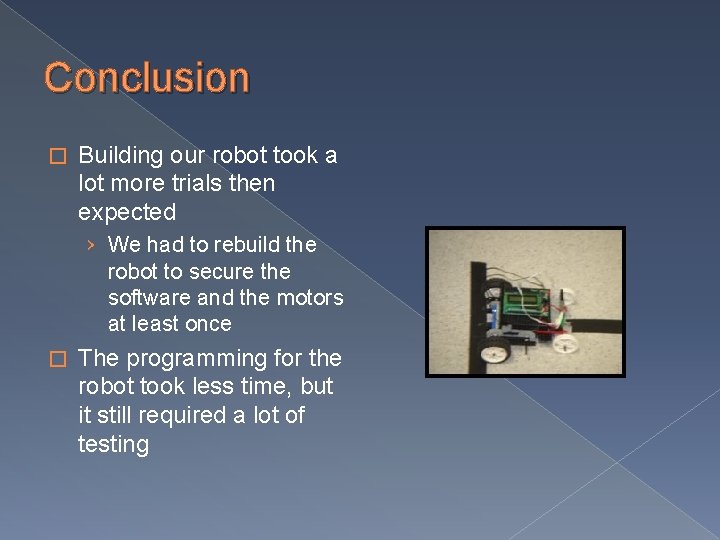
Conclusion � Building our robot took a lot more trials then expected › We had to rebuild the robot to secure the software and the motors at least once � The programming for the robot took less time, but it still required a lot of testing