
Group 1 Deah Bayani Diana Rose Eugenio Danika

Group 1 Deah Bayani Diana Rose Eugenio Danika Balinado Leonard Besa Abigail Mae Velasco Matthew Pena Jerome Fortades Von Anthony Manaig John Paulo Perez Mark Joshua Ferma
KINSHIP BY MARRIAGE �In Anthropology, Kinship is the web of social relationships that form an important part of the lives of most humans in most societies, although its exact meanings even within this discipline are often debated. Anthropologist Robin Fox states that “the study of kinship is the study of what man does with theses basic facts of life – mating, gestation parenthood, socialization, sibling ship etc. ”
KINSHIP BY MARRIAGE �Kinship can refer both to the patterns of social relationship themselves, or it can refer to the study of the patterns of social relationships in one or more human cultures. �Anthropology has developed a number of related concepts and terms in the study of kinship, such as descent, descent group, lineage, affinity/affine, consanguinity/cognate and fictive kinship.
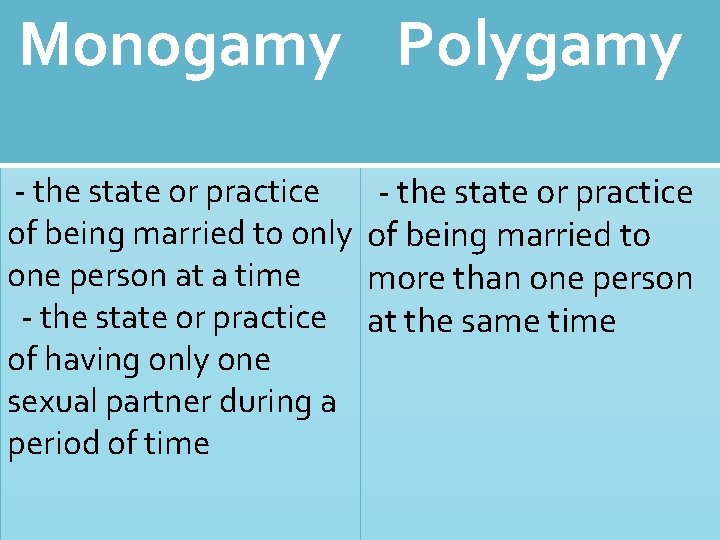
Monogamy Polygamy - the state or practice of being married to only one person at a time - the state or practice of having only one sexual partner during a period of time - the state or practice of being married to more than one person at the same time
�Post Marital residence Rules - Specify where a person resides after marriage and accordingly, influence the structure and size of household units. Anthropologists have identified several basic rules and related domestic forms. However, adherence to a specific residence rules involves many complications and consequences and a firm classification of a particular society’s arrangements is sometime ambiguous. Accordingly, the form and dynamics of household must be understood in terms of household flexibility, idea vs. actual arrangements, and the domestic cycle. The following general patterns have been observed in varying societies around the world.
1. Neolocal Residence �This system is determined by a rule that each spouse leaves his or her family of origin and jointly forms a new household, which develops as nuclear family. This is of course the basic pattern in modern industrial societies.
2. Patrilocal Residence �A patrilocal rule specifies that, upon marriage, a man remains in his father’s household while his wife leaves her family to movie in with him. As children are born, they are added to the paternal unit. The result is a patrolical extended family, in which three or more generations of related men live together to form a shallow patrilineage. An alternate designation, virilocal, refers to a simpler rule that a wife must move to her husband’s residence.
3. Matrilocal Residence �A matrilocal rule specifies that, upon marriage, a woman remains in her mother’s household while her husband leaves his family to move in with her. As children are born, they are added to the maternal unit. The result is a matrilocal extended family, in which three or moregenerations related women live together to form a shallow matrilineage. An alternate designation, uxorilocal, refers to a simpler rule that a husband must move to his wife’s residence.
4. Matrifocal Residence �A matrifocal family consists of a woman and her children and sometimes her daughter’s children, without coresident husbands or other adult men. This pattern is not usually an experession of a rule or cultural preference but results from economic conditions in which a man is unable to support a family. The household is different from a matrilocal one, in which wives and husbands are coresident.
5. Avunculocal Residence �The avunculocal rule is more complicated than the previous ones, since two residence changes are involved. Household formation begins with a virilocal rule, placing a married woman in her husband’s household, where their children are raised. Upon reaching maturity, the men must relocate to their mother’s brother’s household, the actual avunculocal move.
�The result is an avunulocal extended family consisting of one or more elder men, their sister’s sons, and the wives and immature children of all the married men.
6. Ambilocal Residence �In a ambilocal pattern a married couple decides whether to join either the husband’s or wife’s household or origin. According to the choice made in the previous generations, they may with either spouse’s father or mother. The result is an ambilocal extended family.
7. Natalocal Residence �The natalocal rule specifies that each partner remains with his and her own families of residence after marriage. If children remain in their mother’s household the result will be the formation of domestic matrilineages to which all male and female residents belong.

Reffered Marriage
�Marriage, also called matrimony or wedlock, is a socially or ritually recognized union or legal contract between spouses that establishes rights and obligations between them, between them and their childre, and between them and their in-laws. The definition of marriage varies according to different cultures, but it is principally an institution in which interpersonal relationships, usually sexual, are acknowledged. In some cultures, marriage is recommended or considered to be compulsory before persuing any sexual activity. When defined broadly, marriage is considered a cultural universal.
- Slides: 15