
Group 1 CARDBOARD STOCK 1 Define the Problem

Group 1 CARDBOARD STOCK
1. Define the Problem Cardboard is the single largest component of municipal solid waste that businesses produce each year. Nearly 30 million tons of cardboard end up in landfills each year. The product we were given to recycle was a card-board liner used to protect edges of furniture and such during shipping. Our task was to create products using this card-board liner in order to recycle it.
2. Brainstorm, Research, and Generate Ideas Binders Notebooks Table Irrigation Toy Swords Baby Proofing Research 30 million pounds of waste is cardboard Largest waste product of businesses
3. Identify Criteria and Specify Constraints Criteria 4 ft. long card-board liner Constraints 1. Develop at least two products 2. Use the item that has been assigned to the group. You MUST use the item as much intact as possible. 3. It cannot melted down, burned or ripped to shreds. It can be separated or parted. 4. It may also be combined with another waste type product element. 5. It MAY NOT BE TRASH ART. No clocks drink cozies allowed.
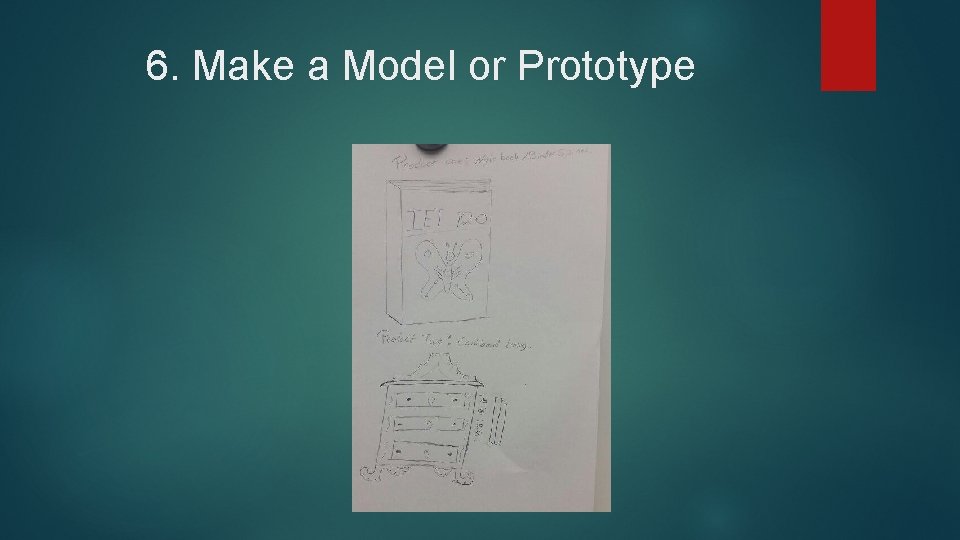
4. Develop and propose designs and choose among alternative solutions Notebooks Baby Proofing The cardboard could be used to line many objects in the home, such as dressers and tables, to create a more child safe surface. Table Notebooks could be made from the cardboard, as well as other school supplies. The carboard is very sturdy, and if applied correctly, could be used to construct tables. Irrigation and Gardening Card-board could possibly be used in gardening to channel water and line gardens. The cardboard would have to be lined with a plastic or rubber cover to prevent the card-board from breaking down.
5. Implement the Proposed Solution Notebooks we decided to separate and part the cardboard, then we reattached it together to form the notebook cover. Baby Proofing you can just attach this too any corner too help keep you baby safe and secure while giving it the love and affection they need.
6. Make a Model or Prototype
7. Evaluation of the Solution and Any of its Problems Notebook this helps cut back on municipal waste in landfills. The bad thing is its hard to shape the notebook out of this cardboard. Baby proofing this helps protect baby's against the harm of corners. The bad thing about card board is that its not the softest things.
8. Refine the Design Notebook We could use different colors and durability's for these Baby Proofing offer different sizes and colors too match certain walls, also more self adhesive materials.
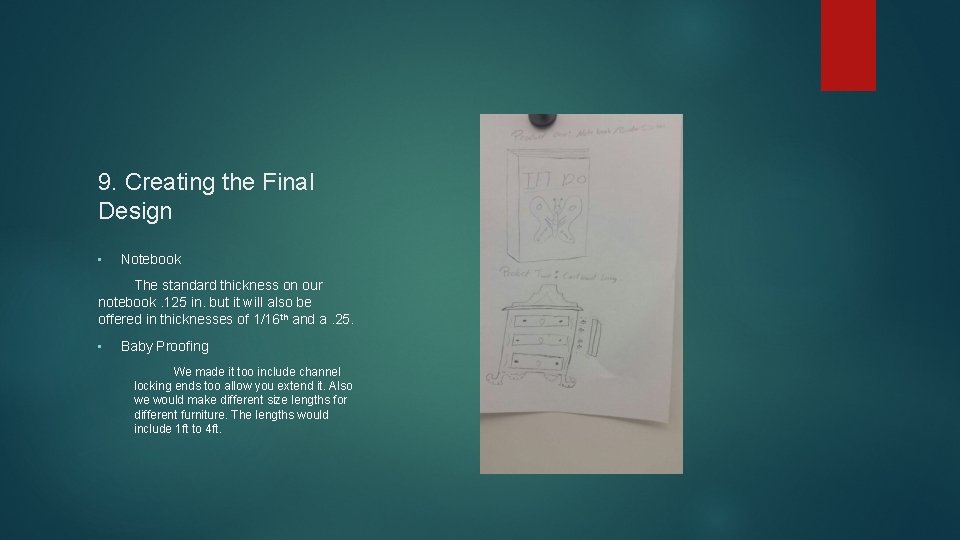
9. Creating the Final Design • Notebook The standard thickness on our notebook. 125 in. but it will also be offered in thicknesses of 1/16 th and a. 25. • Baby Proofing We made it too include channel locking ends too allow you extend it. Also we would make different size lengths for different furniture. The lengths would include 1 ft to 4 ft.
10. The Process and Result We were given a card-board liner and given the task of creating products from this already existing material. Given that the card-board liner had to be left as in-tact as possible, we decided to make notebooks and baby proofing material. Our notebooks, called “Green Books, ” will be offered in several different disabilities and colors to apply to a variety of needs. Our baby proofing material, called “Baby Corners, ” will be offered in several colors to match furniture, and will be produced in several different lengths ranging from 1 ft. to 4 ft. As a result from these product, we can keep tons of these card-board products out of landfills, and produce little waste whilst doing so.
- Slides: 11