
Groundwater Sampling in a Permafrost Environment OBTAINING MEANINGFUL
Groundwater Sampling in a Permafrost Environment OBTAINING MEANINGFUL RESULTS Valérie Bertrand, M. Sc. A. , P. Geol. Senior Geochemist Golder Associates Ltd Nunavut Mining Symposium April 3, 2019
AGENDA Groundwater issues in the arctic § Groundwater flow in permafrost environment § Groundwater quality in talik and sub-permafrost aquifer Approach to groundwater investigation § Well installation § Groundwater sampling § Water quality data analysis Summary ___ 2
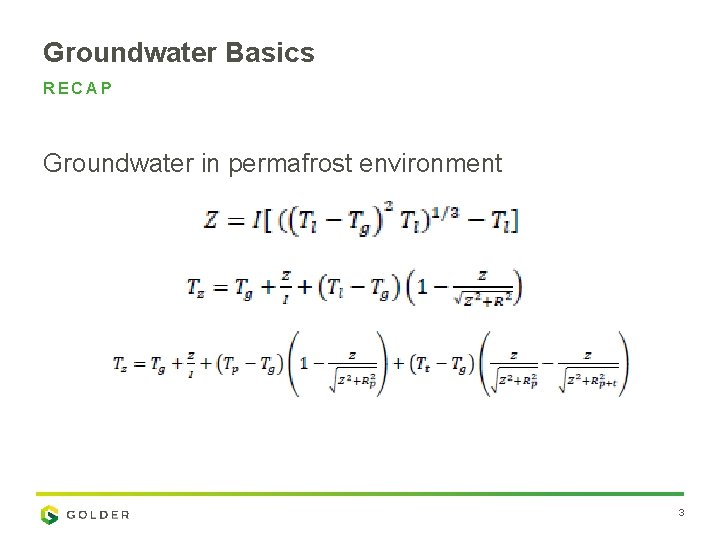
Groundwater Basics RECAP Groundwater in permafrost environment ___ 3
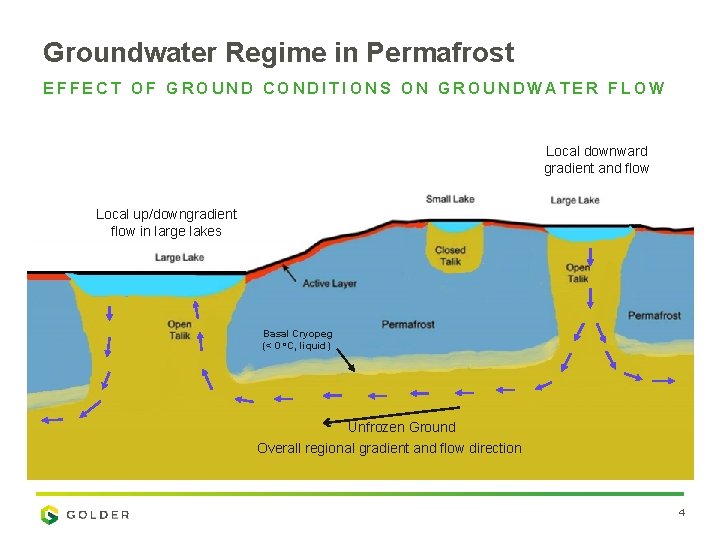
Groundwater Regime in Permafrost EFFECT OF GROUND CONDITIONS ON GROUNDWATER FLOW Local downward gradient and flow Local up/downgradient flow in large lakes Basal Cryopeg (< 0 o. C, liquid) Unfrozen Ground Overall regional gradient and flow direction ___ 4
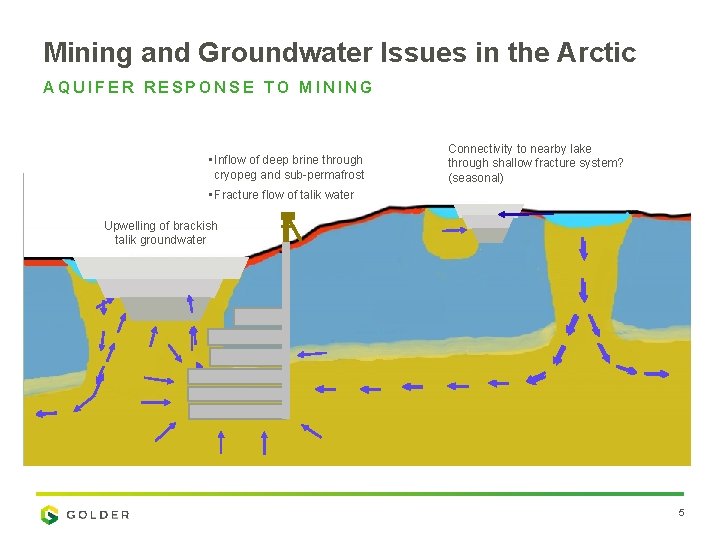
Mining and Groundwater Issues in the Arctic AQUIFER RESPONSE TO MINING • Inflow of deep brine through cryopeg and sub-permafrost Connectivity to nearby lake through shallow fracture system? (seasonal) • Fracture flow of talik water Upwelling of brackish talik groundwater ___ 5
Mining and Groundwater Issues in the Arctic WHY CONSIDER GROUNDWATER? Groundwater inflows add to the volume of water to manage, persist in winter, potential salinity/water quality issue Open pit within permafrost or closed talik § Low/no flow if within permafrost; § Shallow groundwater from the active layer is typically low flow Ø Fractured upper bedrock connection to water body? Open pit in open talik § Inflow from talik area, upwelling of deeper groundwater through pit base Ø Brackish water management Underground mine development sub-permafrost Potential for high inflows, high salinity § Basal cryopeg inflows ___ § 6

Groundwater Quality in Arctic Aquifers GROUNDWATER SALINITY Source: Frape and Fritz 1987 • Most shield brines are calcium chloride signature • Near-ocean brines can be saltier, sodium chloride signature ___ 7
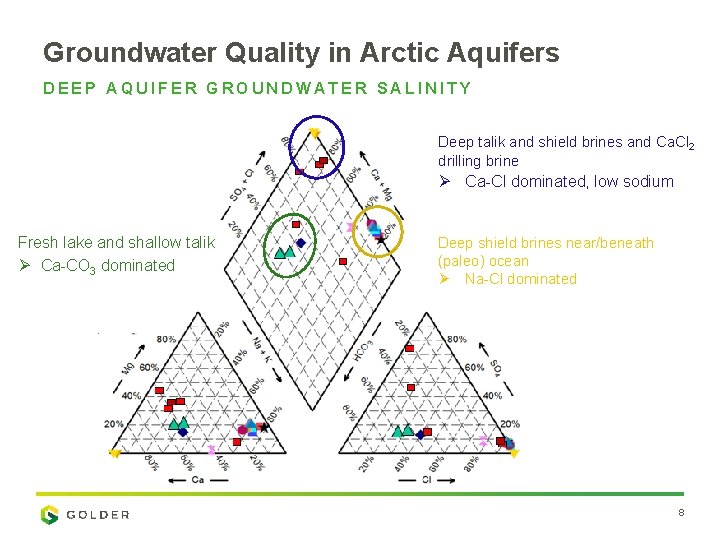
Groundwater Quality in Arctic Aquifers DEEP AQUIFER GROUNDWATER SALINITY Deep talik and shield brines and Ca. Cl 2 drilling brine Ø Ca-Cl dominated, low sodium Fresh lake and shallow talik Ø Ca-CO 3 dominated Deep shield brines near/beneath (paleo) ocean Ø Na-Cl dominated ___ 8
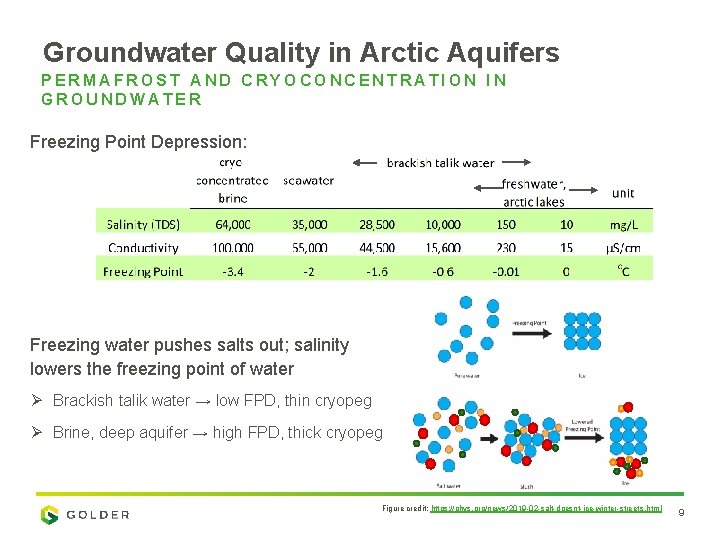
Groundwater Quality in Arctic Aquifers PERMAFROST AND CRYOCONCENTRATION IN GROUNDWATER Freezing Point Depression: Freezing water pushes salts out; salinity lowers the freezing point of water Ø Brackish talik water → low FPD, thin cryopeg Ø Brine, deep aquifer → high FPD, thick cryopeg ___ Figure credit: https: //phys. org/news/2019 -02 -salt-doesnt-ice-winter-streets. html 9

Groundwater Quality in Arctic Aquifers FREEZING POINT DEPRESSION AND GROUNDWATER FLOW High TDS affects depth of cryotic ground = Freezing Point Depression Ø Groundwater inflows above the base of the 0 o. C isotherm Ø FPD of 1. 5 o. C ~ 100 m shallower cryoptic zone = thickness of basal cryopeg ___ 10
Summary of Issues GROUNDWATER FLOW AND SALINITY CONSIDERATIONS • Groundwater inflow into mine in unfrozen ground • Inflows can be elevated: high pressure and large gradients, or if connected to surface water bodies • Deep talik groundwater and sub-permafrost groundwater can be charged chemically, saline • Groundwater salinity affects the depth of permafrost: inflows shallower than suggested by ground temperature alone • Groundwater inflows will persist in winter, may require treatment for discharge. ___ 11
Groundwater Sampling FOR MEANINGFUL RESULTS 12
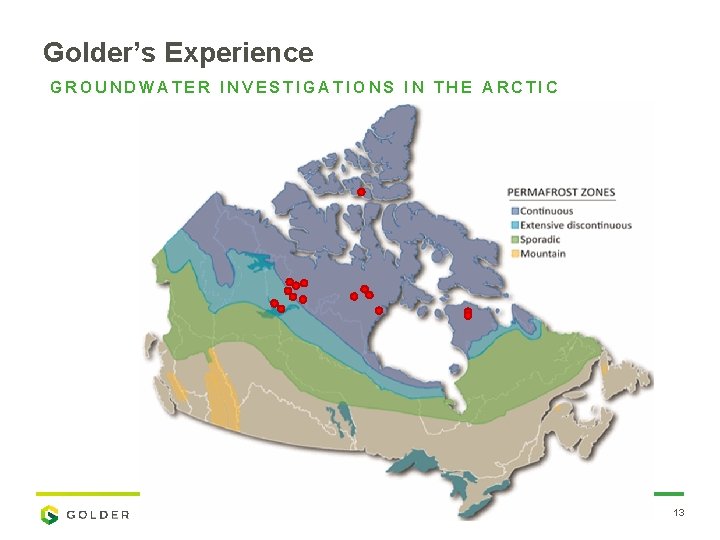
Golder’s Experience GROUNDWATER INVESTIGATIONS IN THE ARCTIC ___ 13
Groundwater Investigation STEPS 1. Define thermal regime and permafrost depth 2. Locate borehole/well to target area of interest 3. Identify potential water-bearing structures, sampling zones 4. Properly develop/purge well/sampling zones 5. Collect water sample(s), determine true formation water quality and salinity 6. Estimate FPD and basal cryopeg thickness 7. Evaluate groundwater inflow rate and water quality ___ 14
Approach to Groundwater Sampling WELL LOCATION Define ground thermal regime • Open or closed talik – lake depth, area, air temperature • Depth of permafrost – installation of thermistors, stabilization period Plan borehole location to achieve target area • Locate well away from sources of artificial inflow/salinity (ex: exploration boreholes drilled with brine) • If installation through permafrost interval, considerations on well design, maintenance and purging • Consider the target rock lithology which can affect groundwater quality ___ 15
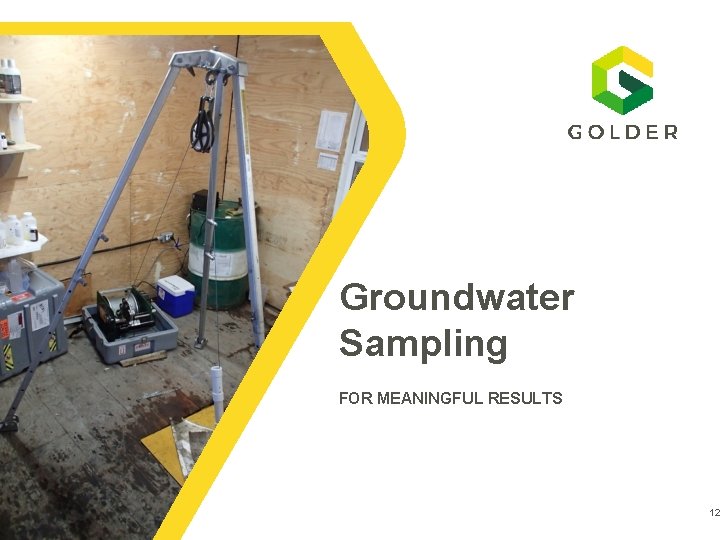
Approach to Groundwater Sampling BOREHOLE DRILLING Important tasks during drilling Tag and monitor all drilling fluids Ø Fluorescence, drilling salt and/or heated salt-free water – consider potential salinity of groundwater! Ø Have a consistent drill water composition: do not mix/change during installation, Ø Continual adjustment of tracer content and monitoring of tracer and conductivity Ø use calibrated meters with adequate precision Ø Monitor water consumption/water return ___ • 17
Approach to Groundwater Sampling BOREHOLE DRILLING Important tasks during drilling • Orientation survey to confirm borehole azimuth and dip, true depth of sampling zones • Log core, map fractures, customize sampling intervals Ø Identify potential water-bearing fractures, hydraulic test of fractured intervals Ø Select groundwater sampling intervals, design well screen/sampling ports accordingly ___ 18
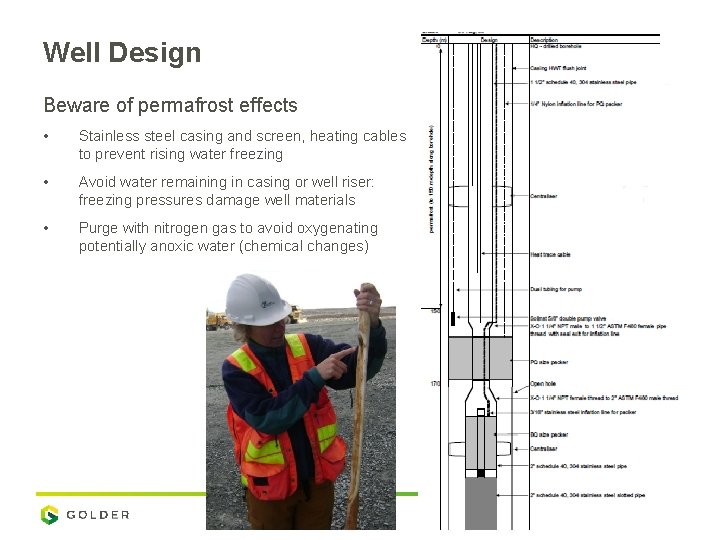
Well Design Beware of permafrost effects • Stainless steel casing and screen, heating cables to prevent rising water freezing • Avoid water remaining in casing or well riser: freezing pressures damage well materials • Purge with nitrogen gas to avoid oxygenating potentially anoxic water (chemical changes) ___ 19
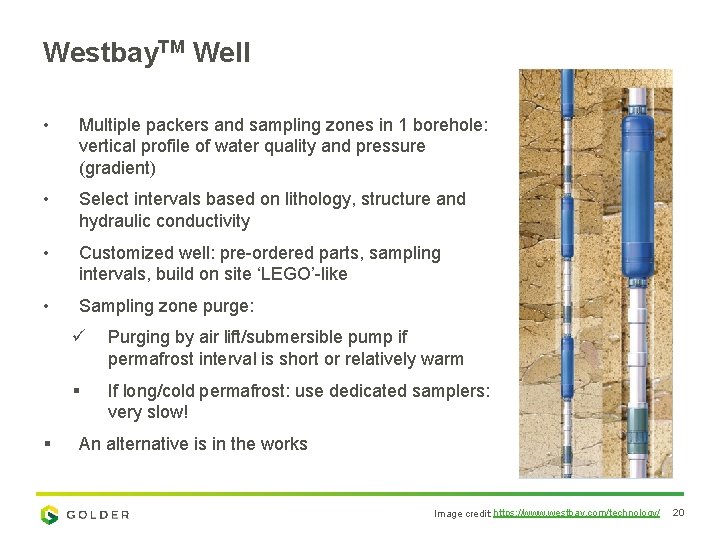
Westbay. TM Well • Multiple packers and sampling zones in 1 borehole: vertical profile of water quality and pressure (gradient) • Select intervals based on lithology, structure and hydraulic conductivity • Customized well: pre-ordered parts, sampling intervals, build on site ‘LEGO’-like • Sampling zone purge: Purging by air lift/submersible pump if permafrost interval is short or relatively warm § If long/cold permafrost: use dedicated samplers: very slow! An alternative is in the works ___ § ü Image credit: https: //www. westbay. com/technology/ 20
Approach to Groundwater Sampling PROPER WELL/SAMPLING ZONE DEVELOPMENT - PURGING In all cases • Sample drill water, source water (for drilling) during drilling and well installation, needed to derive true formation water quality • Continuous, in-situ monitoring of raw groundwater through development, for tracer content, conductivity. • Remove the drilling fluids from sampling interval prior to collecting the groundwater sample • Identify tracer target concentration – aim for >95% drilling fluid removal during development, Lower drill water % to remove the uncertainty on drill fluid composition ___ • 21

Development of well interval MONITORING OF RAW GROUNDWATER DURING PURGING ___ 22
Groundwater Quality Data Analysis WATER QUALITY Analyses • Major ions: calcium, sodium, chloride, magnesium, potassium, etc. conductivity, alkalinity, p. H. • Radium, gases, radiological parameters (uranium, thorium) • Hydrocarbons, drilling fluid contaminants • Trace chemical contents: • Tracers in drilling fluids/salt/tracer • Chemical signature of water – compare with surface water and drill water results ___ 23
Groundwater Quality Data Analysis STABLE ISOTOPES Isotopes of oxygen, hydrogen, sulphur, strontium used to identify the source and pathway of groundwater • Oxygen 18 O and Deuterium 2 H: • • Fractures conveying surface water to underground or pit inflows via depletion ratios and mixing line assessment Tritium 3 H: Age dating of groundwater relative to surface waters for the assessment of connectivity of groundwater to surface water bodies in the time frame of mine operation-post closure. ___ • 24
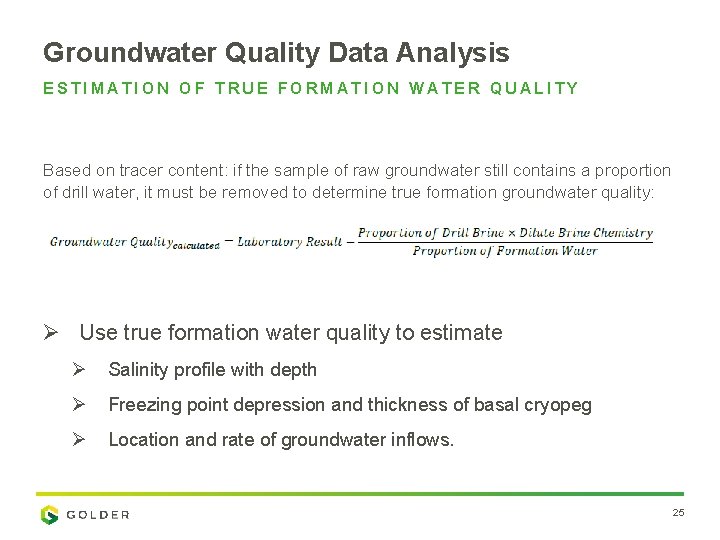
Groundwater Quality Data Analysis ESTIMATION OF TRUE FORMATION WATER QUALITY Based on tracer content: if the sample of raw groundwater still contains a proportion of drill water, it must be removed to determine true formation groundwater quality: Ø Use true formation water quality to estimate Ø Salinity profile with depth Ø Freezing point depression and thickness of basal cryopeg Ø Location and rate of groundwater inflows. ___ 25
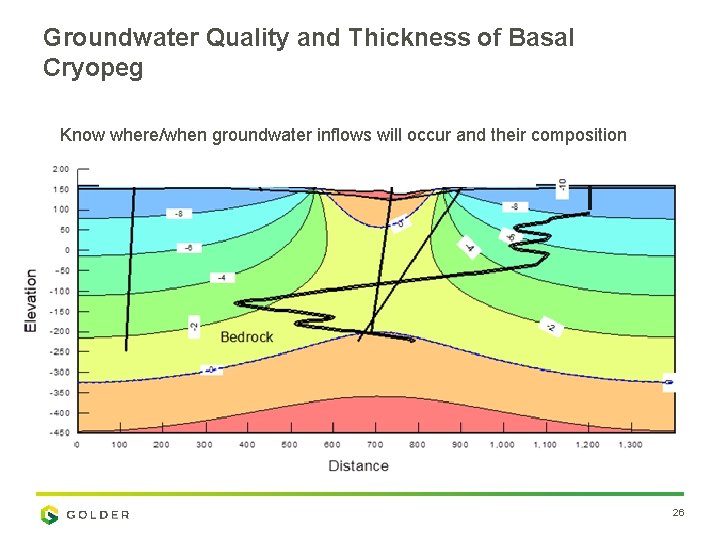
Groundwater Quality and Thickness of Basal Cryopeg Know where/when groundwater inflows will occur and their composition ___ 26
Summary of Key Aspects KEY TO REPRESENTATIVE GROUNDWATER SAMPLES • Understand thermal regime around the proposed mine • Deep, sub-permafrost aquifer is saline, talik water salinity increases with depth. • Groundwater salinity lowers freezing point; affects thickness of the basal cryopeg through which groundwater can flow at <0 o. C • Position well/sampling interval to intersect hydraulically conductive zones • Drilling fluids must be tagged to monitor its complete removal during well/zone development prior to sampling • Use calculated true formation groundwater quality to estimate FPD and thickness of basal cryopeg to evaluate groundwater inflows and their quality ___ 27
Acknowledgement THANK YOU This work is the product of many and varied studies of groundwater in permafrost environments. I wish to thank all who have participated in these studies, including: Golder clients, external reviewers, Golder staff and contributors Don Chorley, Michal Dobr, Jennifer Levenick, Dale Holtze, Emily Henkemans, Denis Vachon ___ 28
- Slides: 27