
Grounded Theory Research n n n Started by
Grounded Theory Research n n n Started by Glaser and Strauss in 1967 Used extensively in nursing research Takes into account the concepts of George Herbert Mead (1934) regarding symbolic interaction theory- how we give meaning to situations, words, objects, symbols Is very individualistic in meaning Most often used to study areas which previous research exists
Steps in Grounded Theory are conducted simultaneously n n n Observation Collection of data Organization of data Review of additional literature Forming theory from the data Using Constant Comparative Analysis
Data Collection Methods Have qualitative and quantitative properties n n n Interviews (one on one, groups) Observation Records (retrospective analysis) Surveys (quantitative) Questionnaires (could be quantitative) Demographic data
Constructs of Grounded Theory n n Conceptual framework comes from the data rather than the literature review There is always an over-riding social issues being addressed called the Basic Social Process (BSP) Researcher focuses on dominate processes rather than describing the setting, or unit You compare all data with all other data
Constructs of Grounded Theory n n You may change data collection methods in mid stream to be more appropriate to what has already been discovered The researcher is to be doing most sequential tasks all at the same time
Constant Comparative Analysis n n Get data, look at it, look at the literature, look at previous data, go get more data, look at more literature, look at all the data, etc. Revise the question, collection method, and keep collecting data, look at literature, compare to old data, etc.
Sampling Methods n n Called Theoretical Sampling n Based on the current question n Add new groups to the sample based on what it is you have learned (may need more men in the sample, or more people over the age of 70, etc. ) The sample being used moves as theory develops
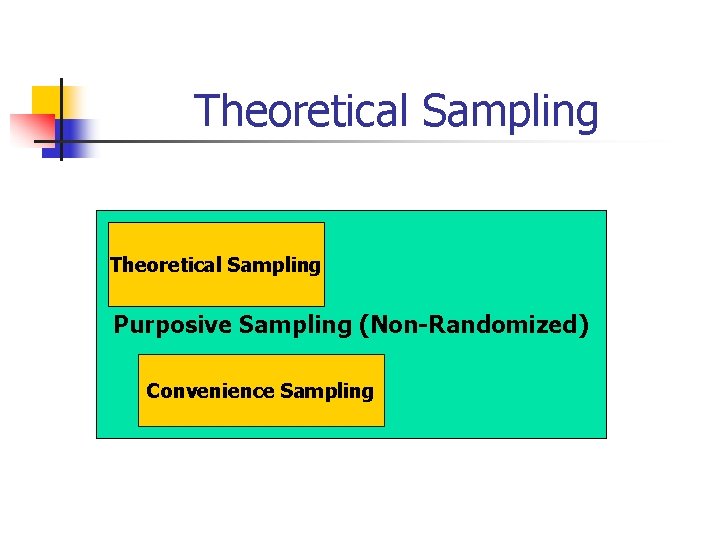
Theoretical Sampling Purposive Sampling (Non-Randomized) Convenience Sampling
Coding the data n n Look for positive AND negative cases related to your social process Step One: read, describe, and interpret Step Two: constant comparison and clustering Step Three: reduce it to a BSP
Conducting Grounded Theory n n n n Be aware of the social life of the participants Make less assumptions in the beginning Sensitizing to the literature, Bracket if needed Layers of reality are explored, assess your own energy to go further Spend enough time with participants and data Be observant to how the participants are doing Learn the symbols being used to create this reality Sample across time
- Slides: 10