
Ground Segment for a L 5 SWE Monitor

- Slides: 11
Ground Segment for a L 5 SWE Monitor Operational Mission L 5 Consortium meeting, London, May 11 th - 14 th Gareth LAWRENCE, Alastair PIDGEON
Abstract 5/22/15 Commercial-in-Confidence
Ground Segment is more than a Ground Station � Several mission studies presented at L 5 Workshop Carrington, EASCO, INSTANT, Operational L 5 NRL, ESA-SSA � Operations costs have been included in all but likely only to support mission control and operations Goes as far as Data telemetry, unpacking and relay only � Operational L 5 mission should be viewed as providing the data that supports an Operational System of Services A Service is founded upon the data, but provides added-value functionality to meet a specific need for a particular User to support their normal work activities Service Users will eg work in industries, or use technologies, that are potentially vulnerable to SWE events � � Providing Operational SWE Services is much more than an operational SWE satellite taking images and measurements in a timely manner 5/22/15 Commercial-in-Confidence
Operational SWE Services � Services are typically more than just provision of data, and can require substantial processing and resources e. g. Data transfer Processing Product Generation Quality Control (CAL/VAL) Archiving (possibly reprocessing) Service Delivery � � � Latency is a critical element for some services. Therefore a number of factors need to be addressed Automation and scheduling of data reception, pipeline processing, product generation Delivery to end-user of service (and perhaps beyond into their own systems) � � Realising the Ground Segment requires particular skills and sufficient resources 5/22/15 Commercial-in-Confidence
Ground Segment design and resourcing are critical to the Operational L 5 system � Services need to meet user requirements, defined in conjunction with users Service also meet operational requirements to ensure they do the right thing in the right way and at the right time � Operational services need to meet all identified requirements, otherwise they will not adequately support users’ activities � Get the requirements right, and then dedicate sufficient resources � This requires effort, therefore needs to be sufficiently budgeted Also requires time, therefore needs to be suitably scheduled Science missions tend to do neither of these Compare with e. g. EUMETSAT who routinely require all processing and operations to be fully detailed and costed in the proposal for the full design lifetime of the mission. � � Total cost will be small compared to other costs, but inadequate resourcing will heavily compromise the Operational System 5/22/15 Commercial-in-Confidence
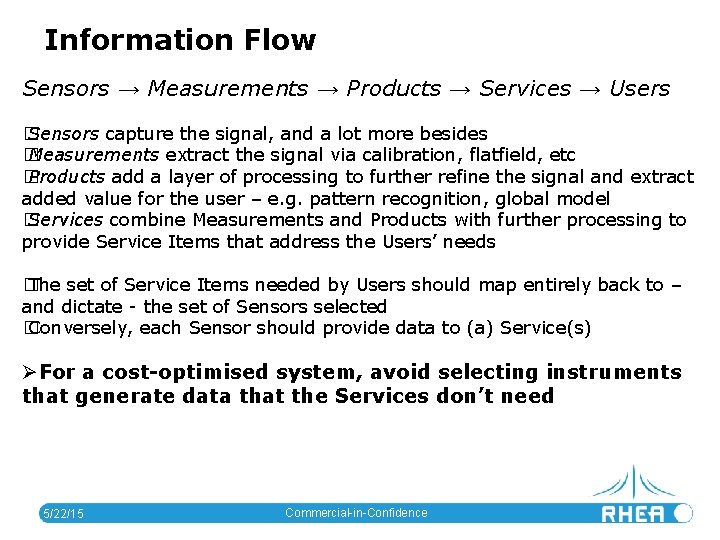
Information Flow Sensors → Measurements → Products → Services → Users � Sensors capture the signal, and a lot more besides � Measurements extract the signal via calibration, flatfield, etc � Products add a layer of processing to further refine the signal and extract added value for the user – e. g. pattern recognition, global model � Services combine Measurements and Products with further processing to provide Service Items that address the Users’ needs � The set of Service Items needed by Users should map entirely back to – and dictate - the set of Sensors selected � Conversely, each Sensor should provide data to (a) Service(s) For a cost-optimised system, avoid selecting instruments that generate data that the Services don’t need 5/22/15 Commercial-in-Confidence
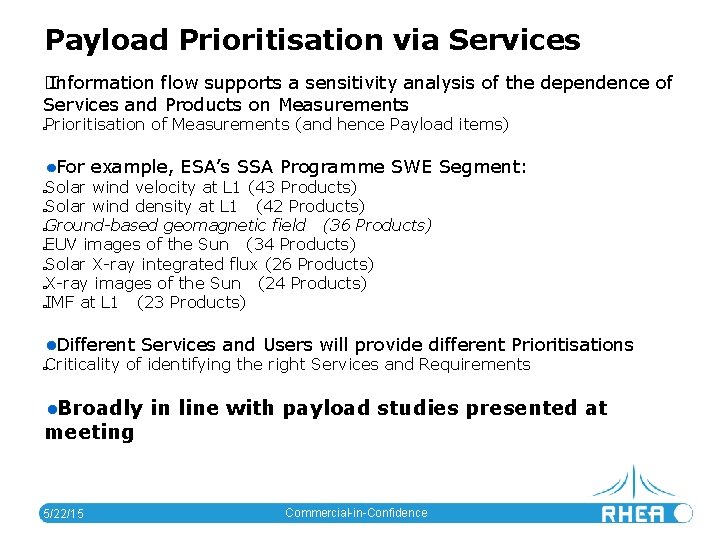
Payload Prioritisation via Services � Information flow supports a sensitivity analysis of the dependence of Services and Products on Measurements Prioritisation of Measurements (and hence Payload items) � For example, ESA’s SSA Programme SWE Segment: Solar wind velocity at L 1 (43 Products) Solar wind density at L 1 (42 Products) Ground-based geomagnetic field (36 Products) EUV images of the Sun (34 Products) Solar X-ray integrated flux (26 Products) X-ray images of the Sun (24 Products) IMF at L 1 (23 Products) � � � � Different Services and Users will provide different Prioritisations Criticality of identifying the right Services and Requirements � Broadly in line with payload studies presented at meeting 5/22/15 Commercial-in-Confidence
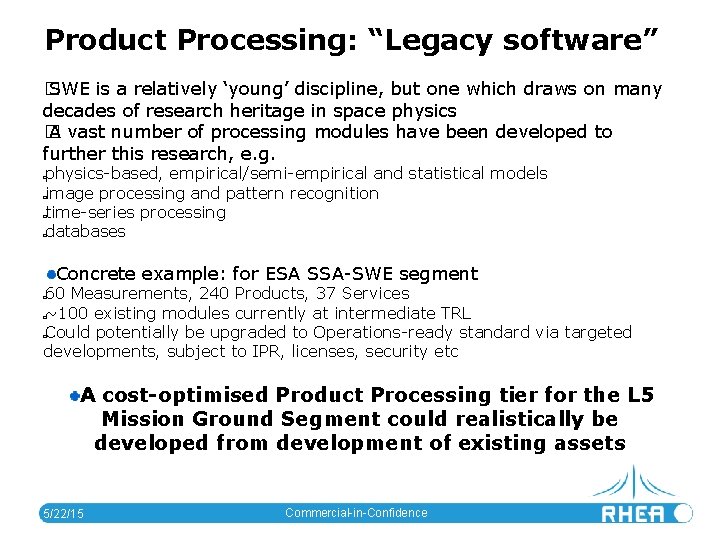
Product Processing: “Legacy software” � SWE is a relatively ‘young’ discipline, but one which draws on many decades of research heritage in space physics � A vast number of processing modules have been developed to further this research, e. g. physics-based, empirical/semi-empirical and statistical models image processing and pattern recognition time-series processing databases � � Concrete example: for ESA SSA-SWE segment 60 Measurements, 240 Products, 37 Services ~100 existing modules currently at intermediate TRL Could potentially be upgraded to Operations-ready standard via targeted developments, subject to IPR, licenses, security etc � � � A cost-optimised Product Processing tier for the L 5 Mission Ground Segment could realistically be developed from development of existing assets 5/22/15 Commercial-in-Confidence
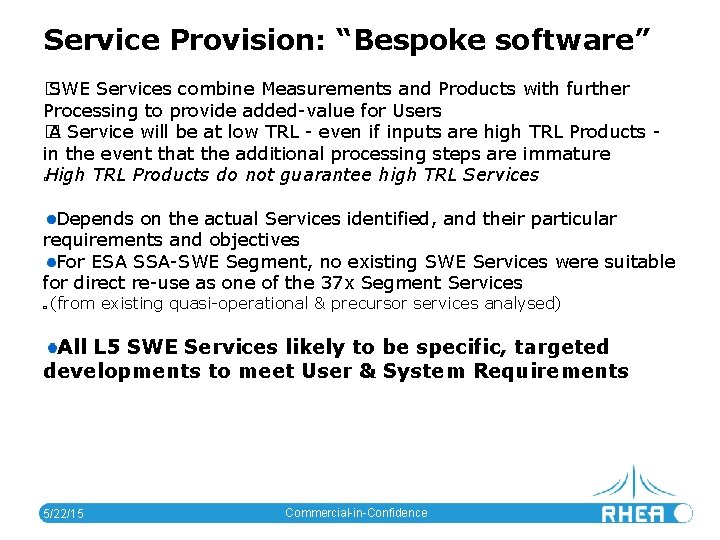
Service Provision: “Bespoke software” � SWE Services combine Measurements and Products with further Processing to provide added-value for Users � A Service will be at low TRL - even if inputs are high TRL Products in the event that the additional processing steps are immature High TRL Products do not guarantee high TRL Services � Depends on the actual Services identified, and their particular requirements and objectives For ESA SSA-SWE Segment, no existing SWE Services were suitable for direct re-use as one of the 37 x Segment Services � (from existing quasi-operational & precursor services analysed) All L 5 SWE Services likely to be specific, targeted developments to meet User & System Requirements 5/22/15 Commercial-in-Confidence
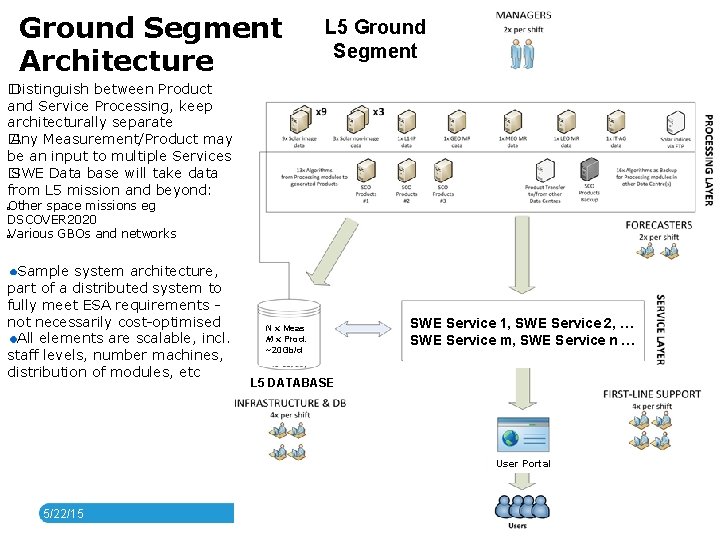
Ground Segment Architecture L 5 Ground Segment � Distinguish between Product and Service Processing, keep architecturally separate � Any Measurement/Product may be an input to multiple Services � SWE Data base will take data from L 5 mission and beyond: Other space missions eg DSCOVER 2020 Various GBOs and networks � � Sample system architecture, part of a distributed system to fully meet ESA requirements not necessarily cost-optimised All elements are scalable, incl. staff levels, number machines, distribution of modules, etc N x Meas M x Prod. ~20 Gb/d SWE Service 1, SWE Service 2, … SWE Service m, SWE Service n … L 5 DATABASE User Portal 5/22/15 Commercial-in-Confidence
Conclusions � The ground segment is an essential element to deliver operational services to the end-users, and goes beyond simple data delivery � Spacecraft and payload operations both need to be addressed by the ground segment (possibly in an integrated way) � It will need to support the needs of both the operational users and the science community � To be cost effective, recurring operations costs need to be minimised yet deliver a high quality product/service, reliably and within the latencies demanded by the end-users � The full development, validation and operations costs for the mission design lifetime (i. e. 10 years) are rarely reflected in science missions � The L 5 mission concept definition has to include a detailed definition of the ground segment, matched to the services that the mission is to support. 5/22/15 Commercial-in-Confidence