
Ground School Private Pilot Airplane Crosswinds Flight School
- Slides: 116
Ground School Private Pilot Airplane Crosswinds Flight School
Requirements for private pilot 17 years of age Able to read, write and converse in English Obtain at least a 3 rd class medical certificate Receive and log ground training from an authorized instructor or complete a home study course Pass a knowledge test scoring 70% or better
Requirements cont. Accumulate at least 40 hours of flight time v. At least 20 hours from an authorized flight instructor, including at least : § 3 hr. cross-country § 3 hr. at night including o 1 cross-country flight over 100 NM total distance o 10 takeoff and landings to a full stop v 3 hr. instrument training v 3 hr. in airplanes in preparation for the practical test within 60 days prior
Solo Requirements 10 hr. solo flight time v 5 hr. of solo cross country flights v 1 solo cross-county of at least 150 NM total distance, with full-stop landings at a minimum of 3 points and with one segment consisting of at least a 50 NM leg between the takeoff and landing locations v 3 solo takeoffs and landings to a full stop at an airport with an operating control tower.
Requirements cont. Obtain a logbook sign-off by your CFI for: v. Preflight preparation/procedures v. Airport/seaport base operations v. Takeoffs, landings, and go-arounds v. Performance maneuvers v. Ground reference maneuvers v. Navigation v. Slow flight and stalls v. Basic instrument maneuvers v. Emergency operations v. Night operations v. Post flight procedures Successfully complete a practical flight test with FAA
Day 1 Aircraft Training Airports Aerodynamics Airplane Stability, Load Factors, and Wake
Aircraft Training � Dispatch procedures � Use of checklists � Certificates and Documents Location and Use � Aircraft Preflight � Aeronautical Decision Making and Judgment � Recovery Procedures � Engine Controls � Flight Controls � Emergency Equipment & survival gear � Aircraft Servicing � Fuel grades
Dispatch procedures Scheduling Aircraft key control procedures Aircraft and airport security/access procedures Handling of aircraft and discrepancies found during preflight including re-dispatch in a new aircraft, if appropriate
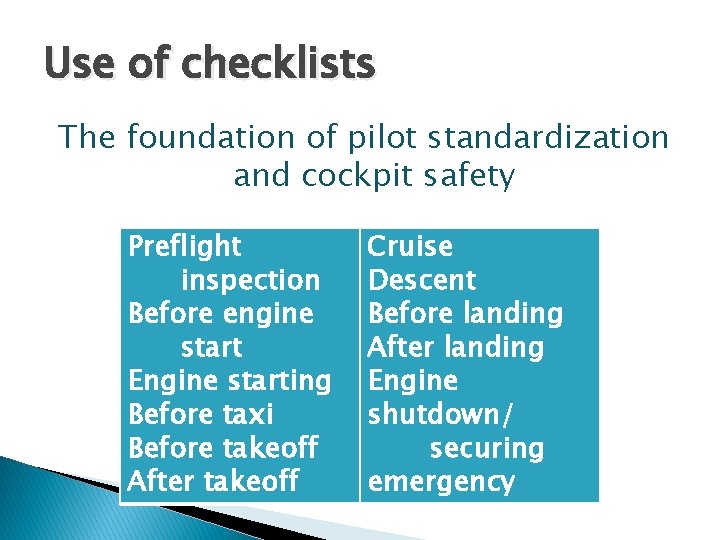
Use of checklists The foundation of pilot standardization and cockpit safety Preflight inspection Before engine start Engine starting Before taxi Before takeoff After takeoff Cruise Descent Before landing After landing Engine shutdown/ securing emergency
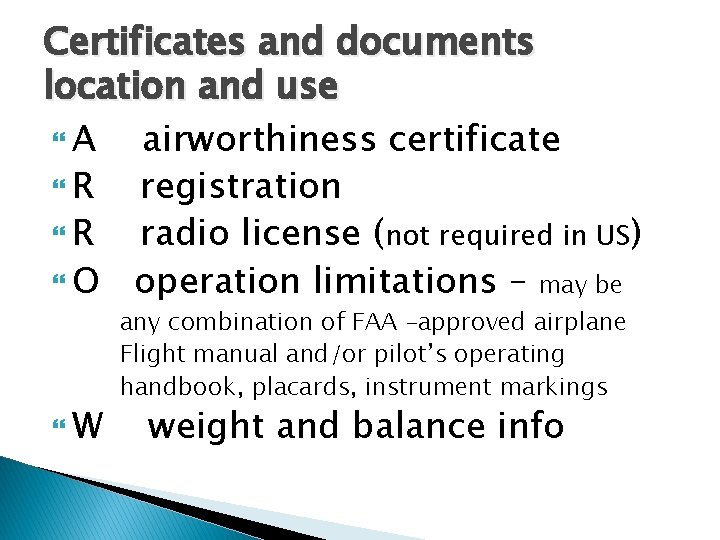
Certificates and documents location and use A airworthiness certificate R registration R radio license (not required in US) O operation limitations – may be W any combination of FAA –approved airplane Flight manual and/or pilot’s operating handbook, placards, instrument markings weight and balance info
Aircraft preflight Follow the checklist!
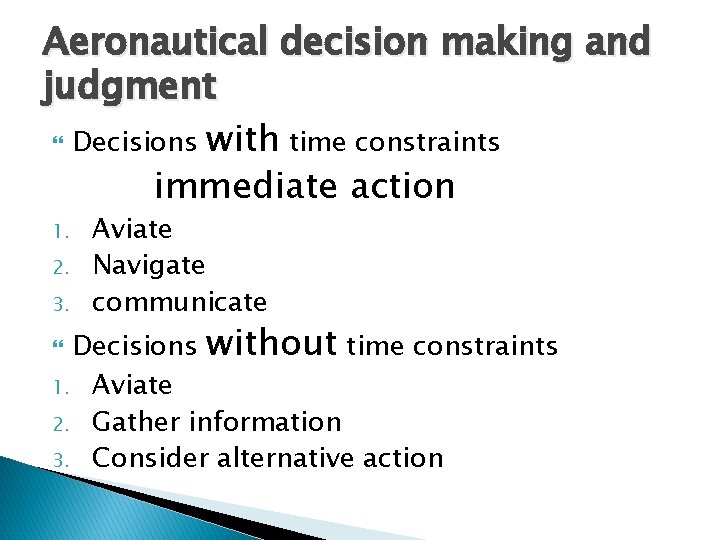
Aeronautical decision making and judgment Decisions with time constraints immediate action 1. 2. 3. Aviate Navigate communicate Decisions without time constraints 1. Aviate 2. Gather information 3. Consider alternative action
Hazardous attitudes Antiauthority - resents supervision, does not like to be bound by schedules or habits, prefers to do things when they feel ready Impulsivity - the inclination of an individual to initiate behavior without adequate forethought as to the consequences of their actions Invulnerability – resistant to harm and impact Macho - trying to cover up their complex Resignation – believes they can’t do it and gives in
Recovery procedures Ground handling after flight – fueling Securing the aircraft Locking and securing keys Paperwork after flight Notification of aircraft discrepancies Return of aircraft to the way it was found
Engine controls Primer – if engine is cold Master switch – battery/alternator Throttle – pump 3 times Ignition – turn to start
Flight controls Ailerons Rudder Elevator
Emergency equipment and survival gear ELT – required Water Food First aid kit Aviation fire extinguisher Cell phone Flotation device – if over water Emergency strobe/flash light – batteries Blanket/hat/coat/gloves – cold weather gear
Aircraft servicing Money or credit card for fuel/oil Make sure you are able to self-service
Fuel grades Low-lead 100 - octane ( 100 LL ) Dyed blue Distinctive AVGAS odor Jet-A Clear or straw colored Kerosene scent and oily to touch Automotive gas –MOGAS (appropriate aircraft)
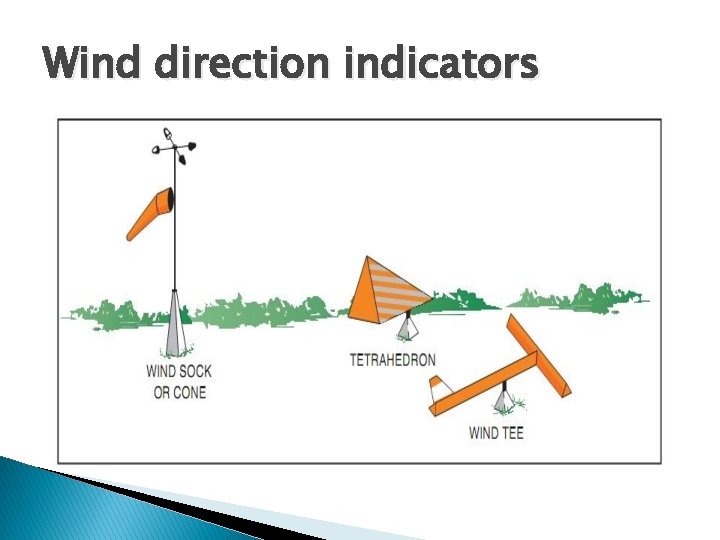
Airports Wind Direction Indicators Airport, Runway, and Taxiway Signs Airport, Runway, and Taxiway Markings Airport, Runway, and Taxiway Lighting Radio Calls and Checks CTAF Obtaining Airport Advisories
Wind direction indicators
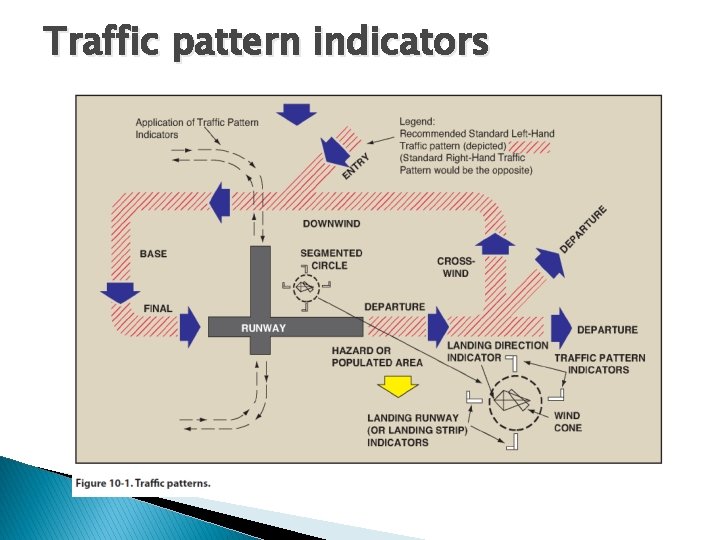
Traffic pattern indicators
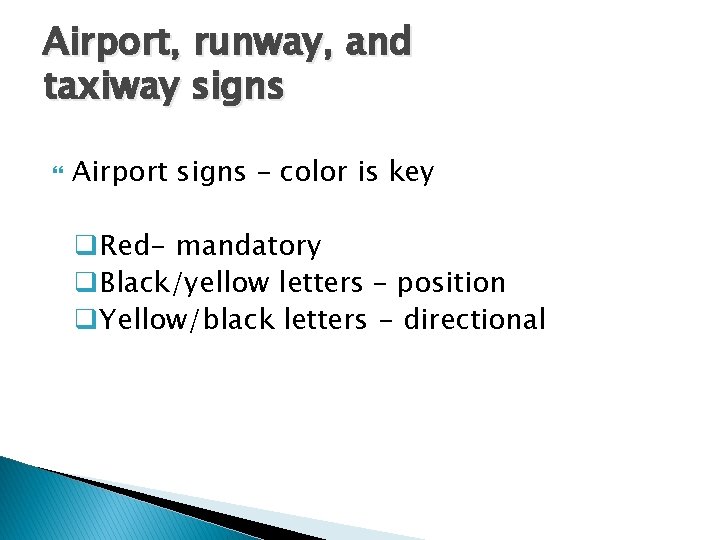
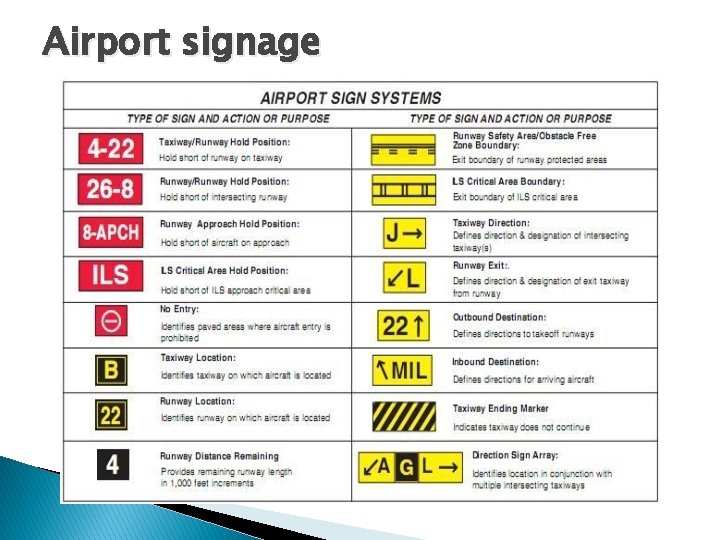
Airport, runway, and taxiway signs Airport signs – color is key q. Red- mandatory q. Black/yellow letters – position q. Yellow/black letters - directional
Airport signage
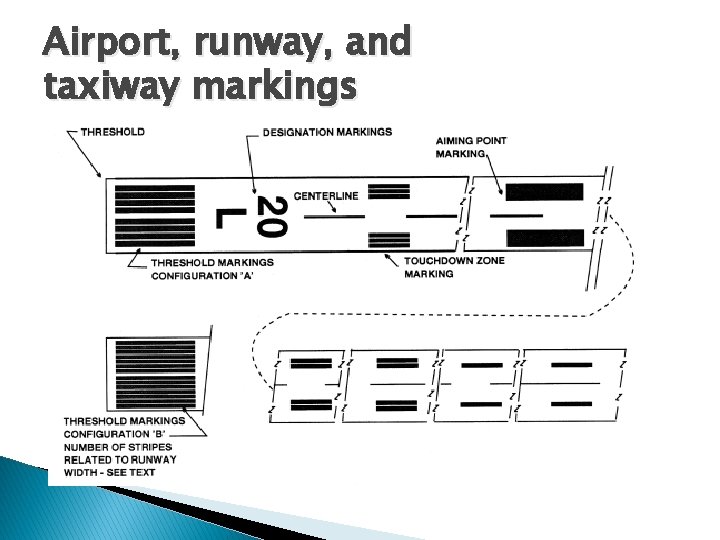
Airport, runway, and taxiway markings
Radio calls and checks Phonetic alphabet Use the 5 W’s q. Who are you calling – “Crosskeys traffic” q. Who are you – “Cessna 14 H” q. Where are you – “Departing/downwind/final/clear” q. What your intentions are - “For 27/9” q. Who are you calling – for clarification – “Crosskeys”
CTAF-common traffic advisory frequency For airports without a control tower May be a: ◦ UNICOM ◦ Multicom ◦ FSS ◦ Tower frequency (when closed) and is identified in appropriate aeronautical publications.
CTAF continued UNICOM – a nongovernmental communications facility which may provide information at certain airports. Multicom – a mobile service not open to public Correspondence used to provide communications essential to conduct the activities being performed by or directed from private aircraft.
Flight service station 1 -800 WX-brief FSS – Air traffic facilities which provide Pilot briefings En route communication VFR search and rescue services Assist lost aircraft and aircraft in emergencies Relay ATC clearances Originate Notices to Airmen (NOTAMS) Broadcast aviation wx and NAS (National air service) information Receive and process flight plans Monitor NAVAIDs
Flight service station continued In addition, at selected locations, FSSs provide En route Flight Advisory Service (Flight watch) Flight Watch is the common name in the United States for an Enroute Flight Advisory Service (EFAS) dedicated to providing weather to and collecting it from pilots operating at lower altitudes (mostly general aviation). Take weather observations Issue airport advisories Advise customs and immigrations of transboarder flights
Obtaining airport advisories Local airport advisory is provided by flight service stations or the military at airports not serviced by an operating control tower ◦ Provides information to arriving and departing aircraft concerning wind direction and speed, favored runway, altimeter setting, pertinent know traffic, pertinent know field conditions, airport taxi routes and traffic patters, and authorized instrument approaches. ◦ This information is advisory only – not an ATC clearance
Obtaining airport advisories Other airport advisories common at nontower airports may be obtained over the CTAF from other aircraft in the pattern or through the UNICOM. Pilots landing at non-tower airports should monitor the CTAF at least 10 -20 miles out to hear other traffic in the pattern. If unable, request an airport advisory 5 -10 miles out. Check wind sock.
Airports continued Runway Incursions Use of Aircraft Lighting during Taxi and Traffic Pattern Operations Collision avoidance Scanning for Traffic Pattern Operations Practice Area Operations
Runway incursions Never taxi onto any runway without first looking for landing traffic. Always monitor the CTAF and/or the appropriate ATC frequencies while operating on the surface of an airport.
Right-of-way rules General – see and avoid In distress – has the right of way above all Converging – the aircraft to the right or the least maneuverable (glider, balloon, airship) or an aircraft towing another aircraft. Head-on – each alters to the right Overtaking – the aircraft being overtaken, the overtaking aircraft alters course to the right. Landing – aircraft on final, or the lower aircraft.
Use of lighting during taxi and traffic pattern operations Engine running - beacon Taxiing – navigation, position, anti collision Crossing runway – all exterior lights Taxi to takeoff – all lights that silhouette Takeoff – landing light on when cleared Day or night – landing light should be left on until well clear of the pattern and turned on well before reaching the pattern.
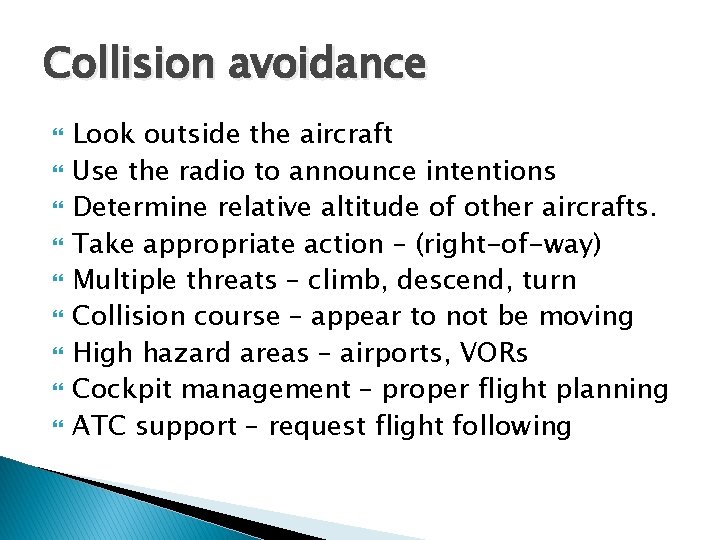
Collision avoidance Look outside the aircraft Use the radio to announce intentions Determine relative altitude of other aircrafts. Take appropriate action – (right-of-way) Multiple threats – climb, descend, turn Collision course – appear to not be moving High hazard areas – airports, VORs Cockpit management – proper flight planning ATC support – request flight following
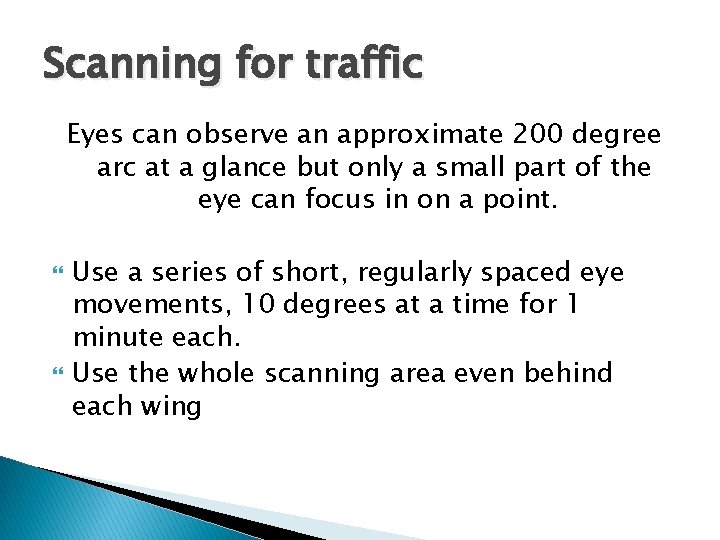
Scanning for traffic Eyes can observe an approximate 200 degree arc at a glance but only a small part of the eye can focus in on a point. Use a series of short, regularly spaced eye movements, 10 degrees at a time for 1 minute each. Use the whole scanning area even behind each wing
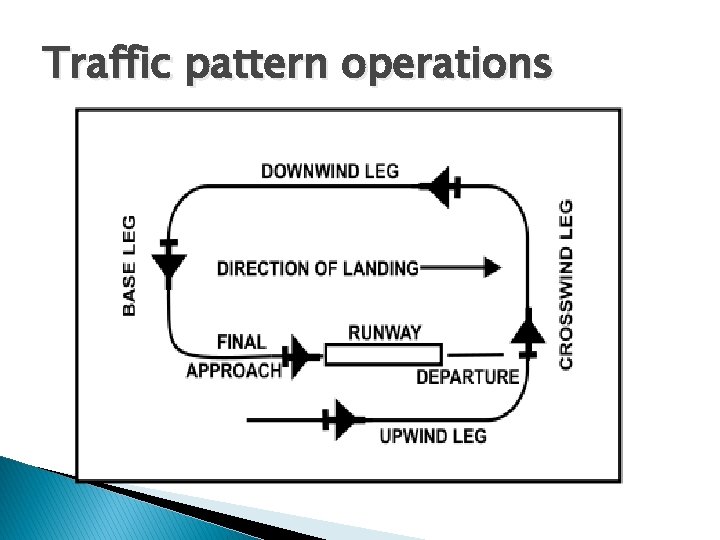
Traffic pattern operations
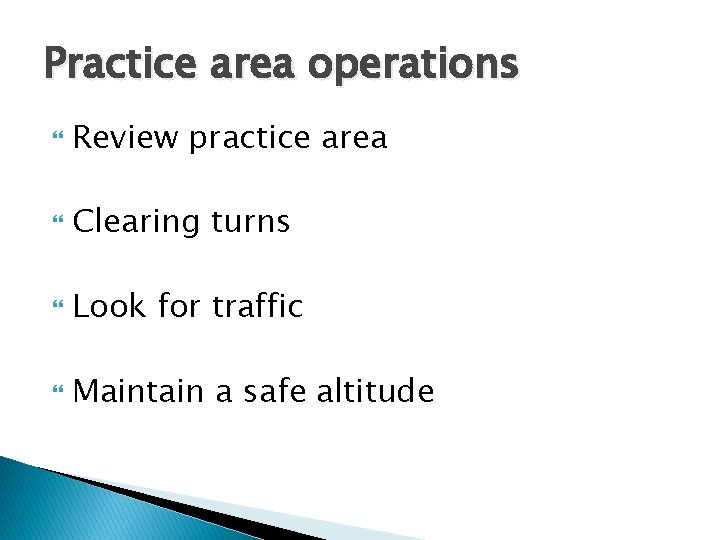
Practice area operations Review practice area Clearing turns Look for traffic Maintain a safe altitude
Aerodynamics � 4 Forces of Flight � Angle of Attack � Airframe (Components) � Three Axes of Flight � Forces Acting on a Climbing Aircraft � Forces Acting on a Descending Aircraft � Forces Acting on a Turning Aircraft � Effects of Flaps � Critical Angle of Attack/Stalls � Spin Awareness
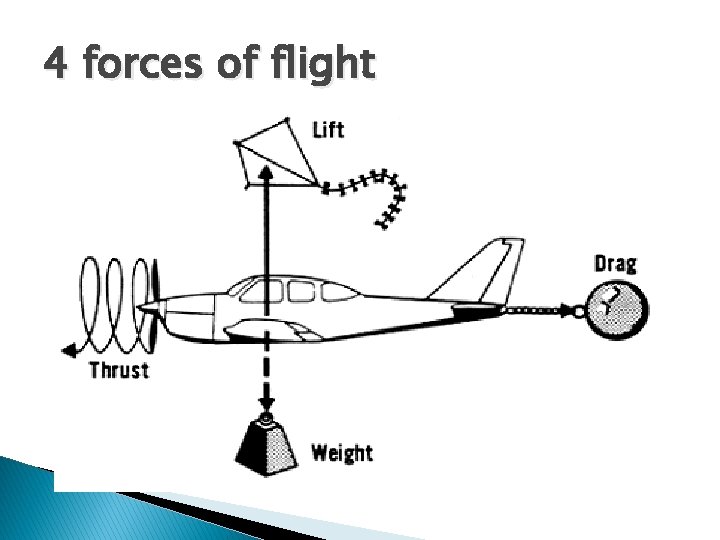
4 forces of flight
Lift Supporting force for flight in an atmosphere Acts perpendicular to the relative wind Generated through Bernoulli’s Principle and Newton’s Law
Bernoulli ‘s Principle As a fluid passes through a pipe that narrows or widens, the velocity and pressure of the fluid vary. As the pipe narrows, the fluid flows more quickly. Surprisingly, Bernoulli's Principle tells us that as the fluid flows more quickly through the narrow sections, the pressure actually decreases rather than increases! http: //mitchellscience. com/bernoulli_principle _animation
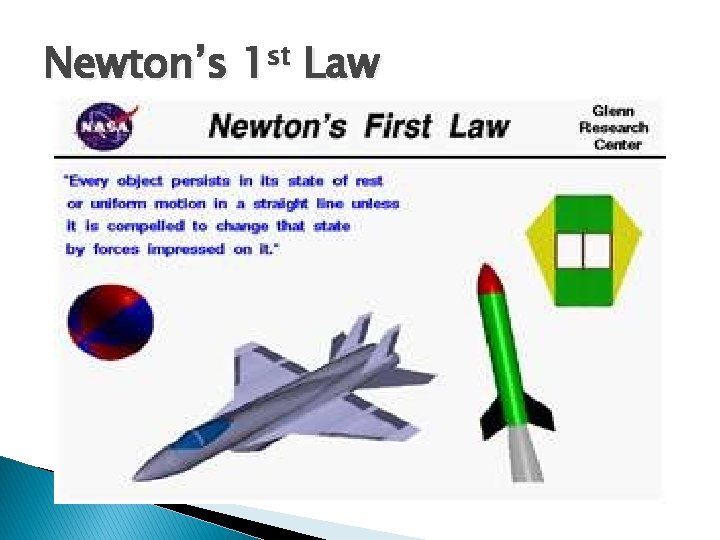
Newton’s 1 st Law
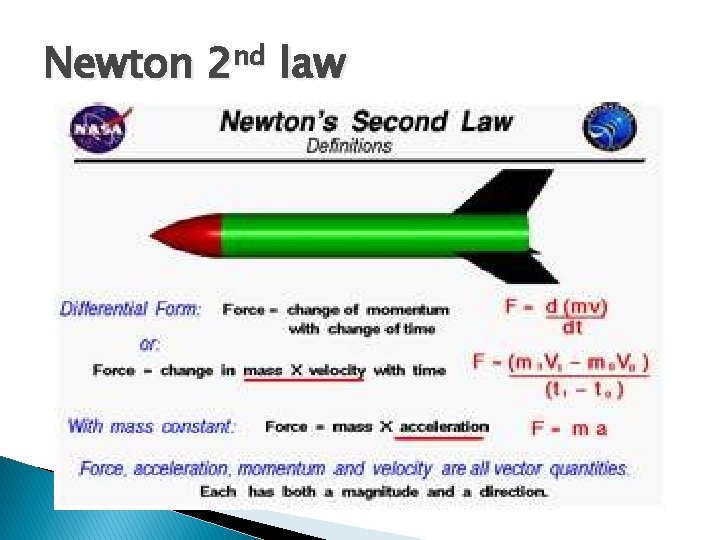
Newton 2 nd law
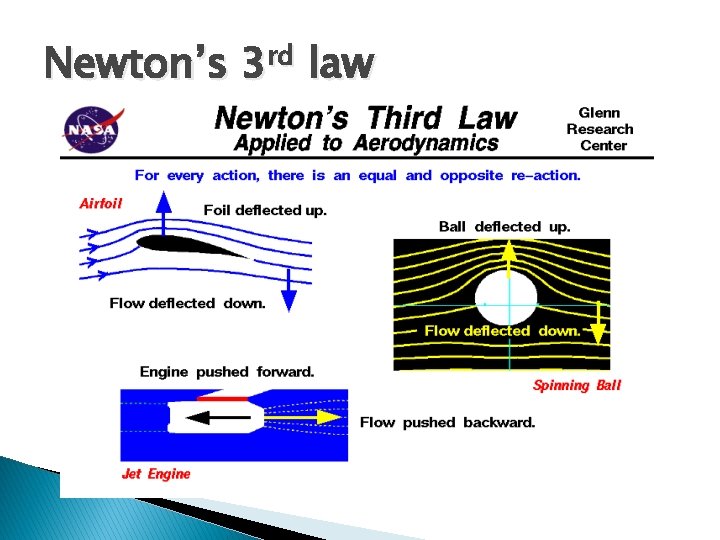
Newton’s 3 rd law
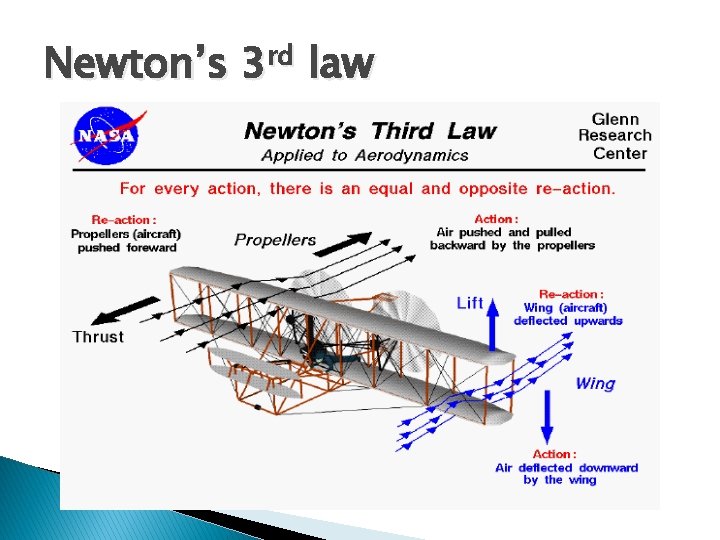
Newton’s 3 rd law
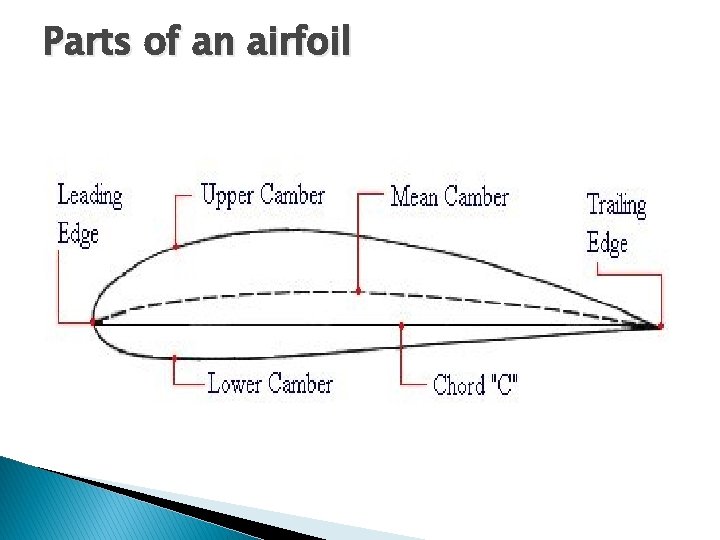
Parts of an airfoil
Thrust Considered to act parallel and just about on the longitudinal axis Produced by movement of the air by propeller or the expansion of air in a turbine
Weight/Gravity Mass X acceleration (gravity) Always act toward the center on the earth Considered to act from the center of gravity v. CG is the point on the aircraft, that if suspended it would balance.
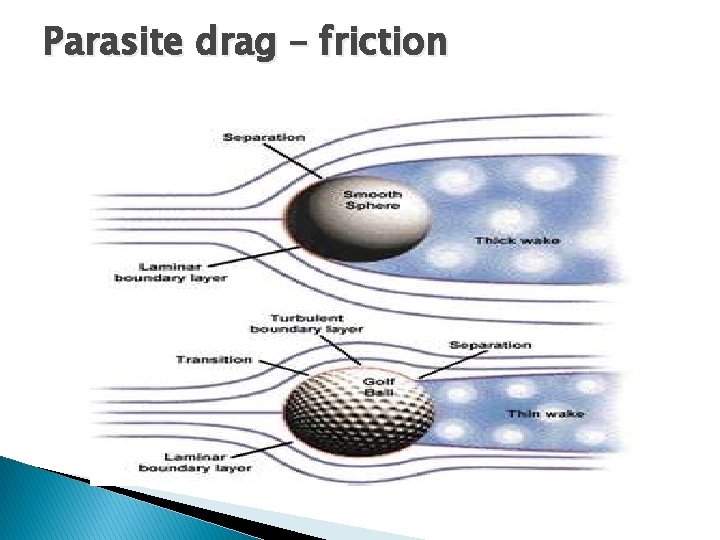
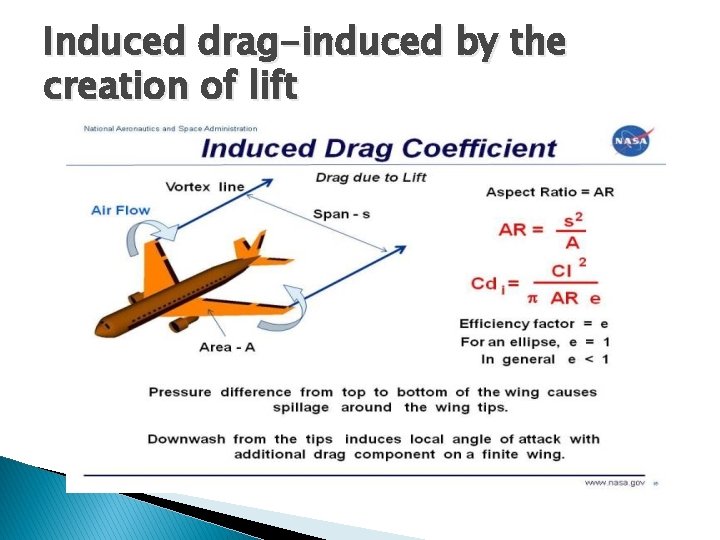
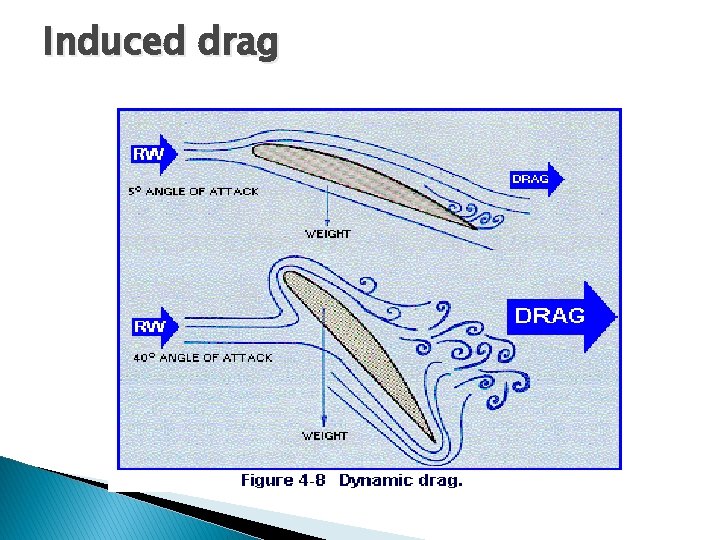
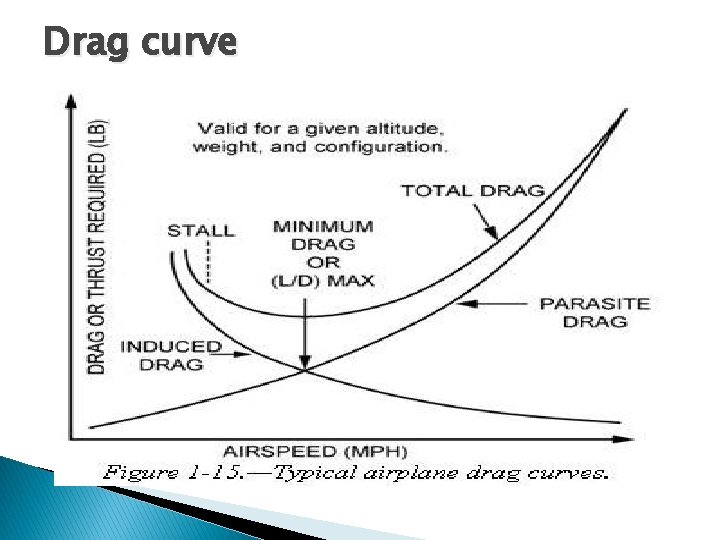
Drag drag v. Two types- parasite & induced v. Retarding force v. Acts parallel to relative wind During straight & level v. Lift = Weight v. Thrust = Drag Steady state flight v. Upward and downward forces are equal v. Forward = retarding forces
Parasite drag – friction
Induced drag-induced by the creation of lift
Induced drag
Drag curve
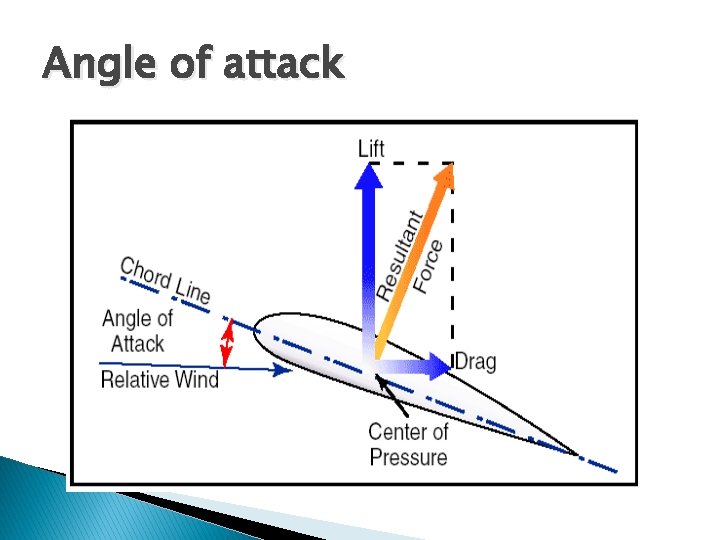
Angle of attack The acute angle between the chord line of the airfoil and the direction of the relative wind At angles less that the critical angle of attack, an increase in the angle of attack will increase lift provided that all other factors are the same
Angle of attack
3 axes of flight
Airframe construction (components)
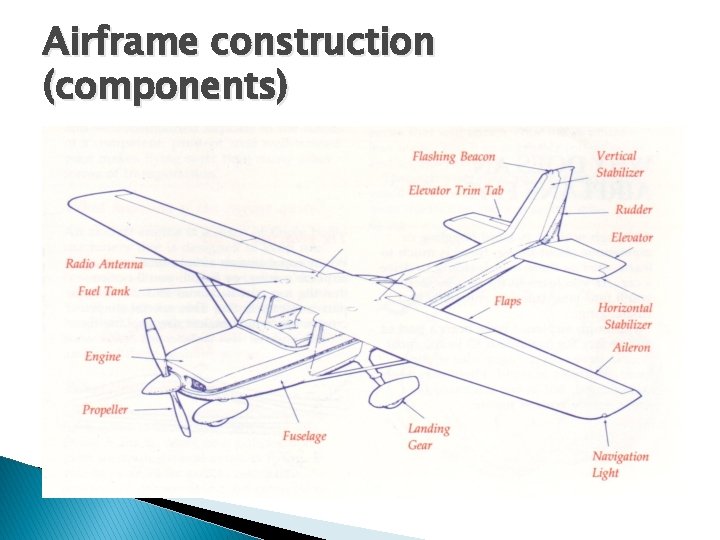
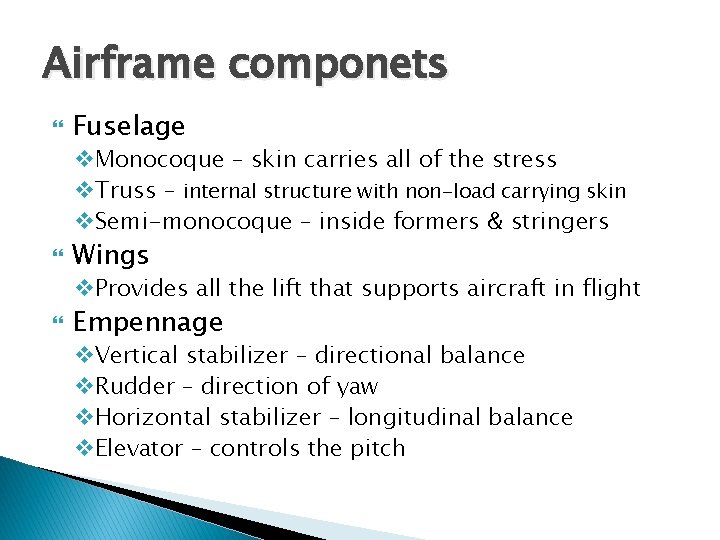
Airframe componets Fuselage v. Monocoque – skin carries all of the stress v. Truss – internal structure with non-load carrying skin v. Semi-monocoque – inside formers & stringers Wings v. Provides all the lift that supports aircraft in flight Empennage v. Vertical stabilizer – directional balance v. Rudder – direction of yaw v. Horizontal stabilizer – longitudinal balance v. Elevator – controls the pitch
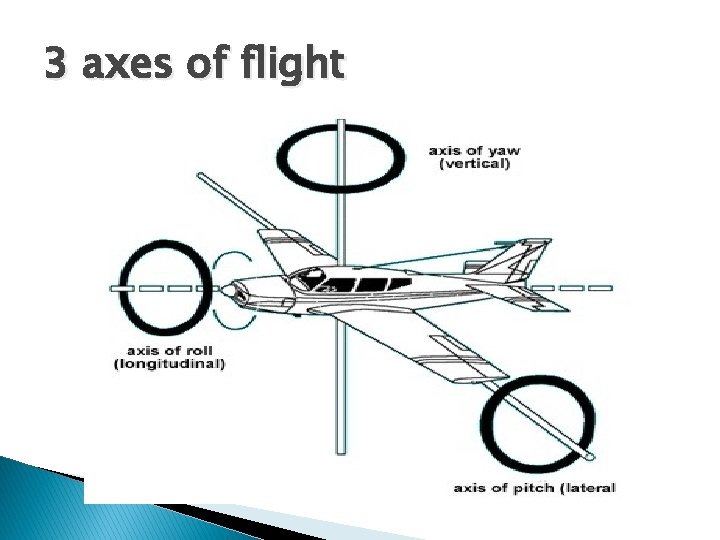
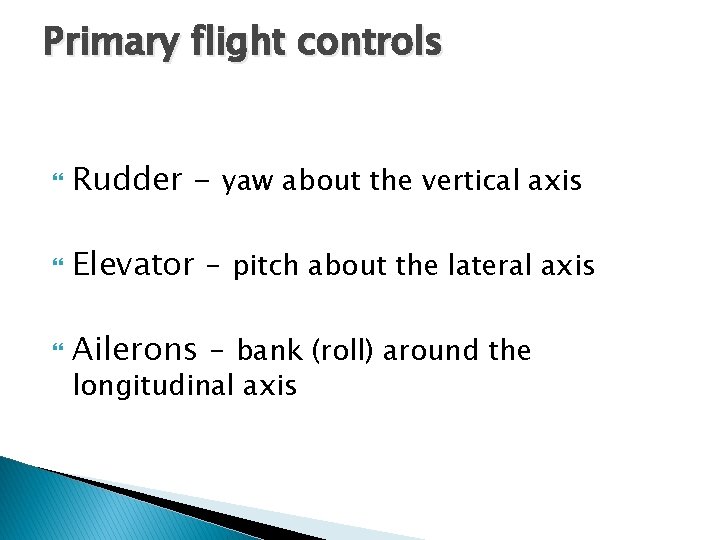
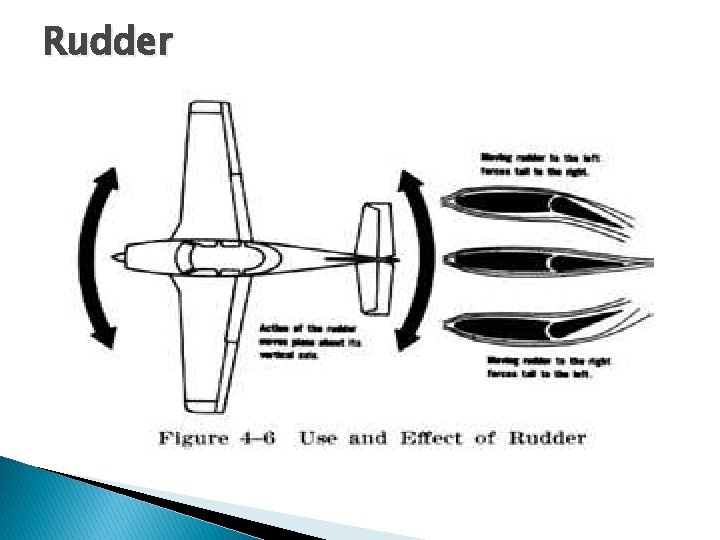
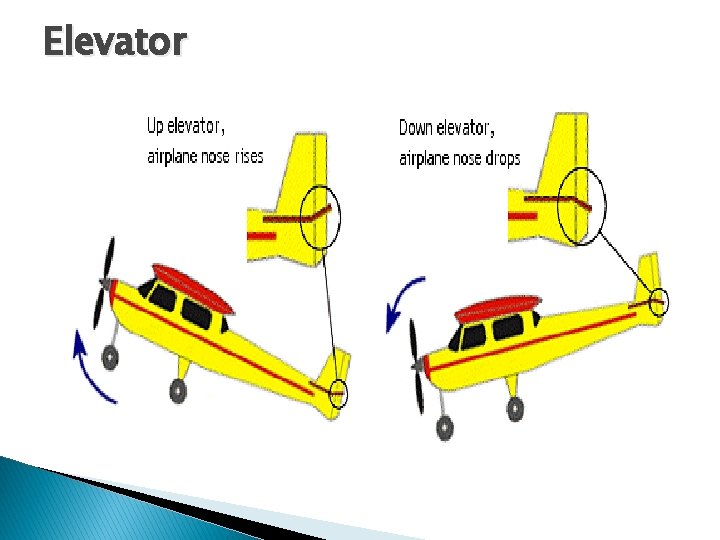
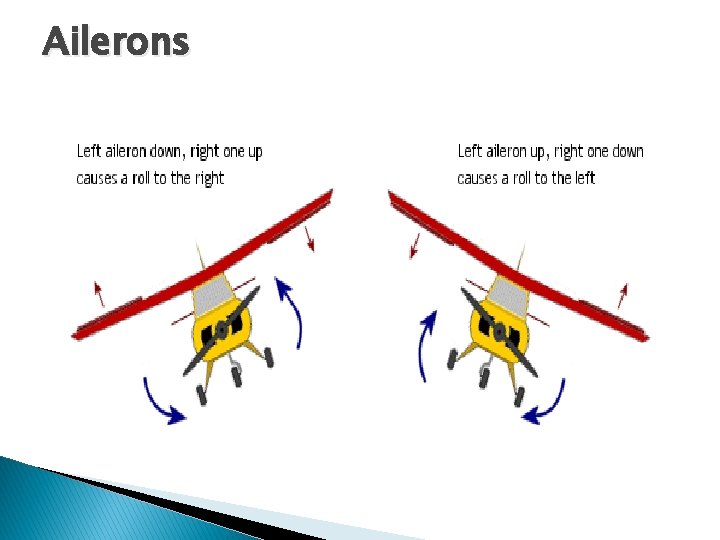
Primary flight controls Rudder - yaw about the vertical axis Elevator – pitch about the lateral axis Ailerons – bank (roll) around the longitudinal axis
Rudder
Elevator
Ailerons
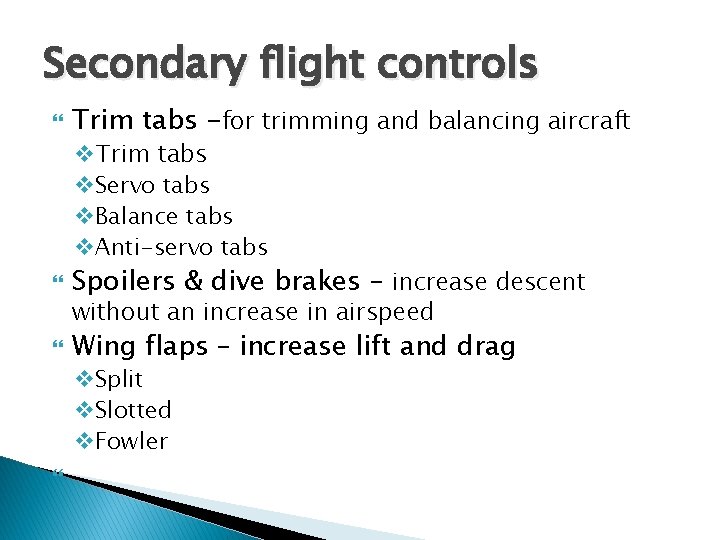
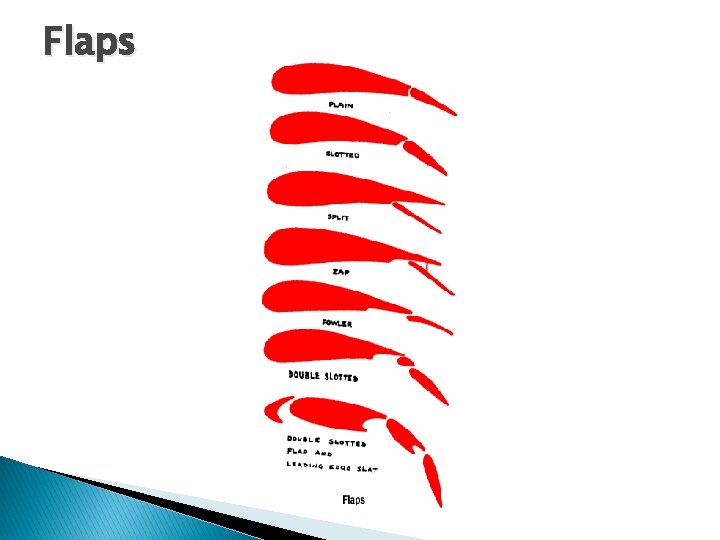
Secondary flight controls Trim tabs -for trimming and balancing aircraft v. Trim tabs v. Servo tabs v. Balance tabs v. Anti-servo tabs Spoilers & dive brakes – increase descent Wing flaps – increase lift and drag without an increase in airspeed v. Split v. Slotted v. Fowler
Flaps
Landing gear Retractable vs. fixed Tricycle vs. conventional (tail wheel)
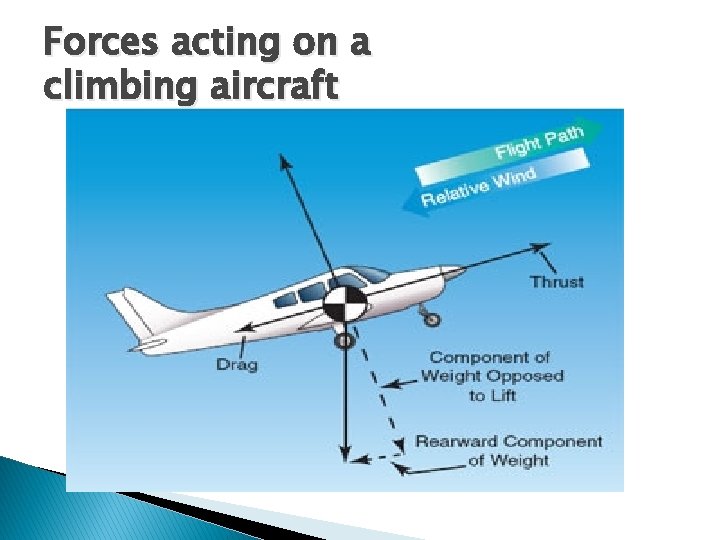
Forces acting on a climbing aircraft
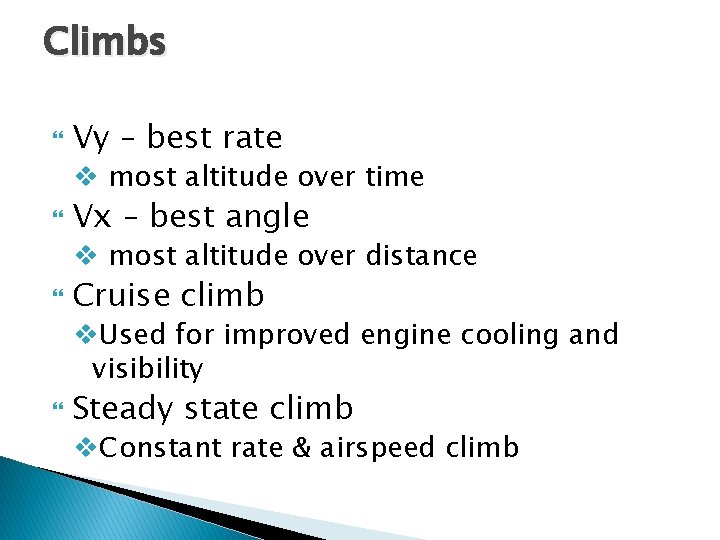
Climbs Vy – best rate v most altitude over time Vx – best angle v most altitude over distance Cruise climb v. Used for improved engine cooling and visibility Steady state climb v. Constant rate & airspeed climb
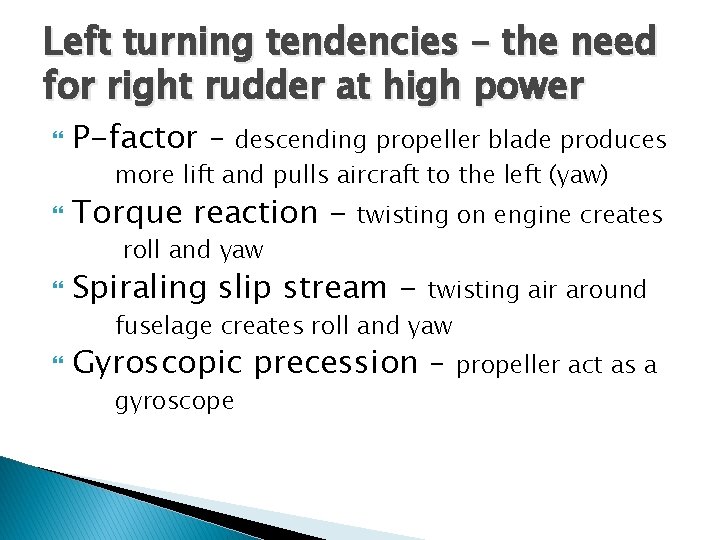
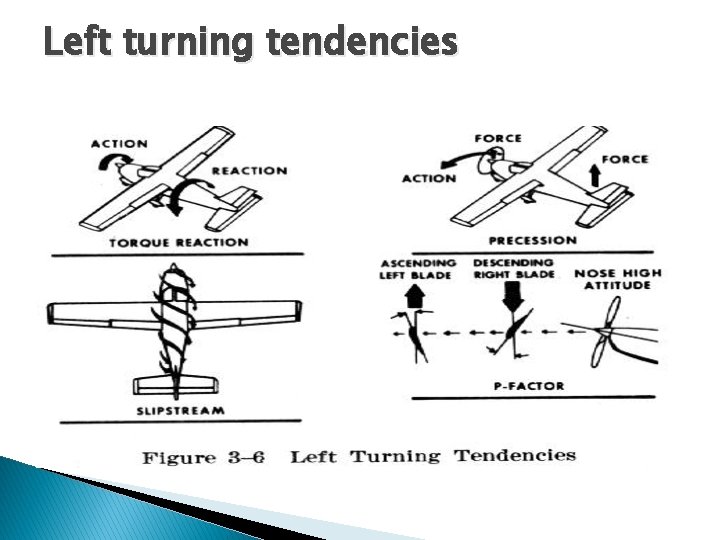
Left turning tendencies – the need for right rudder at high power P-factor – Torque reaction - descending propeller blade produces more lift and pulls aircraft to the left (yaw) roll and yaw twisting on engine creates Spiraling slip stream - Gyroscopic precession – twisting air around fuselage creates roll and yaw gyroscope propeller act as a
Left turning tendencies
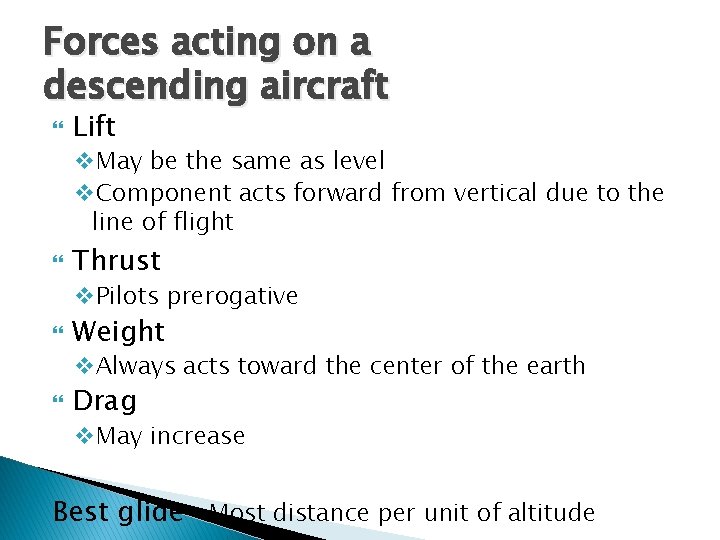
Forces acting on a descending aircraft Lift v. May be the same as level v. Component acts forward from vertical due to the line of flight Thrust v. Pilots prerogative Weight v. Always acts toward the center of the earth Drag v. May increase Best glide -Most distance per unit of altitude
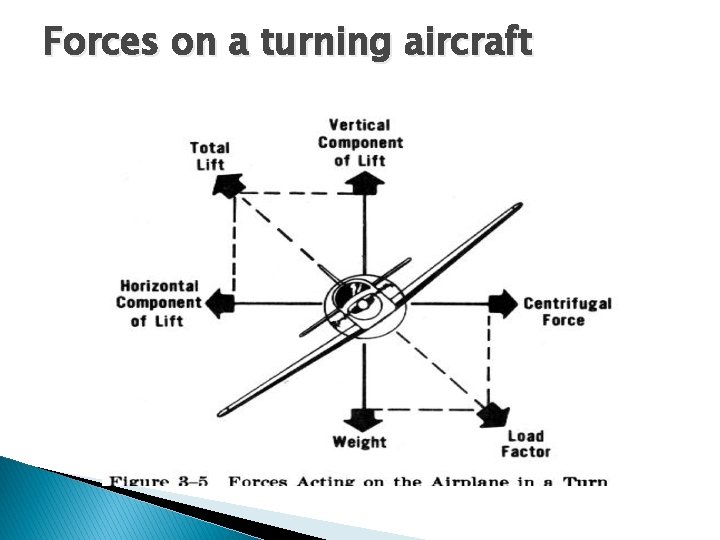
Forces on a turning aircraft
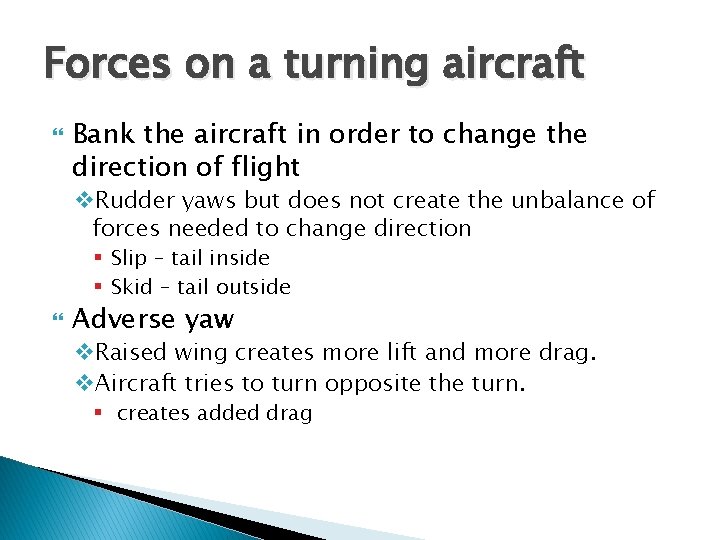
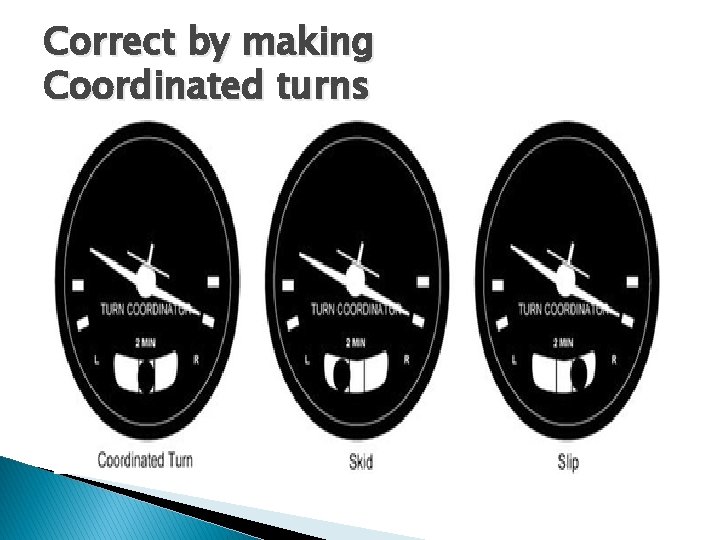
Forces on a turning aircraft Bank the aircraft in order to change the direction of flight v. Rudder yaws but does not create the unbalance of forces needed to change direction § Slip – tail inside § Skid – tail outside Adverse yaw v. Raised wing creates more lift and more drag. v. Aircraft tries to turn opposite the turn. § creates added drag
Correct by making Coordinated turns
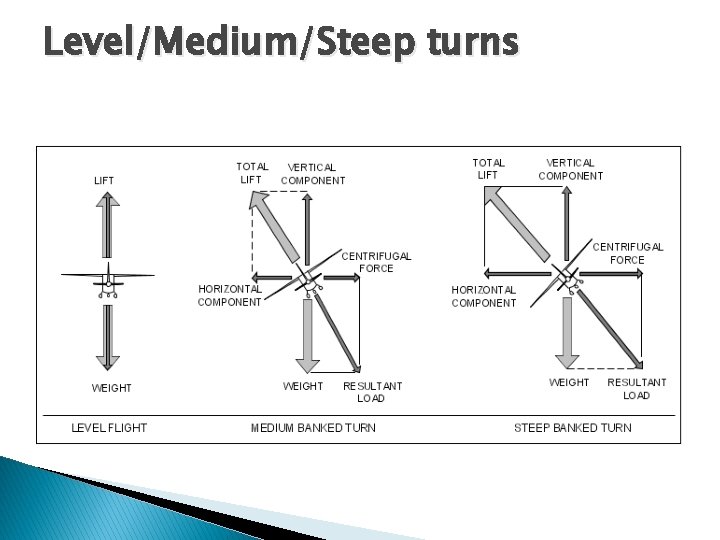
Types of turns Horizontal turns v. Lift vector is tilted § Creates an acceleration Shallow - 0 to 20 degrees of bank Medium – 20 to 45 degree of bank Steep – more than 45 degree of bank Apply coordinated aileron and rudder initially for the turn, then increase back pressure, once the turn is established pressure on controls can be relaxed
Level/Medium/Steep turns
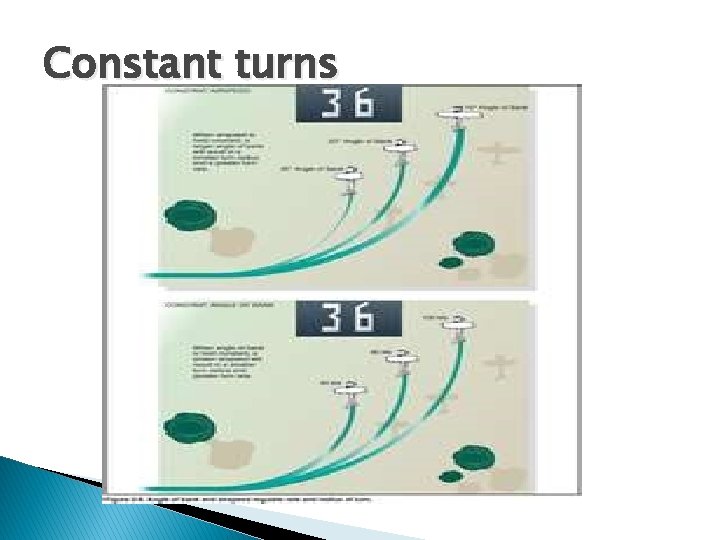
Constant turns
Overbanking tendencies The raised wing creates more lift than the lowered wind. Especially in steeper turns the lift on the raised wing will continue to increase and will need aileron applied opposite the turn in order to correct.
Effect of flaps Extending the flaps increases: v. Wing camber v. Wing area (some types) v. Angle of attack of the wing ØThese changes increase lift and drag (induced and parasite ØAllows the pilot to make a steeper approach without increasing airspeed ØMay provide increased lift required for certain maneuvers
Critical angle of attack/Stalls An airplane will fly as long as the wing is creating sufficient lift to counteract the load imposed on it The angle of attack at which a wing stalls regardless of airspeed, flight attitude, or weight is known as the critical angle of attack
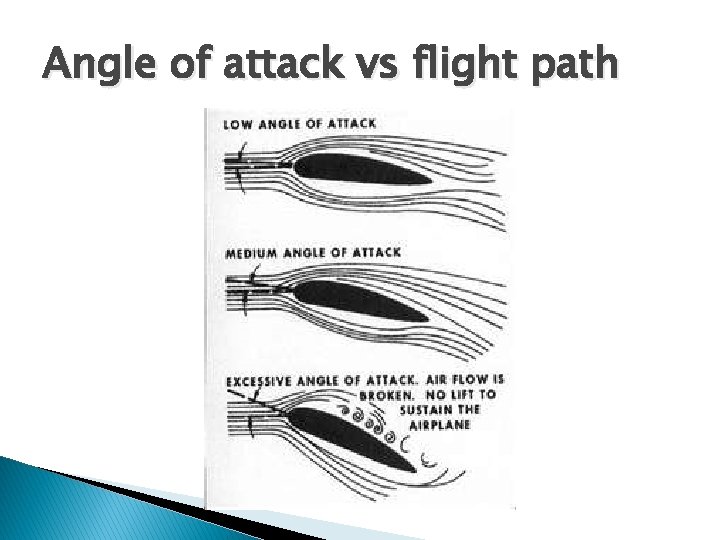
Critical angle of attack/Stalls v. The direct cause of every stall is an excessive angle of attack v. The smooth flow of air over the top of the wing is disturbed at this critical angle of attack v. The stalling speed of a particular airplane is not a fixed value for all flight situations v. A given airplane will always stall at the same angle of attack regardless of airspeed, weight, load factor, or density altitude v. The angle is typically from 16 -20 degrees, depending on the airplane’s design
Angle of attack vs flight path
Critical angle of attack/Stalls The critical angle of attack can be exceeded at any attitude or airspeed v. At low airspeed, the angle of attack will tend to be high v. Abrupt control application and/or higher bank angles will be involved with exceeding the critical angle of attack at higher airspeeds or lower pitch attitudes Recovery from a stall requires the pilot to reduce the angle of attack to allow the smooth air over the wing to begin again v. Considerable altitude may be lost during recovery
Spin awareness A spin may be defined as an aggravated stall that results “autorotation” and the airplane follows a downward corkscrew path The “autorotation” results from an unequal angle of attack on the airplane’s wings v. The rising wing is less stalled v. The descending wing has exceeded the critical angle of attack and is more stalled Spins may occur during stalls with a sideslip or yaw acting on the airplane at the time of the stall
4 phases of a spin Entry - stall Incipient – lasts about 4 to 6 seconds approximately 2 turns Developed – airspeed vertical speed, and rate of rotation are stabilized. Altitude loss approximately 500 feet each 3 second turn Recovery - wings regain lift recovery in about ½ to ¼ turn after anti-spin inputs are applied
Spin recovery Reduce throttle to idle Position the ailerons to neutral Apply full opposite rudder Apply positive forward movement of the elevator forward of neutral to break the stall After spin rotation stops, neutralize the rudder Begin applying back pressure to raise the nose to level flight
Spin avoidance and recovery require positive control applications Intentional spins should only be practiced within the limitations of a properly rigged airplane with a qualified instructor at an altitude allowing recovery prior to descent below 3000 ft AGL
Airplane Stability (PIO), Load Factors, and Wake � Static Stability (Positive/Negative) � Dynamic Stability (Positive/Negative) � Dihedral Effect � Ground Effect � Wing Tip Vortices � Wake Turbulence and Avoidance � Load Factor and Gusts
Stability defined Stability - the inherent quality of an airplane Controllability - the airplane’s capability Maneuverability - the ability of the aircraft to correct for conditions that may disturb it from equilibrium to respond to a pilot’ control inputs to change direction about the three exes and withstand the forces imposed by the maneuver
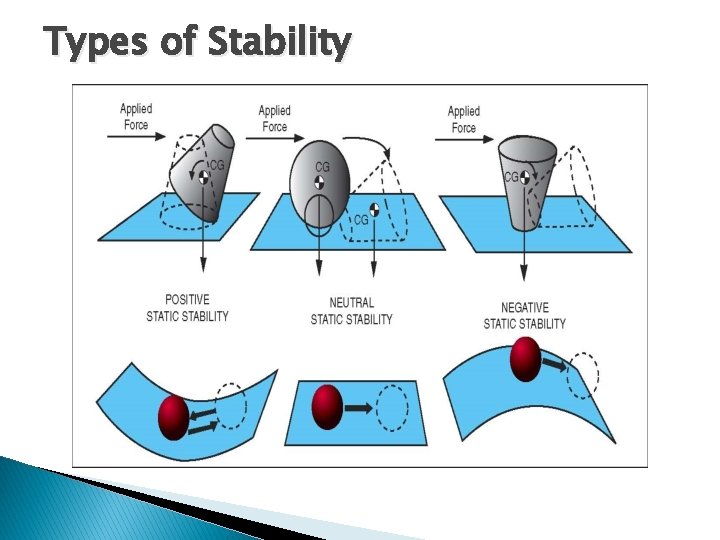
Positive/Neutral/Negative Positive – when moved out of equilibrium the more likely it is to return to equilibrium Neutral – when moved out of equilibrium it will tend to stay in the new position Negative – when moved out of equilibrium the more likely it is to continue in the new direction
Relationships to stability In inherently stable aircraft returns to it’s original position after being disturbed The location of the center of gravity (CG) determines the longitudinal stability Too much stability is detrimental to maneuverability Too little stability can be detrimental to controllability
Types of Stability
Static stability (positive/negative) Stability - the inherent quality of an airplane Controllability - the airplane’s capability Maneuverability - the ability of the aircraft to correct for conditions that may disturb it from equilibrium to respond to a pilot’ control inputs to change direction about the three exes and withstand the forces imposed by the maneuver
Dynamic stability (positive/negative) The result over time when reacting to a disturbance from equilibrium Dynamic stability requires positive static stability as the initial reaction v. An aircraft with positive dynamic stability will tend to return to equilibrium through smaller and smaller oscillations v. An aircraft with neutral dynamic stability will tend to continue oscillation with the same magnitude for each oscillation v. An aircraft with negative dynamic stability will continue oscillating with the magnitude of each oscillation increasing
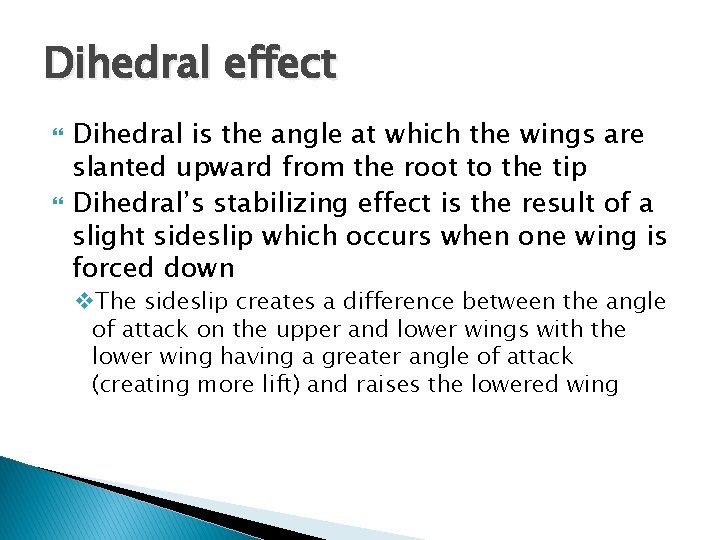
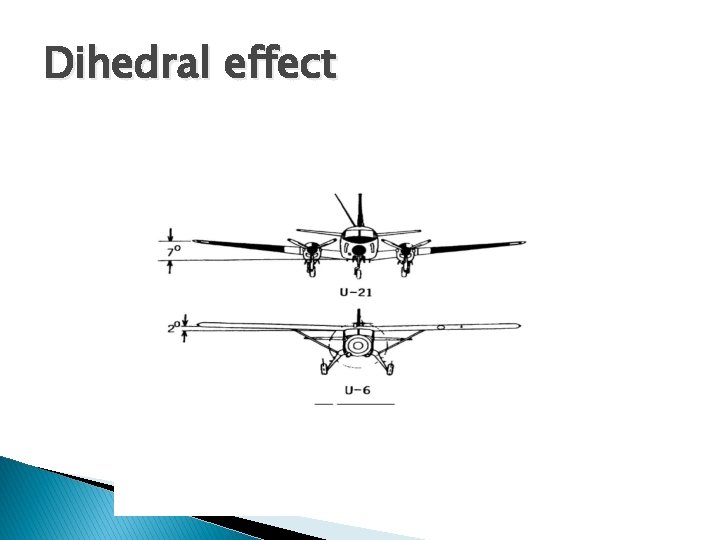
Dihedral effect Dihedral is the angle at which the wings are slanted upward from the root to the tip Dihedral’s stabilizing effect is the result of a slight sideslip which occurs when one wing is forced down v. The sideslip creates a difference between the angle of attack on the upper and lower wings with the lower wing having a greater angle of attack (creating more lift) and raises the lowered wing
Dihedral effect
Pilot induced oscillations (PIO) By over-controlling/correcting the aircraft the pilot disturbs the inherent stability creating oscillations that increase in magnitude until the aircraft become impossible to control
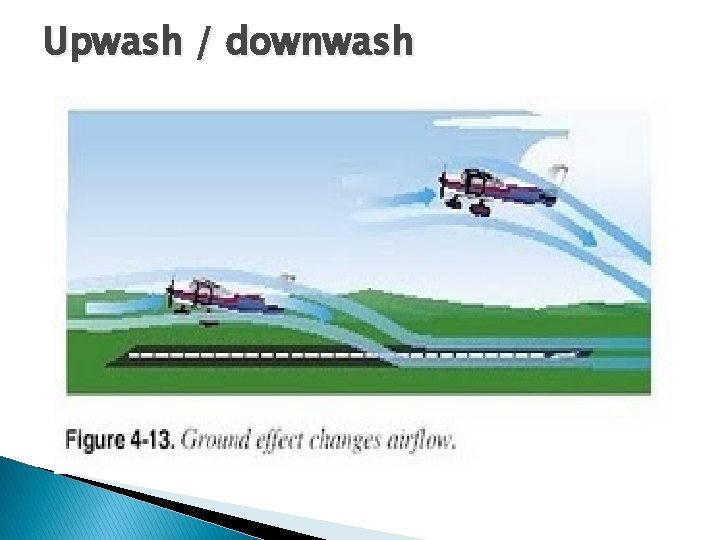
Ground effect The condition of improved performance encountered when the aircraft is near the ground (approximately a wing span) v. The ground changes the airflow around the wing and creates a cushion of air § This reduces the upwash, downwash, and wingtip vortices § Results in a reduction of induced drag
Upwash / downwash
Uses and dangers of ground effect Good stuff v. Allows the pilot to reduce wear and tear on the aircraft and increase acceleration when operating from a soft-field v. May be utilized to soften a landing Bad stuff v. May allow the aircraft to takeoff before the aircraft is ready to continue flying which can result in settling v. May cause excessive float on landing
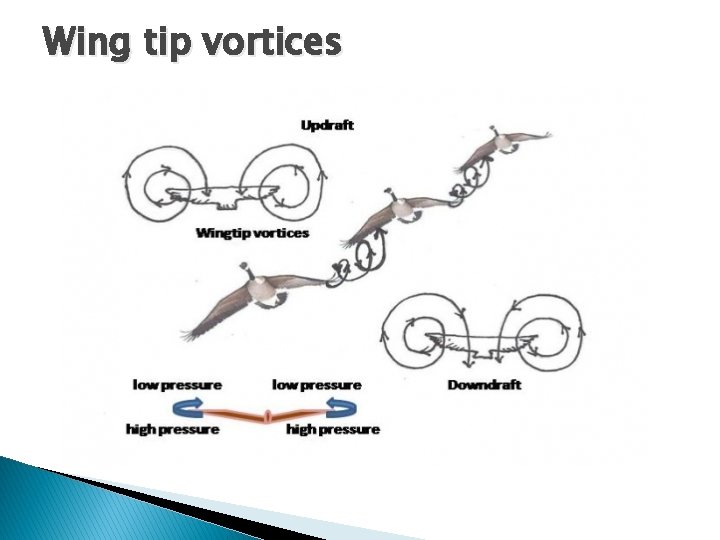
Wing tip vortices
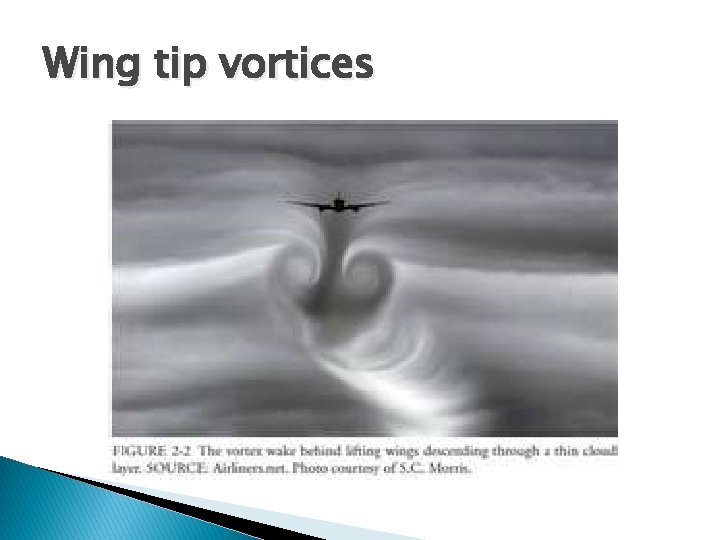
Wing tip vortices
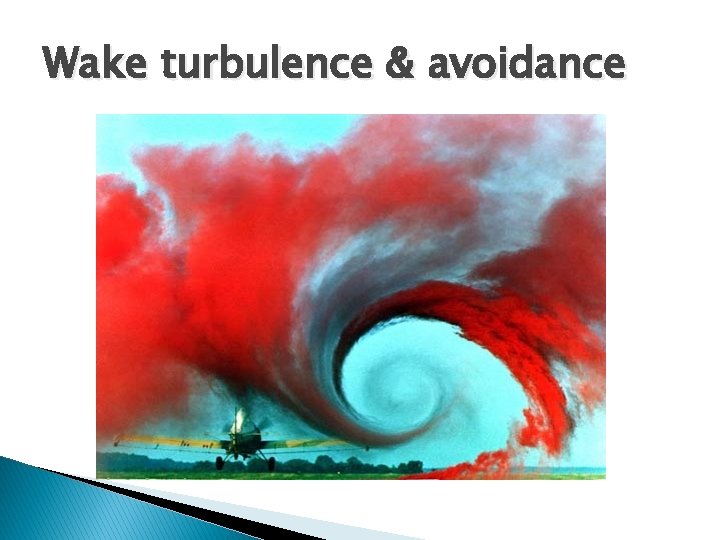
Wake turbulence & avoidance
Wake turbulence Strongest wake v. Heavy (larger AOA) v. Clean (no changes in the wing) v. Slow (larger AOA) Jet blast v. Exhaust from a jet can flip a light aircraft v. Stay back 500 ft.
Wake turbulence & avoidance Wake turbulence avoidance in flight v. Avoid 5+ miles behind the aircraft v. Avoid 1, 000 ft below the aircraft Wake turbulence avoidance landing v. Approach above the larger aircraft’s path v. Touchdown beyond the larger aircraft’s touchdown point v. Land prior to the larger aircraft’s rotation point v. Be cautious of crosswinds that can make them drift Wake turbulence avoidance departing v. Rotate prior to and climb above the flight path v. Wait 2 -3 minutes if departing for dissipation
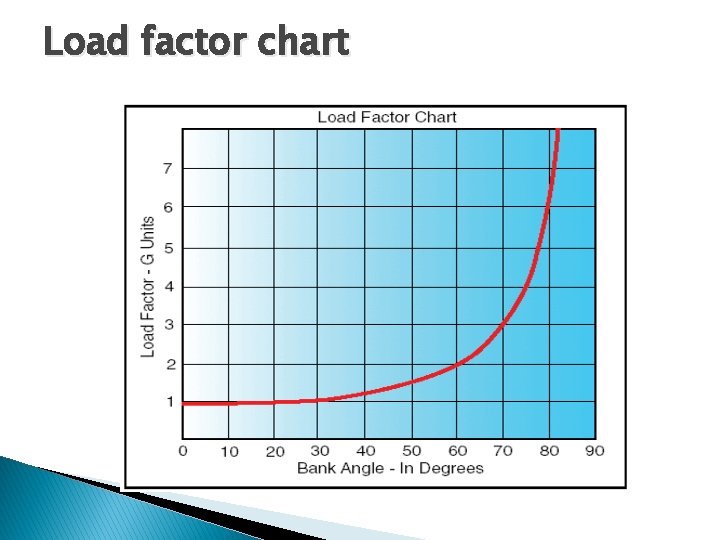
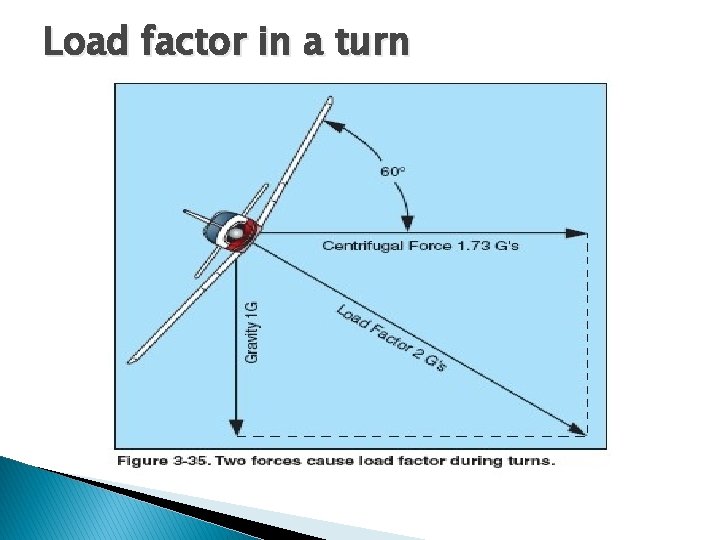
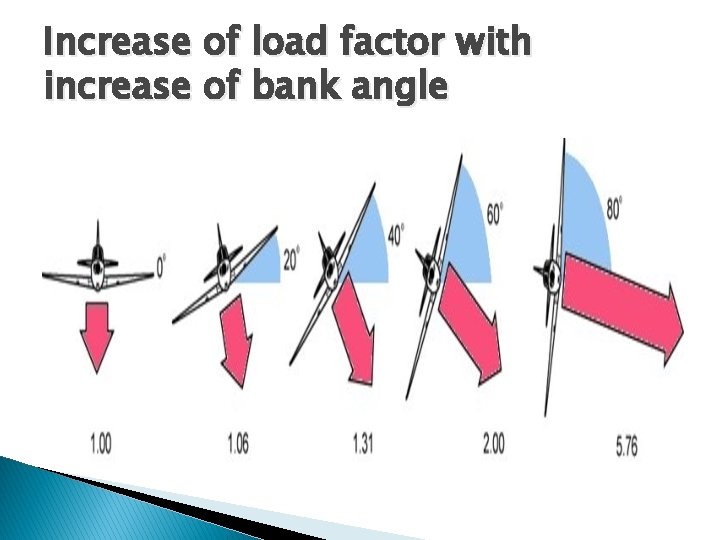
Load factor A load is a force which is supported by the wings of the aircraft the load in straight-and-level unaccelerated flight is the weight of the aircraft and its contents (1 G) A load factor is a ratio of the total load supported by the wings to the actual weight of the aircraft and its contents v. Also referred to as G’s (gravities) Climbing or turning will increase the G load v. The load factor in turning flight is determined by the bank angle
Load factor chart
Load factor in a turn
Increase of load factor with increase of bank angle
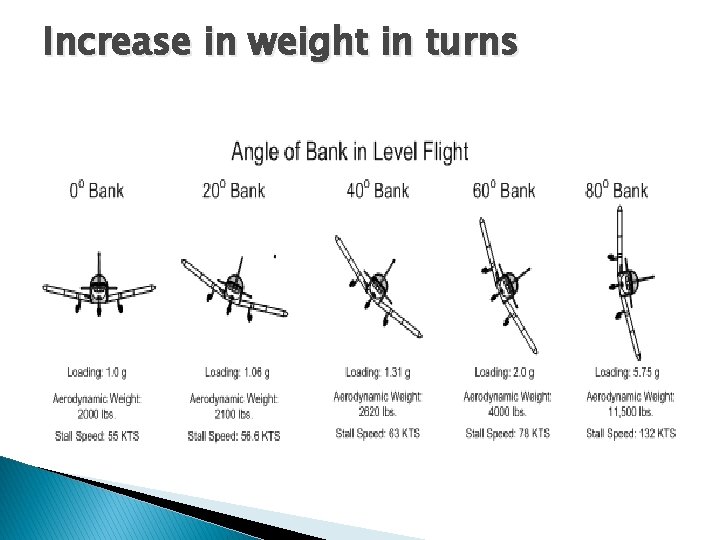
Increase in weight in turns
Stall speed and load factor In order to maintain level flight during a turn, the wings must produce enough lift to support the weight of the aircraft multiplied by the load factor The increased angle of attack required to produce the extra lift at any given bank angle will increase the stall speed of the aircraft (multiply the stall speed by the square root of the load factor to determine the higher stall speed)
Category of aircraft Designed to handle without breaking apart Normal = +2. 5 to +3. 8/-1. 0 to -1. 52 (weight dependent) Utility = +4. 4/-1. 76 Acrobatic = +6. 0/-3. 0 Transport = +2. 5 to +3. 8/-1. 0 (weight dependent)
Va – maneuvering speed Va – the maximum speed that the aircraft will stall before a damaging load factor results or the maximum speed at which full of abrupt control movements may be used without overstressing the aircraft Va changes with the weight of the aircraft Va is typically published for max gross weight (at weights less than max Va is lower)
Vertical gusts/Turbulence Vertical air currents or gusts may impose an increased load factor on an airplane v. These gusts are felt by the pilot and passengers as turbulence v. The aircraft’s speed must be kept below Vno (normal operating range) in any turbulence to prevent damage v. It should be kept below Va in severe of greater turbulence to allow an additional safety factor