
Ground Operations Demonstration Unit for Liquid HydrogenInitial Test
- Slides: 9
Ground Operations Demonstration Unit for Liquid Hydrogen-Initial Test Results William Notardonato 1, Adam Swanger 1, Wesley Johnson 2, and Thomas Tomsik 2 1 -NASA Kennedy Space Center 2 - NASA Glenn Research Center CEC/ICMC 2015 Tuscon, Arizona USA June 30, 2015 1
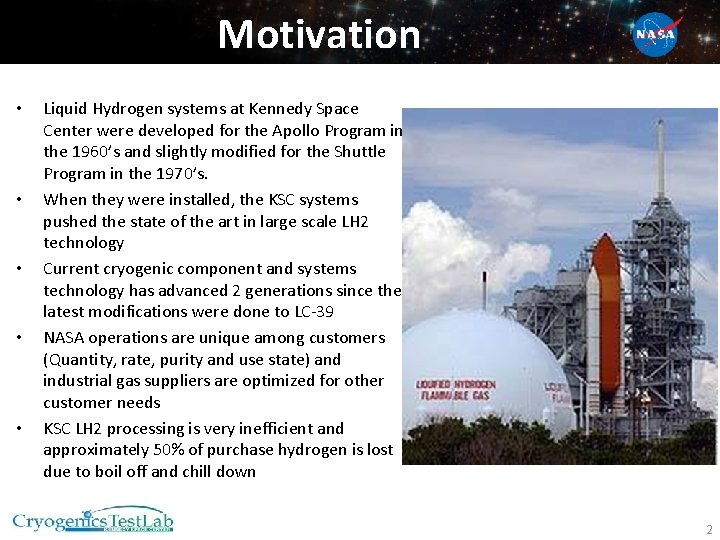
Motivation • • • Liquid Hydrogen systems at Kennedy Space Center were developed for the Apollo Program in the 1960’s and slightly modified for the Shuttle Program in the 1970’s. When they were installed, the KSC systems pushed the state of the art in large scale LH 2 technology Current cryogenic component and systems technology has advanced 2 generations since the latest modifications were done to LC-39 NASA operations are unique among customers (Quantity, rate, purity and use state) and industrial gas suppliers are optimized for other customer needs KSC LH 2 processing is very inefficient and approximately 50% of purchase hydrogen is lost due to boil off and chill down 2
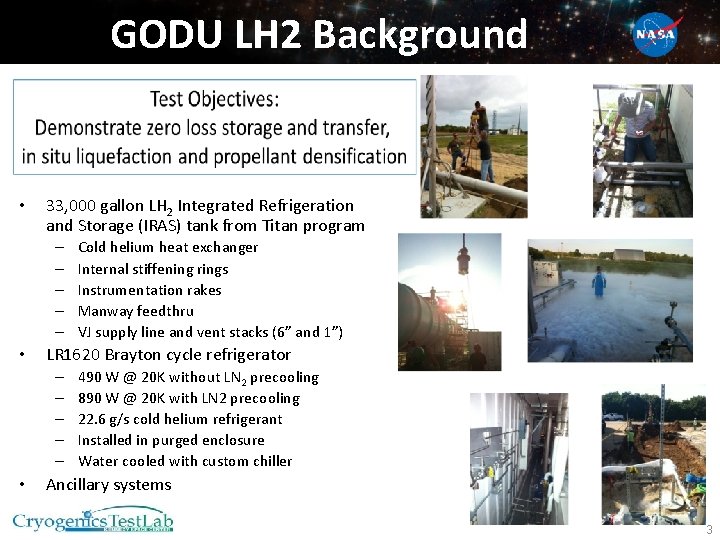
GODU LH 2 Background • 33, 000 gallon LH 2 Integrated Refrigeration and Storage (IRAS) tank from Titan program – – – • LR 1620 Brayton cycle refrigerator – – – • Cold helium heat exchanger Internal stiffening rings Instrumentation rakes Manway feedthru VJ supply line and vent stacks (6” and 1”) 490 W @ 20 K without LN 2 precooling 890 W @ 20 K with LN 2 precooling 22. 6 g/s cold helium refrigerant Installed in purged enclosure Water cooled with custom chiller Ancillary systems 3
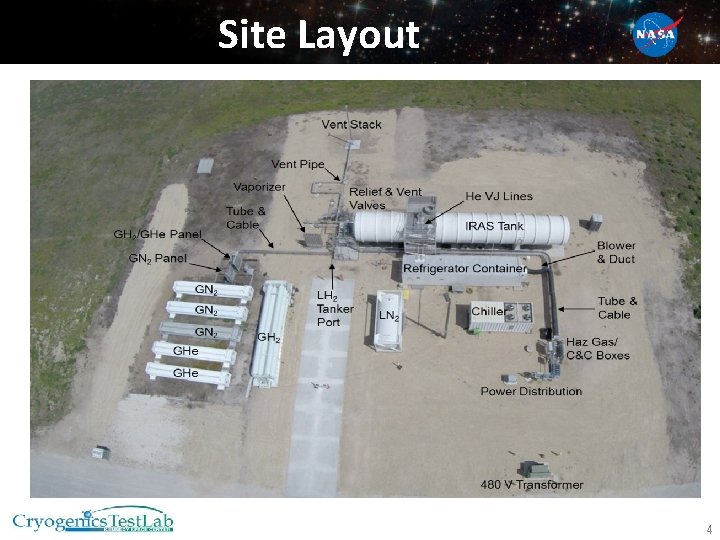
Site Layout 4
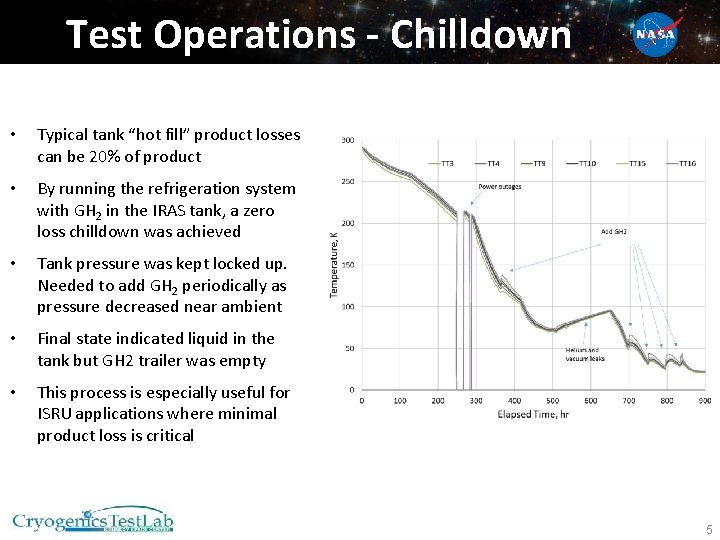
Test Operations - Chilldown • Typical tank “hot fill” product losses can be 20% of product • By running the refrigeration system with GH 2 in the IRAS tank, a zero loss chilldown was achieved • Tank pressure was kept locked up. Needed to add GH 2 periodically as pressure decreased near ambient • Final state indicated liquid in the tank but GH 2 trailer was empty • This process is especially useful for ISRU applications where minimal product loss is critical 5
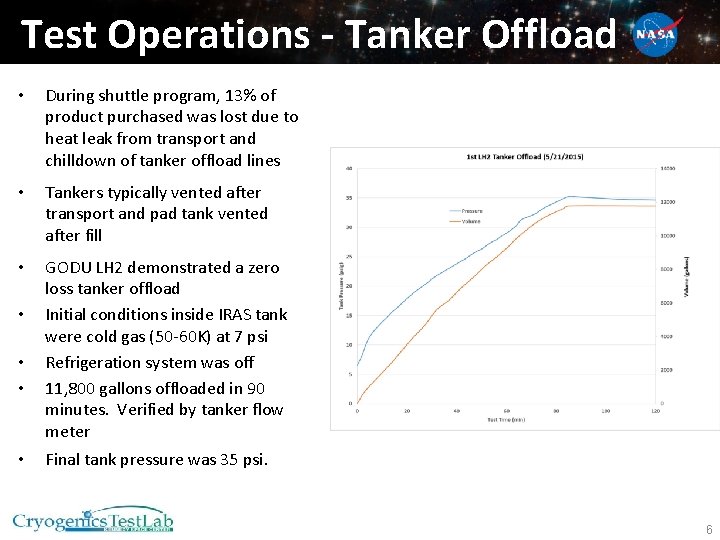
Test Operations - Tanker Offload • During shuttle program, 13% of product purchased was lost due to heat leak from transport and chilldown of tanker offload lines • Tankers typically vented after transport and pad tank vented after fill • GODU LH 2 demonstrated a zero loss tanker offload Initial conditions inside IRAS tank were cold gas (50 -60 K) at 7 psi Refrigeration system was off 11, 800 gallons offloaded in 90 minutes. Verified by tanker flow meter • • Final tank pressure was 35 psi. 6
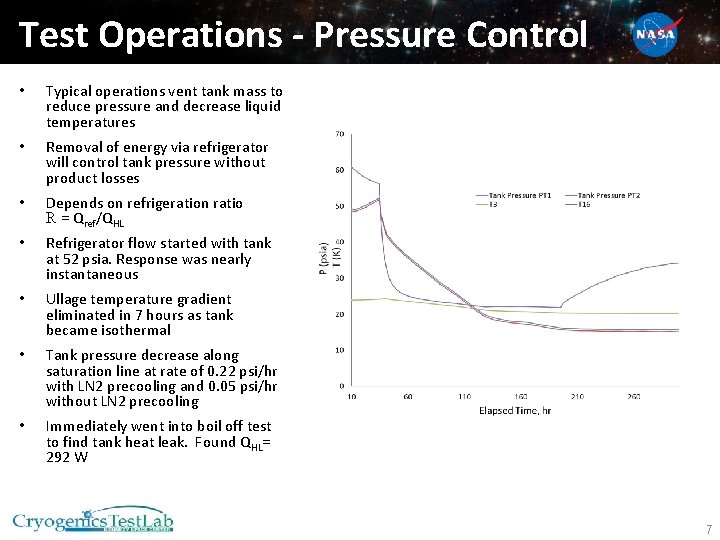
Test Operations - Pressure Control • Typical operations vent tank mass to reduce pressure and decrease liquid temperatures • Removal of energy via refrigerator will control tank pressure without product losses • Depends on refrigeration ratio R = Qref/QHL • Refrigerator flow started with tank at 52 psia. Response was nearly instantaneous • Ullage temperature gradient eliminated in 7 hours as tank became isothermal • Tank pressure decrease along saturation line at rate of 0. 22 psi/hr with LN 2 precooling and 0. 05 psi/hr without LN 2 precooling • Immediately went into boil off test to find tank heat leak. Found QHL= 292 W 7
Next Steps • Test Matrix includes the following tests at the 30%, 60% and 90% fill levels – – Zero loss tanker offload Boil off /heat leak determination Pressure control at 490 W and 890 W power Zero boil off • Temperature control point • Pressure control point • Refrigerator duty cycling – Liquefaction • Top fill and bottom fill – Densification • Hoping to achieve 16. 5 K 8
Conclusions • The GODU LH 2 project has just started its test series and preliminary results for cooldown and first tanker offload were presented • The system demonstrated successful zero loss tanker offload and pressure control using refrigeration • The tank heat leak at 30% fill level was determined • Further testing will occur at the tank 30% fill level – ZBO, pressure control, liquefaction, and densification testing • The test matrix will be re-performed at the 60% and 90% fill levels • At this point the system is behaving as models predicted • This system has the capability to increase the efficiency of KSC LH 2 operations by eliminating boil off and chill down losses, allow for on site liquefaction, and control the state of the propellant (including densification) by the removal and addition of energy 9