
Ground level fall in a patient with cerebral
Ground level fall in a patient with cerebral palsy (Ankle fracture) Jacqueline Dickey 1/04/2021 Diagnostic Radiology 4001 Ronald Bilow
Clinical History • 57 y. o. M with PMH of cerebral palsy, HTN presents after awkward trip and ground level fall. Pt is ambulatory without assistance at baseline • CBC, CMP wnl • Associated R ankle pain with decreased ROM • RLE exam: • • Obvious deformity to right ankle with foot in external rotation/eversion Foot rigid to attempted manipulation Motor: 0/5 big toe extension/flexion, 3/5 gastric/TA 2/2 pain, 5/5 hip/knee Sensation, vascular, and ligamentous knee exam all in tact Mc. Govern Medical School
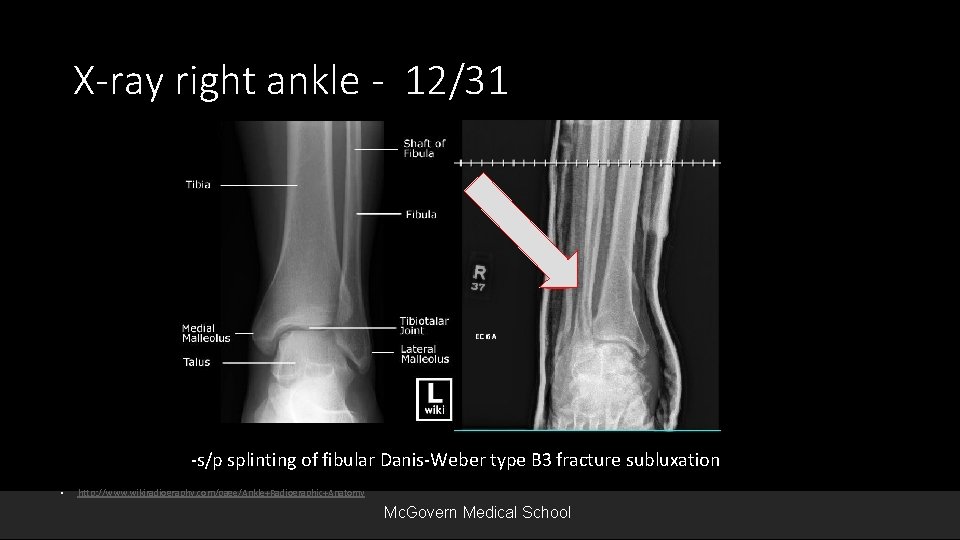
X-ray right ankle - 12/31 -s/p splinting of fibular Danis-Weber type B 3 fracture subluxation • http: //www. wikiradiography. com/page/Ankle+Radiographic+Anatomy Mc. Govern Medical School
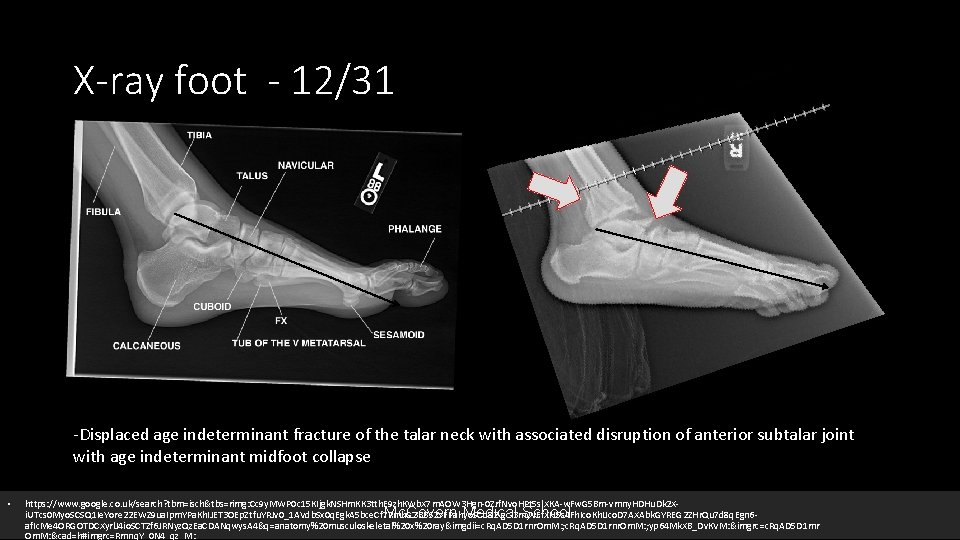
X-ray foot - 12/31 -Displaced age indeterminant fracture of the talar neck with associated disruption of anterior subtalar joint with age indeterminant midfoot collapse • https: //www. google. co. uk/search? tbm=isch&tbs=rimg: Cc 9 y. MWP 0 c 15 KIjgk. NSHm. KK 3 tth. E 9 zh. KWb. X 7 m. AOW 3 Hgn-0 Zrf. Nvo. HPt 5 sl. XKA-w. Fw. G 5 Bm-vmny. HDHu. Dk 2 Xi. UTcs 0 Myo. SCSQ 1 Ie. Yore 22 EWZ 9 ua. Ipm. YPa. Kh. IJET 3 OEp. Ztfu. YRJv 0_1 AVdb. Sx 0 q. Egk. A 5 bce. Cf 7 Rmh. G 3 BBS 2 YFPahyo. SCd 82 -gc-3 my. VEf. XH 5 s 4 Fh. Ico. Kh. IJco. D 7 AXAbk. GYREG 2 ZHr. Qu 7 d 8 q. Egn 6 af. Ic. Me 4 ORGOTDCXyrl. J 4 io. SCTZf 6 JRNyz. Qz. Ea. CDANqwys. A 4&q=anatomy%20 musculoskeletal%20 x%20 ray&imgdii=c. Rq. AD 5 D 1 rnr. Om. M: ; yp 64 Mk. XB_Dv. KVM: &imgrc=c. Rq. AD 5 D 1 rnr Om. M: &cad=h#imgrc=Rmnq. Y_0 N 4_qz_M: Mc. Govern Medical School
Key imaging findings • Danis-Weber type B 3 fracture subluxation • Displaced age indeterminant fracture of the talar neck with associated disruption of anterior subtalar joint with age indeterminant midfoot collapse • Soft tissue swelling about ankle and dorsal aspect of foot Mc. Govern Medical School
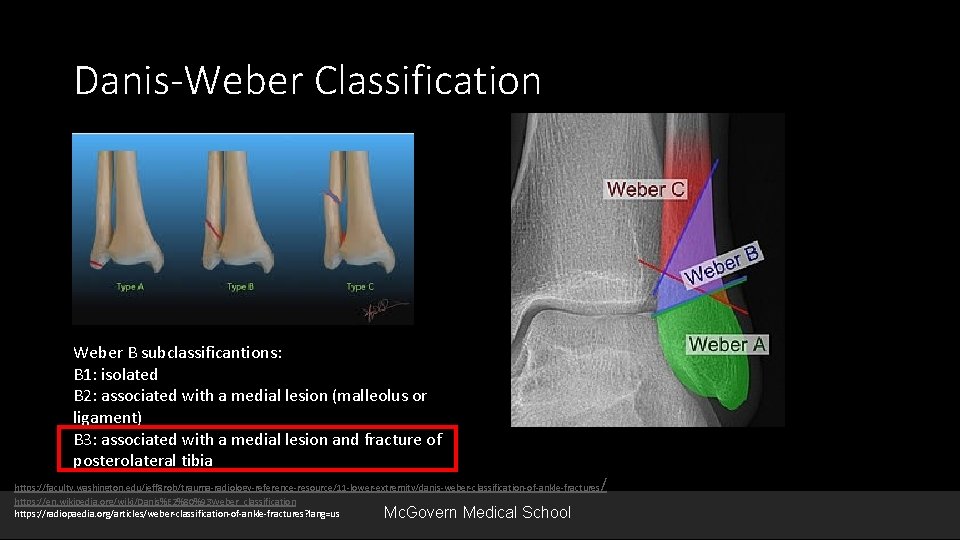
Danis-Weber Classification Weber B subclassificantions: B 1: isolated B 2: associated with a medial lesion (malleolus or ligament) B 3: associated with a medial lesion and fracture of posterolateral tibia / https: //faculty. washington. edu/jeff 8 rob/trauma-radiology-reference-resource/11 -lower-extremity/danis-weber-classification-of-ankle-fractures https: //en. wikipedia. org/wiki/Danis%E 2%80%93 Weber_classification https: //radiopaedia. org/articles/weber-classification-of-ankle-fractures? lang=us Mc. Govern Medical School
Differential Diagnosis • Ankle fracture • Soft tissue injury • Acute compartment syndrome • Foot fracture • Ankle sprain • Tendon injury Mc. Govern Medical School

Discussion- Mechanism of injury • Closed reduction performed in the ED, placed in splint • Post-reduction films show acceptable alignment https: //radiologyassistant. nl/musculoskeletal/ankle/weber-and-lauge-hansen-classification Mc. Govern Medical School
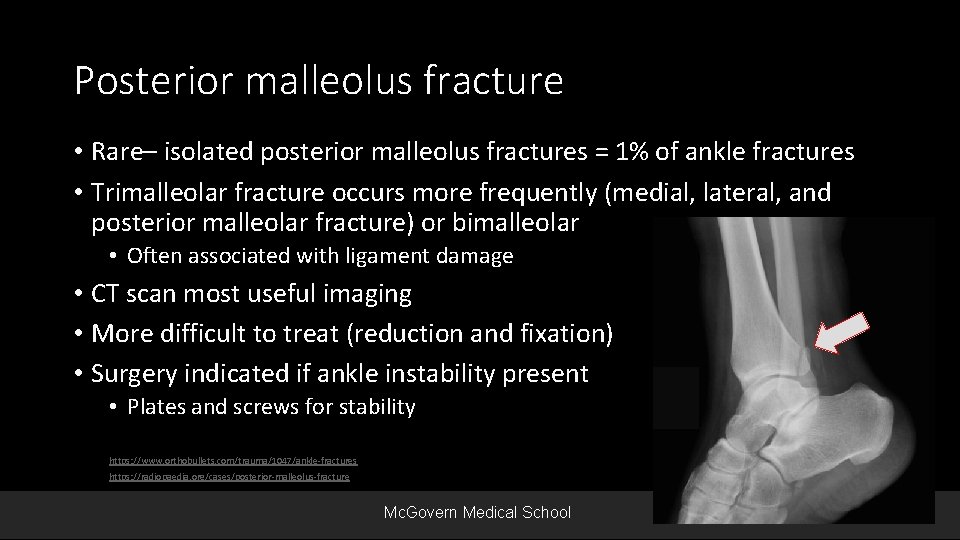
Posterior malleolus fracture • Rare– isolated posterior malleolus fractures = 1% of ankle fractures • Trimalleolar fracture occurs more frequently (medial, lateral, and posterior malleolar fracture) or bimalleolar • Often associated with ligament damage • CT scan most useful imaging • More difficult to treat (reduction and fixation) • Surgery indicated if ankle instability present • Plates and screws for stability https: //www. orthobullets. com/trauma/1047/ankle-fractures https: //radiopaedia. org/cases/posterior-malleolus-fracture Mc. Govern Medical School
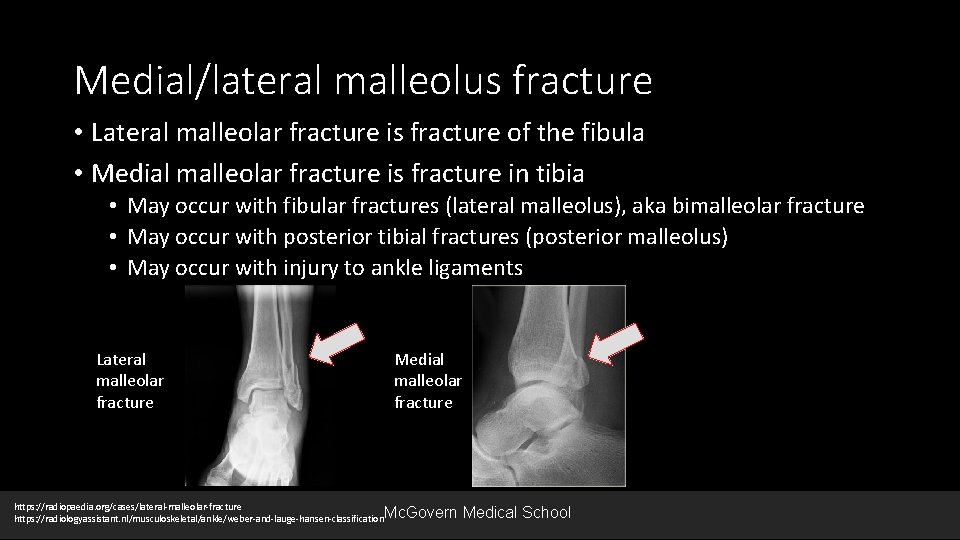
Medial/lateral malleolus fracture • Lateral malleolar fracture is fracture of the fibula • Medial malleolar fracture is fracture in tibia • May occur with fibular fractures (lateral malleolus), aka bimalleolar fracture • May occur with posterior tibial fractures (posterior malleolus) • May occur with injury to ankle ligaments Lateral malleolar fracture https: //radiopaedia. org/cases/lateral-malleolar-fracture https: //radiologyassistant. nl/musculoskeletal/ankle/weber-and-lauge-hansen-classification Medial malleolar fracture Mc. Govern Medical School
Discussion- Treatment • Joint stability • If bone/ligament “ring” of stability in ankle is broken at one site, joint remains stable • If “ring” of stability is broken in more than one site, it becomes unstable • Joint instability SURGERY • Assess stability with abduction/external rotation force • Stress test is used during imaging to determine whether joint is stable • Laxity indicates instability ankle is either displaced or easily displaced with stress *Weber B is most likely to become unstable compared to Weber A or Weber C fractures https: //www. ncbi. nlm. nih. gov/pmc/articles/PMC 5994620/#: ~: text=The%20 ankle%20 joint%20 can%20 be, two%20 columns%3 A%20 lateral%20 and%20 medial. https: //www. physio-pedia. com/Stress_tests_for_Ankle_ligaments https: //www. massgeneral. org/orthopaedics/foot-ankle/conditions-and-treatments/ankle-fractures-unstable Mc. Govern Medical School
Final Diagnosis • Danis-Weber type B 3 fracture subluxation • Displaced fracture of talar neck associated with disruption of the anterior subtalar joint and midfoot collapse. Both age-indeterminant Mc. Govern Medical School
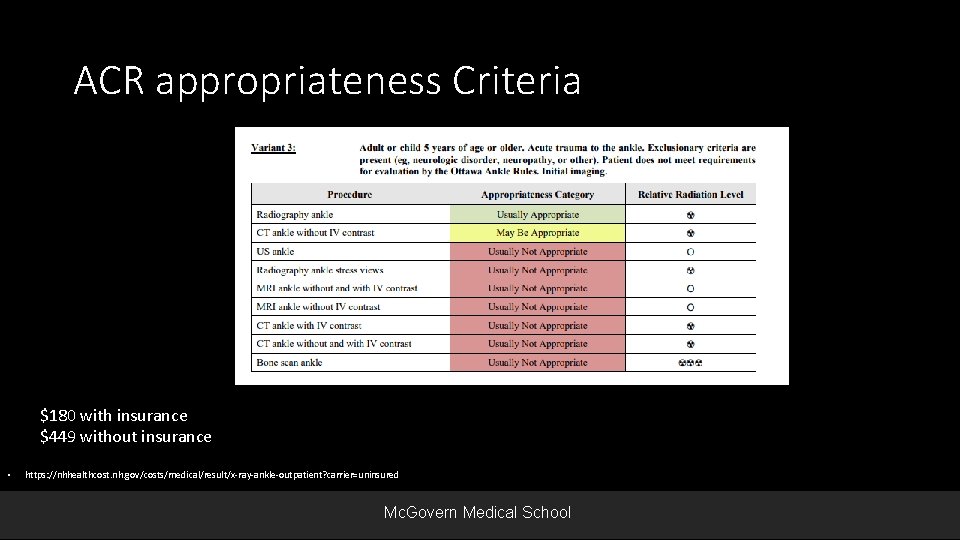
ACR appropriateness Criteria $180 with insurance $449 without insurance • https: //nhhealthcost. nh. gov/costs/medical/result/x-ray-ankle-outpatient? carrier=uninsured Mc. Govern Medical School
Take Home Points / Teaching points • Danis-Weber scale is useful for prognosis. Weber B most commonly causes joint instability • Mechanism of injury gives clues to diagnosis, so a thorough H&P is important • Non-weight bearing and ankle deformities require further assessment • Posterior malleolar fractures are rare and commonly occur with medial and/or lateral malleolus fractures • Can use cortical lines and shape of bones to help determine age of fracture Mc. Govern Medical School

Questions?
- Slides: 15