
Gross National Happiness Policy Outputs in Bhutan from
Gross National Happiness Policy Outputs in Bhutan from 1972 to 2014 Presentation by Professor Michael Givel to International Society for Bhutan Studies on January 2019
Introduction In the 1970 s, the Fourth King of Bhutan, Jigme Singye Wangchuck, indicated that Gross National Happiness (GNH) was more important than Gross Domestic Product (GDP)* Primary reason that King Jigme Sungye Wangchuck called for GNH was to balance capitalism and modernization with traditional Mahayana Buddhist religious and values *The first written account of this was in a New York Times article: Kaufman, Michael, November 16, 1980, The Remote Kingdom of Bhutan, p. 1. Many believe the Fourth King promoted GNH in the early 1970 s.
This presentation examines from 1972 to 2014 the nature and quantity, over time, of how and what impact GNH legislative public policy outputs Public policy outputs are what governments do or do not do that impact segments of thepublic and the public interest In the modern age, governments can regulate adverse behaviors such as pollution, distribute benefits to certain groups in society, Or redistribute wealth or income from certain classes to other classes Instrumentalities used to carry out administrative and legal requirements include executive, legislative, and judicial institutions
Policy outcomes, in this paper are the intended or unintended consequences of the goals and objective of policy outputs For example, if Bhutan adopted legislation designed to bolster protection of its natural environment has that actually occurred From 2008 to 2013, the ruling Druk Phuensum Tshogpa continued to promote GNH as a prime development policy for Bhutan Balance non- GDP values including cultural preservation of traditional Mahayana Buddhism with modern globalization and capitalism
In June 2013, with the election of People’s Democratic Policy of Bhutan, GNH as a policy took a new direction under new Prime Minister Tshering Tobgay: “Although Tobgay has been outspoken in his belief that the government must turn to more concrete matters, he has left the door open to promoting GNH – in its right place. This is where the nation’s beloved monarch comes in. As the country’s symbolic leader, King Jigme Khesar Namgyel Wangchuck, is well suited to take up the torch for GNH in Tobgay’s view. ”* Four matters of primary concern in addition to promoting GNH were: high government debt, rupee shortages, unemployment, and growing corruption * Deharet, J. 2013. Bhutan’s New PM Tshering Tobgay Questions the Politics of Happiness. The Diplomat.
By 2015, in addition to addressing significant domestic problems at home, Bhutan continued to promote GNH policy Including using GNH as a screening, planning, and evaluation tool for national government plans and projects by GNH Commission GNH Index, which is conducted through national public opinion surveys in Bhutan is a subjective indicator developed in the mid-2000 s by the Thimphubased think tank, Centre for Bhutan Studies Index is generally based on four recognized pillars of GNH including sustainable and equitable economic development, good governance, cultural preservation, and environmental protection
Integrated into the four pillars are nine domains that are a subset of and are congruent with the four pillars (Thinley 2009). They include: Standard of living, health and education within the pillar of sustainable and equitable economic development Good governance congruent with the pillar of good governance Cultural vitality and diversity psychological well being, time use and balance, and community vitality within the pillar of cultural preservation Ecosystem vitality congruent with the environmental protection pillar
Integrated into the four pillars are nine domains that are a subset of and are congruent with the four pillars (Thinley 2009). They include: Standard of living, health and education within the pillar of sustainable and equitable economic development Good governance congruent with the pillar of good governance Cultural vitality and diversity psychological well being, time use and balance, and community vitality within the pillar of cultural preservation Ecosystem vitality congruent with the environmental protection pillar
While the GNH Index represents snapshots at different times of subjective Bhutanese public opinion on policy outcomes of happiness in the nine domains It does not measure concurrent public policy outputs initiated or not by the Bhutanese government to implement GNH Little is known to date of how and what emphasis the Bhutanese has placed on GNH public policy outputs In this paper, an examination will be made from 1972 to 2014 of enacted GNH public legislative policy outputs In order to ascertain what GNH legislative public policy outputs trends have been over time
Methods The analysis of the legislative policy outputs implementing GNH and the four pillars included content analysis of national legislation Including 2008 constitutional provisions enacted from 1972 to 2014 Each enacted law or constitutional provision was examined to determine if the law was substantially promoting Preservation of culture Good governance Environmental protection Equitable economic development
Preservation of culture is defined as maintaining or bolstering Mahayana religion and traditions Good governance is defined as government ethics, transparency in government, and anti-corruption practices Environmental protection includes any legislation that preserves and conserves the parks and flora and fauna or counters environmental pollution Equitable economic development including references to economics that also incorporates social and economic justice
Data for this analysis was obtained from National Assembly of Bhutan’s web site at: http: //www. nab. gov. bt/business/acts Data analysis occurred by determining whether a law explicitly mentioned in whole or part one or more of the four pillars For each enacted law, if the law addressed in a substantial and substantive manner either cultural preservation, environmental protection, good governance, or equitable development Then this was counted as one provision of a law promoting any or all of the four pillars The data is reported in tabular form as bar graphs depicting the quantity and degree of enactment of policies related to GNH from 1972 to 2014
The method used to counter subjectivity bias is the audit trail approach As noted above I have a clear record of the research steps taken including the reporting of findings, which any third parties could replicate and analyze for themselves Additionally, this provides an overview of enacted legislation and does not review implementation of GNH policy Implementation has been incorporated into the GNH Commission program, planning, evaluation, and implementation process as well as national Five Year Plans
Results From 1972 to 2014 Bhutan enacted 115 national laws As indicated in Figure 1 (next slide) GNH legislation from 1972 until the mid-1990 s included few laws Almost solely focused on cultural preservation pillar Bhutan focused on maintaining the traditional cultural identity and values of a Mahayana Buddhist monarchy and society
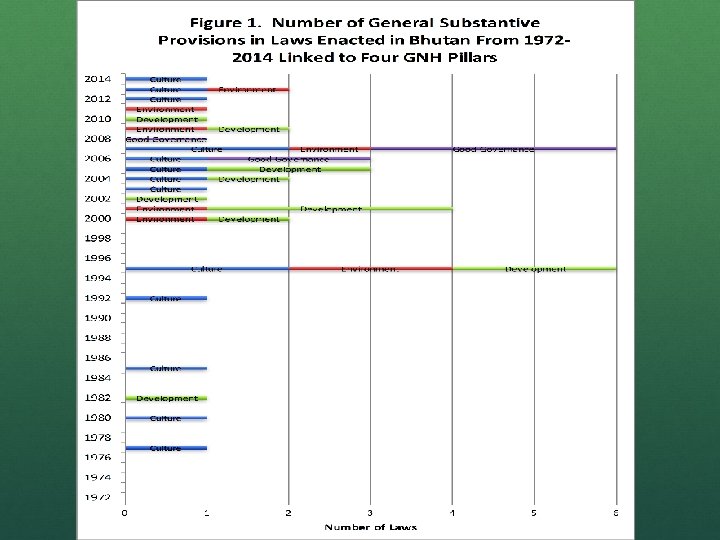
Phase two (Figure 1) of GNH policymaking commenced in mid-1990 s, and expanded scope of policies to include all pillars of GNH Policies addressing ecosystem protection began in the 1990 s, and were extended in the 2000 s Beginning in the mid-2000 s, several good governance policies were enacted to limit corruption, promote greater transparency, and raise accountability in government Other policies continued to emphasize cultural preservation and economic development From 2013 to 2014, the People’s Democratic Party enacted three laws that had significant provisions related to GNH
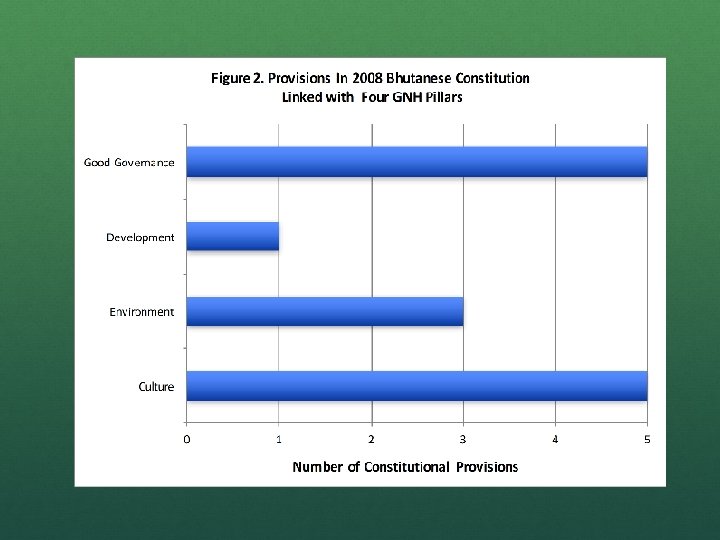
Tracking with the new surge of GNH legislation for all four pillars in the 2000 s in the second phase are key provisions in the 2008 Bhutanese Constitution, (Figure 2) Specifically addressed cultural preservation, sustainable development, environmental protection, and good governance. Similarly, the 2008 Bhutanese Constitution addresses the realms of cultural vitality, standard of living, ecosystem vitality, and cultural vitality Again, this represents a modern effort to maintain traditional cultural values balanced with the forces of modernization and capitalism
Conclusion Prior to 1990 s, GNH legislation was based on maintaining a traditional Mahayana Buddhist culture and society Expansion of the GNH policy agenda from the mid-1990 s to 2014 also occurred in conjunction with Bhutan’s successful effort to steadily modernize the state including mitigate the effects of the global economy. In essence, this was aligned with long-standing government policies to modernize Bhutan This included channeling or maintaining traditional Mahayana Buddhist tradition and values that were established from early statehood to modern times This second phase of GNH legislation also coincided with Bhutan slowly opening itself to the outside world
Thus, the two distinct phases represent a distinct evolution of GNH public policy outputs in Bhutan The second phase represents a clear expansion, as well, with the enactment and implementation of all four pillars as public policies. It is important to note that the roots of the second phase are contained in the first phase with an emphasis on traditional Mahayana Buddhist values The second phase while expanding into new policies areas has a primary historical foundation in the first phase of traditional Mahayana religious values.

This research was not funded by any agency grants. There is no financial interest or benefit arising from direct applications of this research. For further information contact: Michael Givel Professor of Political Science Affiliate Faculty, Asian Studies, College of International and Area Studies, University of Oklahoma, USA Department of Political Science 455 West Lindsey Dale Hall Tower, Room 224 Norman, Oklahoma, USA, 73019 Phone: 01 -405 -824 -5012 Email: mgivel@ou. edu
- Slides: 21