
Gross Anatomy Regional all structures in one part

- Slides: 32
Gross Anatomy § Regional – all structures in one part of the body (such as the abdomen or leg) § Systemic – gross anatomy of the body studied by system § Surface – study of internal structures as they relate to the overlying skin
Microscopic Anatomy § Cytology – study of the cell § Histology – study of tissues
Developmental Anatomy § Traces structural changes throughout life § Embryology – study of developmental changes of the body before birth
Specialized Branches of Anatomy § Pathological anatomy – study of structural changes caused by disease § Radiographic anatomy – study of internal structures visualized by X ray § Molecular biology – study of anatomical structures at a subcellular level
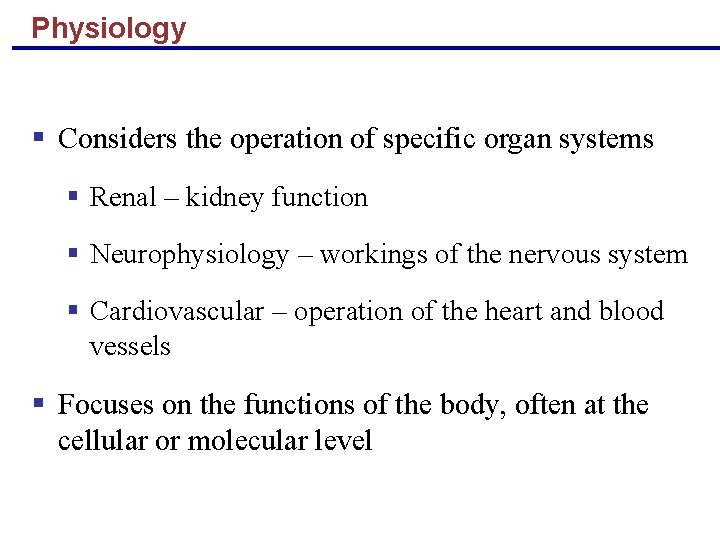
Physiology § Considers the operation of specific organ systems § Renal – kidney function § Neurophysiology – workings of the nervous system § Cardiovascular – operation of the heart and blood vessels § Focuses on the functions of the body, often at the cellular or molecular level
Physiology § Understanding physiology also requires a knowledge of physics, which explains electrical currents, blood pressure, and the way muscle uses bone for movement
Principle of Complementarity § Function always reflects structure § What a structure can do depends on its specific form
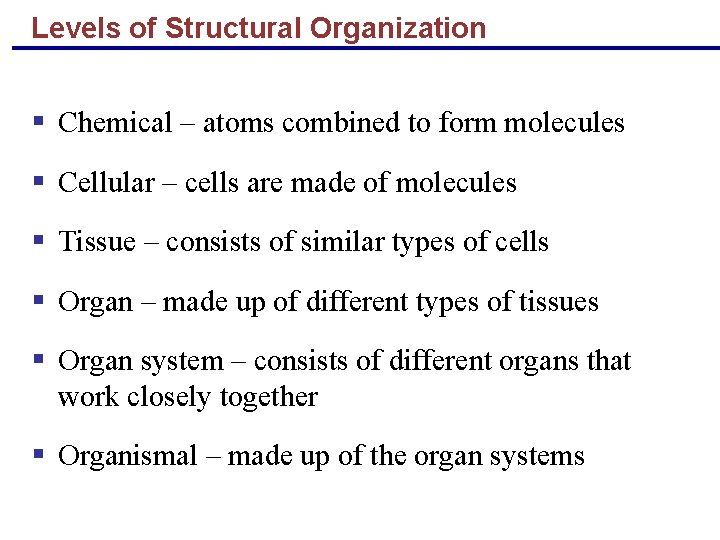
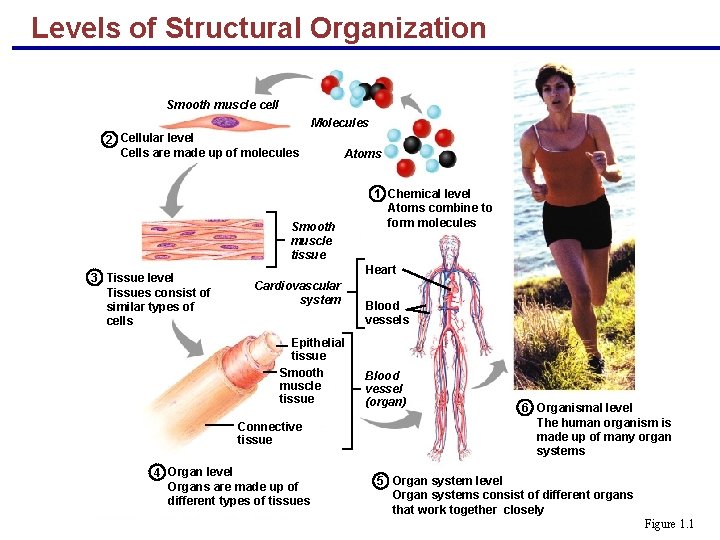
Levels of Structural Organization § Chemical – atoms combined to form molecules § Cellular – cells are made of molecules § Tissue – consists of similar types of cells § Organ – made up of different types of tissues § Organ system – consists of different organs that work closely together § Organismal – made up of the organ systems
Levels of Structural Organization Smooth muscle cell Molecules 2 Cellular level Cells are made up of molecules Atoms Smooth muscle tissue 3 Tissue level Tissues consist of similar types of cells 1 Chemical level Atoms combine to form molecules Heart Cardiovascular system Epithelial tissue Smooth muscle tissue Connective tissue 4 Organ level Organs are made up of different types of tissues Blood vessel (organ) 6 Organismal level The human organism is made up of many organ systems 5 Organ system level Organ systems consist of different organs that work together closely Figure 1. 1
Organ Systems of the Body § Integumentary system § Forms the external body covering § Composed of the skin, sweat glands, oil glands, hair, and nails § Protects deep tissues from injury and synthesizes vitamin D
Organ Systems of the Body § Skeletal system § Composed of bone, cartilage, and ligaments § Protects and supports body organs § Provides the framework for muscles § Site of blood cell formation § Stores minerals
Organ Systems of the Body § Muscular system § Composed of muscles and tendons § Allows manipulation of the environment, locomotion, and facial expression § Maintains posture § Produces heat
Organ Systems of the Body § Nervous system § Composed of the brain, spinal column, and nerves § Is the fast-acting control system of the body § Responds to stimuli by activating muscles and glands
Organ Systems of the Body § Cardiovascular system § Composed of the heart and blood vessels § The heart pumps blood § The blood vessels transport blood throughout the body
Organ Systems of the Body § Lymphatic system § Composed of red bone marrow, thymus, spleen, lymph nodes, and lymphatic vessels § Picks up fluid leaked from blood vessels and returns it to blood § Disposes of debris in the lymphatic stream § Houses white blood cells involved with immunity
Organ Systems of the Body § Respiratory system § Composed of the nasal cavity, pharynx, trachea, bronchi, and lungs § Keeps blood supplied with oxygen and removes carbon dioxide
Organ Systems of the Body § Digestive system § Composed of the oral cavity, esophagus, stomach, small intestine, large intestine, rectum, anus, and liver § Breaks down food into absorbable units that enter the blood § Eliminates indigestible foodstuffs as feces
Organ Systems of the Body § Urinary system § Composed of kidneys, ureters, urinary bladder, and urethra § Eliminates nitrogenous wastes from the body § Regulates water, electrolyte, and p. H balance of the blood
Organ Systems of the Body § Male reproductive system § Composed of prostate gland, penis, testes, scrotum, and ductus deferens § Main function is the production of offspring § Testes produce sperm and male sex hormones § Ducts and glands deliver sperm to the female reproductive tract
Organ Systems of the Body § Female reproductive system § Composed of mammary glands, ovaries, uterine tubes, uterus, and vagina § Main function is the production of offspring § Ovaries produce eggs and female sex hormones § Remaining structures serve as sites for fertilization and development of the fetus § Mammary glands produce milk to nourish the newborn
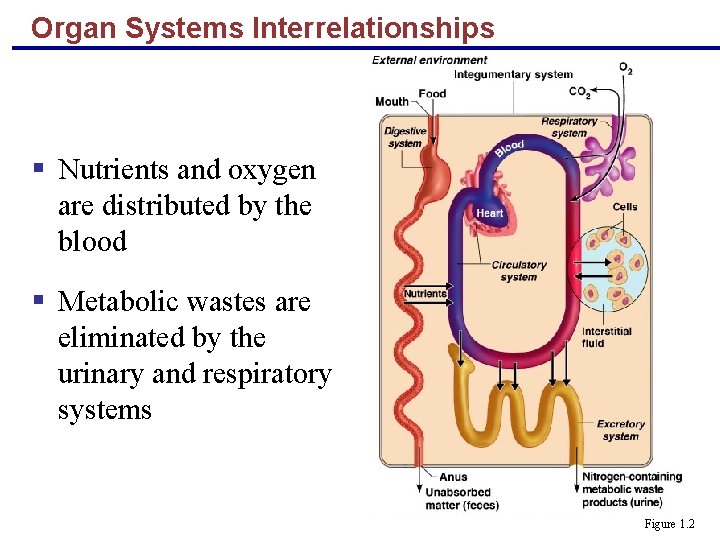
Organ Systems Interrelationships § The integumentary system protects the body from the external environment § Digestive and respiratory systems, in contact with the external environment, take in nutrients and oxygen
Organ Systems Interrelationships § Nutrients and oxygen are distributed by the blood § Metabolic wastes are eliminated by the urinary and respiratory systems Figure 1. 2
Necessary Life Functions I § Maintaining boundaries – the internal environment remains distinct from the external § Cellular level – accomplished by plasma membranes § Organismal level – accomplished by the skin § Movement – locomotion, propulsion (peristalsis), and contractility § Responsiveness – ability to sense changes in the environment and respond to them § Digestion – breakdown of ingested foodstuffs
Necessary Life Functions II § Metabolism – all the chemical reactions that occur in the body § Excretion – removal of wastes from the body § Reproduction – cellular and organismal levels § Cellular – an original cell divides and produces two identical daughter cells § Organismal – sperm and egg unite to make a whole new person § Growth – increase in size of a body part or of the organism
Survival Needs § Nutrients – chemical substances used for energy and cell building § Oxygen – needed for metabolic reactions § Water – provides the necessary environment for chemical reactions § Maintaining normal body temperature – necessary for chemical reactions to occur at life-sustaining rates § Atmospheric pressure – required for proper breathing and gas exchange in the lungs
Homeostasis § Homeostasis is the ability to maintain a relatively stable internal environment in an ever-changing outside world § The internal environment of the body is in a dynamic state of equilibrium § Chemical, thermal, and neural factors interact to maintain homeostasis
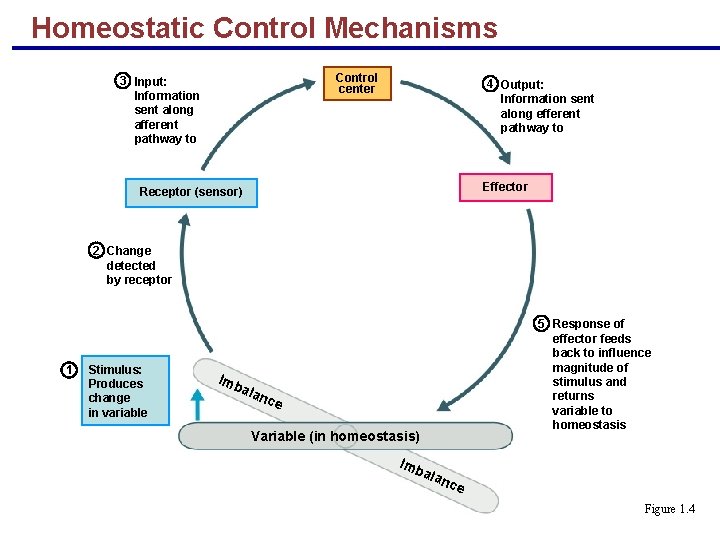
Homeostatic Control Mechanisms § The variable produces a change in the body § The three interdependent components of control mechanisms are: § Receptor – monitors the environments and responds to changes (stimuli) § Control center – determines the set point at which the variable is maintained § Effector – provides the means to respond to the stimulus
Homeostatic Control Mechanisms Control center 3 Input: Information sent along afferent pathway to 4 Output: Information sent along efferent pathway to Effector Receptor (sensor) 2 Change detected by receptor 1 Stimulus: Produces change in variable 5 Response of effector feeds back to influence magnitude of stimulus and returns variable to homeostasis Imb ala nce Variable (in homeostasis) Imb ala nce Figure 1. 4
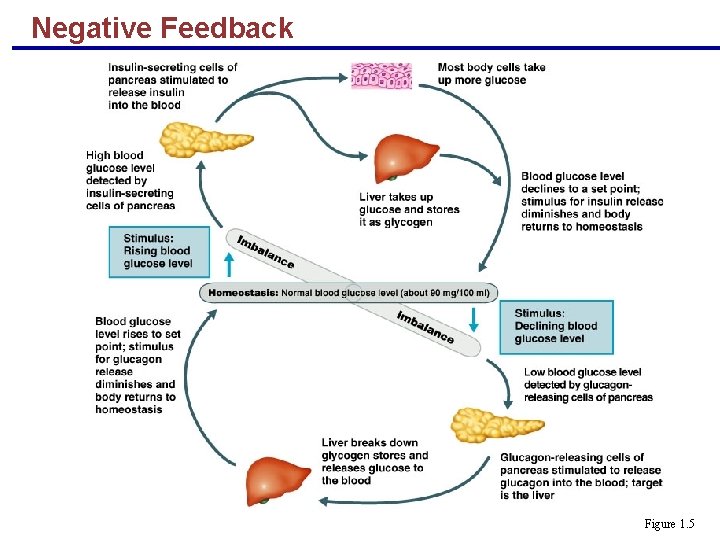
Negative Feedback § In negative feedback systems, the output shuts off the original stimulus § Example: Regulation of blood glucose levels
Negative Feedback Figure 1. 5
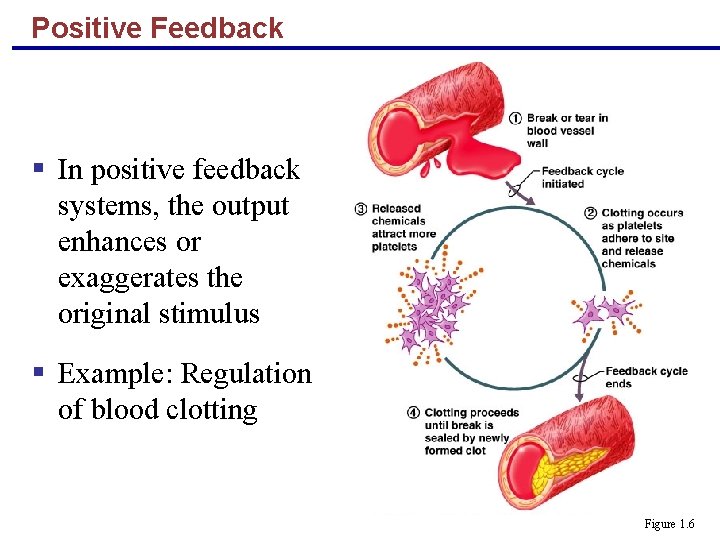
Positive Feedback § In positive feedback systems, the output enhances or exaggerates the original stimulus § Example: Regulation of blood clotting Figure 1. 6
Homeostatic Imbalance § Disturbance of homeostasis or the body’s normal equilibrium § Overwhelming of negative feedback mechanisms allowing destructive positive feedback mechanisms to take over