
Groin Herniae Surgical Anatomy Clinical Examination Ali Sabbour
Groin Herniae Surgical Anatomy & Clinical Examination Ali Sabbour Prof. of General & Vascular Surgery Ain Shams University
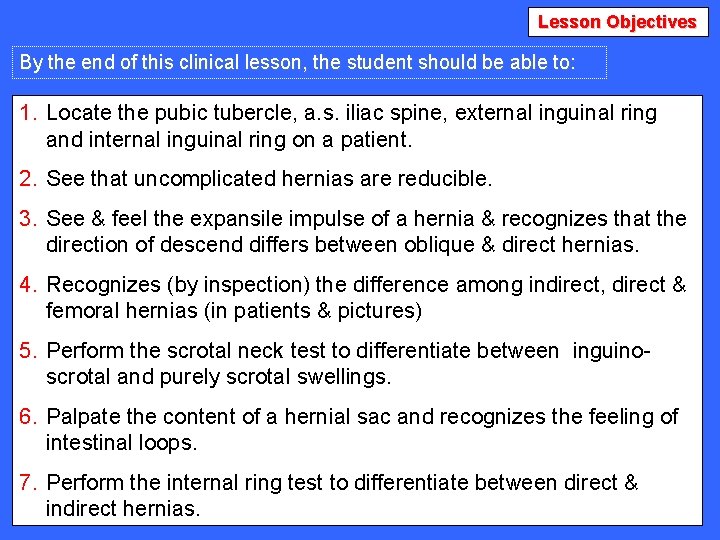
Lesson Objectives By the end of this clinical lesson, the student should be able to: 1. Locate the pubic tubercle, a. s. iliac spine, external inguinal ring and internal inguinal ring on a patient. 2. See that uncomplicated hernias are reducible. 3. See & feel the expansile impulse of a hernia & recognizes that the direction of descend differs between oblique & direct hernias. 4. Recognizes (by inspection) the difference among indirect, direct & femoral hernias (in patients & pictures) 5. Perform the scrotal neck test to differentiate between inguinoscrotal and purely scrotal swellings. 6. Palpate the content of a hernial sac and recognizes the feeling of intestinal loops. 7. Perform the internal ring test to differentiate between direct & indirect hernias.
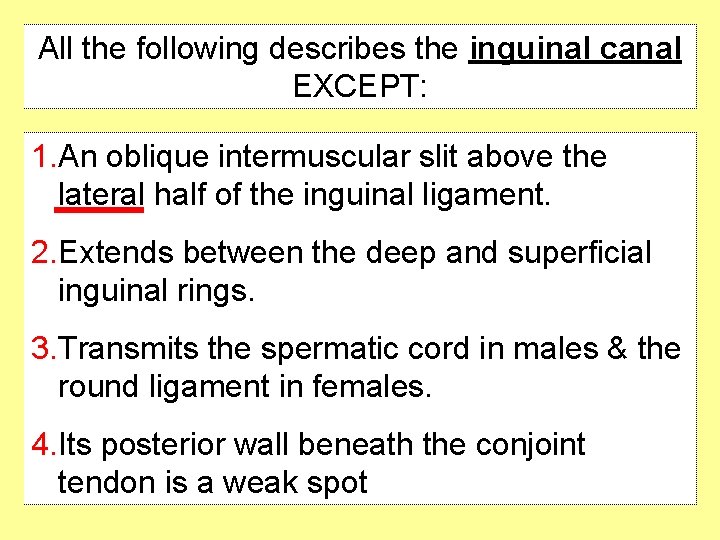
All the following describes the inguinal canal EXCEPT: 1. An oblique intermuscular slit above the lateral half of the inguinal ligament. 2. Extends between the deep and superficial inguinal rings. 3. Transmits the spermatic cord in males & the round ligament in females. 4. Its posterior wall beneath the conjoint tendon is a weak spot
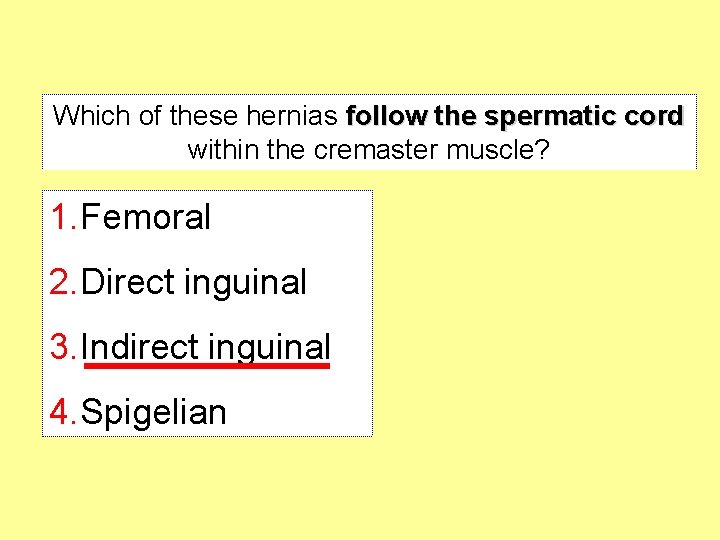
Which of these hernias follow the spermatic cord within the cremaster muscle? 1. Femoral 2. Direct inguinal 3. Indirect inguinal 4. Spigelian
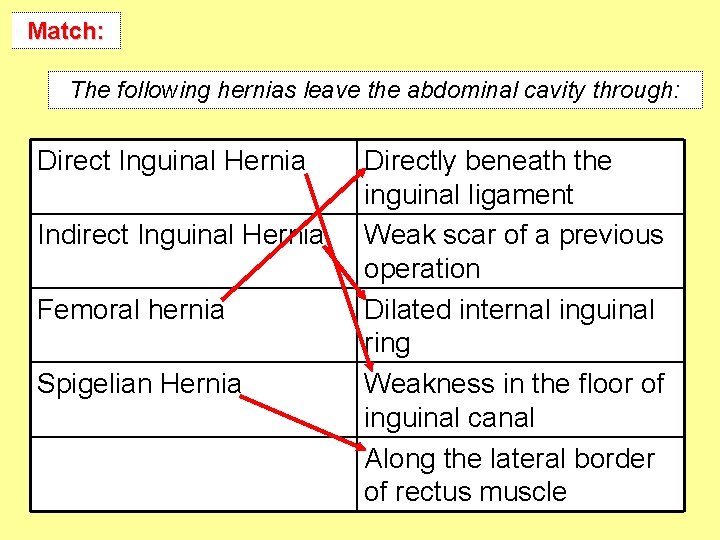
Match: The following hernias leave the abdominal cavity through: Direct Inguinal Hernia Indirect Inguinal Hernia Femoral hernia Spigelian Hernia Directly beneath the inguinal ligament Weak scar of a previous operation Dilated internal inguinal ring Weakness in the floor of inguinal canal Along the lateral border of rectus muscle
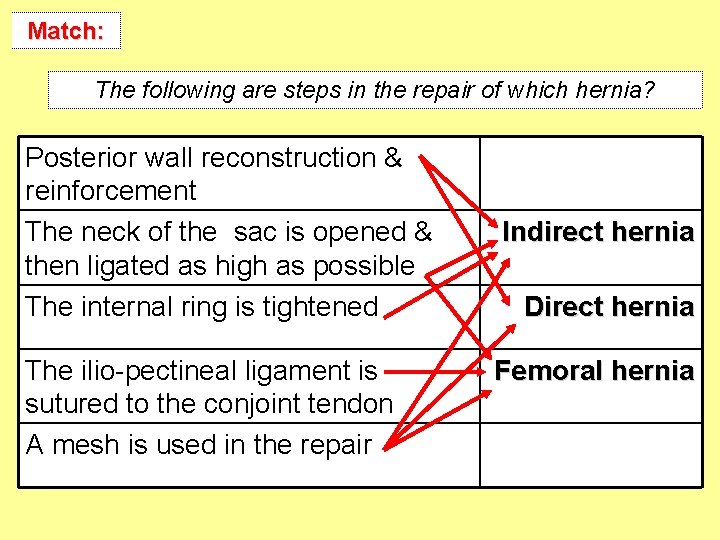
Match: The following are steps in the repair of which hernia? Posterior wall reconstruction & reinforcement The neck of the sac is opened & then ligated as high as possible The internal ring is tightened The ilio-pectineal ligament is sutured to the conjoint tendon A mesh is used in the repair Indirect hernia Direct hernia Femoral hernia
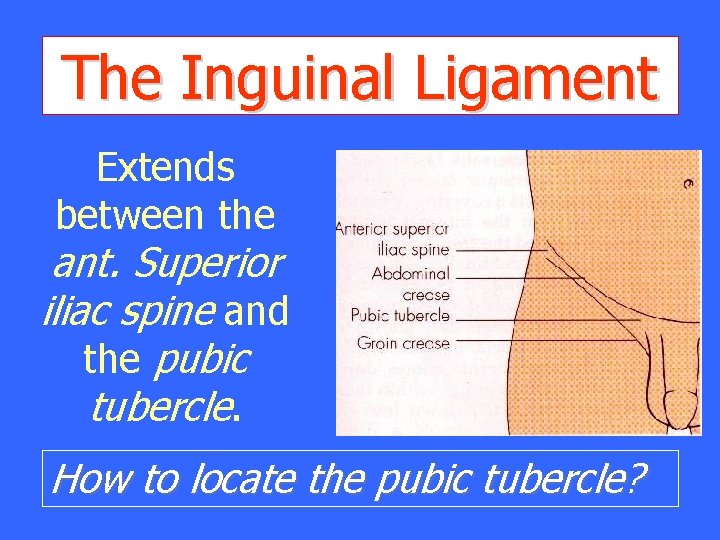
The Inguinal Ligament Extends between the ant. Superior iliac spine and the pubic tubercle. How to locate the pubic tubercle?

The External Ring A triangular defect in the external oblique aponeurosis, above the pubic crest. The spermatic cord emerges from it
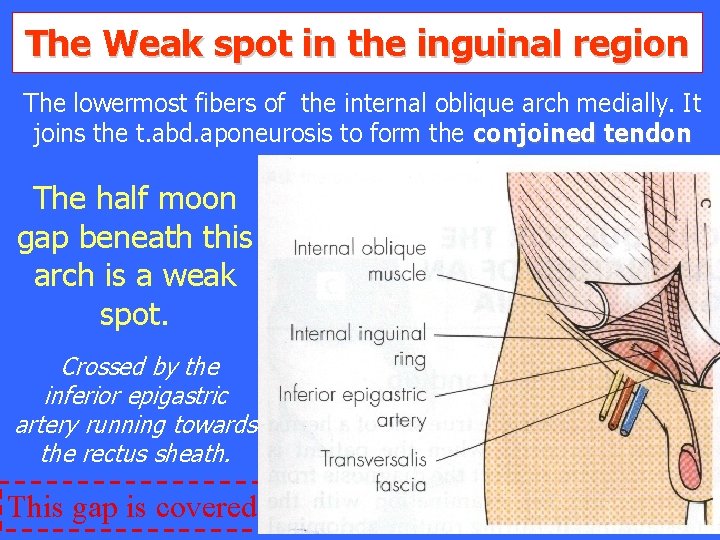
The Weak spot in the inguinal region The lowermost fibers of the internal oblique arch medially. It joins the t. abd. aponeurosis to form the conjoined tendon The half moon gap beneath this arch is a weak spot. Crossed by the inferior epigastric artery running towards the rectus sheath. This gap is covered by …
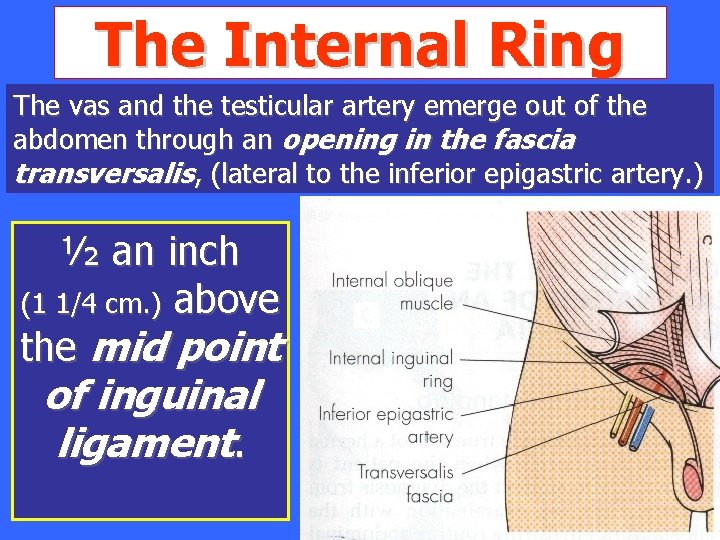
The Internal Ring The vas and the testicular artery emerge out of the abdomen through an opening in the fascia transversalis, (lateral to the inferior epigastric artery. ) ½ an inch (1 1/4 cm. ) above the mid point of inguinal ligament.

Oblique (Indirect) Inguinal hernia The sac: • Begins at the internal ring along the vas. • Lateral to the inf. epig. a. • Passes inside the spermatic cord. • Out of the external ring, • Down to the scrotum. (oblique course) What are the coverings of the oblique hernia?
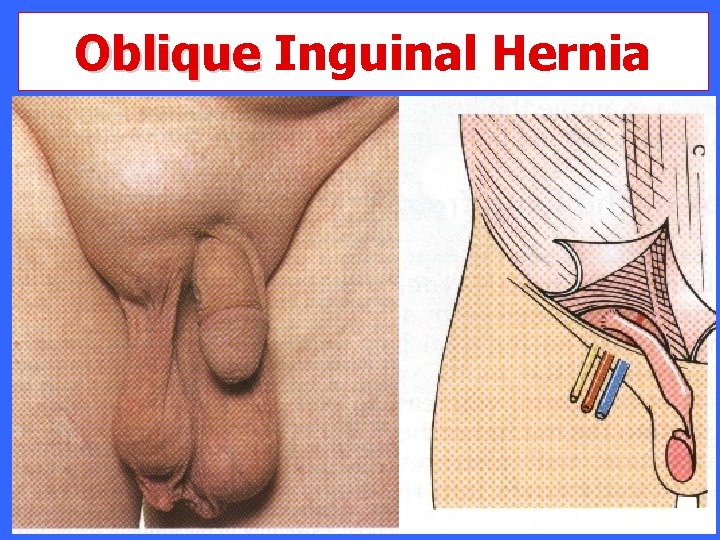
Oblique Inguinal Hernia
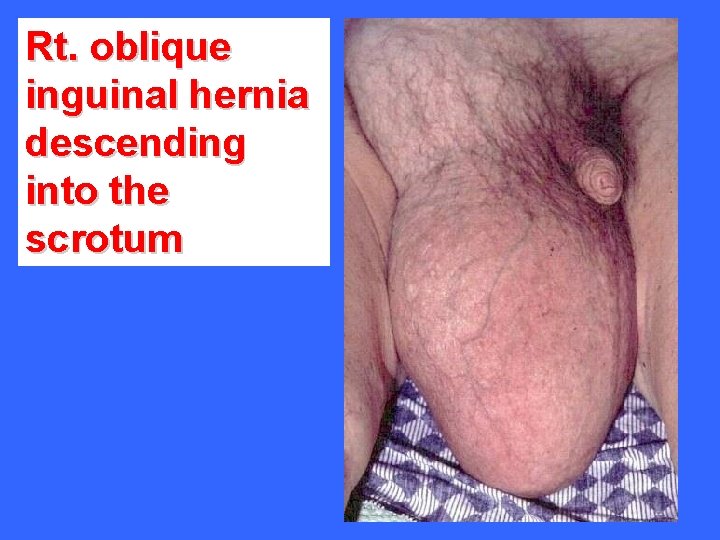
Rt. oblique inguinal hernia descending into the scrotum
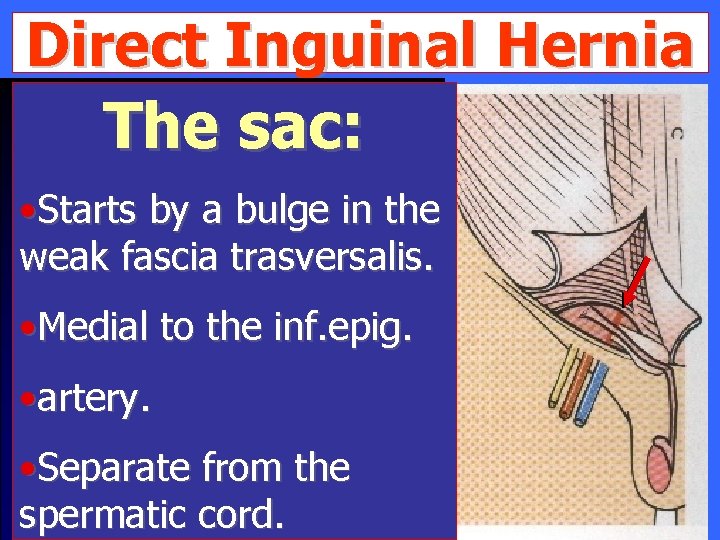
Direct Inguinal Hernia The sac: • Starts by a bulge in the weak fascia trasversalis. • Medial to the inf. epig. • artery. • Separate from the spermatic cord.
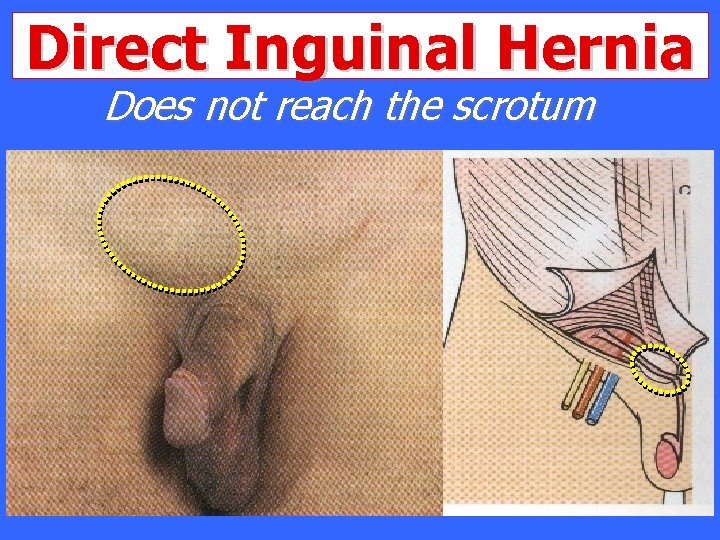
Direct Inguinal Hernia Does not reach the scrotum
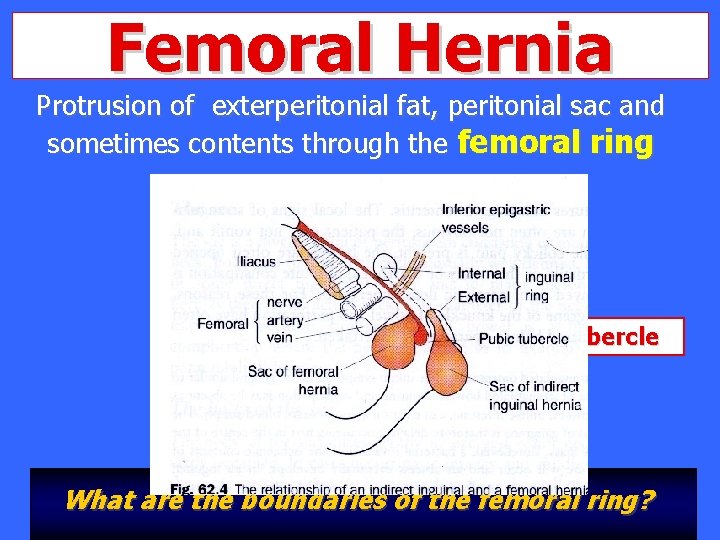
Femoral Hernia Protrusion of exterperitonial fat, peritonial sac and sometimes contents through the femoral ring Pubic tubercle What are the boundaries of the femoral ring?
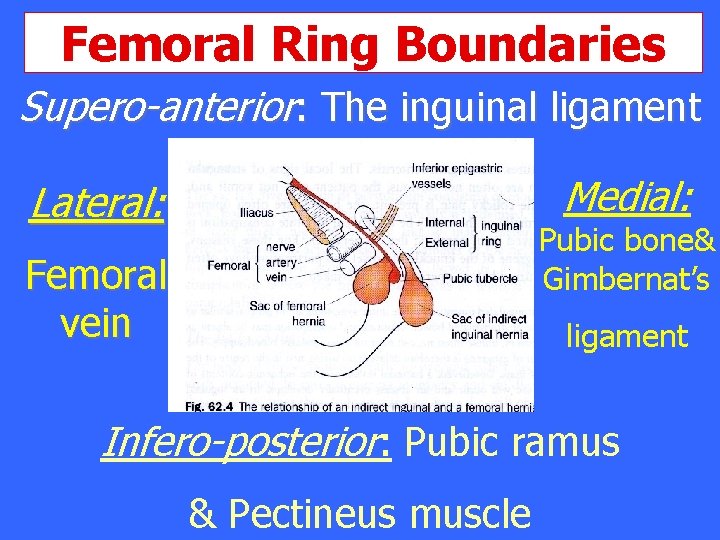
Femoral Ring Boundaries Supero-anterior: The inguinal ligament Medial: Lateral: Pubic bone& Gimbernat’s Femoral vein ligament Infero-posterior: Pubic ramus & Pectineus muscle
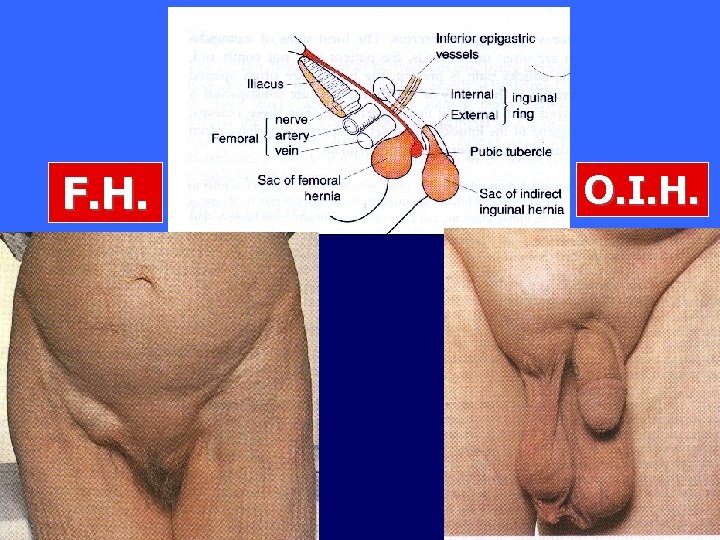
F. H. O. I. H.
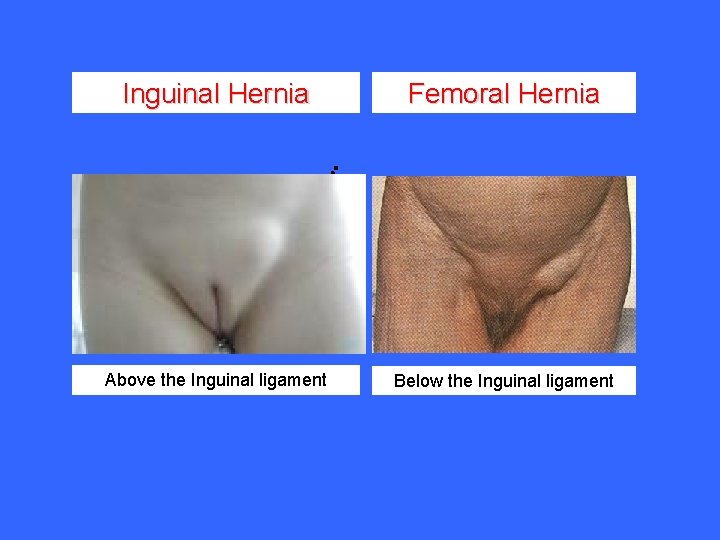
Inguinal Hernia Femoral Hernia Above the Inguinal ligament Below the Inguinal ligament
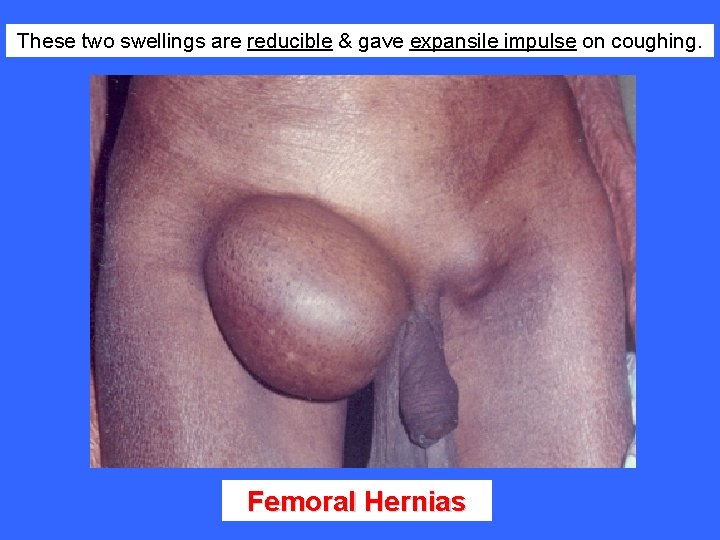
These two swellings are reducible & gave expansile impulse on coughing. Femoral Hernias
Groin Herniae History Taking & Examination Ali SABBOUR
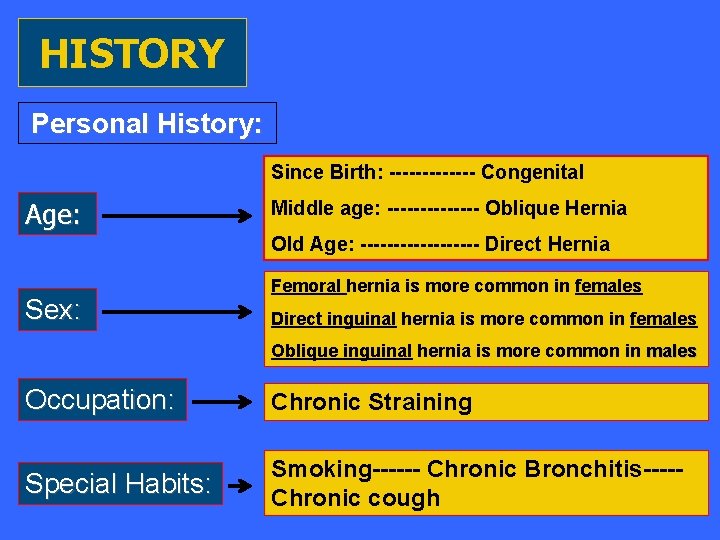
HISTORY Personal History: Since Birth: ------- Congenital Age: Middle age: ------- Oblique Hernia Old Age: --------- Direct Hernia Sex: Femoral hernia is more common in females Direct inguinal hernia is more common in females Oblique inguinal hernia is more common in males Occupation: Chronic Straining Special Habits: Smoking------ Chronic Bronchitis----Chronic cough
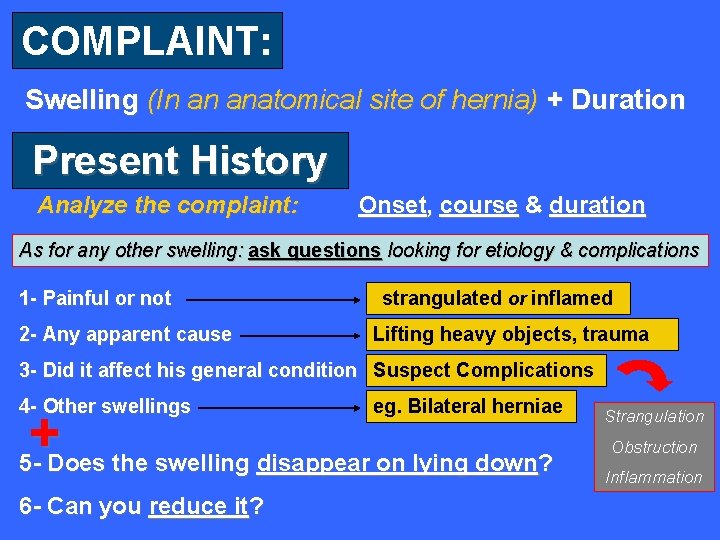
COMPLAINT: Swelling (In an anatomical site of hernia) + Duration Present History Analyze the complaint: Onset, course & duration As for any other swelling: ask questions looking for etiology & complications 1 - Painful or not 2 - Any apparent cause strangulated or inflamed Lifting heavy objects, trauma 3 - Did it affect his general condition Suspect Complications 4 - Other swellings eg. Bilateral herniae + 5 - Does the swelling disappear on lying down? 6 - Can you reduce it? Strangulation Obstruction Inflammation
Pain with inguinal herniea §Many herniea cause no pain, and the patient presents because he noticed a swelling in the groin. §However, it is not uncommon to complain of a dragging ach or discomfort in the groin, which gets worth as the day passes. §Sometimes the patient describes localized groin pain few weeks earlier, which disappears as the swelling appears (Preeruptive pain) §If the hernia becomes very painful & tender it is probably strangulated.
Symptoms of intestinal obstruction §Colicky abdominal pain. §Vomiting. §Abdominal distention. §Absolute constipation A bowel may be obstructed without being strangulated Strangulation will only be accompanied with obstruction if the hernia contains bowel
Review of other systems symptoms What -in particular- would you like to ask about? Respiratory symptoms Chronic cough G. I. T. symptoms Chronic constipation Urinary symptoms Straining with urination prostate, stricture urethra
Past History Of operation Recurrent hernia – Appendectomy Family History
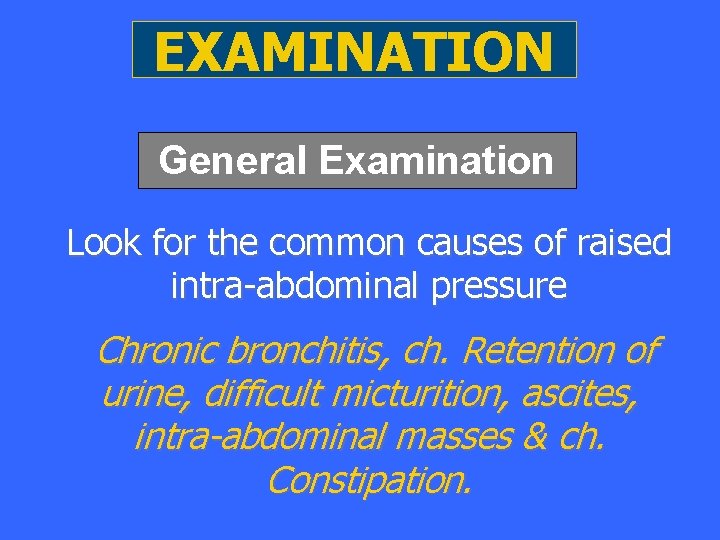
EXAMINATION General Examination Look for the common causes of raised intra-abdominal pressure Chronic bronchitis, ch. Retention of urine, difficult micturition, ascites, intra-abdominal masses & ch. Constipation.
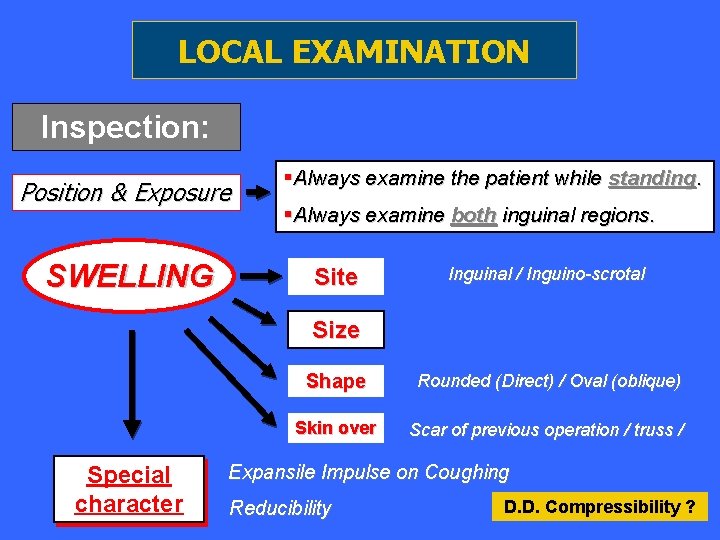
LOCAL EXAMINATION Inspection: Position & Exposure SWELLING §Always examine the patient while standing. §Always examine both inguinal regions. Site Inguinal / Inguino-scrotal Size Special character Shape Rounded (Direct) / Oval (oblique) Skin over Scar of previous operation / truss / Expansile Impulse on Coughing Reducibility D. D. Compressibility ?
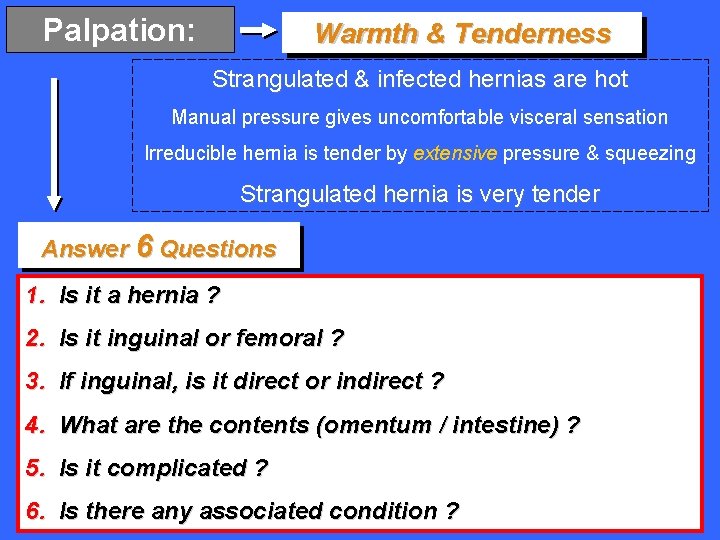
Palpation: Warmth & Tenderness Strangulated & infected hernias are hot Manual pressure gives uncomfortable visceral sensation Irreducible hernia is tender by extensive pressure & squeezing Strangulated hernia is very tender Answer 6 Questions 1. Is it a hernia ? 2. Is it inguinal or femoral ? 3. If inguinal, is it direct or indirect ? 4. What are the contents (omentum / intestine) ? 5. Is it complicated ? 6. Is there any associated condition ?
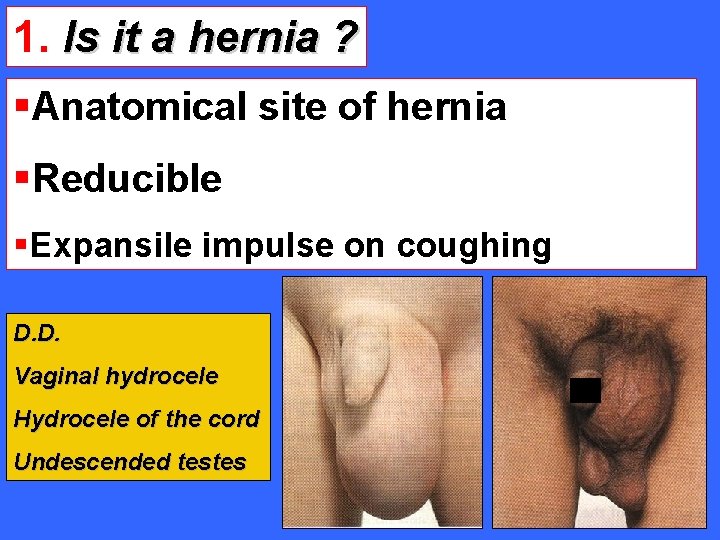
1. Is it a hernia ? §Anatomical site of hernia §Reducible §Expansile impulse on coughing D. D. Vaginal hydrocele Hydrocele of the cord Undescended testes
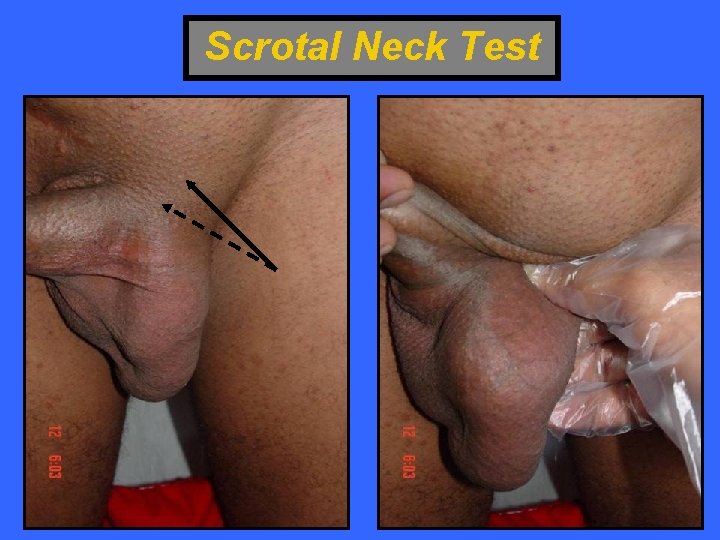
Scrotal Neck Test
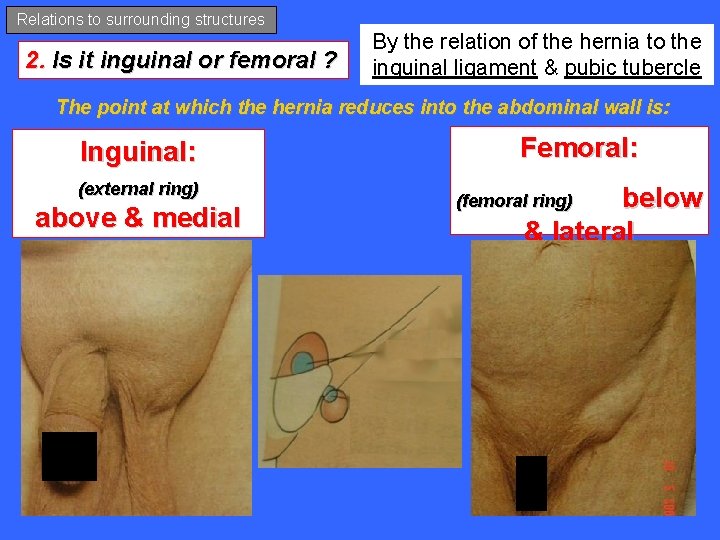
Relations to surrounding structures 2. Is it inguinal or femoral ? By the relation of the hernia to the inguinal ligament & pubic tubercle The point at which the hernia reduces into the abdominal wall is: Femoral: Inguinal: (external ring) below & lateral (femoral ring) above & medial X X X
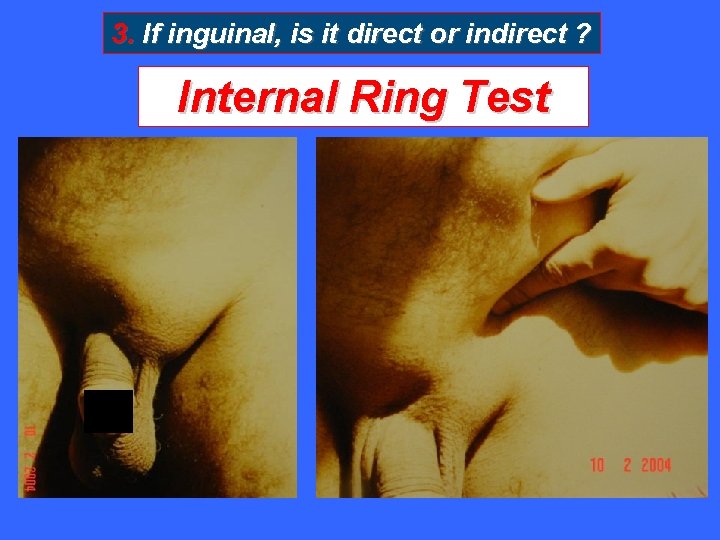
3. If inguinal, is it direct or indirect ? Internal Ring Test X X
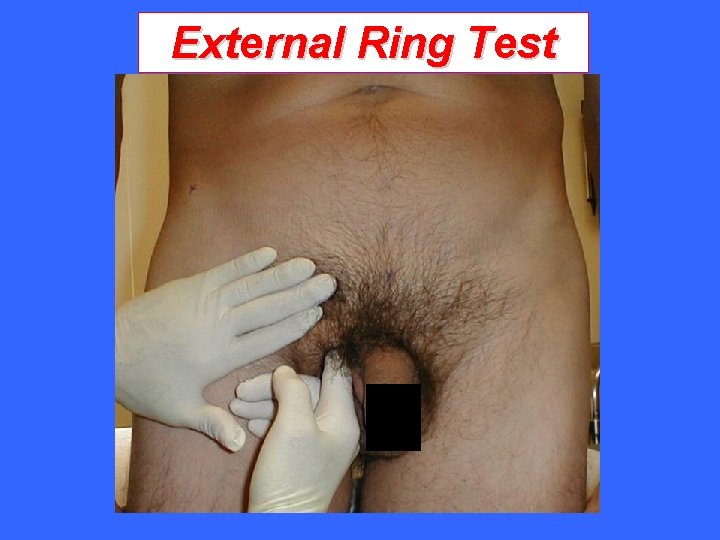
External Ring Test
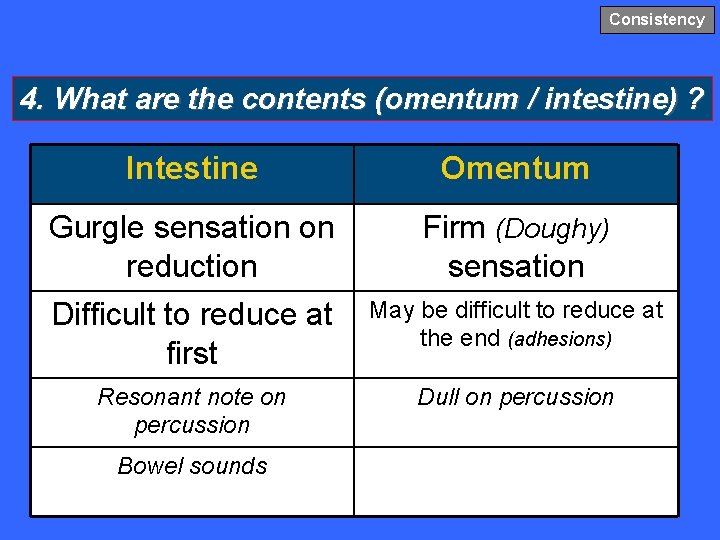
Consistency 4. What are the contents (omentum / intestine) ? Intestine Omentum Gurgle sensation on reduction Firm (Doughy) sensation Difficult to reduce at first May be difficult to reduce at the end (adhesions) Resonant note on percussion Dull on percussion Bowel sounds
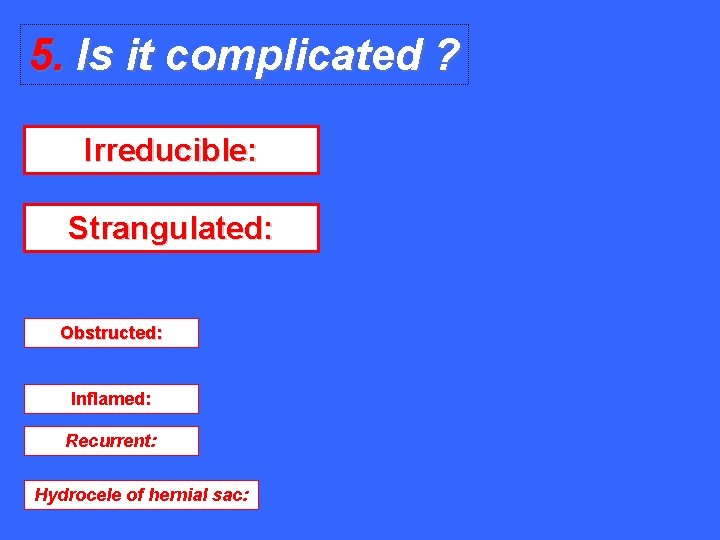
5. Is it complicated ? Irreducible: Strangulated: Obstructed: Inflamed: Recurrent: Hydrocele of hernial sac:
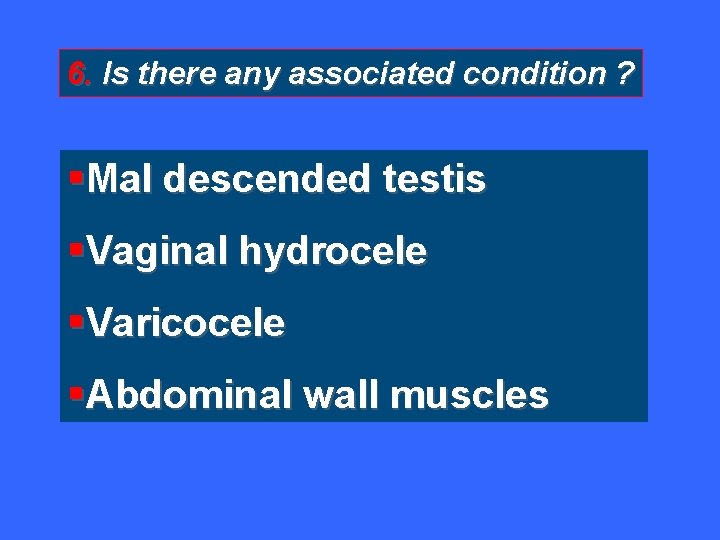
6. Is there any associated condition ? §Mal descended testis §Vaginal hydrocele §Varicocele §Abdominal wall muscles
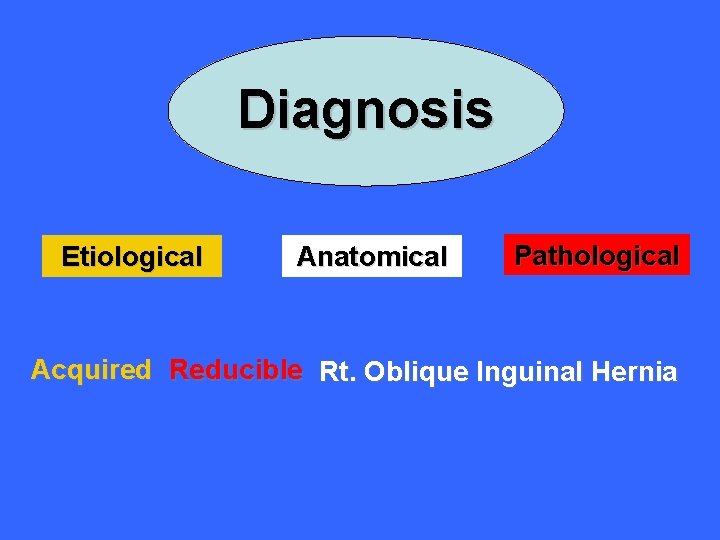
Diagnosis Etiological Anatomical Pathological Acquired Reducible Rt. Oblique Inguinal Hernia
- Slides: 39