
Grignard Reagents Review Katharine Goodenough 310805 Background Discovered
Grignard Reagents – Review Katharine Goodenough 31/08/05
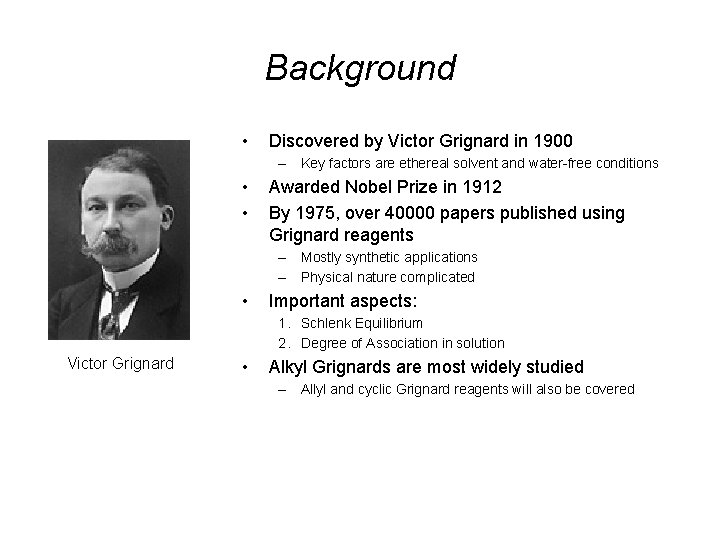
Background • Discovered by Victor Grignard in 1900 – Key factors are ethereal solvent and water-free conditions • • Awarded Nobel Prize in 1912 By 1975, over 40000 papers published using Grignard reagents – Mostly synthetic applications – Physical nature complicated • Important aspects: 1. Schlenk Equilibrium 2. Degree of Association in solution Victor Grignard • Alkyl Grignards are most widely studied – Allyl and cyclic Grignard reagents will also be covered
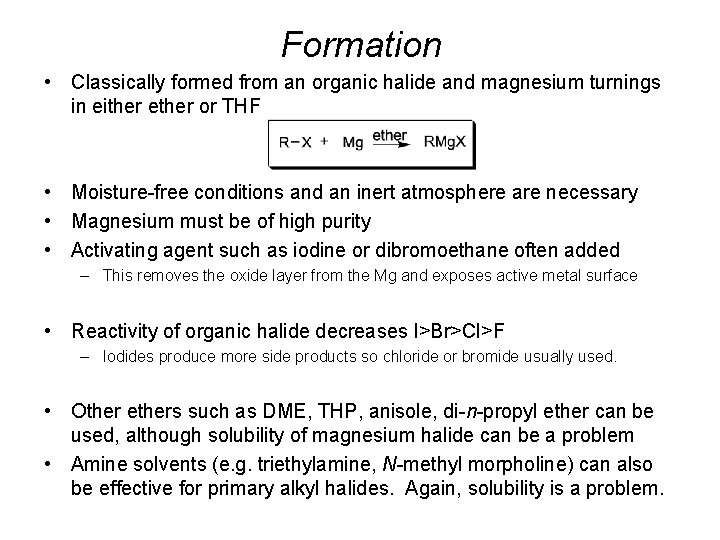
Formation • Classically formed from an organic halide and magnesium turnings in either ether or THF • Moisture-free conditions and an inert atmosphere are necessary • Magnesium must be of high purity • Activating agent such as iodine or dibromoethane often added – This removes the oxide layer from the Mg and exposes active metal surface • Reactivity of organic halide decreases I>Br>Cl>F – Iodides produce more side products so chloride or bromide usually used. • Other ethers such as DME, THP, anisole, di-n-propyl ether can be used, although solubility of magnesium halide can be a problem • Amine solvents (e. g. triethylamine, N-methyl morpholine) can also be effective for primary alkyl halides. Again, solubility is a problem.
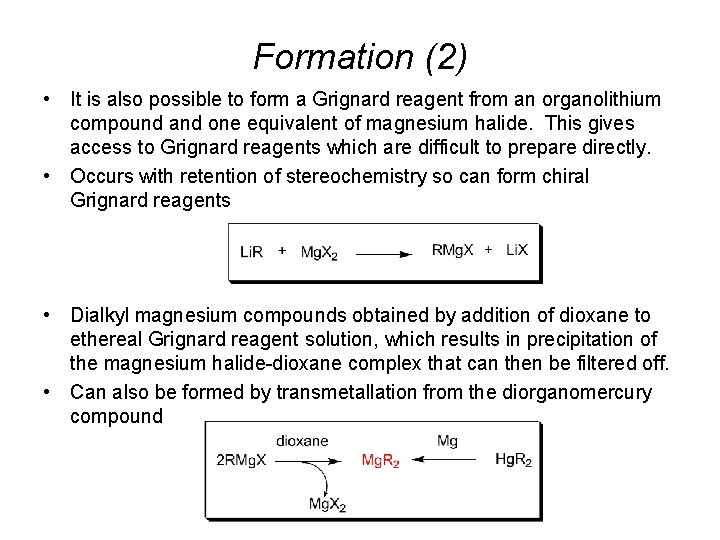
Formation (2) • It is also possible to form a Grignard reagent from an organolithium compound and one equivalent of magnesium halide. This gives access to Grignard reagents which are difficult to prepare directly. • Occurs with retention of stereochemistry so can form chiral Grignard reagents • Dialkyl magnesium compounds obtained by addition of dioxane to ethereal Grignard reagent solution, which results in precipitation of the magnesium halide-dioxane complex that can then be filtered off. • Can also be formed by transmetallation from the diorganomercury compound
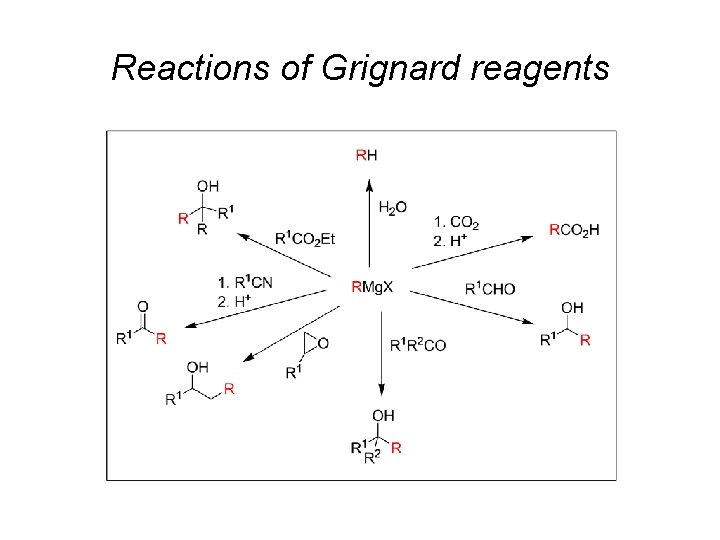
Reactions of Grignard reagents
Mechanism of reaction with ketones 2
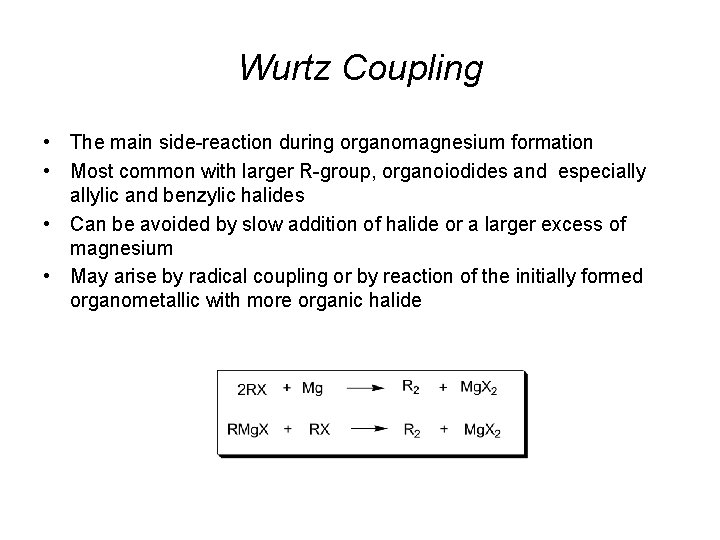
Wurtz Coupling • The main side-reaction during organomagnesium formation • Most common with larger R-group, organoiodides and especiallylic and benzylic halides • Can be avoided by slow addition of halide or a larger excess of magnesium • May arise by radical coupling or by reaction of the initially formed organometallic with more organic halide
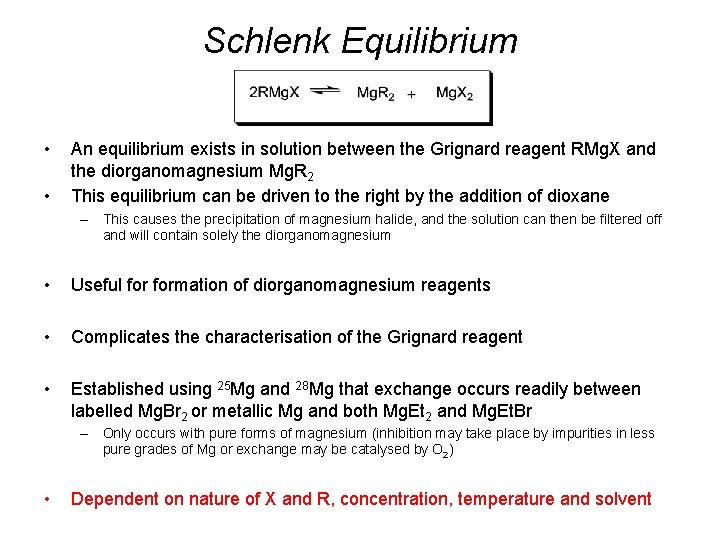
Schlenk Equilibrium • • An equilibrium exists in solution between the Grignard reagent RMg. X and the diorganomagnesium Mg. R 2 This equilibrium can be driven to the right by the addition of dioxane – This causes the precipitation of magnesium halide, and the solution can then be filtered off and will contain solely the diorganomagnesium • Useful formation of diorganomagnesium reagents • Complicates the characterisation of the Grignard reagent • Established using 25 Mg and 28 Mg that exchange occurs readily between labelled Mg. Br 2 or metallic Mg and both Mg. Et 2 and Mg. Et. Br – Only occurs with pure forms of magnesium (inhibition may take place by impurities in less pure grades of Mg or exchange may be catalysed by O 2) • Dependent on nature of X and R, concentration, temperature and solvent
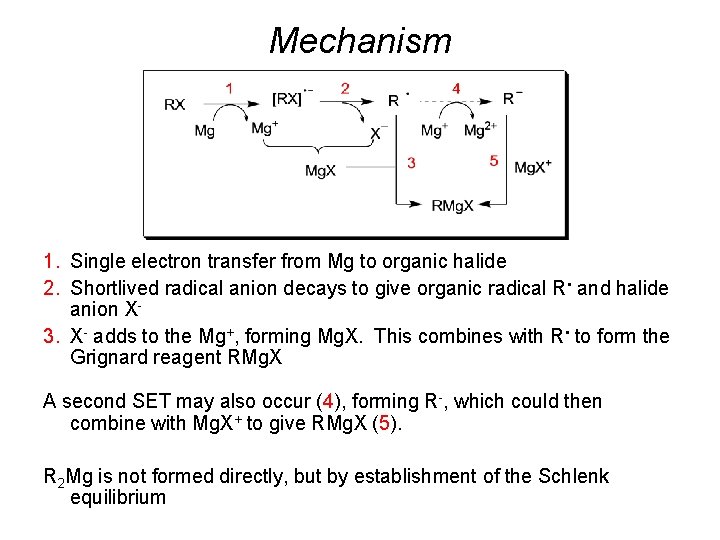
Mechanism 1. Single electron transfer from Mg to organic halide 2. Shortlived radical anion decays to give organic radical R • and halide anion X 3. X- adds to the Mg+, forming Mg. X. This combines with R • to form the Grignard reagent RMg. X A second SET may also occur (4), forming R-, which could then combine with Mg. X+ to give RMg. X (5). R 2 Mg is not formed directly, but by establishment of the Schlenk equilibrium
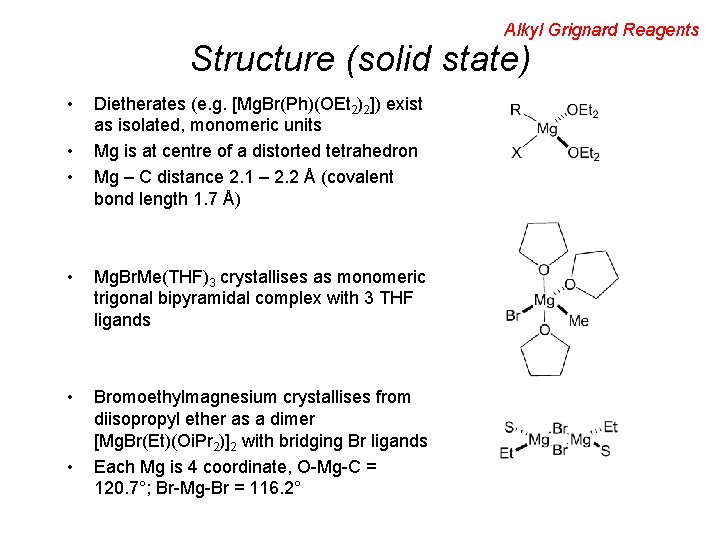
Alkyl Grignard Reagents Structure (solid state) • • • Dietherates (e. g. [Mg. Br(Ph)(OEt 2)2]) exist as isolated, monomeric units Mg is at centre of a distorted tetrahedron Mg – C distance 2. 1 – 2. 2 Å (covalent bond length 1. 7 Å) • Mg. Br. Me(THF)3 crystallises as monomeric trigonal bipyramidal complex with 3 THF ligands • Bromoethylmagnesium crystallises from diisopropyl ether as a dimer [Mg. Br(Et)(Oi. Pr 2)]2 with bridging Br ligands Each Mg is 4 coordinate, O-Mg-C = 120. 7°; Br-Mg-Br = 116. 2° •
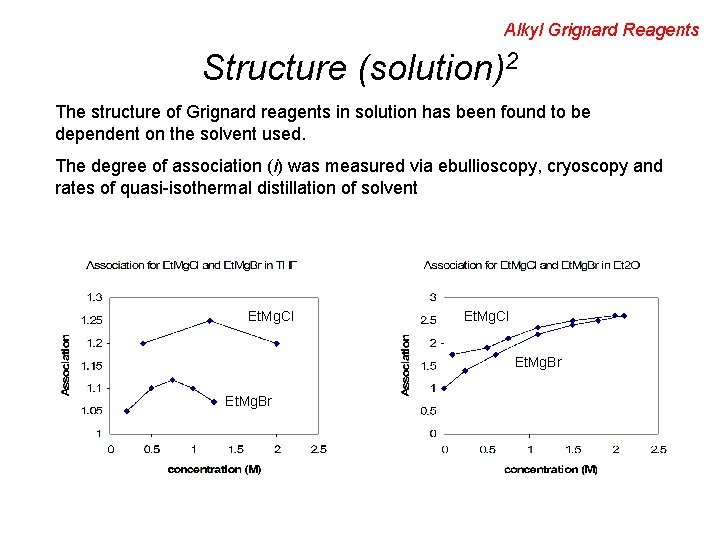
Alkyl Grignard Reagents Structure (solution)2 The structure of Grignard reagents in solution has been found to be dependent on the solvent used. The degree of association (i) was measured via ebullioscopy, cryoscopy and rates of quasi-isothermal distillation of solvent Et. Mg. Cl Et. Mg. Br

Alkyl Grignard Reagents • In THF, RMg. X (X = Cl, Br, I) are monomeric over a wide concentration range – For X = F, compounds are dimeric (ie [RMg. F]2) • In Et 2 O, RMg. X (X = Cl, F) are dimeric over a wide concentration range. • For X = Br, I, association patterns are more complex. – At low concentration, monomeric species exist (in accordance with Schlenk equilibrium) – At high concentration, association increases to greater than 2 (ie dimers and larger present) • Four possible structures for dimer of RMg. X (or Mg. R 2+ Mg. X 2):
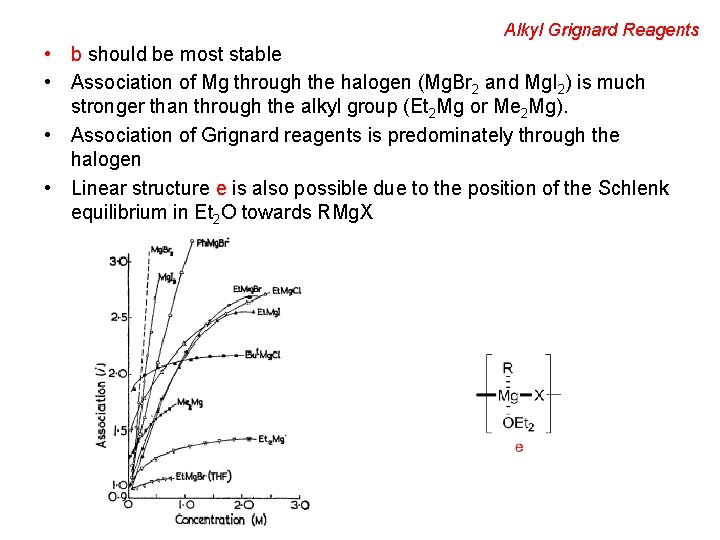
Alkyl Grignard Reagents • b should be most stable • Association of Mg through the halogen (Mg. Br 2 and Mg. I 2) is much stronger than through the alkyl group (Et 2 Mg or Me 2 Mg). • Association of Grignard reagents is predominately through the halogen • Linear structure e is also possible due to the position of the Schlenk equilibrium in Et 2 O towards RMg. X

Alkyl Grignard Reagents Thermodynamics of Schlenk equilibrium 3 Grignard reagent Solvent K Me. Mg. Br Et 2 O 320 THF 3. 5 – 4 Et 2 O 480 – 484 THF 5. 09 THF 5. 52 Et. Mg. Br Et. Mg. Cl • In ether, Mg. RX is prevalent (K~10 – 103) but in THF (K = 1 -10), a more random distribution is seen. • Since THF adducts tend to have higher coordination numbers than those of Et 2 O, differences attributed to degree of solvation. • In hydrocarbon solvent, K is very small; in triethylamine it is very large
Alkyl Grignard Reagents NMR Studies 4 • Mg. R 2 and RMg. X can be distinguished provided exchange is slow on the NMR timescale • α-H atoms of magnesium-bound alkyl group R resonate at δ-2 – 0 ppm (average under conditions of fast exchange) • Mg. XR is at lower field than Mg. R 2 due to shielding by halogen – Me. Mg. Br δ -1. 55 ppm; Mg. Me 2 δ -1. 70 ppm in Et 2 O at -100 °C • Can detect variation in composition – Varies with nature of solvent, organic group, halide, temperature and concentration • Alkyl groups undergo exchange under the reaction conditions – Rate of alkyl group exchange determined by structure of alkyl group and secondarily by nature of solvent

Alkyl Grignard Reagents • For Me 2 Mg in Et 2 O: – The lower field signals are attributed to bridging Me groups in associated dimethylmagnesium – The higher field signal is attributed to terminal methyl groups of the associated molecules, and to monomers • In THF: – Signal at 11. 76 at +20 °C, shifts to 11. 83 at -76 °C – Supports its existence as a monomeric species in THF – At low temp, a small signal was seen at 11. 70, attributed to small amounts of associated species

• For Me. Mg. Br in Et 2 O: Alkyl Grignard Reagents – At low temperature, two distinct signals are seen. • The lower field signal (τ 11. 55) is attributed to Me. Mg. Br • The higher field signal (τ 11. 70) is Me 2 Mg as before • Equilibrium constants for the Schlenk equilibrium cannot be obtained due to precipitation during cooling • In THF: – Chemical shifts are very dependant on temperature, moving to higher field with lower temperature. – It was not possible to observe distinct signals for Me. Mg. Br and Me 2 Mg as was possible in ether. – The Schlenk equilibrium seems to shift towards the dialkylmagnesium at lower temperature, since the spectrum approaches that of Me 2 Mg at -76 °C – May be partially due to Mg. Br 2 precipitating • From these data, equilibrium constant was calculated for Me. Mg. Br in THF, K = 4 ± 2. 6
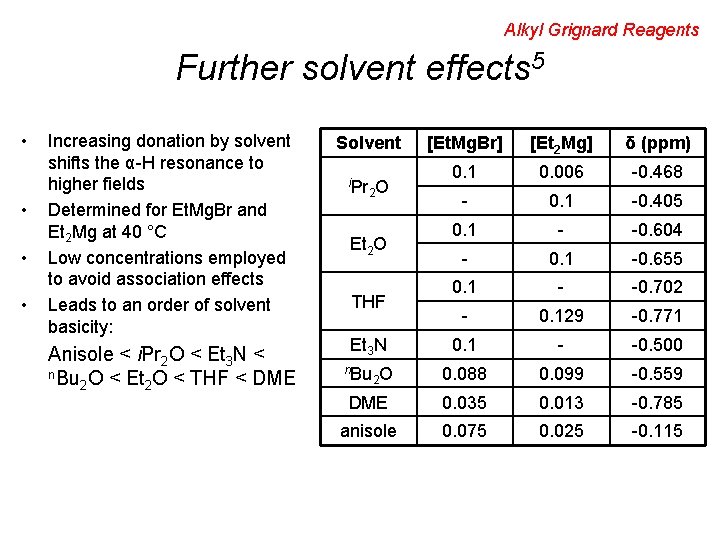
Alkyl Grignard Reagents Further solvent effects 5 • • Increasing donation by solvent shifts the α-H resonance to higher fields Determined for Et. Mg. Br and Et 2 Mg at 40 °C Low concentrations employed to avoid association effects Leads to an order of solvent basicity: Anisole < i. Pr 2 O < Et 3 N < n. Bu O < Et O < THF < DME 2 2 Solvent [Et. Mg. Br] [Et 2 Mg] δ (ppm) 0. 1 0. 006 -0. 468 - 0. 1 -0. 405 0. 1 - -0. 604 - 0. 1 -0. 655 0. 1 - -0. 702 - 0. 129 -0. 771 0. 1 - -0. 500 0. 088 0. 099 -0. 559 DME 0. 035 0. 013 -0. 785 anisole 0. 075 0. 025 -0. 115 i. Pr 2 O Et 2 O THF Et 3 N n. Bu 2 O
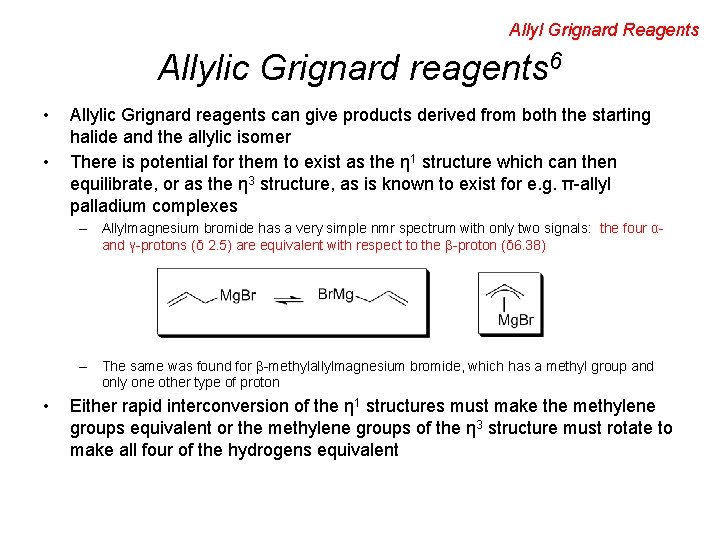
Allyl Grignard Reagents Allylic Grignard reagents 6 • • Allylic Grignard reagents can give products derived from both the starting halide and the allylic isomer There is potential for them to exist as the η 1 structure which can then equilibrate, or as the η 3 structure, as is known to exist for e. g. π-allyl palladium complexes – Allylmagnesium bromide has a very simple nmr spectrum with only two signals: the four αand γ-protons (δ 2. 5) are equivalent with respect to the β-proton (δ 6. 38) – The same was found for β-methylallylmagnesium bromide, which has a methyl group and only one other type of proton • Either rapid interconversion of the η 1 structures must make the methylene groups equivalent or the methylene groups of the η 3 structure must rotate to make all four of the hydrogens equivalent
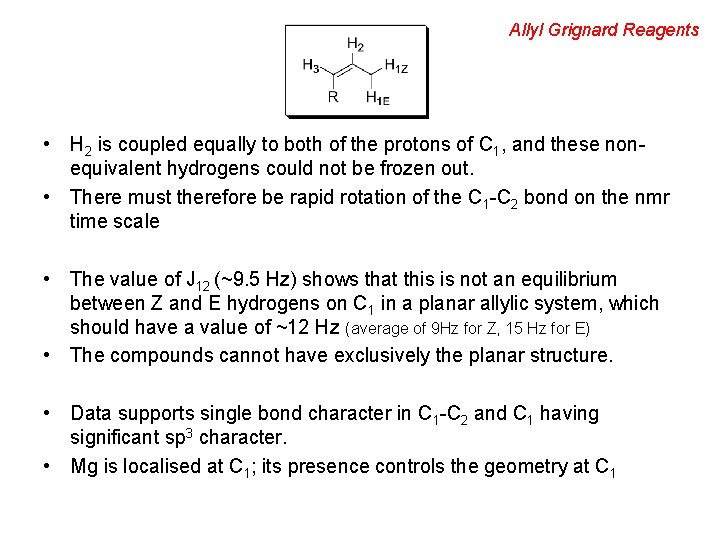
Allyl Grignard Reagents • H 2 is coupled equally to both of the protons of C 1, and these nonequivalent hydrogens could not be frozen out. • There must therefore be rapid rotation of the C 1 -C 2 bond on the nmr time scale • The value of J 12 (~9. 5 Hz) shows that this is not an equilibrium between Z and E hydrogens on C 1 in a planar allylic system, which should have a value of ~12 Hz (average of 9 Hz for Z, 15 Hz for E) • The compounds cannot have exclusively the planar structure. • Data supports single bond character in C 1 -C 2 and C 1 having significant sp 3 character. • Mg is localised at C 1; its presence controls the geometry at C 1
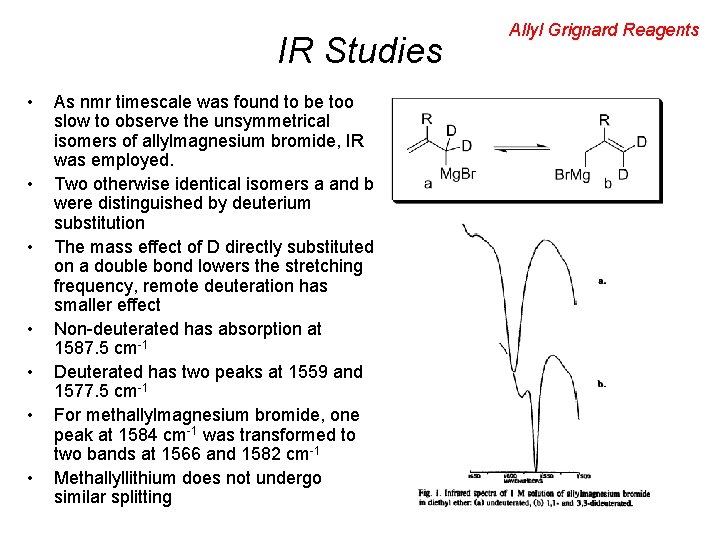
IR Studies • • As nmr timescale was found to be too slow to observe the unsymmetrical isomers of allylmagnesium bromide, IR was employed. Two otherwise identical isomers a and b were distinguished by deuterium substitution The mass effect of D directly substituted on a double bond lowers the stretching frequency, remote deuteration has smaller effect Non-deuterated has absorption at 1587. 5 cm-1 Deuterated has two peaks at 1559 and 1577. 5 cm-1 For methallylmagnesium bromide, one peak at 1584 cm-1 was transformed to two bands at 1566 and 1582 cm-1 Methallyllithium does not undergo similar splitting Allyl Grignard Reagents
13 C • nmr studies Allyl Grignard Reagents 13 C spectrum of allylmagnesium bromide has two lines of similar width: the methylene carbons at δ 58. 7 and the methine carbon at δ 148. 1 ppm. • As temperature was reduced, the methylene resonance broadened and disappeared into baseline noise, while the methine signal remained constant. • At the lowest temperatures studied (~180 K at 62. 9 MHz) there was no sign of the appearance of separate high- and low-field methylene resonances; only the broadening of the average signal • The allylic rearrangement is the only process that could be taking place with a large enough shift difference to account for the observed broadening • Similar behaviour is also observed for methallylmagnesium bromide
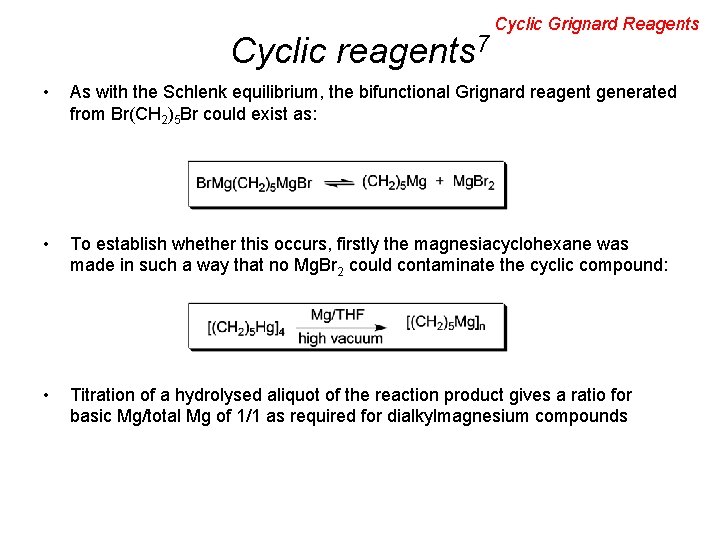
Cyclic reagents 7 Cyclic Grignard Reagents • As with the Schlenk equilibrium, the bifunctional Grignard reagent generated from Br(CH 2)5 Br could exist as: • To establish whether this occurs, firstly the magnesiacyclohexane was made in such a way that no Mg. Br 2 could contaminate the cyclic compound: • Titration of a hydrolysed aliquot of the reaction product gives a ratio for basic Mg/total Mg of 1/1 as required for dialkylmagnesium compounds
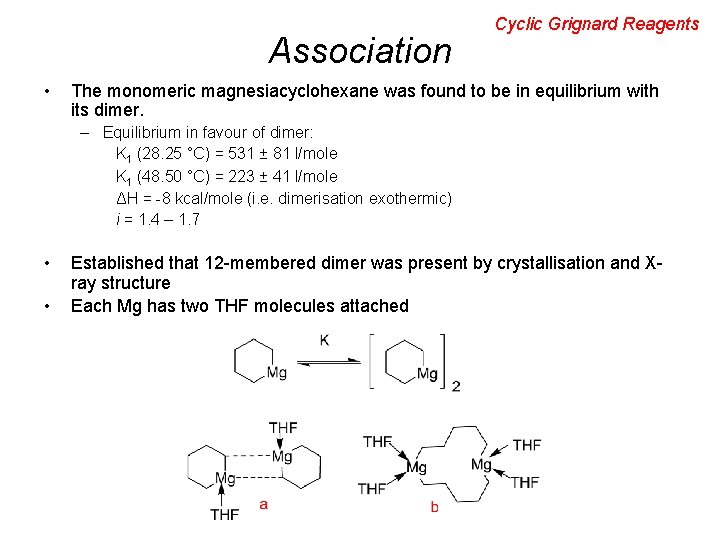
Association • Cyclic Grignard Reagents The monomeric magnesiacyclohexane was found to be in equilibrium with its dimer. – Equilibrium in favour of dimer: K 1 (28. 25 °C) = 531 ± 81 l/mole K 1 (48. 50 °C) = 223 ± 41 l/mole ΔH = -8 kcal/mole (i. e. dimerisation exothermic) i = 1. 4 – 1. 7 • • Established that 12 -membered dimer was present by crystallisation and Xray structure Each Mg has two THF molecules attached
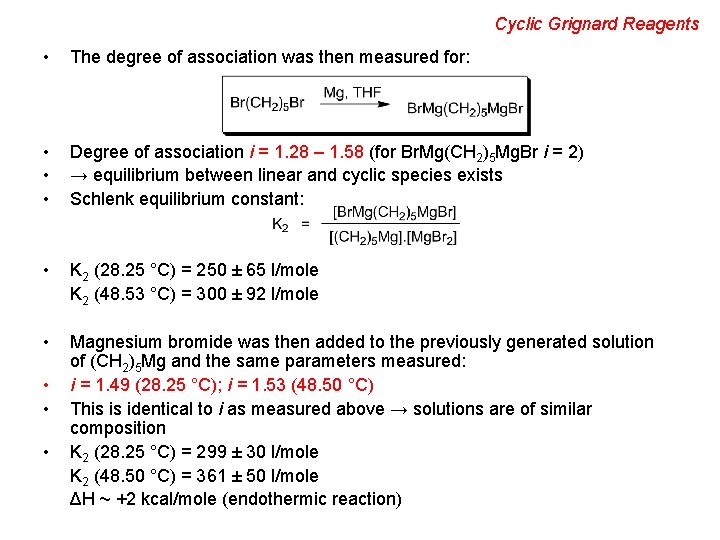
Cyclic Grignard Reagents • The degree of association was then measured for: • • • Degree of association i = 1. 28 – 1. 58 (for Br. Mg(CH 2)5 Mg. Br i = 2) → equilibrium between linear and cyclic species exists Schlenk equilibrium constant: • K 2 (28. 25 °C) = 250 ± 65 l/mole K 2 (48. 53 °C) = 300 ± 92 l/mole • Magnesium bromide was then added to the previously generated solution of (CH 2)5 Mg and the same parameters measured: i = 1. 49 (28. 25 °C); i = 1. 53 (48. 50 °C) This is identical to i as measured above → solutions are of similar composition K 2 (28. 25 °C) = 299 ± 30 l/mole K 2 (48. 50 °C) = 361 ± 50 l/mole ΔH ~ +2 kcal/mole (endothermic reaction) • • •
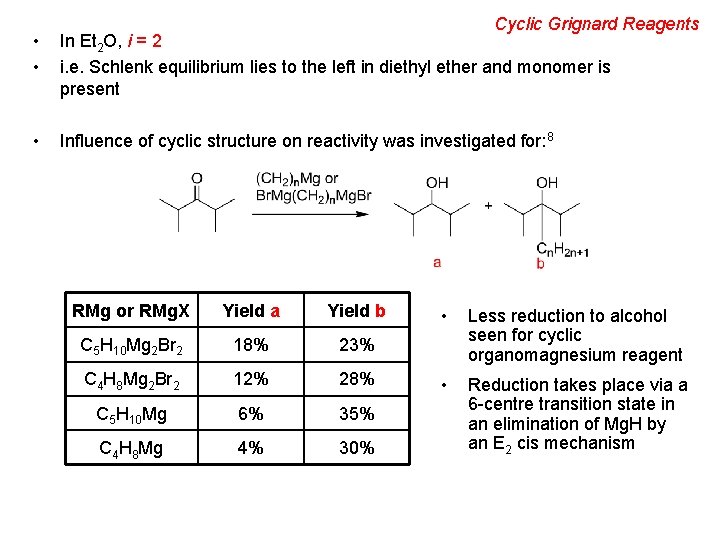
Cyclic Grignard Reagents • • In Et 2 O, i = 2 i. e. Schlenk equilibrium lies to the left in diethyl ether and monomer is present • Influence of cyclic structure on reactivity was investigated for: 8 RMg or RMg. X Yield a Yield b C 5 H 10 Mg 2 Br 2 18% 23% C 4 H 8 Mg 2 Br 2 12% 28% C 5 H 10 Mg 6% 35% C 4 H 8 Mg 4% 30% • Less reduction to alcohol seen for cyclic organomagnesium reagent • Reduction takes place via a 6 -centre transition state in an elimination of Mg. H by an E 2 cis mechanism
Conclusions • Deceptively simple nature of Grignard reactions complicated by behaviour in solution • In Et 2 O, Grignard reagents tend to exist as RMg. X, but at higher concentrations are highly associated in solution • In THF, there is an equilibrium between RMg. X and R 2 Mg. However, the organomagesium reagents tend to be monomeric. • Allylic Grignard reagents are complicated by the nature of their conjugation • Di-Grignard reagents can exist as the cyclic species
References 1. Magnesium, Calcium, Strontium and Barium, W. E. Lindsell, Comprehensive Organometallic Chemistry 1, 1982, 155 2. E. C. Ashby, Quarterly Reviews of the Chemical Society, 1967, 21, 259 3. M. B. Smith, W. E. Becker, Tetrahedron, 1966, 22, 3027; 1967, 23, 4215 4. G. E. Parris, E. C. Ashby, J. Am. Chem. Soc. 1971, 93, 1206 5. G. Westera, C. Blomberg, F. Bickelhaupt, J. Organomet. Chem. 155 (1978) C 55 6. A) E. A. Hill, W. A. Boyd, H. Desai, A. Darki, L. Bivens, J. Organomet. Chem. 514 (1996) 1. B) D. A. Hutchison, K. R. Beck, R. A. Benkeser, J. Am. Chem. Soc. 1973, 95, 7075 7. H. C. Holtkamp, C. Blomberg, F. Bickelhaupt, J. Organomet. Chem. 19 (1969) 279. 8. B. Denise, J. -F. Fauvarque, J. Ducom, Tetrahedron Lett. 5 (1970), 355
- Slides: 28