
GRIFFITH QUANTUM THEORY SEMINAR 10 NOVEMBER 2003 Entanglement
GRIFFITH QUANTUM THEORY SEMINAR 10 NOVEMBER 2003 Entanglement, correlation, and errorcorrection in the ground states of manybody systems Henry Haselgrove School of Physical Sciences University of Queensland Michael Nielsen - UQ Tobias Osborne – Bristol Nick Bonesteel – Florida State quant-ph/0308083 quant-ph/0303022 – to appear in PRL
When we make basic assumptions about the interactions in a multi-body quantum system, what are the implications for the ground state? n Basic assumptions --- simple general assumptions of physical plausibility, applicable to most physical systems. u Nature gets by with just 2 -body interactions u Far-apart n things don’t directly interact Implications for the ground state --- using the concepts of Quantum Information Theory. u Error-correcting properties u Entanglement properties

Why ground states are really cool n Physically, ground states are interesting: T=0 is only thermal state that can be a pure state (vs. mixed state) u Pure states are the “most quantum”. u Physically: superconductivity, superfluidity, quantum hall effect, … u n Ground states in Quantum Information Processing: u Naturally fault-tolerant systems u Adiabatic quantum computing
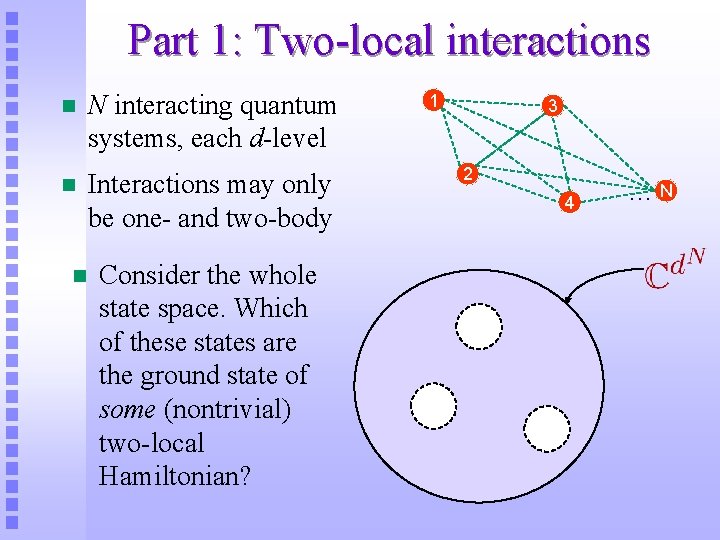
Part 1: Two-local interactions n N interacting quantum systems, each d-level n Interactions may only be one- and two-body n Consider the whole state space. Which of these states are the ground state of some (nontrivial) two-local Hamiltonian? 1 3 2 4 … N
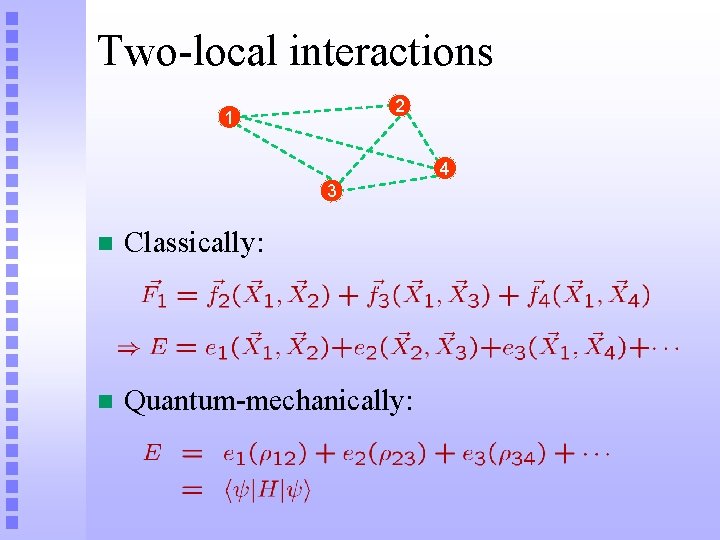
Two-local interactions 2 1 4 3 n Classically: n Quantum-mechanically:
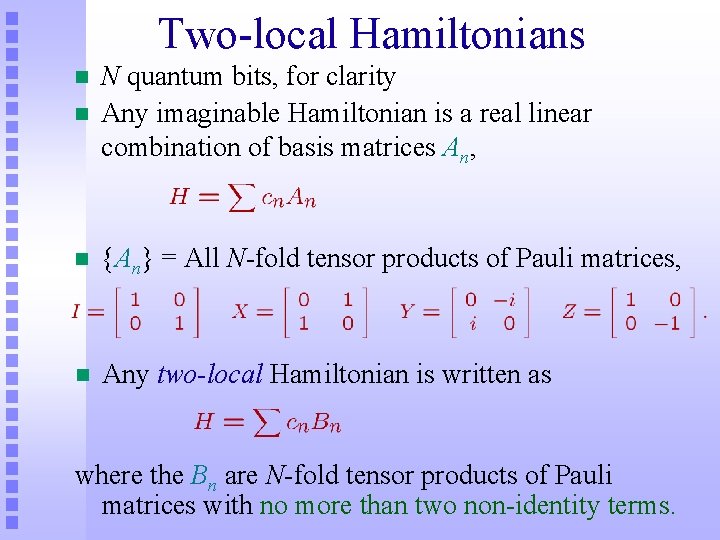
Two-local Hamiltonians n N quantum bits, for clarity Any imaginable Hamiltonian is a real linear combination of basis matrices An, n {An} = All N-fold tensor products of Pauli matrices, n Any two-local Hamiltonian is written as n where the Bn are N-fold tensor products of Pauli matrices with no more than two non-identity terms.
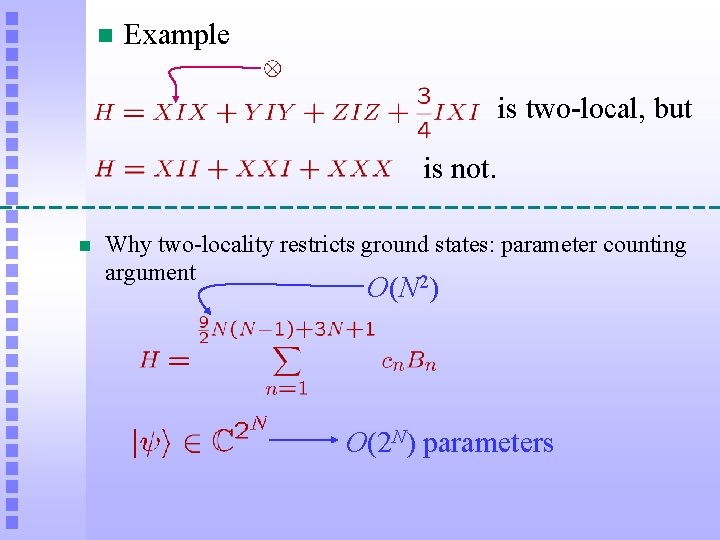
n Example is two-local, but is not. n Why two-locality restricts ground states: parameter counting argument 2 O(N ) O(2 N) parameters
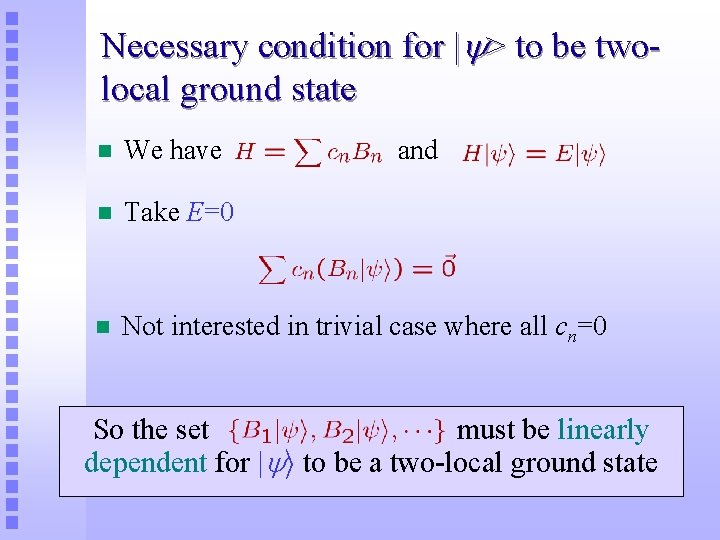
Necessary condition for | > to be twolocal ground state n We have and n Take E=0 n Not interested in trivial case where all cn=0 So the set must be linearly dependent for | i to be a two-local ground state
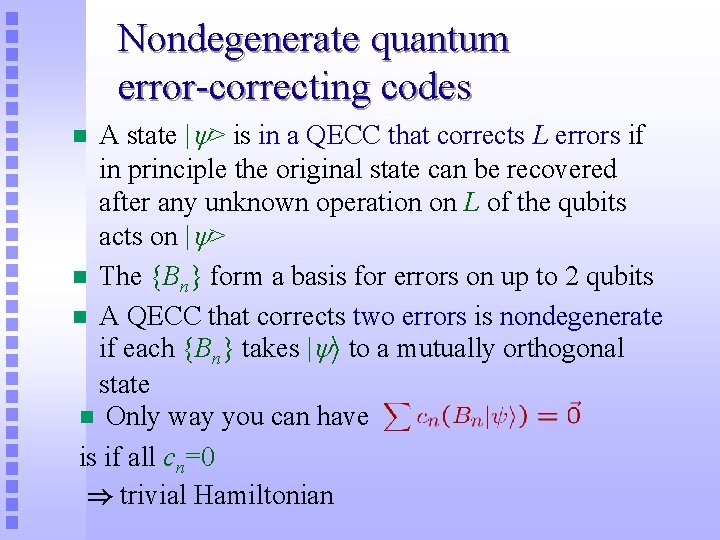
Nondegenerate quantum error-correcting codes A state | > is in a QECC that corrects L errors if in principle the original state can be recovered after any unknown operation on L of the qubits acts on | > n The {Bn} form a basis for errors on up to 2 qubits n A QECC that corrects two errors is nondegenerate if each {Bn} takes | i to a mutually orthogonal state n Only way you can have is if all cn=0 ) trivial Hamiltonian n
n n A nondegenerate QECC can not be the eigenstate of any nontrivial two-local Hamiltonian In fact, it can not be even near an eigenstate of any nontrivial two-local Hamiltonian
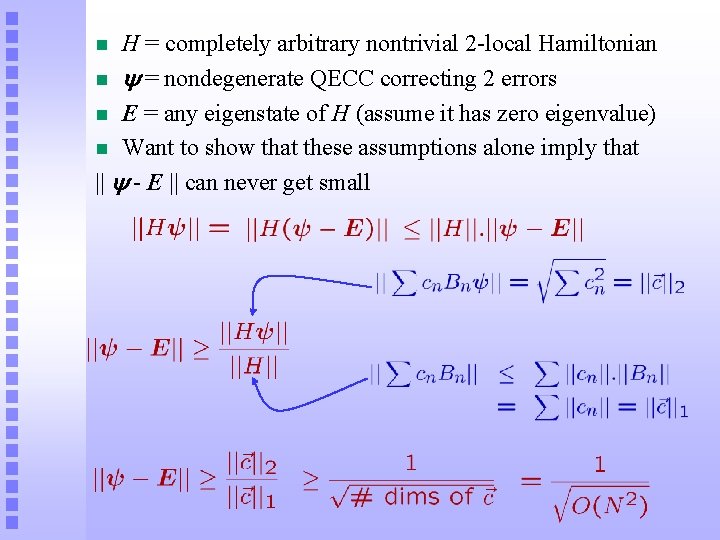
H = completely arbitrary nontrivial 2 -local Hamiltonian n = nondegenerate QECC correcting 2 errors n E = any eigenstate of H (assume it has zero eigenvalue) n Want to show that these assumptions alone imply that || - E || can never get small n
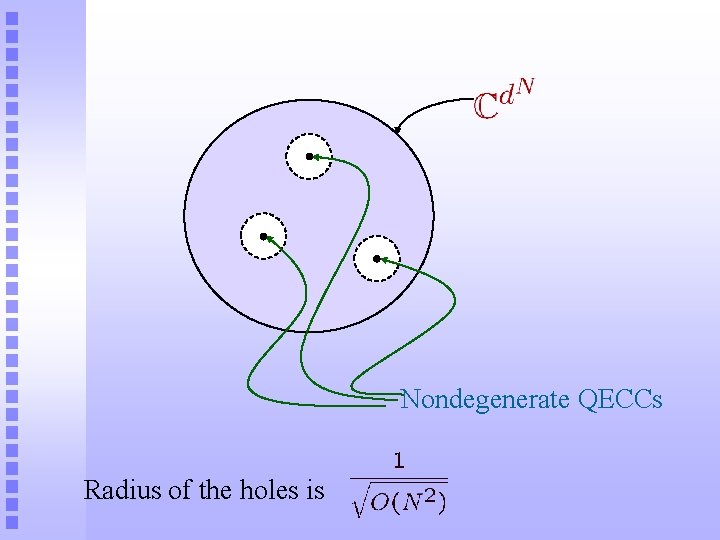
Nondegenerate QECCs Radius of the holes is
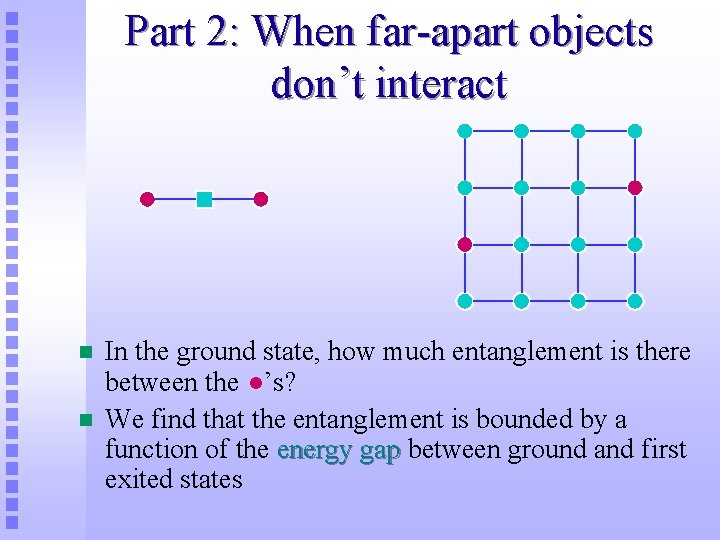
Part 2: When far-apart objects don’t interact n n In the ground state, how much entanglement is there between the ●’s? We find that the entanglement is bounded by a function of the energy gap between ground and first exited states
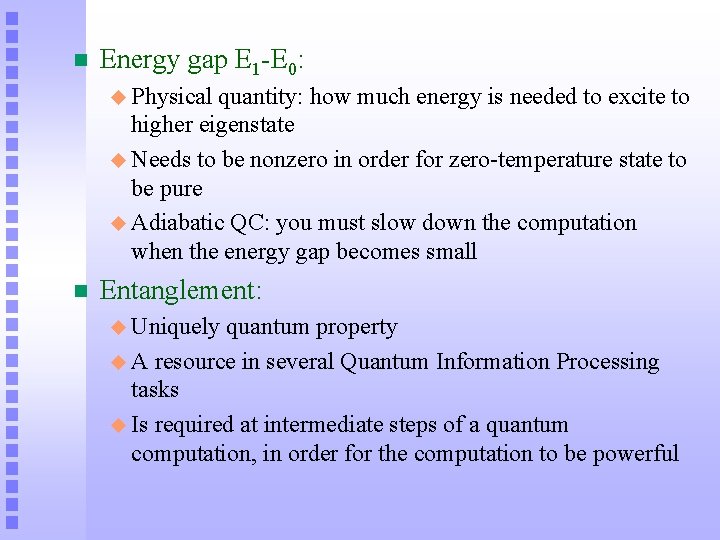
n Energy gap E 1 -E 0: u Physical quantity: how much energy is needed to excite to higher eigenstate u Needs to be nonzero in order for zero-temperature state to be pure u Adiabatic QC: you must slow down the computation when the energy gap becomes small n Entanglement: u Uniquely quantum property u A resource in several Quantum Information Processing tasks u Is required at intermediate steps of a quantum computation, in order for the computation to be powerful
Some related results n Theory of quantum phase transitions. At a QPT, one sees both ua vanishing energy gap, and correlations in the ground state. Theory usually applies to infinite quantum systems. u long-range n Non-relativistic Goldstone Theorem. u Diverging correlations imply vanishing energy gap. u Applies to infinite systems, and typically requires additional symmetry assumptions
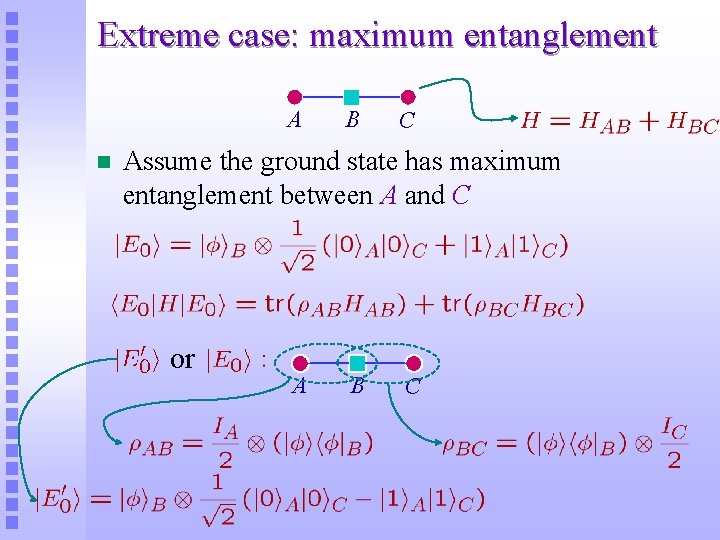
Extreme case: maximum entanglement A n B C Assume the ground state has maximum entanglement between A and C or A B C
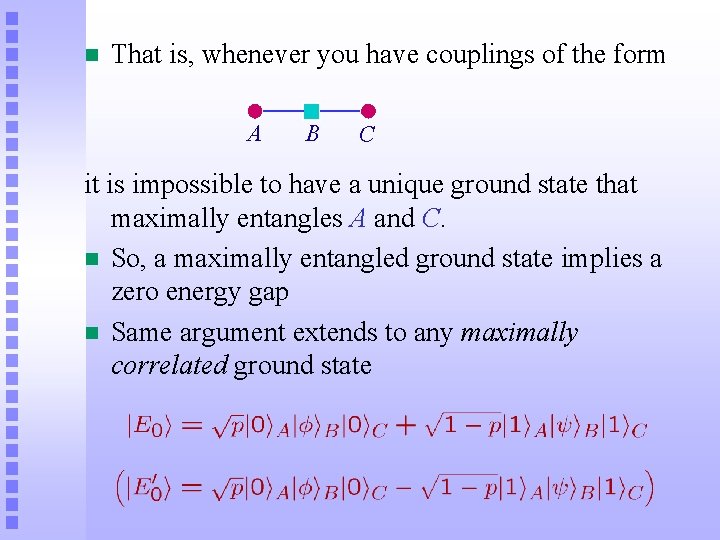
n That is, whenever you have couplings of the form A B C it is impossible to have a unique ground state that maximally entangles A and C. n So, a maximally entangled ground state implies a zero energy gap n Same argument extends to any maximally correlated ground state
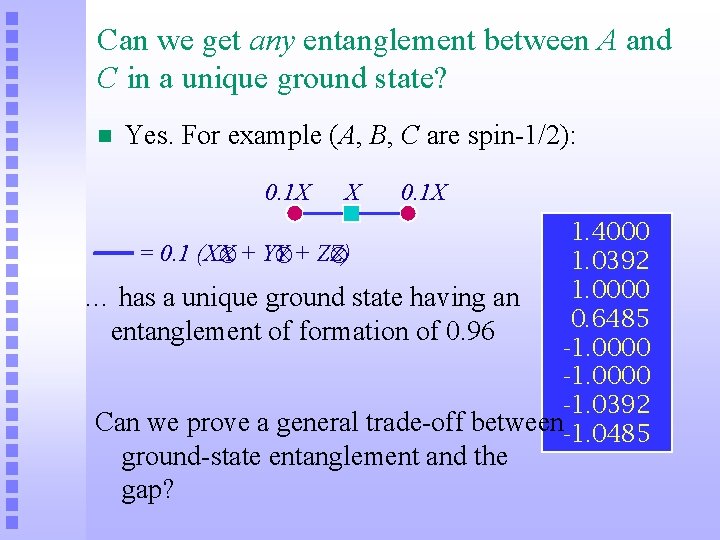
Can we get any entanglement between A and C in a unique ground state? n Yes. For example (A, B, C are spin-1/2): 0. 1 X X 0. 1 X 1. 4000 = 0. 1 (X X + Y Y + Z Z) 1. 0392 1. 0000 … has a unique ground state having an 0. 6485 entanglement of formation of 0. 96 -1. 0000 -1. 0392 Can we prove a general trade-off between-1. 0485 ground-state entanglement and the gap?
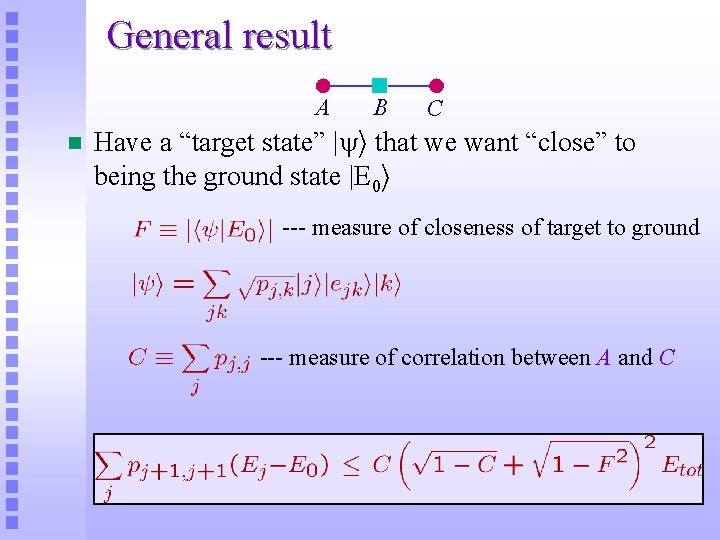
General result A n B C Have a “target state” | i that we want “close” to being the ground state |E 0 i --- measure of closeness of target to ground --- measure of correlation between A and C
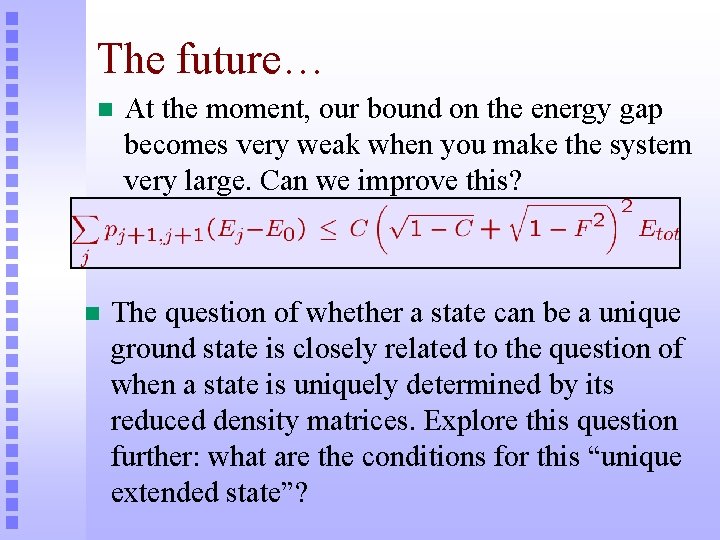
The future… n n At the moment, our bound on the energy gap becomes very weak when you make the system very large. Can we improve this? The question of whether a state can be a unique ground state is closely related to the question of when a state is uniquely determined by its reduced density matrices. Explore this question further: what are the conditions for this “unique extended state”?
Conclusions Simple yet widely-applicable assumptions on the interactions in a many-body quantum system, lead to interesting and powerful results regarding the ground states of those systems 1. 2. Assuming two-locality affects the error-correcting abilities Assuming that two parts don’t directly interact, introduces a correlation-gap trade-off.
- Slides: 21