
Griffith 12 1 DNA Questioned how bacteria made
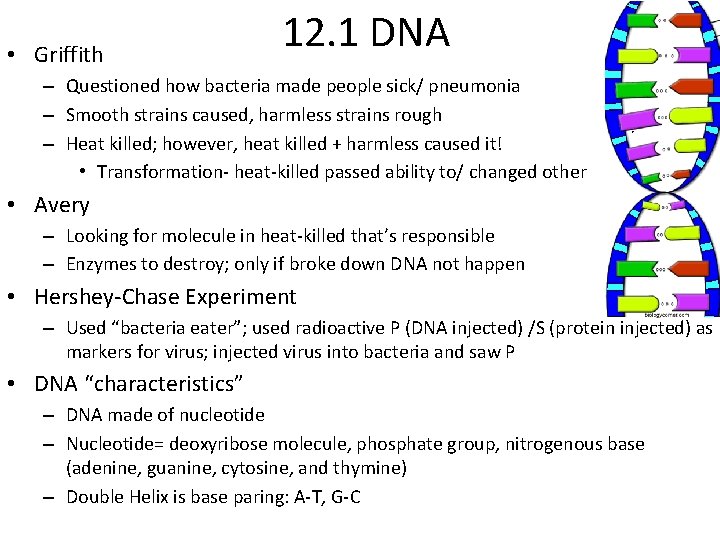
• Griffith 12. 1 DNA – Questioned how bacteria made people sick/ pneumonia – Smooth strains caused, harmless strains rough – Heat killed; however, heat killed + harmless caused it! • Transformation- heat-killed passed ability to/ changed other • Avery – Looking for molecule in heat-killed that’s responsible – Enzymes to destroy; only if broke down DNA not happen • Hershey-Chase Experiment – Used “bacteria eater”; used radioactive P (DNA injected) /S (protein injected) as markers for virus; injected virus into bacteria and saw P • DNA “characteristics” – DNA made of nucleotide – Nucleotide= deoxyribose molecule, phosphate group, nitrogenous base (adenine, guanine, cytosine, and thymine) – Double Helix is base paring: A-T, G-C
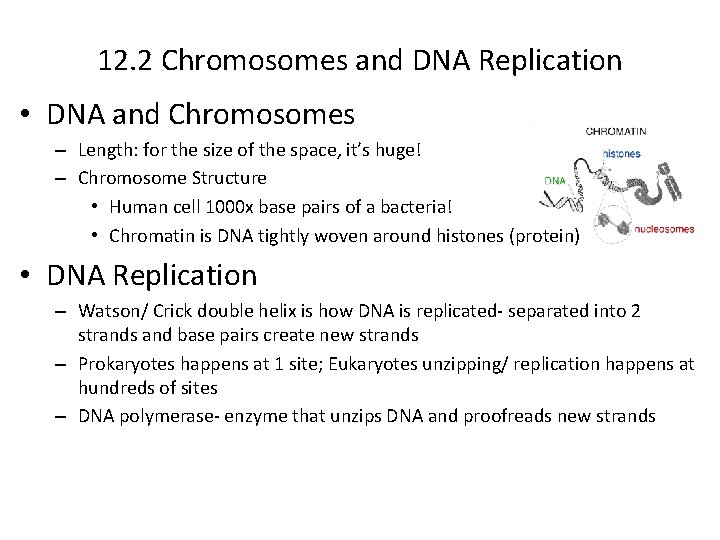
12. 2 Chromosomes and DNA Replication • DNA and Chromosomes – Length: for the size of the space, it’s huge! – Chromosome Structure • Human cell 1000 x base pairs of a bacteria! • Chromatin is DNA tightly woven around histones (protein) • DNA Replication – Watson/ Crick double helix is how DNA is replicated- separated into 2 strands and base pairs create new strands – Prokaryotes happens at 1 site; Eukaryotes unzipping/ replication happens at hundreds of sites – DNA polymerase- enzyme that unzips DNA and proofreads new strands
12. 3 RNA and Protein Synthesis • Structure Differences: – Sugar is ribose, single-stands, uricil- U (instead of thymine-T) • 3 Types – m. RNA (instructions to assemble aa to proteins); r. RNA (proteins assembled); t. RNA (construction of protein, coding/ transfer) • Transcription – RNA polymerase binds to/ separates DNA; uses 1 strand as template to assemble into strand of RNA; only binds to DNA areas known as promoters (specific base sequence) • Editing- RNA is copying DNA – Introns- m. RNA sequences not involved in coding of proteins – Exons- expressed m. RNA sequences in synthesis of proteins
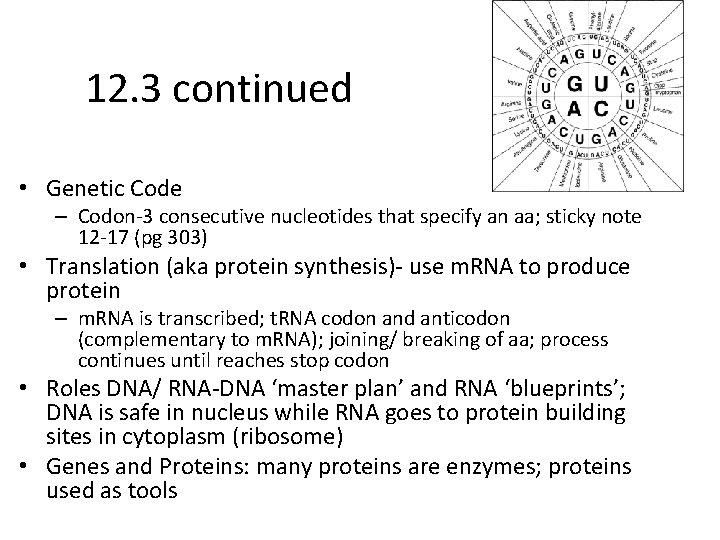
12. 3 continued • Genetic Code – Codon-3 consecutive nucleotides that specify an aa; sticky note 12 -17 (pg 303) • Translation (aka protein synthesis)- use m. RNA to produce protein – m. RNA is transcribed; t. RNA codon and anticodon (complementary to m. RNA); joining/ breaking of aa; process continues until reaches stop codon • Roles DNA/ RNA-DNA ‘master plan’ and RNA ‘blueprints’; DNA is safe in nucleus while RNA goes to protein building sites in cytoplasm (ribosome) • Genes and Proteins: many proteins are enzymes; proteins used as tools
12. 4 Mutations • Kinds – Point Mutations: change one/ few nucleotide; substitution (change base) or insertions/ deletion (base inserted or removed) – Frameshift Mutitations: nucleotide +/- still group in 3 to make aa, groupings for codons shifted; shift of “reading frame” changes every aa that follows – Chromosomal Mutations: changes # or structure of chromosomes; deletions, duplications, inversions (reverse direction), or translocation (parts break off one and attach to other) • Significance – – Many are neutral; little/ no effect on expression Dramatic change in protein structure = harmful Genetic variation can be helpful Polyploidy: extra set of chromosomes, “super” crops
12. 5 Gene Regulation • Gene Regulation – Operon: group of genes operate together; must be expressed lac operon – Lac genes turned off by repressors and on by lactose – Operator: region for repressor to bind to, preventing transcription of gene • Eukaryotic Gene Regulation – Have TATA box to help position RNA polymerase/ marking point just before transcription begins – Reason more complex is because of cell specialization! • Development and Differentiation – Differentiation of cells = cells specialized – Hox genes: control differentiation of cells/ tissues as embryo develop
- Slides: 7