
Grieving as a Community Angela Oblinger MSW LISWS
Grieving as a Community Angela Oblinger, MSW, LISW-S 9 Germantown, Ohio (937) 999 -8325
Topics for tonight • What is Grief? • Community Grief • Individual Grief • How to Talk to Kids about Grief • What to Say/Not to Say • Self-Care Techniques • Resources • Disclaimer
Grief Defined • Great sorrow • For what you have lost already and for the future • Takes tremendous energy • Acute moments – no warning • Feel like going crazy • Trouble thinking • Physical, Emotional, Spiritual, and Behavioral • Don’t forget about grandparents • Feeling numb explained • Body wants balance • Constant companion • No “how to” manual • Needs to be validated • No time line • Different with time, not better

Two Models of Grief 5 Stages / 5 Steps Tear drop tasks of grief o Shock o Anger o Bargaining o Depression o Acceptance T= To accept reality of the loss E= Experience the pain A= Adjust to new environment R= reinvest in reality
Grieving as a Community • • • United States (individualized) vs. most of the world (collective) Valley View close knit Bodies feel it/emotions kept in our body Ex. My heart hurts for them Talk to normalize our own reactions Connecting/crying shows you’re not alone Don’t have to know the person to grieve Have the need to do something (show up, support, attend funeral, meal train, pray) Make memorials in their honor Bring people together, strength in #, create public mourning Helps to have a useful language Be sensitive to the idea they are now known as “that family”

Grieving as an Individual • Recognize your own unresolved grief • Experts of our own grief/no one size fits all • Natural to want to gain facts to regain sense of control • Increased anxiety over safety of own family • Smiling doesn’t change the depth of my pain • Laugh when you can, cry when you need too
How kids respond • Old enough to love, old enough to grieve • Respond differently (work out through play, activities, hobbies) • Routine is good • Observers of those they are around • May worry they are not safe • Encourage them to ask questions • Still effects them physically, emotionally, spiritually, and behaviorally • May regress and throw tantrums, thumb suck, etc. • May not understand death fully, but know something sad has happened • Children have neurological brain neuro plasticity to adapt • Give clear explanations of what to expect helps them to thrive • Tell them the truth and what is age appropriate • Don’t use Euphemisms “Better place” “Went to sleep” “Passed away” “Gone to God” • Say “Their death means their body has stopped working. ” • They want reassurance. This is why they go to magical places. • Don’t change the subject when they walk in the room • May think “How do I matter now? ” • Accept their emotions, don’t judge • Give them cry breaks • New family unit, so create a new tradition • Will say goodbye in their own way
Red Flags to look for in children Problems with daily functioning: vsleep veat vsocial isolation vextreme changes in academics vaggression vlack of interest in something they enjoyed vrefusal to go to school vhyperfocus on death vregressive behavior
How to help What to Not to Say • How are you doing? • Be strong • Call if you need anything • Have faith • Time heals all wounds • They’re in a better place • Let go • At least… • Everything happens for a reason • Be thankful/You were lucky • I know how you feel • Something good will come from this • Don’t think about it/only good times What to Say • I have no words • You’ve been on my mind • It’s good to see you • I love you • I’m thinking/praying for you • My favorite memory… • I’m sorry for your loss • Give a hug • I don’t know how you feel, but I am here • I miss them too
How to help continued What not to do Don’t hide Don’t try to fix it Don’t silence me/say you can’t… Don’t tell them how you feel Don’t change the subject if they are talking • Face the rawness and be vulnerable with me, don’t be threatened by my emotion • • • What to do • Sit/stand with me • Accept the discomfort of your own emotions • Accept helplessness • Drop off food • Write cards and letters anytime • Gift cards • Mow lawn, walk dog, change oil • Share memories/Say their name • Getting a gift from a stranger can be deeply moving • Give them your phone number
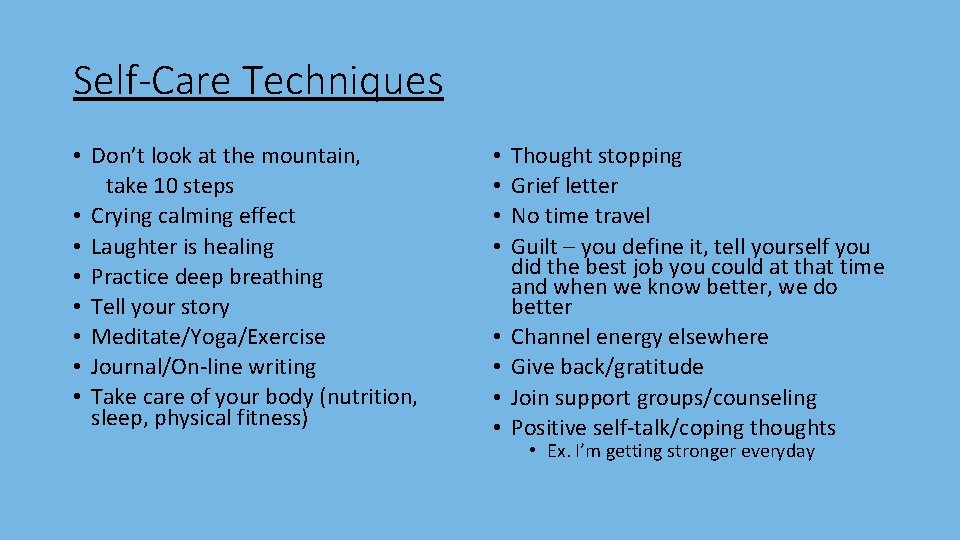
Self-Care Techniques • Don’t look at the mountain, take 10 steps • Crying calming effect • Laughter is healing • Practice deep breathing • Tell your story • Meditate/Yoga/Exercise • Journal/On-line writing • Take care of your body (nutrition, sleep, physical fitness) • • Thought stopping Grief letter No time travel Guilt – you define it, tell yourself you did the best job you could at that time and when we know better, we do better Channel energy elsewhere Give back/gratitude Join support groups/counseling Positive self-talk/coping thoughts • Ex. I’m getting stronger everyday
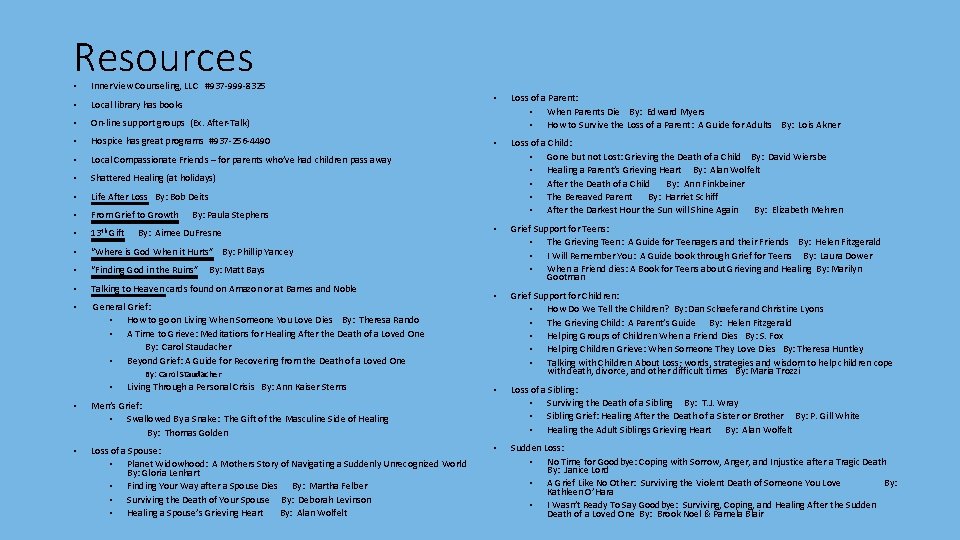
Resources • Inner. View Counseling, LLC #937 -999 -8325 • Local library has books • On-line support groups (Ex. After-Talk) • Hospice has great programs #937 -256 -4490 • Local Compassionate Friends – for parents who’ve had children pass away • Shattered Healing (at holidays) • Life After Loss By: Bob Deits • From Grief to Growth • 13 th Gift • “Where is God When it Hurts” By: Phillip Yancey • “Finding God in the Ruins” • Talking to Heaven cards found on Amazon or at Barnes and Noble • General Grief: • How to go on Living When Someone You Love Dies By: Theresa Rando • A Time to Grieve: Meditations for Healing After the Death of a Loved One By: Carol Staudacher • Beyond Grief: A Guide for Recovering from the Death of a Loved One • Loss of a Parent: • When Parents Die By: Edward Myers • How to Survive the Loss of a Parent: A Guide for Adults By: Lois Akner • Loss of a Child: • Gone but not Lost: Grieving the Death of a Child By: David Wiersbe • Healing a Parent’s Grieving Heart By: Alan Wolfelt • After the Death of a Child By: Ann Finkbeiner • The Bereaved Parent By: Harriet Schiff • After the Darkest Hour the Sun will Shine Again By: Elizabeth Mehren • Grief Support for Teens: • The Grieving Teen: A Guide for Teenagers and their Friends By: Helen Fitzgerald • I Will Remember You: A Guide book through Grief for Teens By: Laura Dower • When a Friend dies: A Book for Teens about Grieving and Healing By: Marilyn Gootman • Grief Support for Children: • How Do We Tell the Children? By: Dan Schaefer and Christine Lyons • The Grieving Child: A Parent’s Guide By: Helen Fitzgerald • Helping Groups of Children When a Friend Dies By: S. Fox • Helping Children Grieve: When Someone They Love Dies By: Theresa Huntley • Talking with Children About Loss; words, strategies and wisdom to help children cope with death, divorce, and other difficult times By: Maria Trozzi • Loss of a Sibling: • Surviving the Death of a Sibling By: T. J. Wray • Sibling Grief: Healing After the Death of a Sister or Brother By: P. Gill White • Healing the Adult Siblings Grieving Heart By: Alan Wolfelt • Sudden Loss: • No Time for Goodbye: Coping with Sorrow, Anger, and Injustice after a Tragic Death By: Janice Lord • A Grief Like No Other: Surviving the Violent Death of Someone You Love By: Kathleen O’Hara • I Wasn’t Ready To Say Goodbye: Surviving, Coping, and Healing After the Sudden Death of a Loved One By: Brook Noel & Pamela Blair By: Paula Stephens By: Aimee Du. Fresne By: Matt Bays By: Carol Staudacher • Living Through a Personal Crisis By: Ann Kaiser Sterns • Men’s Grief: • Swallowed By a Snake: The Gift of the Masculine Side of Healing By: Thomas Golden • Loss of a Spouse: • Planet Widowhood: A Mothers Story of Navigating a Suddenly Unrecognized World By: Gloria Lenhart • Finding Your Way after a Spouse Dies By: Martha Felber • Surviving the Death of Your Spouse By: Deborah Levinson • Healing a Spouse’s Grieving Heart By: Alan Wolfelt
- Slides: 12