
Grids Business and the Evolution of Corporate IT
Grids, Business, and the Evolution of Corporate IT Martin Antony Walker BSc DIC Ph. D Segment Manager, Scientific Research and Grids, HP EMEA © 2006 Hewlett-Packard Development Company, L. P. The information contained herein is subject to change without notice
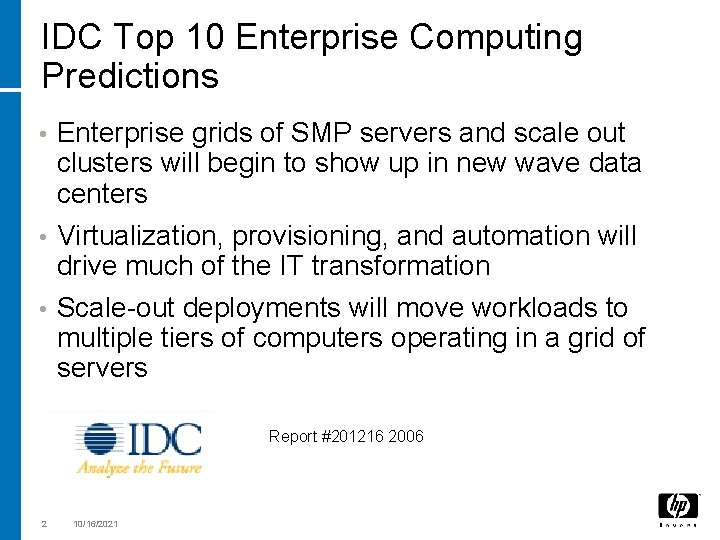
IDC Top 10 Enterprise Computing Predictions • Enterprise grids of SMP servers and scale out clusters will begin to show up in new wave data centers Virtualization, provisioning, and automation will drive much of the IT transformation • Scale-out deployments will move workloads to multiple tiers of computers operating in a grid of servers • Report #201216 2006 2 10/16/2021
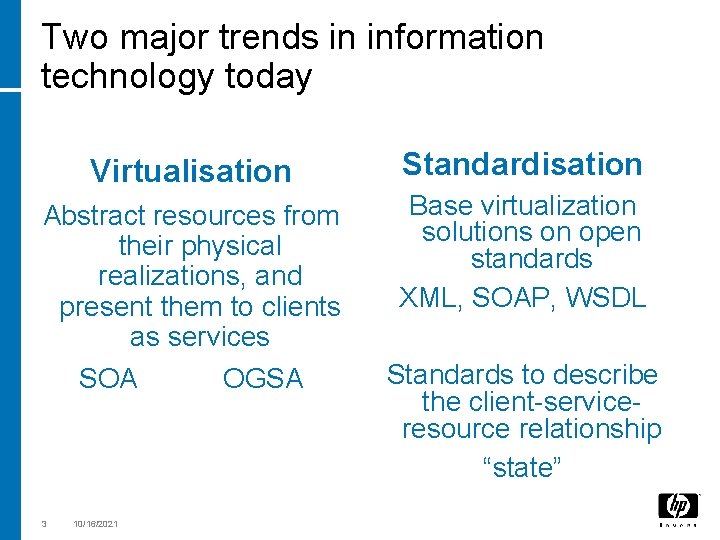
Two major trends in information technology today Virtualisation Standardisation Abstract resources from their physical realizations, and present them to clients as services SOA OGSA Base virtualization solutions on open standards XML, SOAP, WSDL 3 10/16/2021 Standards to describe the client-serviceresource relationship “state”
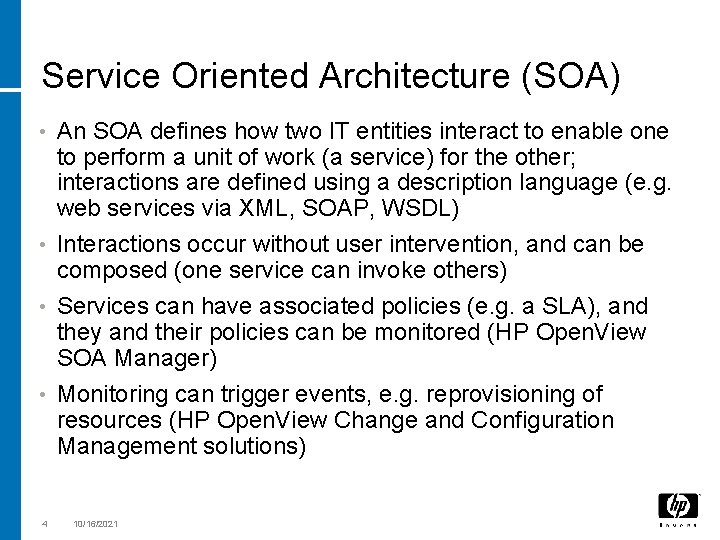
Service Oriented Architecture (SOA) An SOA defines how two IT entities interact to enable one to perform a unit of work (a service) for the other; interactions are defined using a description language (e. g. web services via XML, SOAP, WSDL) • Interactions occur without user intervention, and can be composed (one service can invoke others) • Services can have associated policies (e. g. a SLA), and they and their policies can be monitored (HP Open. View SOA Manager) • Monitoring can trigger events, e. g. reprovisioning of resources (HP Open. View Change and Configuration Management solutions) • 4 10/16/2021
Convergence/Divergence • Two stacks of web service specifications have been developed to handle the issue of state − WSDM/WSRF (OASIS) − WS-Management (W 3 C and DMTF) • 5 The major IT industry players have now agreed on the basic underlying web service specification stack (WS-Man), and have begun the process of integration and standardization 10/16/2021
Important Questions • What (business) problems can be solved by grid? How do grids relate to SOA, utility computing models, event-driven services, messaging, and database and networking systems? • How do legacy assets interact with new technologies? • 6 10/16/2021
A perspective HPC is often the leading-edge technology indicator for the commercial enterprise • • • 7 Unix NFS Web Computer graphics Pipelining Threads Parallelism cc. NUMA Grid (? ) 10/16/2021
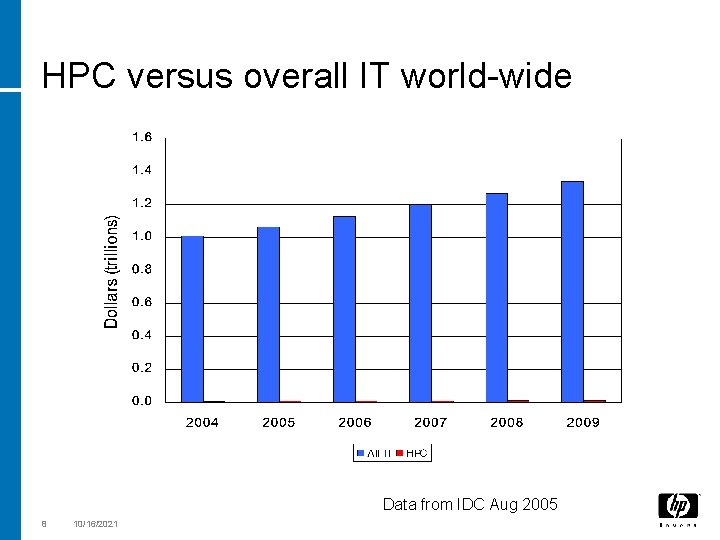
HPC versus overall IT world-wide Data from IDC Aug 2005 8 10/16/2021
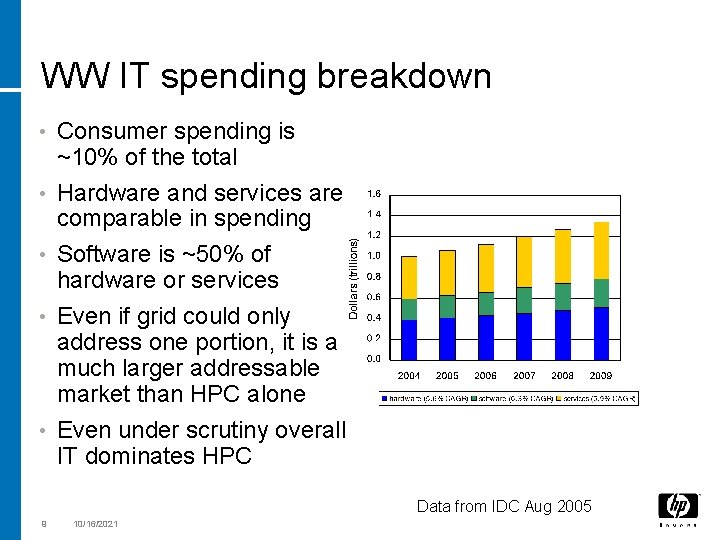
WW IT spending breakdown • • • Consumer spending is ~10% of the total Hardware and services are comparable in spending Software is ~50% of hardware or services Even if grid could only address one portion, it is a much larger addressable market than HPC alone Even under scrutiny overall IT dominates HPC Data from IDC Aug 2005 9 10/16/2021
Conclusion: If grid is relevant to the commercial enterprise then it represents a much larger market than HPC • People involved in grid R&D should not ignore the requirements of enterprise IT • However, to be clear, the commercial enterprise is more challenging than HPC • 10 10/16/2021
Enterprise IT pain-points IT executives will invariably list at least some of these as their principal issues − Increasing data-center complexity − Increasing management/administration spending • Think of this as the staff/asset ratio − Low resource utilization − “Brittle” nature of IT resources − Inability to share resources − Lack of alignment and sync with the business − Heterogeneity − Application provisioning and life cycle management 11 10/16/2021
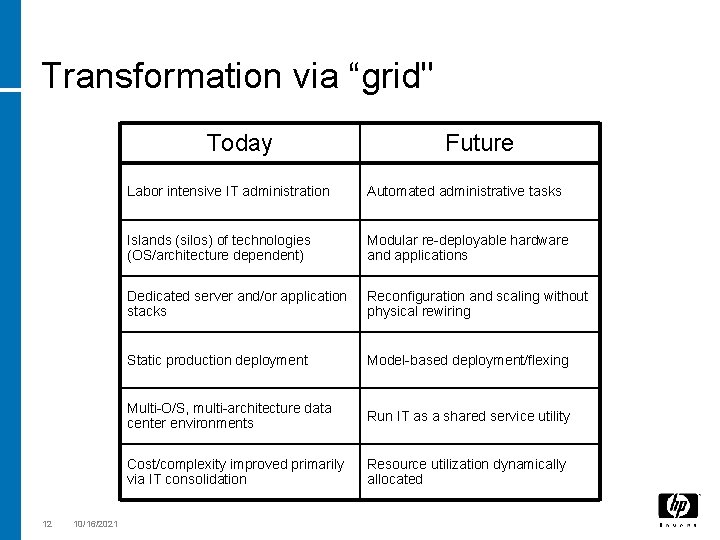
Transformation via “grid" Today 12 10/16/2021 Future Labor intensive IT administration Automated administrative tasks Islands (silos) of technologies (OS/architecture dependent) Modular re-deployable hardware and applications Dedicated server and/or application stacks Reconfiguration and scaling without physical rewiring Static production deployment Model-based deployment/flexing Multi-O/S, multi-architecture data center environments Run IT as a shared service utility Cost/complexity improved primarily via IT consolidation Resource utilization dynamically allocated
Conclusion: • The grid solution space is congruent to the enterprise problem space • Caution needed here since it is a journey to make it true in practice − We are on the way but there is a long way still to go 13 10/16/2021
Inhibitors to grid • Top issues preventing Grid adoption: − Security − Social engineering • To avoid confusion… − These are not the only issues, there are (many) others 14 10/16/2021
Security • In a Grid environment we have different classes of users possibly sharing resources and metadata − Family − Friends − Strangers − Enemies (i. e. , Coke and Pepsi) • 15 If security isn’t assured and trusted, sharing and automation are hampered 10/16/2021
Social engineering • Moving to Grid forces IT management to embrace a new operational model − Loss of direct ownership (aka “server hugging”) − Reliance on others − Feels risky • Nobody gets fired maintaining the status quo − Different way to “do IT” • Grid actually, initially, adds complexity − Organizational politics − Managing expectations − As a change it is just uncomfortable for people • 16 Don’t underestimate how hard this issue is 10/16/2021
Five key conclusions 1. Convergence is happening Pay attention to requirements of commercial enterprise 3. The principal enterprise IT issues are known 4. Grid addresses the enterprise IT issues 5. Challenges are security and social engineering 2. 17 10/16/2021

18 10/16/2021
- Slides: 18