
Gridded population data for the UK redistribution models
Gridded population data for the UK – redistribution models and applications David Martin 20 February 2009
Overview • UK gridded data history (brief!) – Small area data availability – Grid-based modelling responses – Applications and uses • New small area data and the European Grid Map project 2

UK gridded data history.
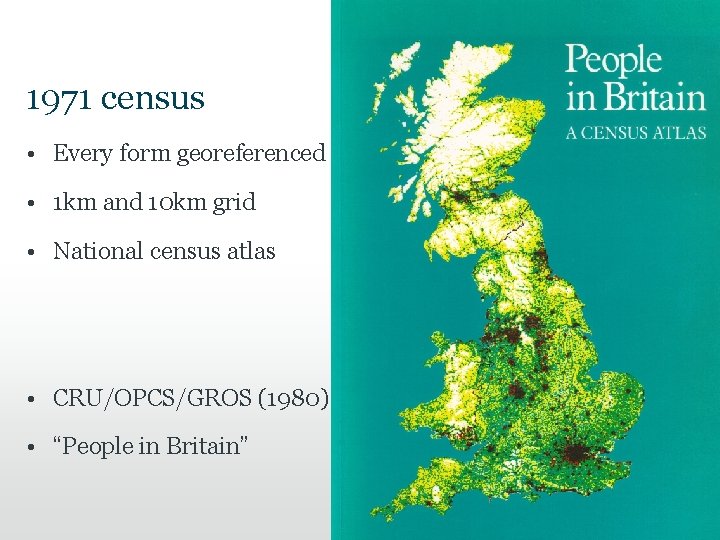
1971 census • Every form georeferenced • 1 km and 10 km grid • National census atlas • CRU/OPCS/GROS (1980) • “People in Britain” 4
Small area data availability • No grid-based data constructed from subsequent censuses – Except in Northern Ireland (100 m/1 km 1971 -2001) • All other small area outputs for irregular zones – Enumeration districts/output areas • Improvements over time in spatial resolution, temporal frequency, directory products • In general, population counts associated with coordinate references but uncertain spatial extents 5
UK small area geographies Census Postcode • Smallest zones • Smallest units full enumeration districts postcodes (since 1970 s) (1971 -91) and output areas • Population size 50 (15 (2001) addresses) • Population size 3 -400 • Single grid reference, no boundaries • Single centroid coordinates, (digital • List of overlaps with boundaries 1991, 2001) census EDs, Oas (no direct match) 6
Grid-based modelling responses • Population-weighted centroid(s) as summary points of local distribution • Locally adaptive kernel estimation based on inter-centroid distances • Redistribution of centroid counts into grid: spatially discontinuous model • Various derivatives and parameters possible – experience suggests little gained by complexity 7
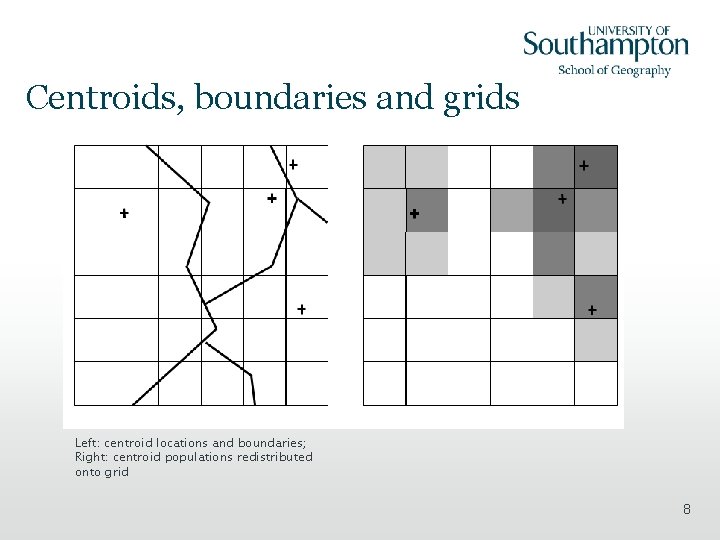
Centroids, boundaries and grids Left: centroid locations and boundaries; Right: centroid populations redistributed onto grid 8
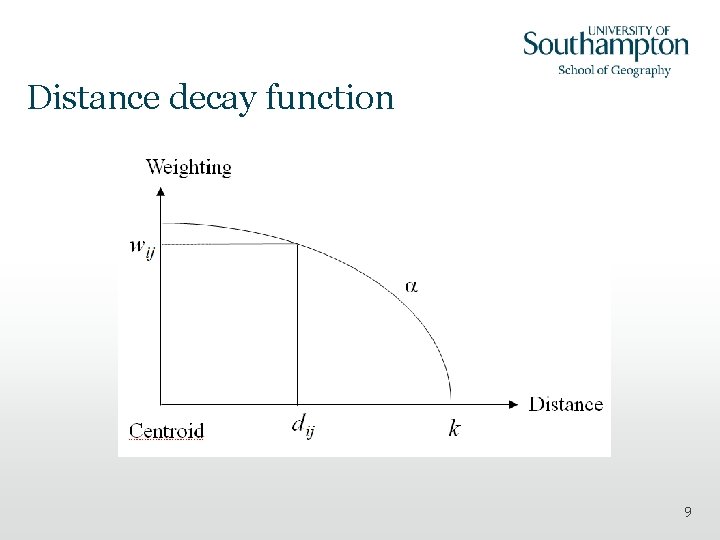
Distance decay function Always try to provide a caption next to your picture in this style 9
Implementation • Originally implemented as Fortran program (Sbuild) • Source code shared with other researchers • Set of national population models constructed for 1981, 1991 censuses and made available online (Surpop database) • Surface. Builder Visual Basic 6 code developed for 2001 census and downloadable for research use 10
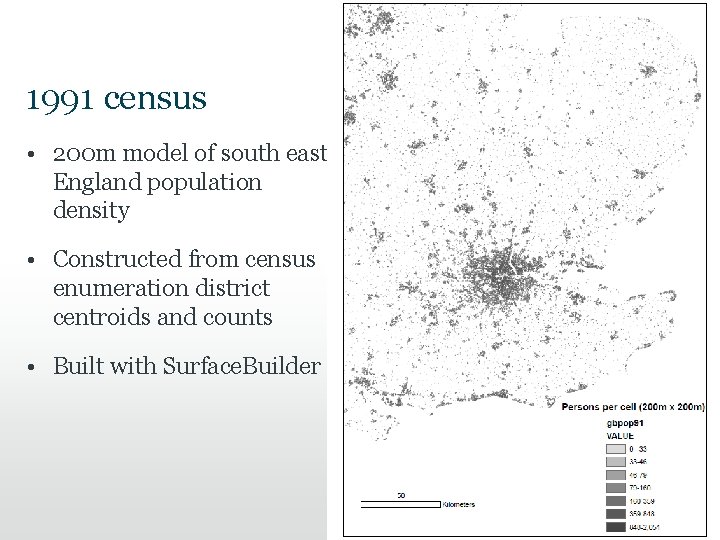
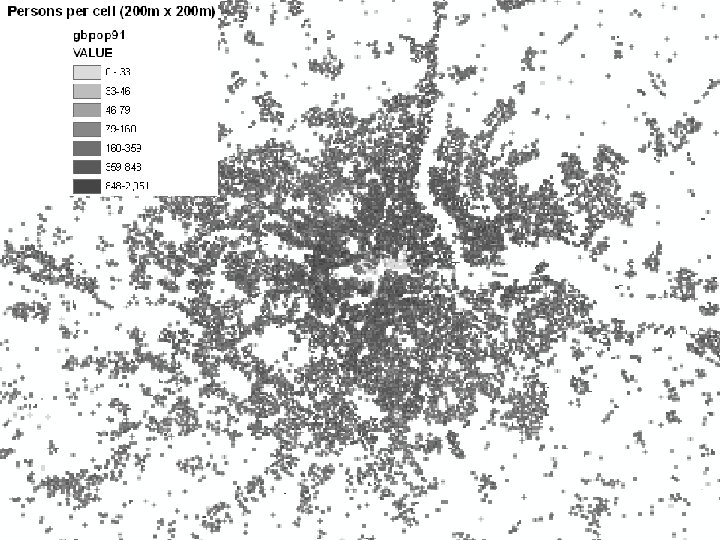
1991 census • 200 m model of south east England population density • Constructed from census enumeration district centroids and counts • Built with Surface. Builder 11
12
Applications and uses: examples • Use both of national reference models from Surpop and Sbuild/Surface. Builder software by researchers using own data • Applications which require detailed model of spatial population distribution, settlement pattern, accessibility drive times, hazard exposure • Novel applications and visualizations which develop analyses only possible using grid-based models 13
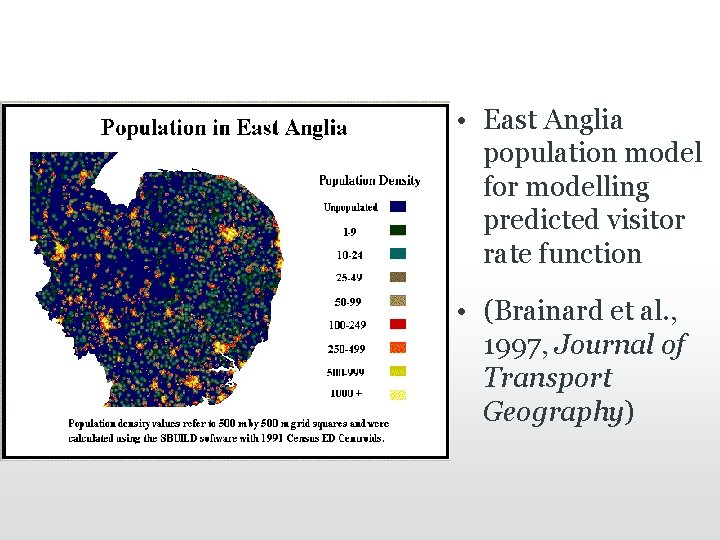
• East Anglia population model for modelling predicted visitor rate function • (Brainard et al. , 1997, Journal of Transport Geography)
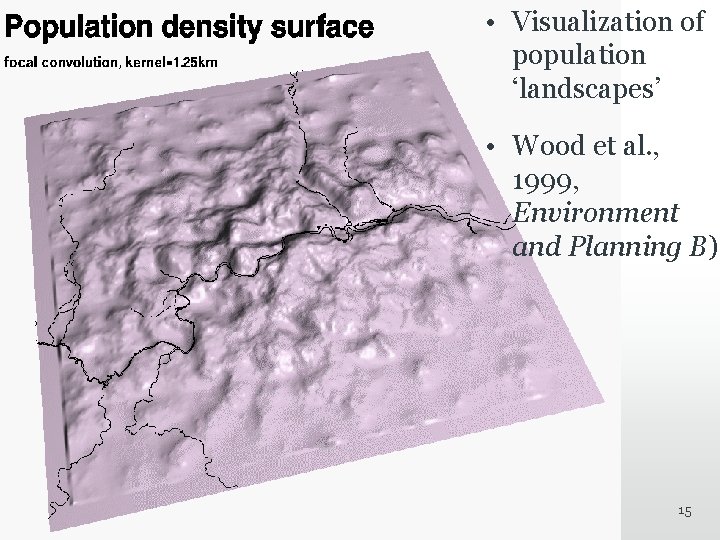
• Visualization of population ‘landscapes’ • Wood et al. , 1999, Environment and Planning B) 15
Applications and uses: advantages • Zonal geography weak for visualization • Data collection zones as inappropriate analysis units for sparse populations • Need maximum spatial information for calculation of distances, populations at risk, etc. • Difficulties appropriately integrating zonal populations with environmental information • Gridded geographies – many advantages for comparison between countries and through time 16

New small area data and the European Grid Map project.
Direct aggregation from experimental data • ONS producing new small area population estimates – Experimental data, annual estimates using census updated from administrative sources – Published for lower super output areas but internally modelled for postcodes • Direct aggregation permits production of 1 km grid square estimates and generation of grid map • Data precision overcomes many earlier methodological difficulties over choice of distance decay function etc. 18
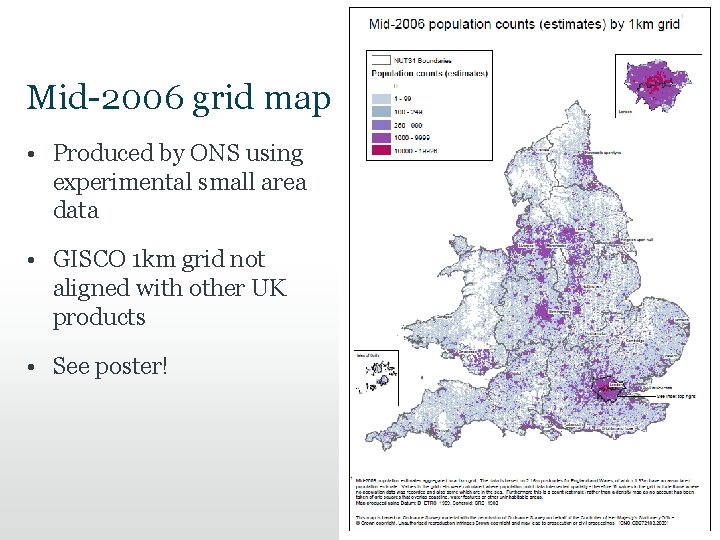
Mid-2006 grid map • Produced by ONS using experimental small area data • GISCO 1 km grid not aligned with other UK products • See poster! 19
Further work • Aggregation from small area estimates: no direct disclosure control challenges from modelled data: may not be possible to use same method with 2011 census data • Challenge of GISCO grid for UK users: incompatible with national mapping products • Simplistic aggregation – assumes all population of postcode falls in same grid cell: need to consider redistribution model, edge effects • Potential for modelling distribution at higher resolution within cells 20
- Slides: 20