
Grid World Case Study Barbara Ericson Georgia Tech
Grid. World Case Study Barbara Ericson Georgia Tech ericson@cc. gatech. edu Jan 2008 Grid. World Case Study 1
Purpose of a Case Study • Give students a larger program to study and extend – context to apply inheritance and polymorphism • Serve as an example of good design and coding practices – and a context for discussion of issues • An early study showed that students who had a case study performed better on the AP exam than those who didn't – women perform better than men usually on case study questions Grid. World Case Study 2
Why did the Case Study Change? • The Marine Biology Case Study – was too complicated – hard to extend beyond fish • Goals for new case study – Reuse part of the Marine Biology Case Study – Have fewer classes – Be easier to extend – Be rich enough for a variety of exam questions Grid. World Case Study 3
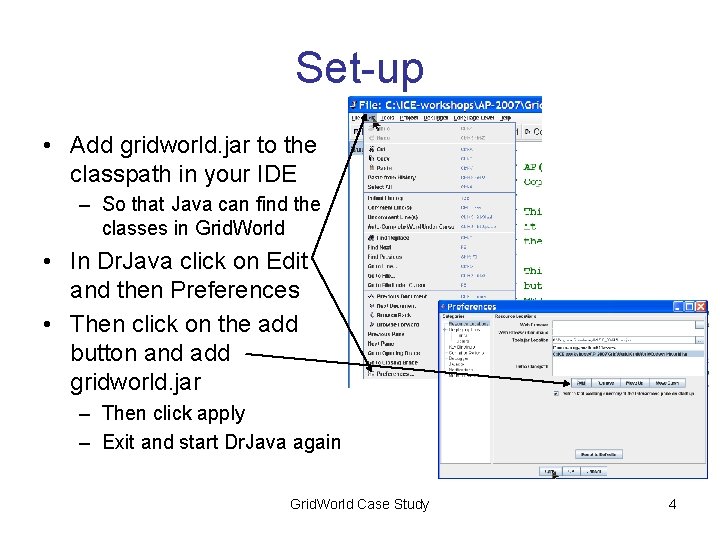
Set-up • Add gridworld. jar to the classpath in your IDE – So that Java can find the classes in Grid. World • In Dr. Java click on Edit and then Preferences • Then click on the add button and add gridworld. jar – Then click apply – Exit and start Dr. Java again Grid. World Case Study 4
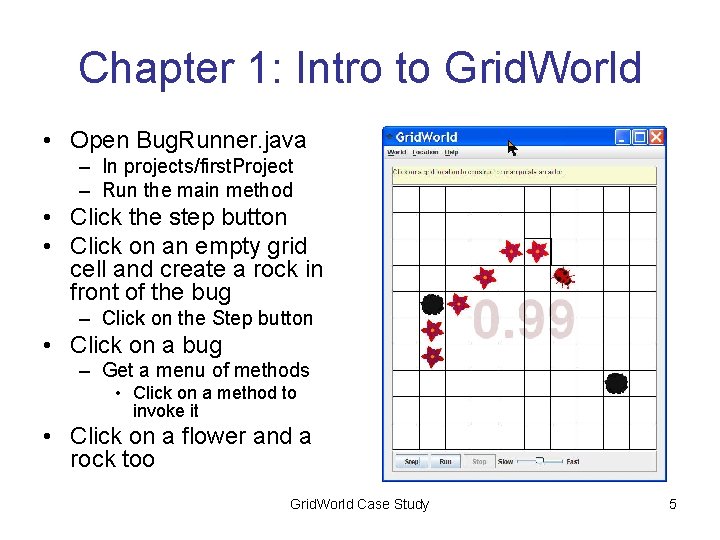
Chapter 1: Intro to Grid. World • Open Bug. Runner. java – In projects/first. Project – Run the main method • Click the step button • Click on an empty grid cell and create a rock in front of the bug – Click on the Step button • Click on a bug – Get a menu of methods • Click on a method to invoke it • Click on a flower and a rock too Grid. World Case Study 5
Exercise Set 1 1. 2. 3. 4. 5. Does the bug always move to a new location? In what direction does the bug move? What does the bug do if it can’t move? What does the bug leave behind when it moves? What happens when the bug is at the edge of the grid? 1. And facing the edge? 2. And not facing the edge? 6. What happens when a bug is facing a rock and you click step? 7. Does a flower move? 8. What behavior does a flower have? 9. Does a rock move or have any other behavior? 10. Can more than one actor (bug, flower, rock) be in the same grid location at the same time? Grid. World Case Study 6
Exercise Answers Set 1 1. Does the bug always move to a new location? – 2. In what direction does the bug move? – 3. Turns right 45 degrees What does the bug leave behind when it moves? – 5. The direction it is facing What does the bug do if it can’t move? – 4. No, not if a rock is in front or if it is facing a boundary of the world A flower What happens when the bug is at the edge of the grid? 1. And facing the edge? • Turns 45 2. And not facing the edge? • 6. What happens when a bug is facing a rock and you click step? – 7. Continues to move if it can, else turns 45 right It turns 45 degrees to the right. Does a flower move? 1. No • What behavior does a flower have? 1. The color gets darker over time. It can act. It inherits other behavior from Actor (set. Color, set. Direction, etc) • Does a rock move or have any other behavior? 1. It doesn’t change over time. It can act. It inherits other behavior from Actor (set. Color, set. Direction, etc) • Can more than one actor (bug, flower, rock) be in the same grid location at the same time? 1. No Grid. World Case Study 7
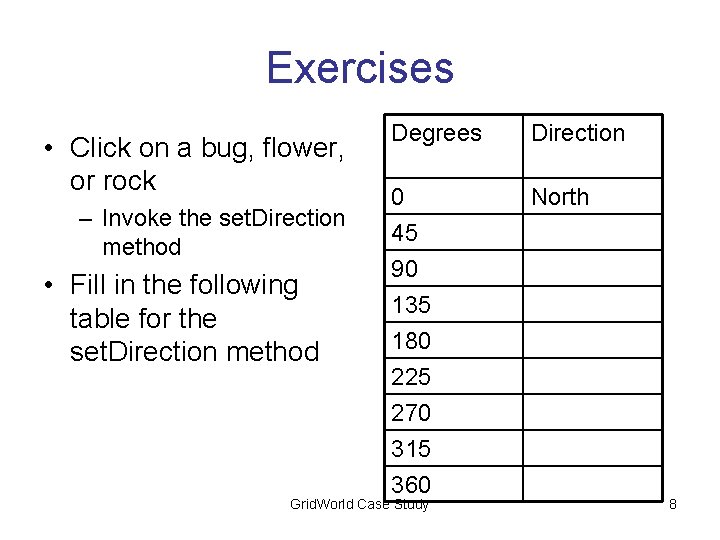
Exercises • Click on a bug, flower, or rock – Invoke the set. Direction method • Fill in the following table for the set. Direction method Degrees Direction 0 45 North 90 135 180 225 270 315 360 Grid. World Case Study 8
Exercise Answers • Click on a bug, flower, or rock – Invoke the set. Direction method • Fill in the following table for the set. Direction method • Can you set the direction to an angle that isn’t a multiple of 45? – What happens? Degrees 0 45 90 Direction Northeast East 135 180 225 270 315 360 Southeast Southwest West Northwest North Grid. World Case Study 9
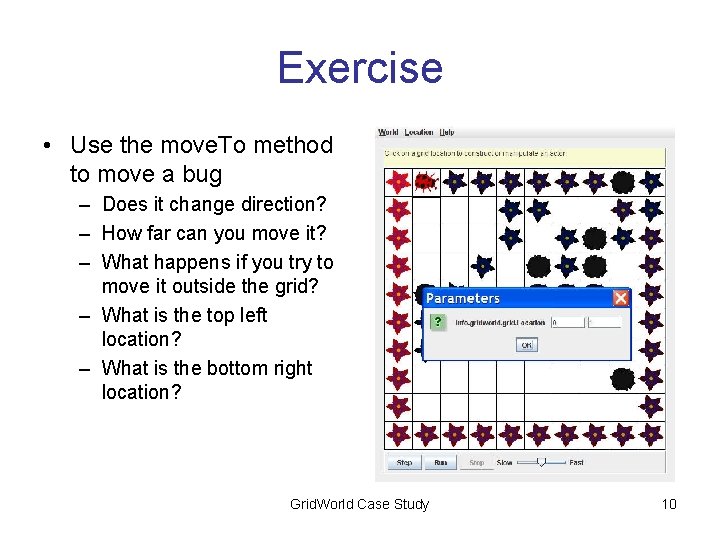
Exercise • Use the move. To method to move a bug – Does it change direction? – How far can you move it? – What happens if you try to move it outside the grid? – What is the top left location? – What is the bottom right location? Grid. World Case Study 10
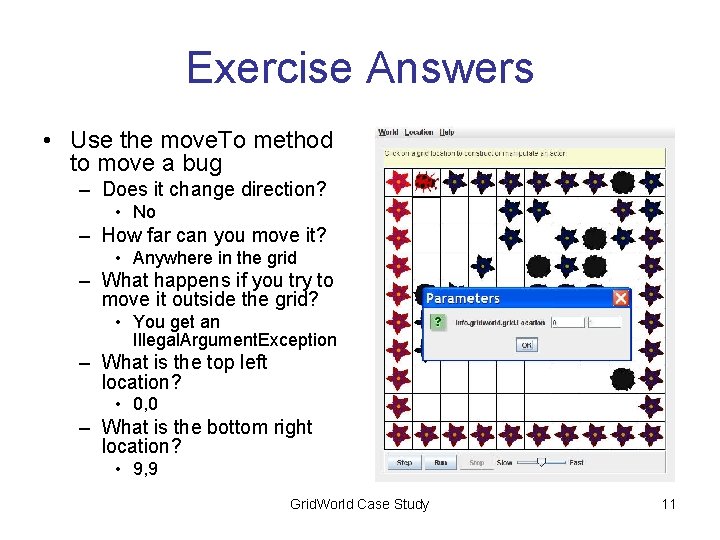
Exercise Answers • Use the move. To method to move a bug – Does it change direction? • No – How far can you move it? • Anywhere in the grid – What happens if you try to move it outside the grid? • You get an Illegal. Argument. Exception – What is the top left location? • 0, 0 – What is the bottom right location? • 9, 9 Grid. World Case Study 11
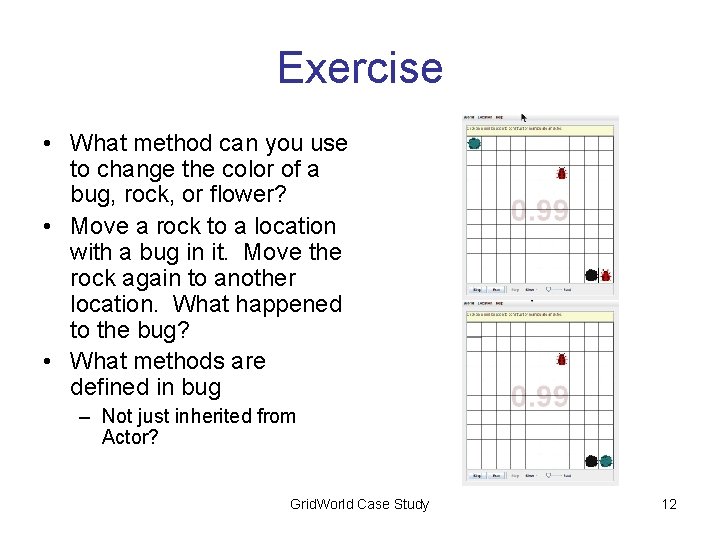
Exercise • What method can you use to change the color of a bug, rock, or flower? • Move a rock to a location with a bug in it. Move the rock again to another location. What happened to the bug? • What methods are defined in bug – Not just inherited from Actor? Grid. World Case Study 12
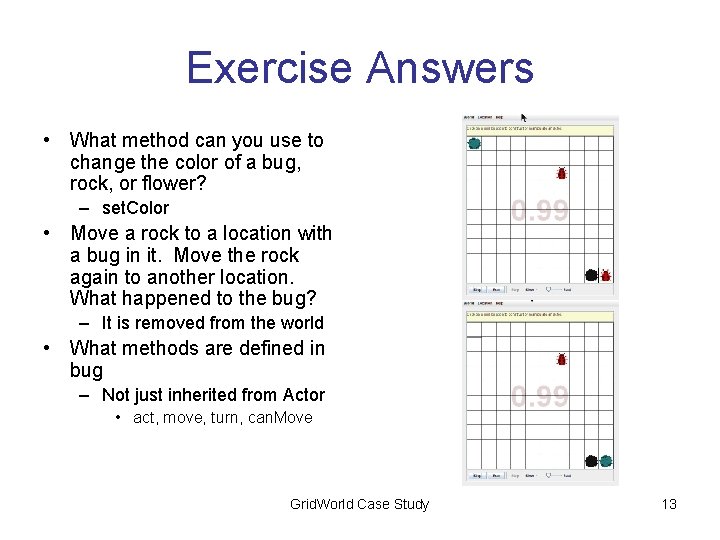
Exercise Answers • What method can you use to change the color of a bug, rock, or flower? – set. Color • Move a rock to a location with a bug in it. Move the rock again to another location. What happened to the bug? – It is removed from the world • What methods are defined in bug – Not just inherited from Actor • act, move, turn, can. Move Grid. World Case Study 13
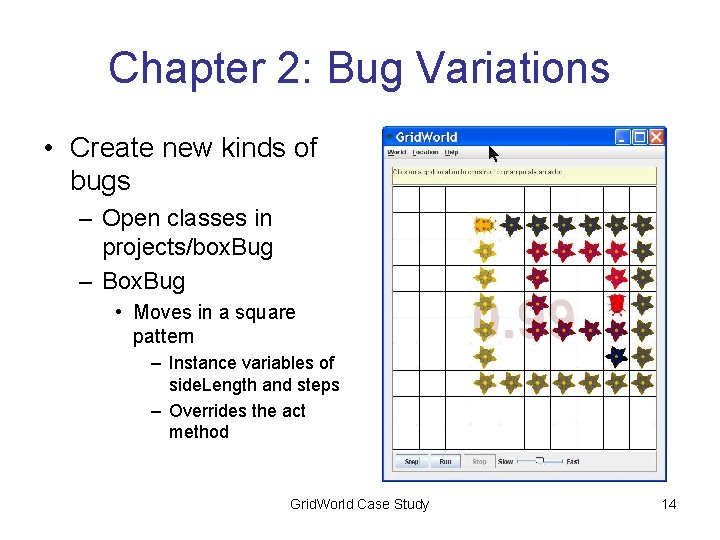
Chapter 2: Bug Variations • Create new kinds of bugs – Open classes in projects/box. Bug – Box. Bug • Moves in a square pattern – Instance variables of side. Length and steps – Overrides the act method Grid. World Case Study 14
Exercise Set 2 1. What is the role of the instance variable side. Length? 2. What is the role of the instance variable steps? 3. Why is the turn method called twice when steps becomes equal to side. Length? 4. Why can the move method be called in Box. Bug when there is no move method in the Box. Bug class? 5. After a Box. Bug is constructed will the size of the square pattern always be the same? 6. Can the path a Box. Bug travels ever change? 7. When will the value of steps be zero? Grid. World Case Study 15
Exercise Answers Set 2 1. What is the role of the instance variable side. Length? – The number of grid cells in one side of the box – 1. 2. What is the role of the instance variable steps? – Keeps track of the current number of steps the bug has taken on the current side. 3. Why is the turn method called twice when steps becomes equal to side. Length? – To make a 90 degree turn (each turn is 45 degrees) 4. Why can the move method be called in Box. Bug when there is no move method in the Box. Bug class? – It is inherited from Bug since the Bug. Bog class extends the Bug class 5. After a Box. Bug is constructed will the size of the square pattern always be the same? – Yes, there is no mutator (modifier) method in Box. Bug for side. Length 6. Can the path a Box. Bug travels ever change? – Yes, if it can’t move it turns 90 degrees. 7. When will the value of steps be zero? – When it is constructed and after each 90 degree turn. Grid. World Case Study 16
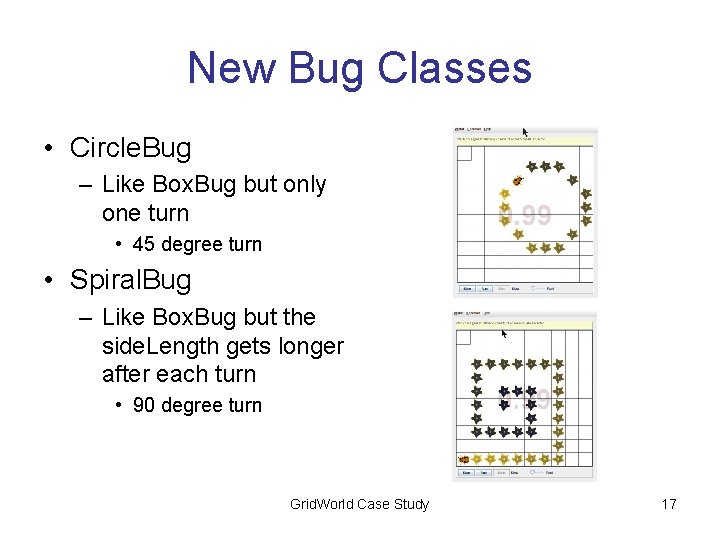
New Bug Classes • Circle. Bug – Like Box. Bug but only one turn • 45 degree turn • Spiral. Bug – Like Box. Bug but the side. Length gets longer after each turn • 90 degree turn Grid. World Case Study 17
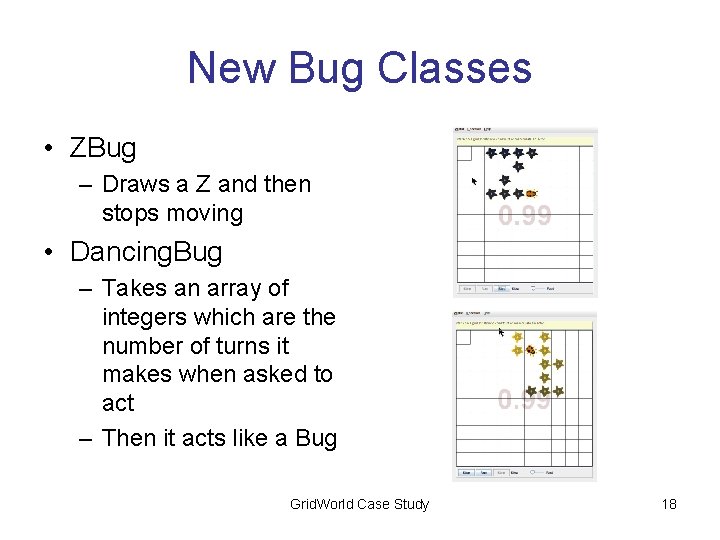
New Bug Classes • ZBug – Draws a Z and then stops moving • Dancing. Bug – Takes an array of integers which are the number of turns it makes when asked to act – Then it acts like a Bug Grid. World Case Study 18
Problem • The Grid. World case study says to make Circle. Bug and Spiral. Bug like Box. Bug – Hints at copy and paste • Should use inheritance – But side. Length and steps are private in Box. Bug – Can add public accessors and modifier methods to Box. Bug • And inherit from Box. Bug – But is a Circle. Bug a kind of Box. Bug? – Better to pull out side. Length and steps and put in a Pattern. Bug abstract class • And have Box. Bug inherit from Pattern. Bug Grid. World Case Study 19
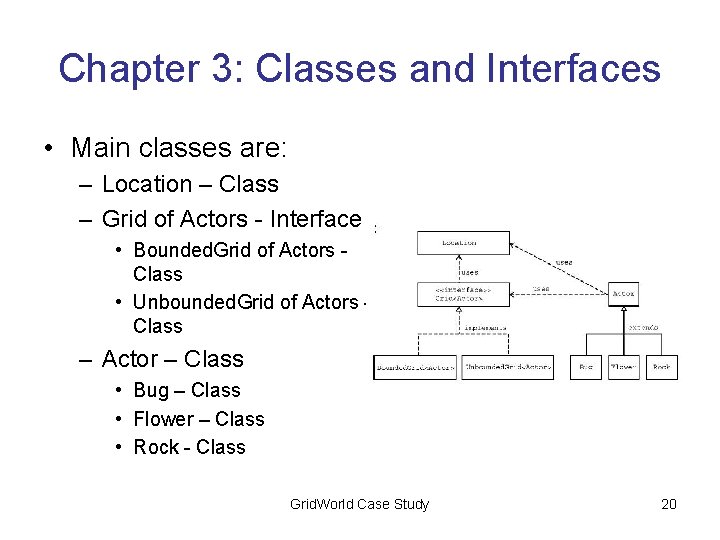
Chapter 3: Classes and Interfaces • Main classes are: – Location – Class – Grid of Actors - Interface • Bounded. Grid of Actors Class • Unbounded. Grid of Actors Class – Actor – Class • Bug – Class • Flower – Class • Rock - Class Grid. World Case Study 20
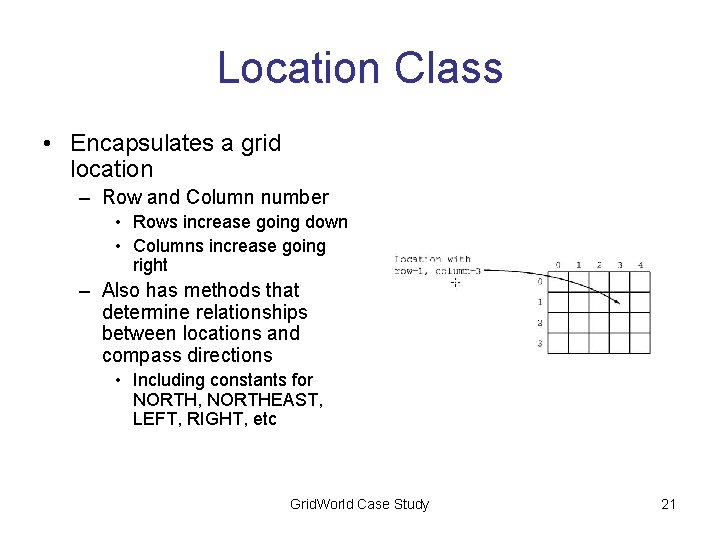
Location Class • Encapsulates a grid location – Row and Column number • Rows increase going down • Columns increase going right – Also has methods that determine relationships between locations and compass directions • Including constants for NORTH, NORTHEAST, LEFT, RIGHT, etc Grid. World Case Study 21
Location Class • Accessor methods – get. Row – get. Col • Working with locations – Get a neighbor location in a direction • public Location get. Adjacent. Location(int direction) – Get the closest compass direction toward target • public int get. Direction. Toward(Location target) • Two Location objects are equal if they have the same row and column – Location implements the Comparable interface Grid. World Case Study 22
Turning by an Amount • We have been using multiple calls to the turn method to turn an Actor – We can use set. Direction and Location constants for this instead – set. Direction(get. Direction() + Location. HALF_RIGHT); // turn 45 degrees Grid. World Case Study 23
Exercise Set 3 • Given – Location loc 1 = new Location(4, 3); – Location loc 2 = new Location(3, 4); 1. How would you access the row value of loc 1? 2. What is the value of b after the following statement is executed? 1. boolean b = loc 1. equals(loc 2); 3. What is the value of loc 3 after the following? 1. Location loc 3 = loc 2. get. Adjacent. Location(Location. SOUTH); 4. What is the value of dir after the following? 1. int dir = loc 1. get. Direction. Toward(new Location(6, 5)); 5. How does the get. Adjacent. Location method know which location to return? Grid. World Case Study 24
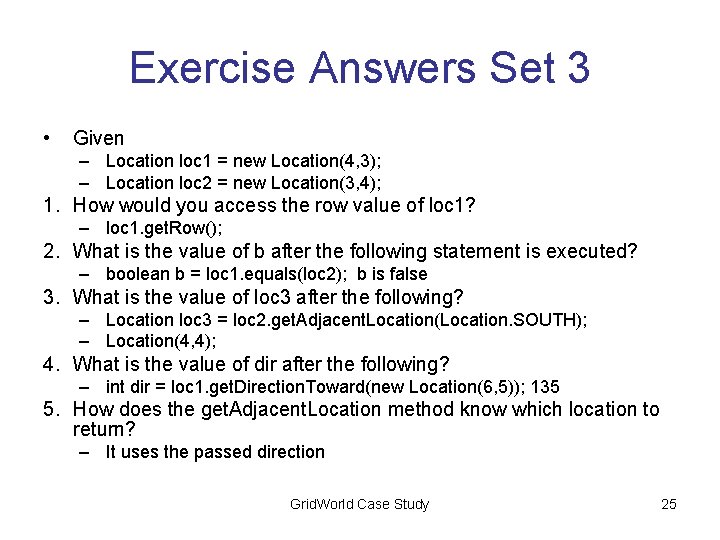
Exercise Answers Set 3 • Given – Location loc 1 = new Location(4, 3); – Location loc 2 = new Location(3, 4); 1. How would you access the row value of loc 1? – loc 1. get. Row(); 2. What is the value of b after the following statement is executed? – boolean b = loc 1. equals(loc 2); b is false 3. What is the value of loc 3 after the following? – Location loc 3 = loc 2. get. Adjacent. Location(Location. SOUTH); – Location(4, 4); 4. What is the value of dir after the following? – int dir = loc 1. get. Direction. Toward(new Location(6, 5)); 135 5. How does the get. Adjacent. Location method know which location to return? – It uses the passed direction Grid. World Case Study 25
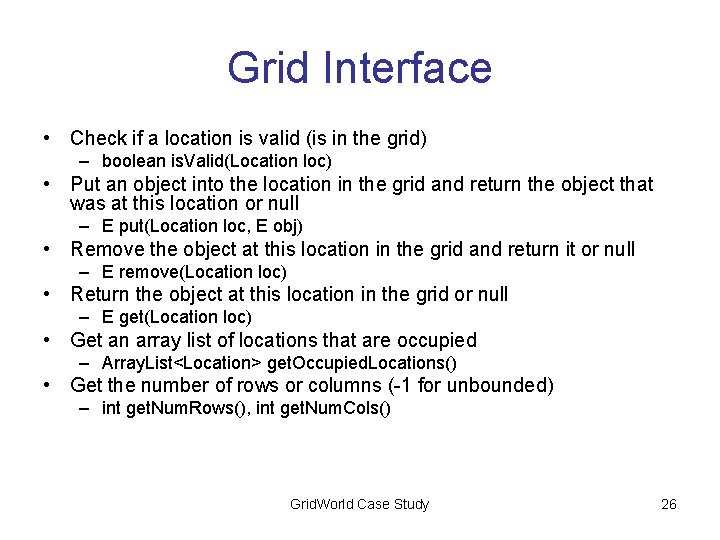
Grid Interface • Check if a location is valid (is in the grid) – boolean is. Valid(Location loc) • Put an object into the location in the grid and return the object that was at this location or null – E put(Location loc, E obj) • Remove the object at this location in the grid and return it or null – E remove(Location loc) • Return the object at this location in the grid or null – E get(Location loc) • Get an array list of locations that are occupied – Array. List<Location> get. Occupied. Locations() • Get the number of rows or columns (-1 for unbounded) – int get. Num. Rows(), int get. Num. Cols() Grid. World Case Study 26
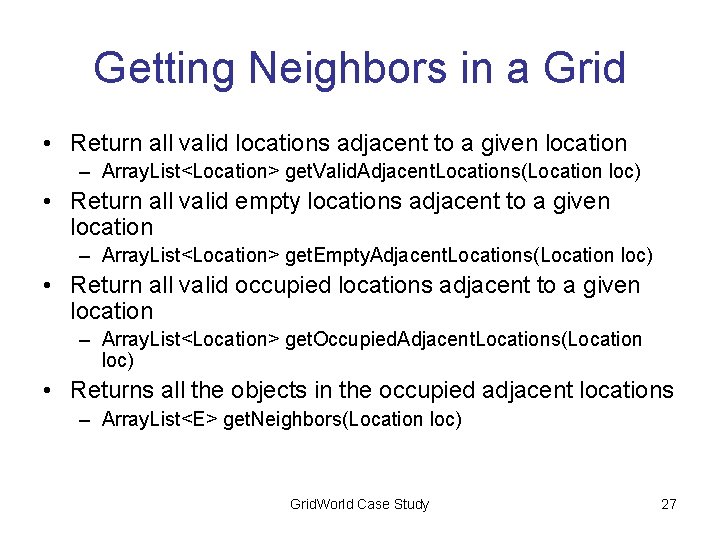
Getting Neighbors in a Grid • Return all valid locations adjacent to a given location – Array. List<Location> get. Valid. Adjacent. Locations(Location loc) • Return all valid empty locations adjacent to a given location – Array. List<Location> get. Empty. Adjacent. Locations(Location loc) • Return all valid occupied locations adjacent to a given location – Array. List<Location> get. Occupied. Adjacent. Locations(Location loc) • Returns all the objects in the occupied adjacent locations – Array. List<E> get. Neighbors(Location loc) Grid. World Case Study 27
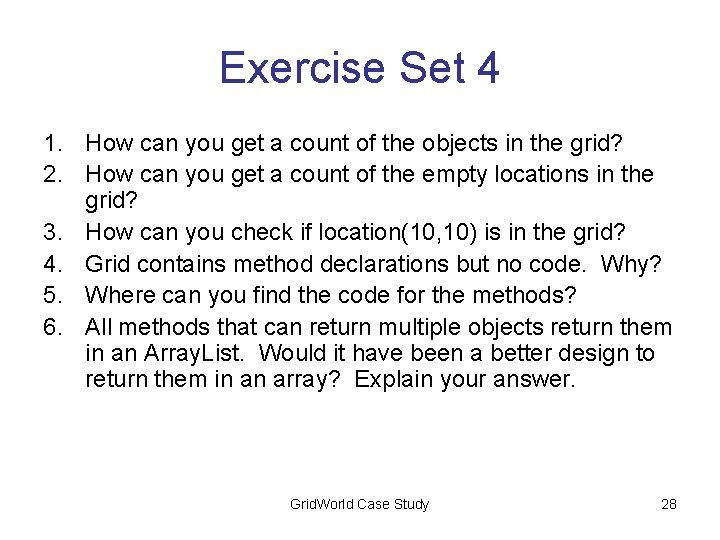
Exercise Set 4 1. How can you get a count of the objects in the grid? 2. How can you get a count of the empty locations in the grid? 3. How can you check if location(10, 10) is in the grid? 4. Grid contains method declarations but no code. Why? 5. Where can you find the code for the methods? 6. All methods that can return multiple objects return them in an Array. List. Would it have been a better design to return them in an array? Explain your answer. Grid. World Case Study 28
Exercise Answers Set 4 1. How can you get a count of the objects in the grid? – get. Occupied. Locations(). size() 2. How can you get a count of the empty locations in the grid? – get. Num. Rows() * get. Num. Cols() – get. Occupied. Locations. size() 3. How can you check if location(10, 10) is in the grid? – is. Valid(new Location(10, 10)); 4. Grid contains method declarations but no code. Why? – It is an interface 5. Where can you find the code for the methods? – In the classes that implement the interface: Bounded. Grid and Unbounded. Grid 6. All methods that can return multiple objects return them in an Array. List. Would it have been a better design to return them in an array? Explain your answer. – Array. Lists are arrays that can grow or shrink. They are better than arrays when you don’t know how many items you will have. Grid. World Case Study 29
Actor Class • • • public Color get. Color() public int get. Direction() public Grid<Actor> get. Grid() public Location get. Location() public void put. Self. In. Grid(Grid<Actor> gr, Location loc) – Use this for adding an actor to the grid as it also sets the Actor’s location • public void remove. Self. From. Grid(); – Use this for removing an Actor from the grid. It sets the grid and location instance variables to null. Grid. World Case Study 30
Actor Class • Moves this Actor to the given location and removes anything currently at this location – public void move. To(Location loc) • Mutator (modifier) methods – public void set. Color(Color new. Color) – public void set. Direction(int new. Dir) • Act method: by default reverses direction. Override this method in subclasses. – public void act() Grid. World Case Study 31
Exercise Set 5 1. Name 3 properties that every Actor has. 2. When an actor is constructed what is its direction and color? 3. Why was the Actor class created as a class and not an interface? 4. Can an Actor put itself in the grid twice without removing itself? 5. Can an Actor remove itself from the grid twice? 6. Can an actor place itself in the grid and then remove itself and then add itself to the grid? Try it. What happens? 7. How can an actor turn 90 degrees to the right? Grid. World Case Study 32
Exercise Answers Set 5 1. Name 3 properties that every Actor has. – Color, direction, location 2. When an actor is constructed what is its direction and color? – Blue and North 3. Why was the Actor class created as a class and not an interface? – Use classes or abstract classes when we want to provide fields and methods. Interfaces can only define constants and abstract methods. 4. Can an Actor put itself in the grid twice without removing itself? – No, you will get an Illegal. State. Exception 5. Can an Actor remove itself from the grid twice? – No, you will get an Illegal. State. Exception 6. Can an actor place itself in the grid and then remove itself and then add itself to the grid? Try it. What happens? – Should work. 7. How can an actor turn 90 degrees to the right? – set. Direction(get. Direction() + Location. RIGHT); Grid. World Case Study 33
Rock and Flower Classes • Subclasses of Actor – Override act() • Rocks don’t do anything in the act method – Empty body {} • Flowers change the color – reduces the red, green, and blue by the same amount (0. 05) Grid. World Case Study 34
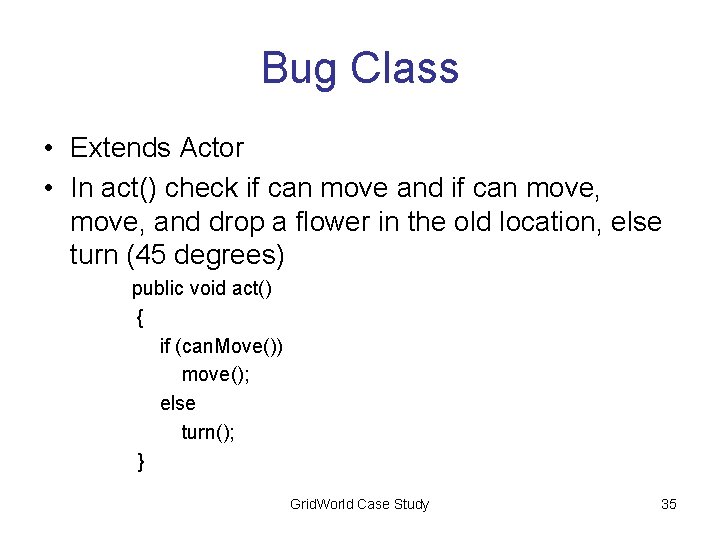
Bug Class • Extends Actor • In act() check if can move and if can move, and drop a flower in the old location, else turn (45 degrees) public void act() { if (can. Move()) move(); else turn(); } Grid. World Case Study 35
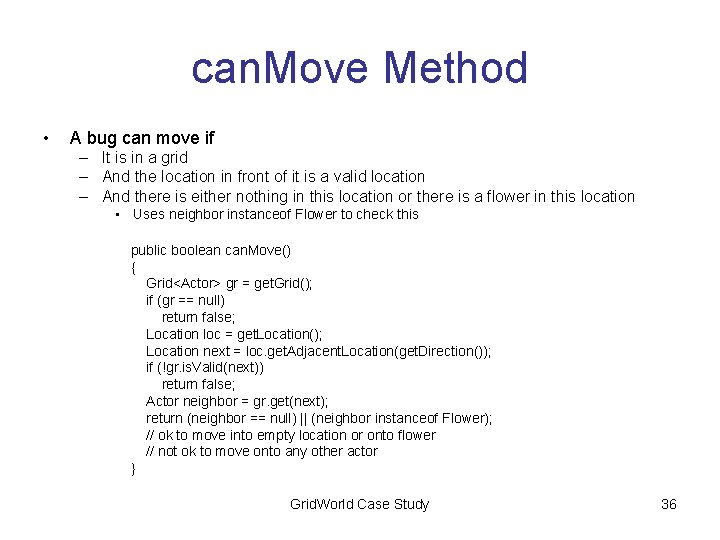
can. Move Method • A bug can move if – It is in a grid – And the location in front of it is a valid location – And there is either nothing in this location or there is a flower in this location • Uses neighbor instanceof Flower to check this public boolean can. Move() { Grid<Actor> gr = get. Grid(); if (gr == null) return false; Location loc = get. Location(); Location next = loc. get. Adjacent. Location(get. Direction()); if (!gr. is. Valid(next)) return false; Actor neighbor = gr. get(next); return (neighbor == null) || (neighbor instanceof Flower); // ok to move into empty location or onto flower // not ok to move onto any other actor } Grid. World Case Study 36
Exercise Set 6 1. Which statement in the can. Move method ensures that a bug doesn’t move out of the grid? 2. Which statement in the can. Move method keeps a bug from walking into a rock? 3. Which methods from the Grid interface are invoked in the can. Move method and why? 4. Which method in the Location class is invoked in the can. Move method and why? 5. Which methods inherited from the Actor class are invoked in the can. Move method and why? 6. What happens in the move method when the location in front of the bug is out of the grid? 7. Is the variable loc needed in the move method or could it be avoided by calling get. Location() multiple times? 8. Why do you think that the flowers that are dropped by the bug have the same color as the bug? 9. When a bug removes itself from the grid will it, will it place a flower in its previous location? 10. Which statement in the move method places a flower in the grid at the previous location? 11. If a bug needs to turn 180 degrees how many times should it call the turn method? Grid. World Case Study 37
Exercise Answers Set 6 1. Which statement in the can. Move method ensures that a bug doesn’t move out of the grid? • if (!gr. is. Valid(next)) 2. Which statement in the can. Move method keeps a bug from walking into a rock? • return (neighbor == null) || (neighbor instanceof Flower); 3. Which methods from the Grid interface are invoked in the can. Move method and why? • is. Valid is used to check if the location in front of the bug is value and get is used to get the object in the grid in front of the bug 4. Which method in the Location class is invoked in the can. Move method and why? • get. Adjacent. Location to get the location in front of the bug 5. Which methods inherited from the Actor class are invoked in the can. Move method and why? • get. Grid is used to check that the bug is in a grid, and get. Location is used to get the current location Grid. World Case Study 38
Exercise Answers Set 6 6. What happens in the move method when the location in front of the bug is out of the grid? • 7. The bug removes itself from the grid Is the variable loc needed in the move method or could it be avoided by calling get. Location() multiple times? • 8. It is needed to store the previous location so that a flower can be put there Why do you think that the flowers that are dropped by the bug have the same color as the bug? • 9. To make it clear which bug they come from When a bug removes itself from the grid will it, will it place a flower in its previous location? • 10. Yes Which statement in the move method places a flower in the grid at the previous location? • 11. flower. put. Self. In. Grid(gr, loc); If a bug needs to turn 180 degrees how many times should it call the turn method? • 180 / 45 = 4 Grid. World Case Study 39
Jumper Activity • In groups of 3 -5 students – Create a Jumper class. • Objects of this class can move forward 2 cells and can jump over rocks or flowers. They don’t leave anything behind – Discuss the following: • What happens if the next location is empty but the one two in front contains a rock or flower? • What should happen if the location two in front is out of the grid? • What should a Jumper do if it is facing the edge of the grid? • What should a Jumper do if the location two in front has another Actor in it (not a Flower or Rock) • What will a Jumper do if it encounters another Jumper? • Are there any other tests a Jumper needs to make? Grid. World Case Study 40
Jumper Activity Cont. • Consider the following design issues: – Which class should Jumper extend? – Is there an existing class that is similar to Jumper? – Should you create a constructor? What parameters should it have? – Which methods should be overriden? – What new methods should be added? – How will you test the class? • Code the Jumper and Jumper. Runner classes • Test the Jumper class – Or give it to another group to test Grid. World Case Study 41
The Graphical User Interface • The World class connects the described classes and the GUI – The GUI asks the World for the grid, gets the objects in the grid, and draws them at their locations – Actor. World is a subclass of World • That has a step method that calls act() on each object in the Grid • Has methods for adding objects – public void add(Location loc, Actor the. Actor) – public void add(Actor the. Actor) » Adds the actor to a random location • Has a method for removing objects – Public Actor remove(Location loc) Grid. World Case Study 42
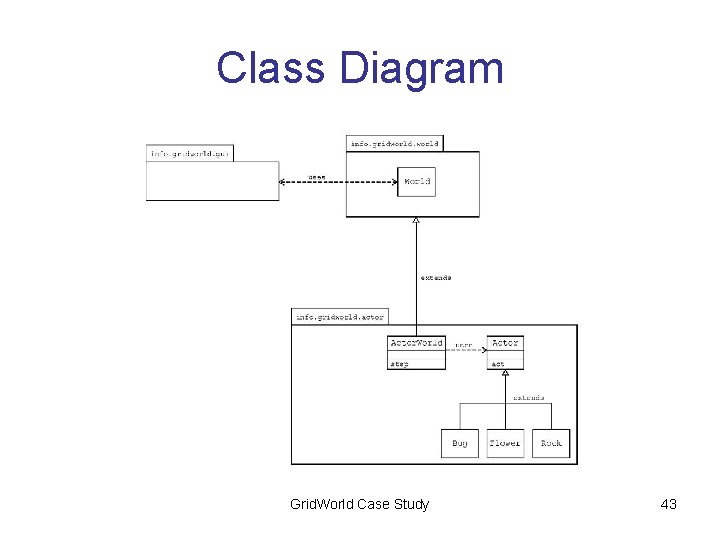
Class Diagram Grid. World Case Study 43
Part 4: Interacting Objects • Critters are actors that have a common pattern for behavior – Use the same act() method • When a critter acts it: – gets a list of actors to process • Array. List<Actor> get. Actors() – processes the actors • void process. Actors(Array. List<Actor> actors); – generates a list of locations it can move to • Array. List<Location> get. Move. Locations() – selects a location • Location select. Move. Location(Array. List<Location> loc. List) – moves to the selected location • void make. Move(Location loc) Grid. World Case Study 44
Exercise Set 7 1. What methods are implemented in Critter? What does each do? 2. What are the 5 basic actions common to all Critters when they act? 3. Should subclasses of Critter override the get. Actors() method? 4. Describe 3 ways a Critter could process actors? 5. What 3 methods must be invoked to make a Critter move? Explain each method. 6. Why is there no Critter constructor? Grid. World Case Study 45
Exercise Answers Set 7 1. What methods are implemented in Critter? What does each do? – act, get. Actors, process. Actors, get. Move. Locations, select. Move. Location, make. Move • • • Act checks that the Critter is in a grid and if so calls the other methods get. Actors gets the neighboring (1 cell away) Actors process. Actors eats (removes) actors that are not Rocks or Critters get. Move. Locations returns valid empty neighboring locations (1 cell away) select. Move. Location returns current location if no empty neighbors or a random empty neighbor make. Move if the location is null remove self from grid otherwise move to the location 2. What are the 5 basic actions common to all Critters when they act? – Get actors to process, process the actors, get a list of locations, select a location, move 3. Should subclasses of Critter override the get. Actors() method? – Yes, if they want to control the type of actors to interact with or to get more than just the neighboring Actors (one cell away) 4. Describe 3 ways a Critter could process actors? – Change their color, Change their direction, remove them from the grid, etc 5. What 3 methods must be invoked to make a Critter move? – get. Move. Locations, select. Move. Location, make. Move. 6. Why is there no Critter constructor? – Because it inherits from Actor and Actor has a no-arg constructor so by not providing any constructors the compiler will add a no-arg constructor that calls super() Grid. World Case Study 46
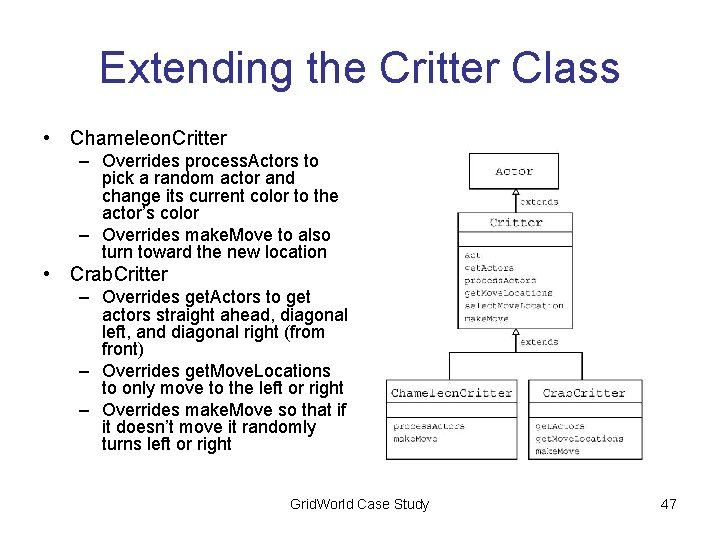
Extending the Critter Class • Chameleon. Critter – Overrides process. Actors to pick a random actor and change its current color to the actor’s color – Overrides make. Move to also turn toward the new location • Crab. Critter – Overrides get. Actors to get actors straight ahead, diagonal left, and diagonal right (from front) – Overrides get. Move. Locations to only move to the left or right – Overrides make. Move so that if it doesn’t move it randomly turns left or right Grid. World Case Study 47
Exercise Set 8 1. Why does act cause a Chameleon. Critter to act differently than a Critter even though act is not overriden? 2. Why does the make. Move method of Chameleon. Critter call super. make. Move? 3. How would you make a Chameleon. Critter drop a flower in the old location when it moves? 4. Why doesn’t Chameleon. Critter override the get. Actors method? 5. Which class contains the get. Location method? 6. How can a Critter access its own grid? Grid. World Case Study 48
Exercise Answers Set 8 1. Why does act cause a Chameleon. Critter to act differently than a Critter even though act is not overriden? • 2. Why does the make. Move method of Chameleon. Critter call super. make. Move? • 3. It wants the same behavior Which class contains the get. Location method? • 6. Save the current location before you move and then create a flower and add it to this saved location just like in Bug Why doesn’t Chameleon. Critter override the get. Actors method? • 5. Because it wants to do the same actions as the parent class How would you make a Chameleon. Critter drop a flower in the old location when it moves? • 4. Because some of the methods act calls are overriden Actor How can a Critter access its own grid? • The inherited get. Grid method (from Actor) Grid. World Case Study 49
Exercise Set 9 1. Why doesn’t Crab. Critter override the process. Actors method? 2. Describe the process Crab. Critter uses to find and eat actors. 1. Does it always eat all neighboring actors? 2. Explain. 3. Why is the get. Locations. In. Directions method used in Crab. Critter? 4. If a Crab. Critter has location (3, 4) and faces south what are the possible locations for actors returned by get. Actors? 5. What are the similarities and differences between the movements of a Crab. Critter and a Critter? 6. How does a Crab. Critter determine when it turns instead of moving? 7. Why don’t the Crab. Critters objects eat each other? Grid. World Case Study 50
Exercise Answers Set 9 1. Why doesn’t Crab. Critter override the process. Actors method? • Because it wants to eat the actors which is what the method in Critter does 2. Describe the process Crab. Critter uses to find and eat actors. 1. Does it always eat all neighboring actors? • No only the ones in front, or diagonally left or right 2. Explain. • It overrides get. Actor to get only these and then calls process. Actors to eat them 3. Why is the get. Locations. In. Directions method used in Crab. Critter? • To get the locations in front, diagonally left and right to get Actors in these locations 4. If a Crab. Critter has location (3, 4) and faces south what are the possible locations for actors returned by get. Actors? • (4, 4), (4, 3), (4, 5) Grid. World Case Study 51
Exercise Answers Set 9 5. What are the similarities and differences between the movements of a Crab. Critter and a Critter? • If a Crab. Critter can’t move it randomly turns left or right, if it can move it moves like a Critter 6. How does a Crab. Critter determine when it turns instead of moving? • It turns only if it can’t move 7. Why don’t the Crab. Citters objects eat each other? • Because process. Actors in Critter won’t eat other Critters and a Crab. Critter is a type of Critter Grid. World Case Study 52
Chapter 5: Grid Data Structures • Abstract. Grid defines methods that are common to Bounded. Grid and Unbounded. Grid – public Array. List<E> get. Neighbors(Location loc) – public Array. List<E> get. Valid. Adjacent. Locations(Location loc) – public Array. List<E> get. Empty. Adjacent. Locations(Location loc) – public Array. List<E> get. Occupied. Adjacent. Locations(Location loc) – public String to. String() • This class must be abstract as it implements Grid but doesn’t define all the methods specified in the Grid interface – These are defined in Bounded. Grid and Unbounded. Grid. World Case Study 53
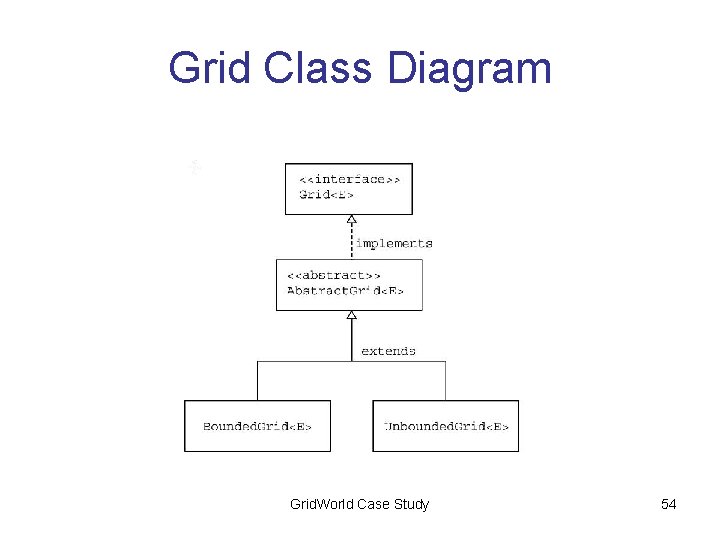
Grid Class Diagram Grid. World Case Study 54
Exercise Set 10 1. Where is the is. Valid method specified? a. 2. 3. Which Abstract. Grid methods call the is. Valid method? Why don’t other methods call it? Which methods of the Grid interface are called by the get. Neighbors method? a. 4. 5. Which classes implement this method? Which classes implement these methods? Why must the get method which returns objects of type E be used in the get. Empty. Adjacent. Locations method when this method returns Location objects? What would be the affect of replacing the constant Location. HALF_RIGHT with Location. RIGHT where it appears in get. Valid. Adjacent. Locatins? Grid. World Case Study 55
Exercise Answers Set 10 1. Where is the is. Valid method specified? • a. In concrete subclasses of Abstract. Grid Which classes implement this method? – 2. Bounded. Grid and Unbounded. Grid Which Abstract. Grid methods call the is. Valid method? Why don’t other methods call it? • 3. get. Valid. Adjacent. Locations others don’t because they call this method Which methods of the Grid interface are called by the get. Neighbors method? • a. get. Occupied. Adjacent. Locations Which classes implement these methods? – 4. Abstract. Grid Why must the get method which returns objects of type E be used in the get. Empty. Adjacent. Locations method when this method returns Location objects? – 5. Because that is how it checks that the location is empty What would be the affect of replacing the constant Location. HALF_RIGHT with Location. RIGHT where it appears in get. Valid. Adjacent. Locatins? – It wouldn’t get diagonal neighbors Grid. World Case Study 56
Bounded. Grid Class • Fixed number of rows and columns – Throws runtime exception if you try to access a location outside the grid • Stores objects in a two-dimensional array – private Object[][] occupant. Array; • Can’t declare an array of a generic type in Java Grid. World Case Study 57
Exercise Set 11 1. 2. 3. 4. 5. 6. 7. 8. What ensures that a grid has at least one valid location? How is the number of columns in the grid determined? What assumption makes this possible? What are the requirements for a Location to be valid in a Bounded. Grid? What type is returned by the get. Occupied. Locations method? What is the time complexity (Big-Oh) for this method? What type is returned by the get method? What is the time complexity (Big-Oh) for this method? What conditions cause an exception to be thrown by the put method? What is the Big-Oh? What type is returned by the remove method? What happens if you try to remove from an empty location? What is the Big-Oh? Based on your answers to 4 -7 is this an efficient implementation? Grid. World Case Study 58
Exercise Answers Set 11 1. What ensures that a grid has at least one valid location? • 2. The constructor checks that the number of rows and columns is at least 1 How is the number of columns in the grid determined? What assumption makes this possible? • 3. return occupant. Array[0]. length; That there is at least one row and that this is an array of arrays with the inner array being the columns. What are the requirements for a Location to be valid in a Bounded. Grid? • 4. The row index is >= 0 and < num rows, the col index is >= 0 and less than the number of columns What type is returned by the get. Occupied. Locations method? What is the time complexity (Big -Oh) for this method? • 5. Array. List<Location> O(r * c) where r is the number of rows and c is the number of cols What type is returned by the get method? What is the time complexity (Big-Oh) for this method? • 6. E O(1) What conditions cause an exception to be thrown by the put method? What is the Big-Oh? • 7. If the location isn’t valid or the object is null O(1) What type is returned by the remove method? What happens if you try to remove from an empty location? What is the Big-Oh? • 8. E, nothing it just returns null, O(1) Based on your answers to 4 -7 is this an efficient implementation? • It is pretty efficient for arrays that aren’t too big. If the array is really big and doesn’t include many objects then there are better ways to do the get. Occupied. Locations Grid. World Case Study 59
Unbounded. Grid • All locations are valid even if the row and col are negative • Stores objects in a Map<Location, E> • get. Num. Rows() and get. Num. Cols() – return -1 Grid. World Case Study 60
Exercise Set 12 1. 2. 3. 4. 5. Which method must the Location class implement so that Location can be used as the key to the map? What would be required if the Map was a Tree. Map? Does Location satisfy these requirements? Why are the checks for null included in the get, put, and remove methods? Why don’t the methods in Bounded. Grid do this? What is the average time complexity (Big-Oh) for get, put, and remove? What would it be if Tree. Map where used instead of Hash. Map? How would the behavior of the class differ, aside from time complexity if Tree. Map where used instead of Hash. Map? Could you use a Map for a Bounded. Grid? Is there an advantage to using a 2 -D array for a Bounded. Grid? Grid. World Case Study 61
Exercise Answers Set 12 1. Which method must the Location class implement so that Location can be used as the key to the map? What would be required if the Map was a Tree. Map? Does Location satisfy these requirements? • 2. hash. Code, implement Comparable consistent with equals, Yes Why are the checks for null included in the get, put, and remove methods? Why don’t the methods in Bounded. Grid do this? • 3. You can only have one null key in a Hash. Map What is the average time complexity (Big-Oh) for get, put, and remove? O(1) What would it be if Tree. Map where used instead of Hash. Map? How would the behavior of the class differ, aside from time complexity if Tree. Map where used instead of Hash. Map? 4. • 5. The keys would be kept in sorted order in a Tree. Map. Could you use a Map for a Bounded. Grid? Is there an advantage to using a 2 -D array for a Bounded. Grid? • Yes, but it would take more space for a small bounded grid and be less efficient when the grid was fairly full. Grid. World Case Study 62
Extending the Case Study • You can use an actor world • Create new classes that extend the actor class – and override act • To add pictures save a gif with the same name as the class in the same directory – 48 by 48 pixels work best – Or custom draw your objects by providing a Class. Name. Display class • see Mouse. Display Grid. World Case Study 63
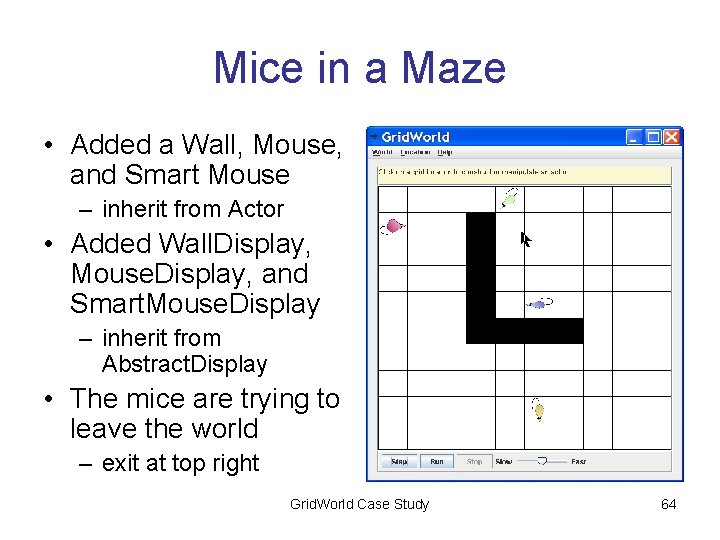
Mice in a Maze • Added a Wall, Mouse, and Smart Mouse – inherit from Actor • Added Wall. Display, Mouse. Display, and Smart. Mouse. Display – inherit from Abstract. Display • The mice are trying to leave the world – exit at top right Grid. World Case Study 64
- Slides: 64