
Grid Stability Applications Wide Area Monitoring System Paddy
Grid Stability Applications Wide Area Monitoring System Paddy Mc. Nabb Senior Engineer January 2016 Imagination at work.
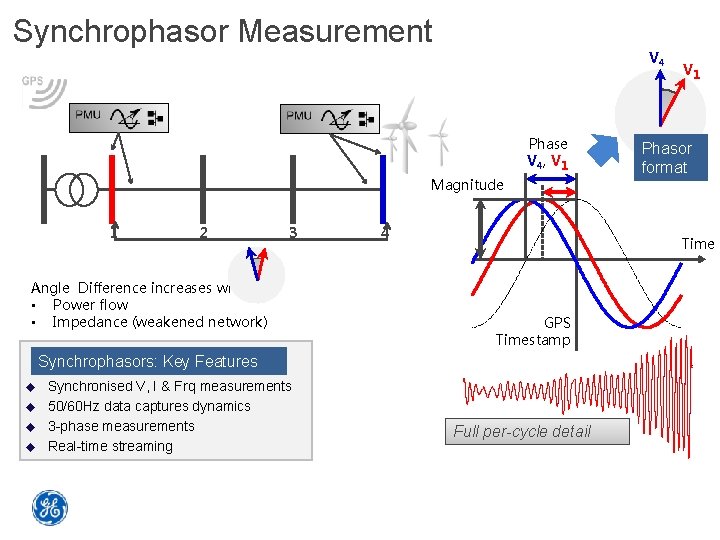
Synchrophasor Measurement V 4 Phase V 4 , V 1 Magnitude 1 2 3 Angle Difference increases with • Power flow • Impedance (weakened network) 4 u u u Synchronised V, I & Frq measurements 50/60 Hz data captures dynamics 3 -phase measurements Real-time streaming Phasor format Time GPS Timestamp Synchrophasors: Key Features u V 1 Full per-cycle detail
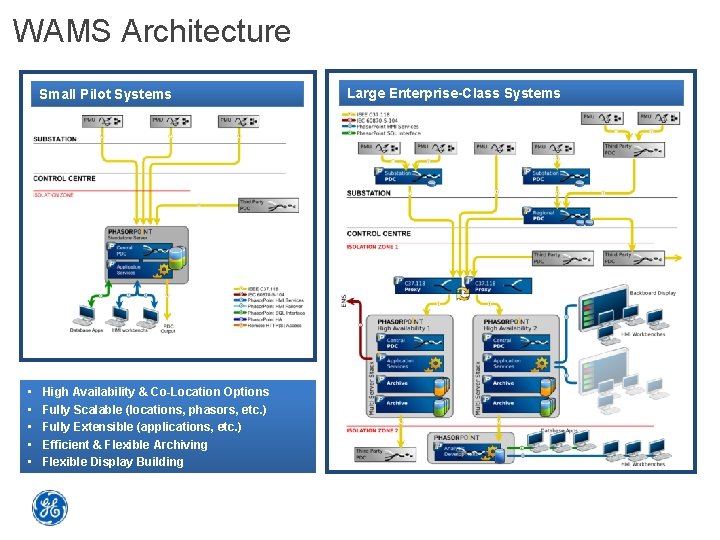
WAMS Architecture Small Pilot Systems • • • High Availability & Co-Location Options Fully Scalable (locations, phasors, etc. ) Fully Extensible (applications, etc. ) Efficient & Flexible Archiving Flexible Display Building Large Enterprise-Class Systems
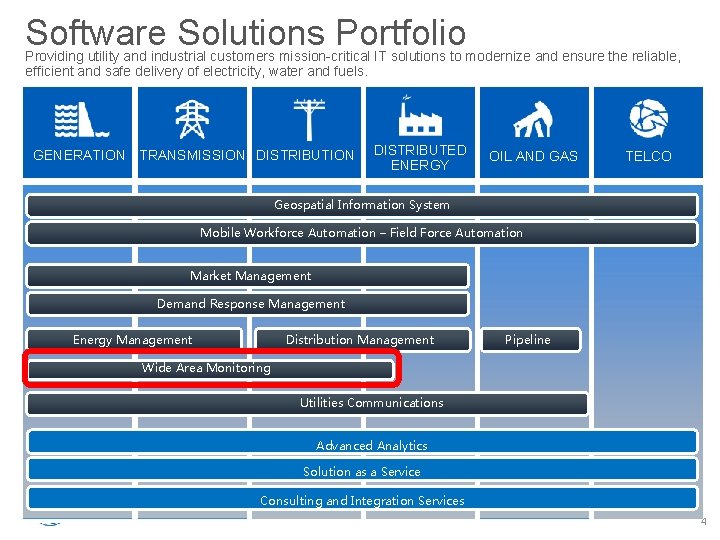
Software Solutions Portfolio Providing utility and industrial customers mission-critical IT solutions to modernize and ensure the reliable, efficient and safe delivery of electricity, water and fuels. GENERATION TRANSMISSION DISTRIBUTED ENERGY OIL AND GAS TELCO Geospatial Information System Mobile Workforce Automation – Field Force Automation Market Management Demand Response Management Distribution Management Energy Management Pipeline Wide Area Monitoring Utilities Communications Advanced Analytics Solution as a Service Consulting and Integration Services 4
URTDSM – Powergrid, India 5

Largest WAMS Report in Blackouts called for WAMS; • 1800 PMU’s with expansion capability to 3000 PMU’s • ~ 350 substations • > 20, 000 phasor streams at 50 Hz All data aggregated up to national level: • State Level • Regional Level • National Level
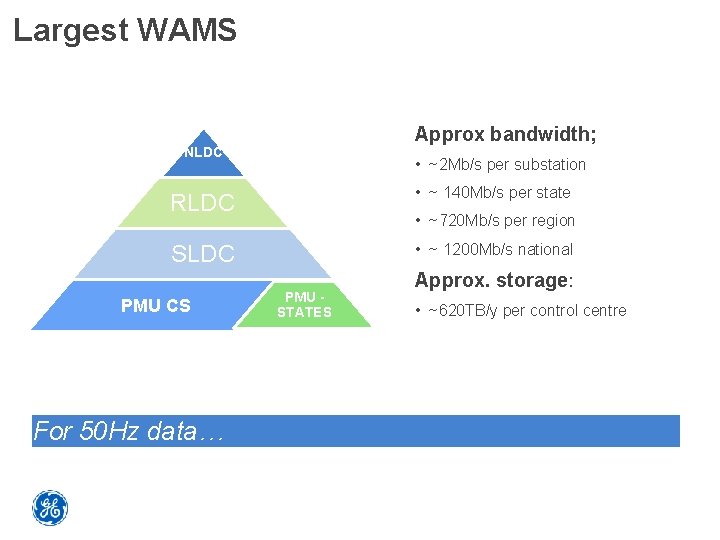
Largest WAMS Approx bandwidth; NLDC • ~2 Mb/s per substation RLDC • ~ 140 Mb/s per state SLDC • ~ 1200 Mb/s national PMU CS For 50 Hz data… • ~720 Mb/s per region PMU STATES Approx. storage: • ~620 TB/y per control centre
VISOR – Scottish Power 8
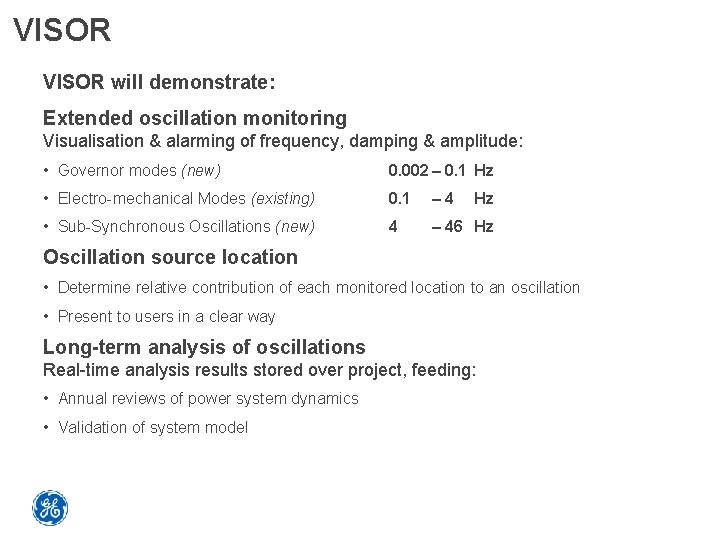
VISOR will demonstrate: Extended oscillation monitoring Visualisation & alarming of frequency, damping & amplitude: • Governor modes (new) 0. 002 – 0. 1 Hz • Electro-mechanical Modes (existing) 0. 1 – 4 • Sub-Synchronous Oscillations (new) 4 – 46 Hz Hz Oscillation source location • Determine relative contribution of each monitored location to an oscillation • Present to users in a clear way Long-term analysis of oscillations Real-time analysis results stored over project, feeding: • Annual reviews of power system dynamics • Validation of system model
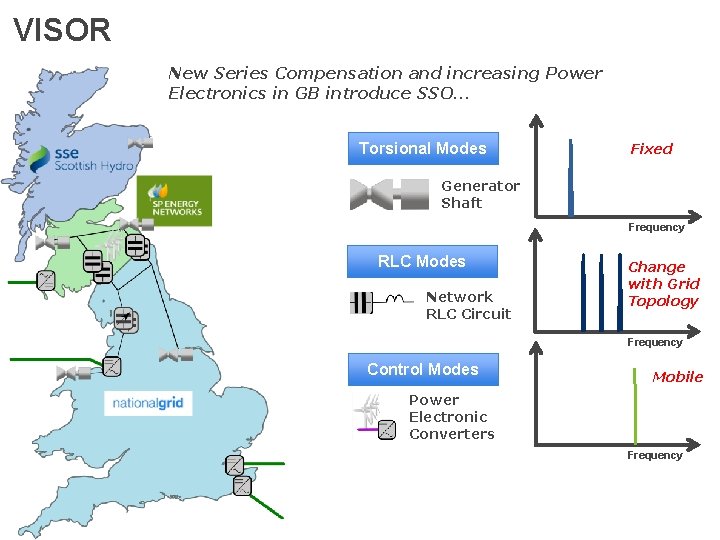
VISOR New Series Compensation and increasing Power Electronics in GB introduce SSO… Torsional Modes Fixed Generator Shaft Frequency RLC Modes Network RLC Circuit Change with Grid Topology Frequency Control Modes Mobile Power Electronic Converters Frequency
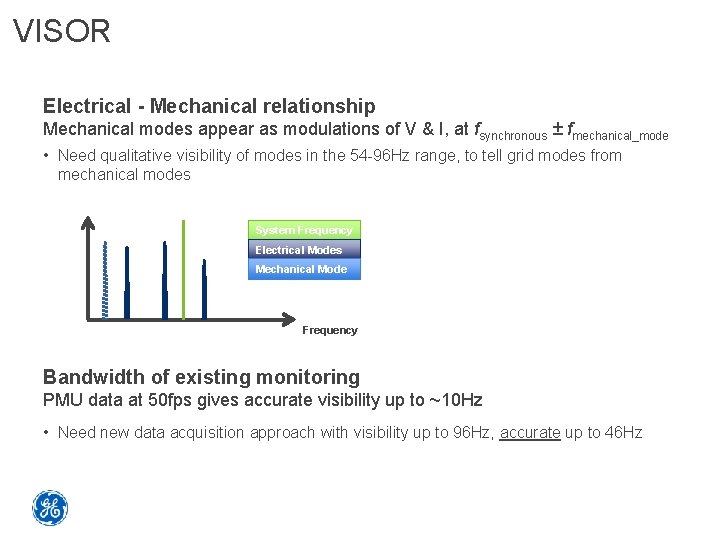
VISOR Electrical - Mechanical relationship Mechanical modes appear as modulations of V & I, at fsynchronous ± fmechanical_mode • Need qualitative visibility of modes in the 54 -96 Hz range, to tell grid modes from mechanical modes System Frequency Electrical Modes Mechanical Mode Frequency Bandwidth of existing monitoring PMU data at 50 fps gives accurate visibility up to ~10 Hz • Need new data acquisition approach with visibility up to 96 Hz, accurate up to 46 Hz
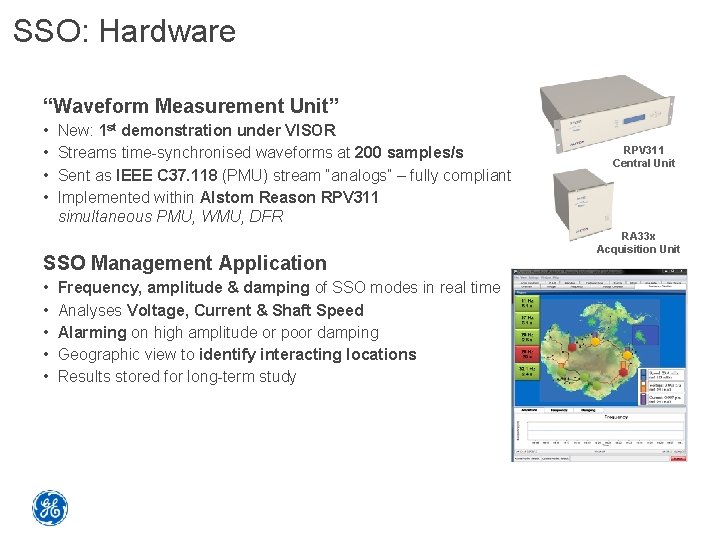
SSO: Hardware “Waveform Measurement Unit” • • New: 1 st demonstration under VISOR Streams time-synchronised waveforms at 200 samples/s Sent as IEEE C 37. 118 (PMU) stream “analogs” – fully compliant Implemented within Alstom Reason RPV 311 simultaneous PMU, WMU, DFR SSO Management Application • • • Frequency, amplitude & damping of SSO modes in real time Analyses Voltage, Current & Shaft Speed Alarming on high amplitude or poor damping Geographic view to identify interacting locations Results stored for long-term study RPV 311 Central Unit RA 33 x Acquisition Unit

HARMONICS 13
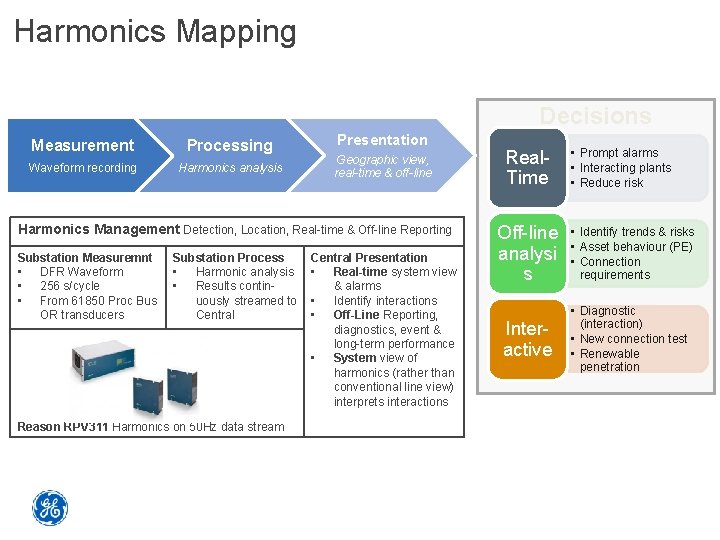
Harmonics Mapping Decisions Measurement Processing Waveform recording Harmonics analysis Presentation Geographic view, real-time & off-line Harmonics Management Detection, Location, Real-time & Off-line Reporting Substation Measuremnt • DFR Waveform • 256 s/cycle • From 61850 Proc Bus OR transducers Substation Process • Harmonic analysis • Results continuously streamed to Central Reason RPV 311 Harmonics on 50 Hz data stream Central Presentation • Real-time system view & alarms • Identify interactions • Off-Line Reporting, diagnostics, event & long-term performance • System view of harmonics (rather than conventional line view) interprets interactions Real. Time • Prompt alarms • Interacting plants • Reduce risk Off-line analysi s • Identify trends & risks • Asset behaviour (PE) • Connection requirements Interactive • Diagnostic (interaction) • New connection test • Renewable penetration
Conclusion Future Trends include: Larger WAMS • > 3000 PMU/WMU’s • Current storage in ~0. 6 PB/yr range but technology is still being adopted • ~1. 2 Gb/s bandwidth Higher frequency phenomena due to increased PE • 200 Hz analysis for SSO, enhanced fault analysis • 256 s/cycle = ~ 12. 8 k. Hz sampling, ~200 times data handling compared to 50 Hz sampling Better ways of handling & processing data • Compression techniques • Error handling, mainly for control and sensitive monitoring applications • Extraction and analysis of key stability indicators in power systems

- Slides: 16