
Grid Sim 2 0 Adv Grid Modelling Simulation
- Slides: 27
Grid. Sim 2. 0 Adv. Grid Modelling & Simulation Toolkit Rajkumar Buyya, Manzur Murshed (Monash), Anthony Sulistio, Chee Shin Yeo Grid Computing and Distributed Systems (GRIDS) Lab, Dept. of Computer Science and Software Engineering The University of Melbourne www. gridbus. org Thanks to David Abramson 1
Outline • • • Motivation. System Architecture. Grid. Sim Entities. Visual Modeller. Experiments. 2
Performance Evaluation: With Large Scenarios • Varying the number of ü ü ü ü Resources (1 to 100 s. . 1000 s. . ). Resource capability. Cost (Access Price). Users. Deadline and Budget. Workload. Different Time (Peak and Off-Peak). • We need a repeatable and controllable environment. • Can this be achieved on Real Grid testbed ? 3
Grid Environment • Dynamic: 1. Resource and User Properties vary with time. § Experiment cannot be repeated. 2. Resources are distributed and owned by different organisations. Heterogeneous users. § It is hard to create a controllable environment. • Grid testbed size is limited. • Also, creating testbed infrastructure is time consuming and expensive. • Hence, grid computing researchers turn to modelling and simulation. 4
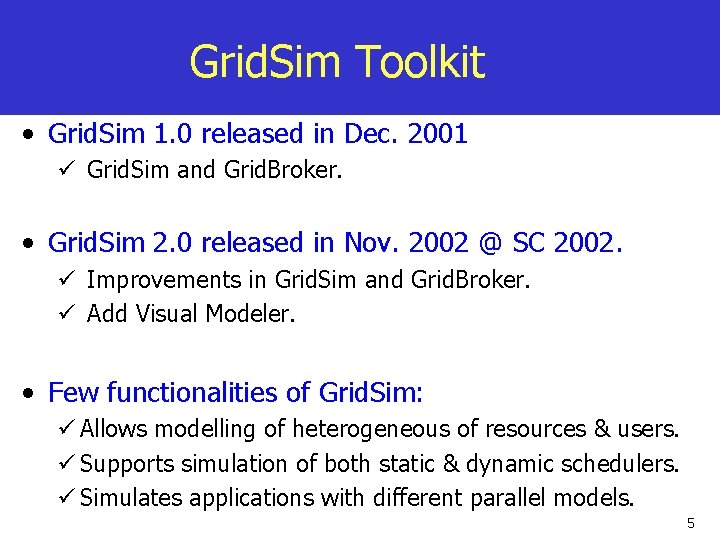
Grid. Sim Toolkit • Grid. Sim 1. 0 released in Dec. 2001 ü Grid. Sim and Grid. Broker. • Grid. Sim 2. 0 released in Nov. 2002 @ SC 2002. ü Improvements in Grid. Sim and Grid. Broker. ü Add Visual Modeler. • Few functionalities of Grid. Sim: ü Allows modelling of heterogeneous of resources & users. ü Supports simulation of both static & dynamic schedulers. ü Simulates applications with different parallel models. 5
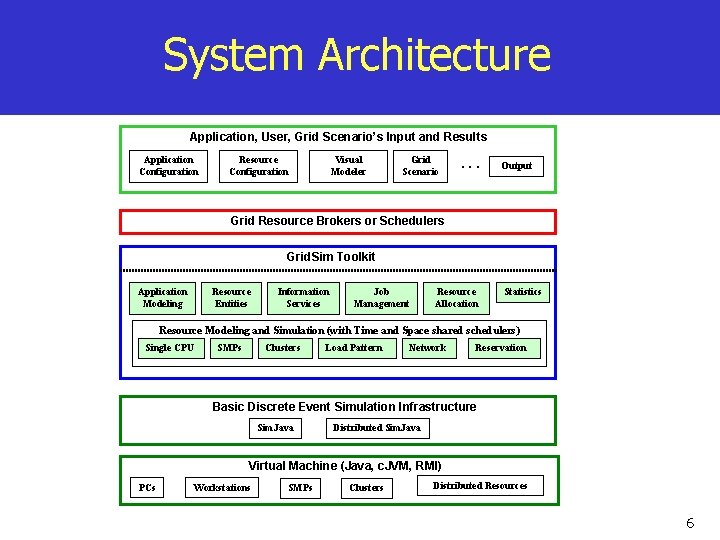
System Architecture Application, User, Grid Scenario’s Input and Results Application Configuration Resource Configuration Visual Modeler Grid Scenario . . . Output Grid Resource Brokers or Schedulers Grid. Sim Toolkit Application Modeling Resource Entities Information Services Job Management Resource Allocation Statistics Resource Modeling and Simulation (with Time and Space shared schedulers) Single CPU SMPs Clusters Load Pattern Network Reservation Basic Discrete Event Simulation Infrastructure Sim. Java Distributed Sim. Java Virtual Machine (Java, c. JVM, RMI) PCs Workstations SMPs Clusters Distributed Resources 6
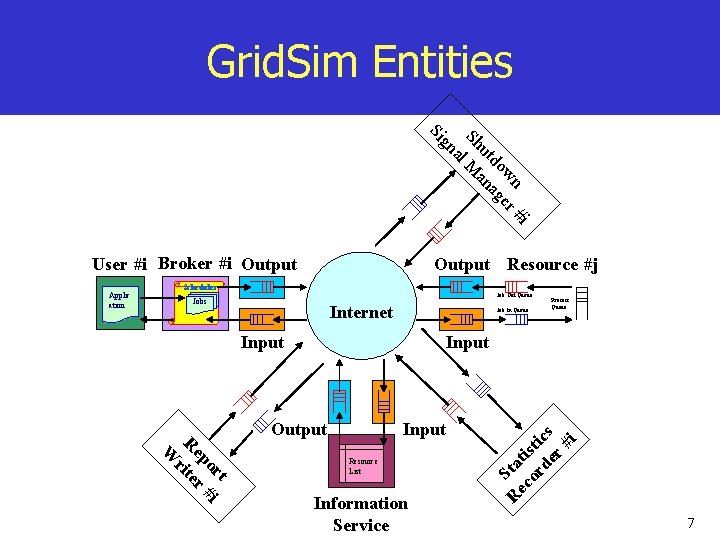
Grid. Sim Entities n #i w er do ag ut an Sh M al gn Si User #i Broker #i Output Scheduler Job Out Queue Jobs Internet Job In Queue Input Process Queue Input Output t or #i ep r R rite W Resource List Information Service R Sta ec tis or ti de cs r# i Applic ation Output Resource #j 7
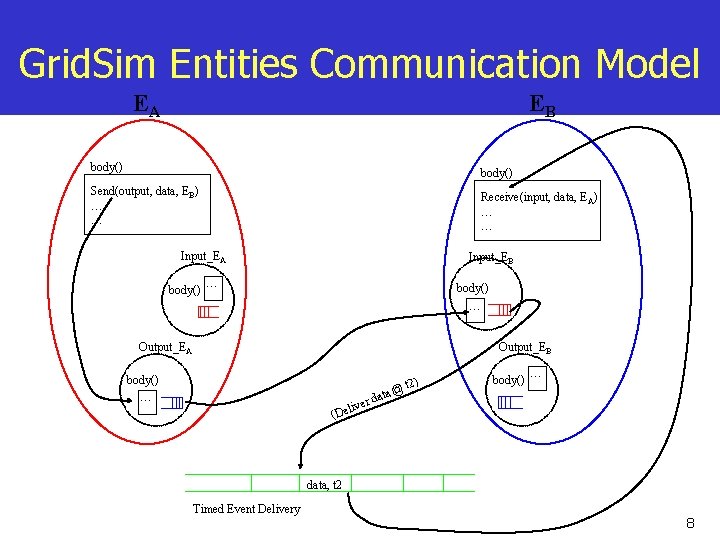
Grid. Sim Entities Communication Model EA EB body() Send(output, data, EB) … … Receive(input, data, E A) … … Input_EA body() Input_EB … body() … Output_EA Output_EB body() … er eliv data 2) @t body() … (D data, t 2 Timed Event Delivery 8
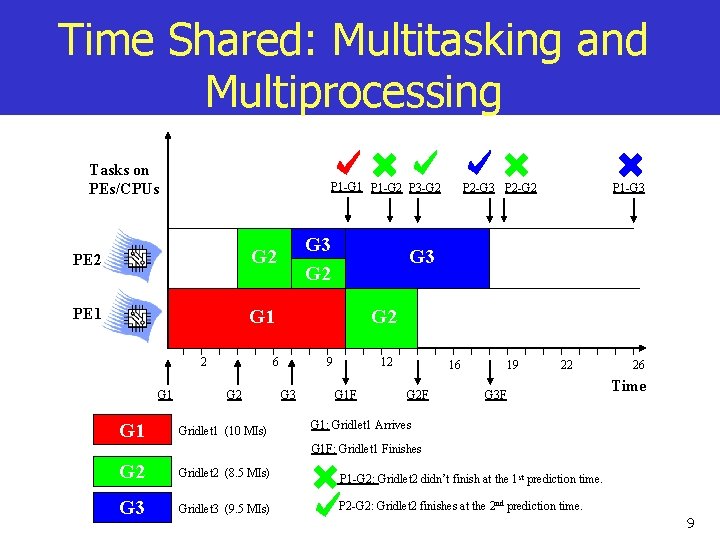
Time Shared: Multitasking and Multiprocessing Tasks on PEs/CPUs P 1 -G 1 P 1 -G 2 P 3 -G 2 PE 2 G 2 PE 1 G 1 G 2 Gridlet 1 (10 MIs) P 1 -G 3 G 2 6 2 G 1 G 3 G 2 P 2 -G 3 P 2 -G 2 9 G 3 12 G 1 F 16 G 2 F 19 22 G 3 F 26 Time G 1: Gridlet 1 Arrives G 1 F: Gridlet 1 Finishes G 2 Gridlet 2 (8. 5 MIs) P 1 -G 2: Gridlet 2 didn’t finish at the 1 st prediction time. G 3 Gridlet 3 (9. 5 MIs) P 2 -G 2: Gridlet 2 finishes at the 2 nd prediction time. 9
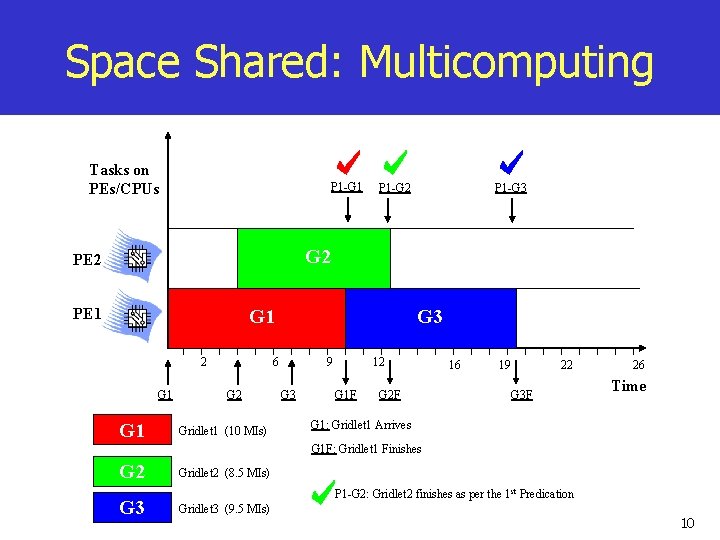
Space Shared: Multicomputing Tasks on PEs/CPUs P 1 -G 1 P 1 -G 2 P 1 -G 3 G 2 PE 1 G 3 G 1 6 2 G 1 G 3 G 2 Gridlet 1 (10 MIs) 9 G 3 12 G 1 F G 2 F 16 19 22 G 3 F 26 Time G 1: Gridlet 1 Arrives G 1 F: Gridlet 1 Finishes G 2 G 3 Gridlet 2 (8. 5 MIs) P 1 -G 2: Gridlet 2 finishes as per the 1 st Predication Gridlet 3 (9. 5 MIs) 10
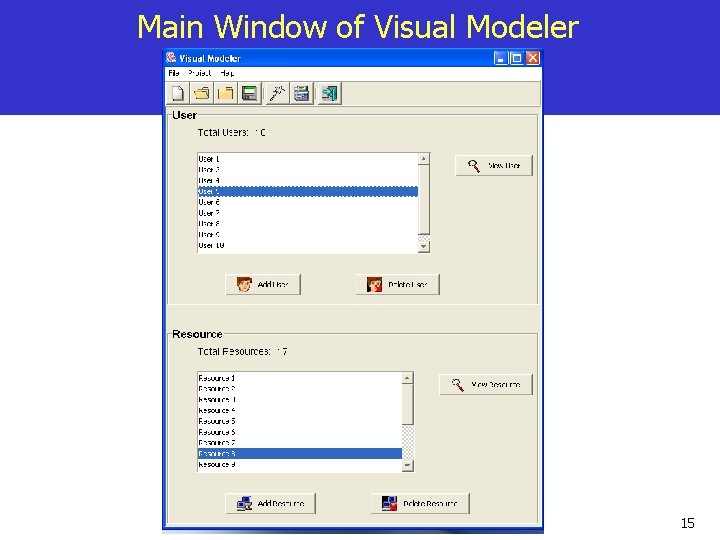
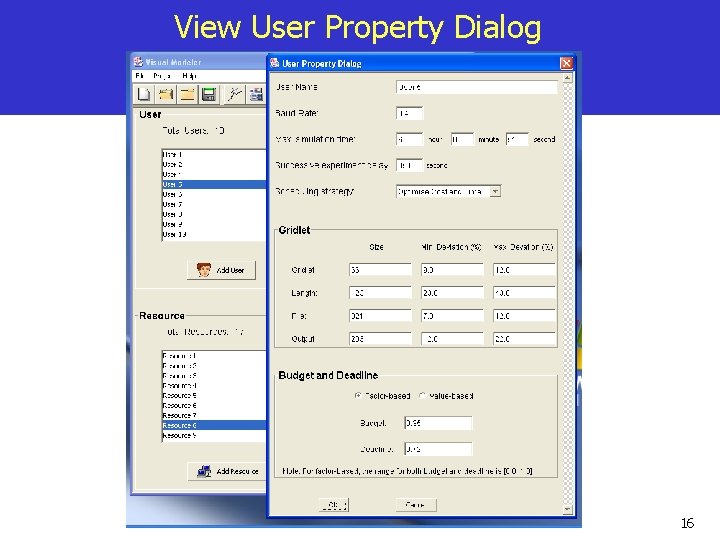
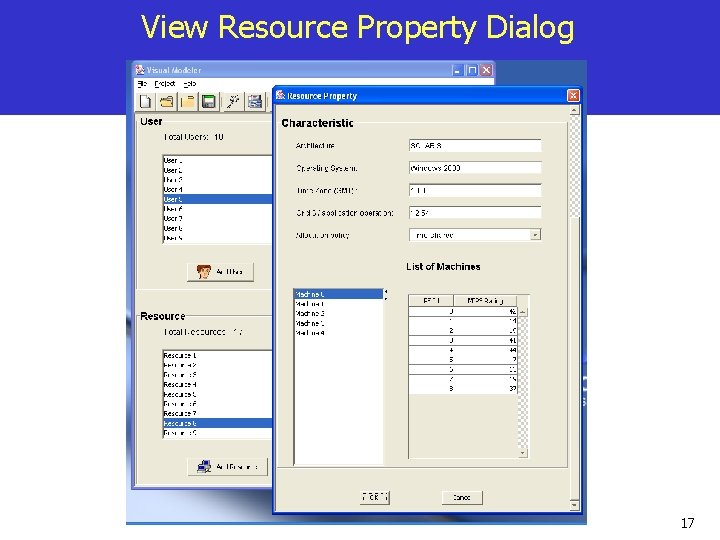
Visual Modeler • Available in Grid. Sim 2. 0 • Functionalities: ü Create and delete many users and resources. ü Able to save and load the model file (XML format). ü Generate Java source code. 11
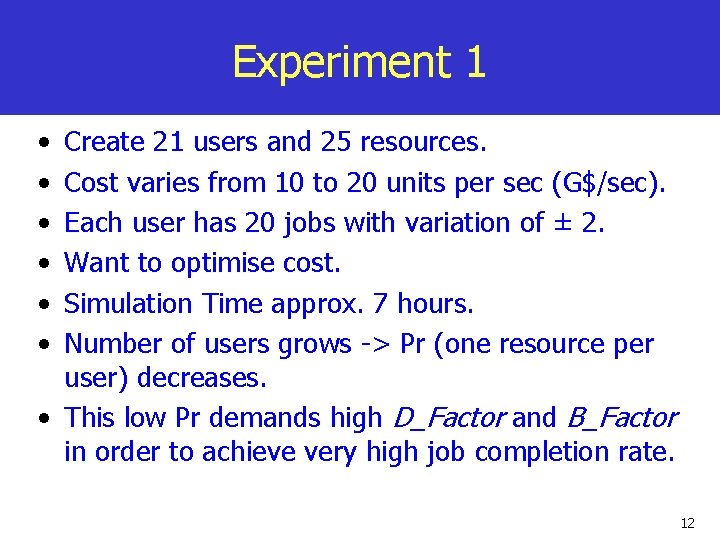
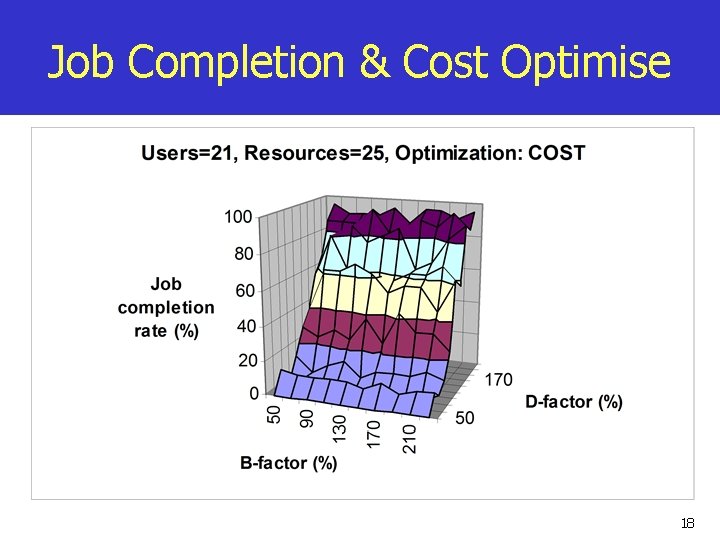
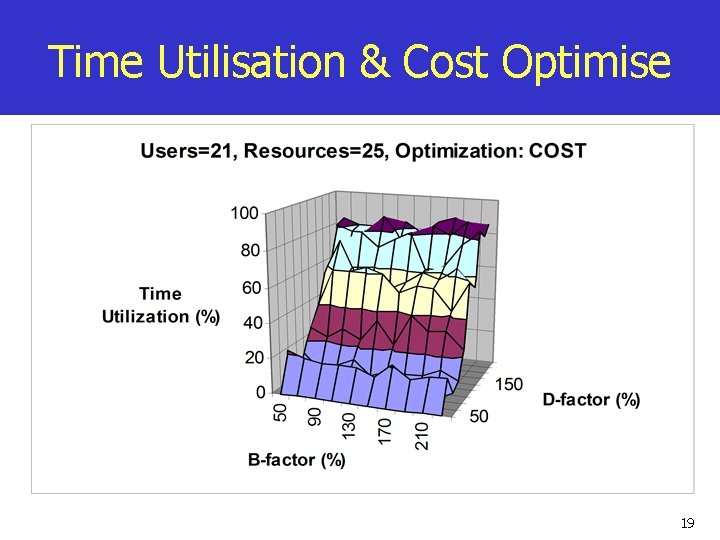
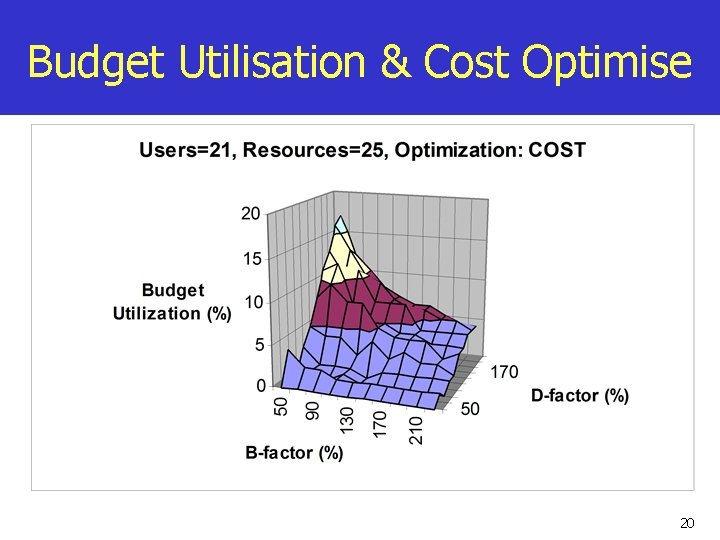
Experiment 1 • • • Create 21 users and 25 resources. Cost varies from 10 to 20 units per sec (G$/sec). Each user has 20 jobs with variation of ± 2. Want to optimise cost. Simulation Time approx. 7 hours. Number of users grows -> Pr (one resource per user) decreases. • This low Pr demands high D_Factor and B_Factor in order to achieve very high job completion rate. 12
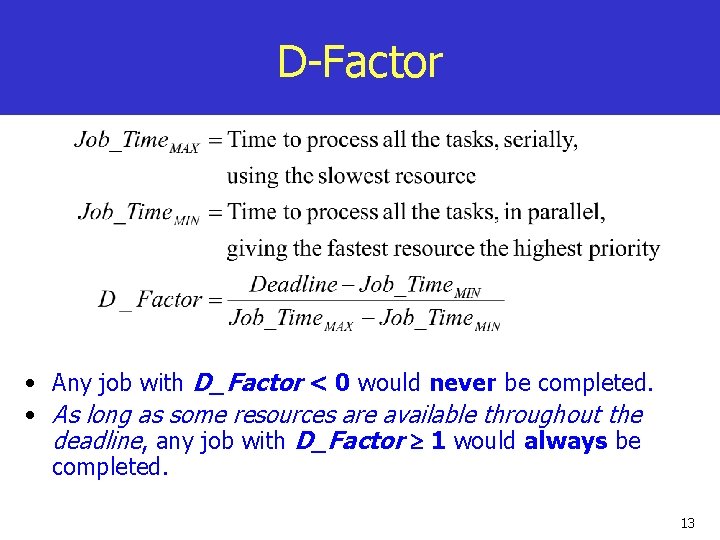
D-Factor • Any job with D_Factor < 0 would never be completed. • As long as some resources are available throughout the deadline, any job with D_Factor 1 would always be completed. 13
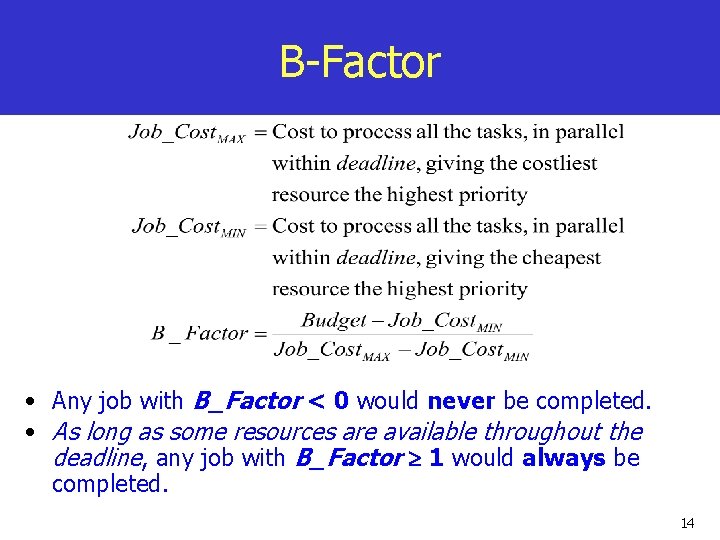
B-Factor • Any job with B_Factor < 0 would never be completed. • As long as some resources are available throughout the deadline, any job with B_Factor 1 would always be completed. 14
Main Window of Visual Modeler 15
View User Property Dialog 16
View Resource Property Dialog 17
Job Completion & Cost Optimise 18
Time Utilisation & Cost Optimise 19
Budget Utilisation & Cost Optimise 20
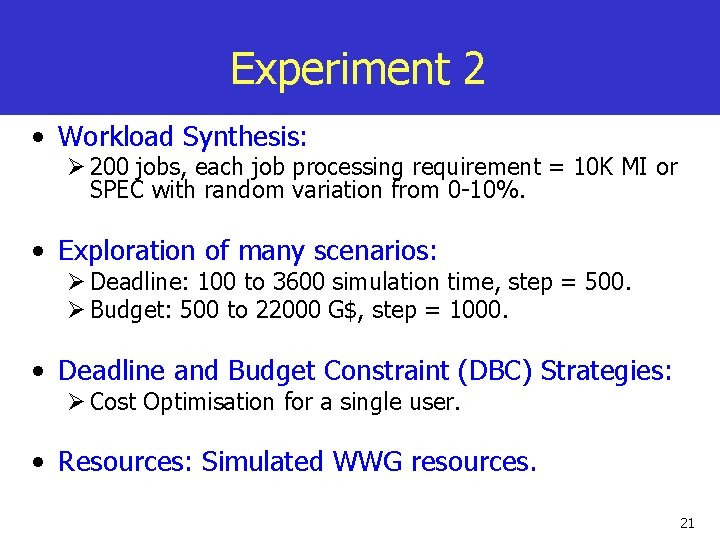
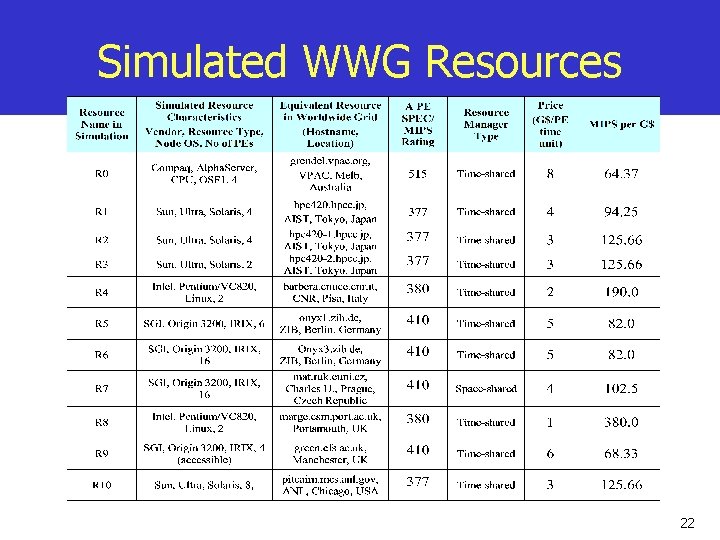
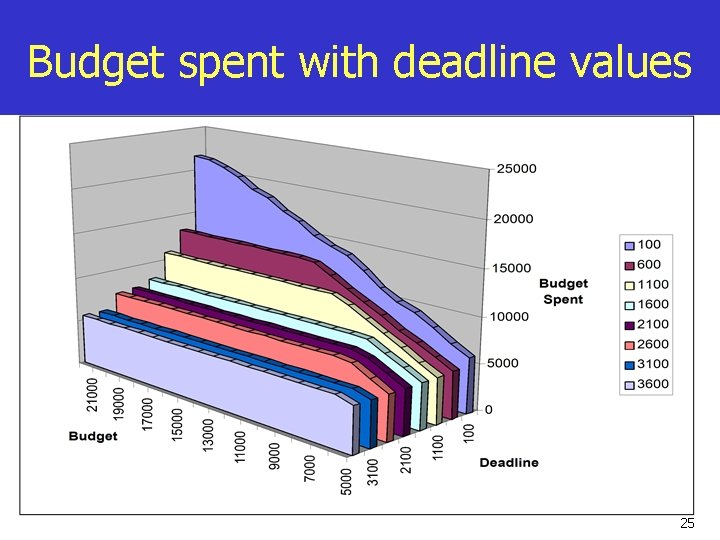
Experiment 2 • Workload Synthesis: Ø 200 jobs, each job processing requirement = 10 K MI or SPEC with random variation from 0 -10%. • Exploration of many scenarios: Ø Deadline: 100 to 3600 simulation time, step = 500. Ø Budget: 500 to 22000 G$, step = 1000. • Deadline and Budget Constraint (DBC) Strategies: Ø Cost Optimisation for a single user. • Resources: Simulated WWG resources. 21
Simulated WWG Resources 22
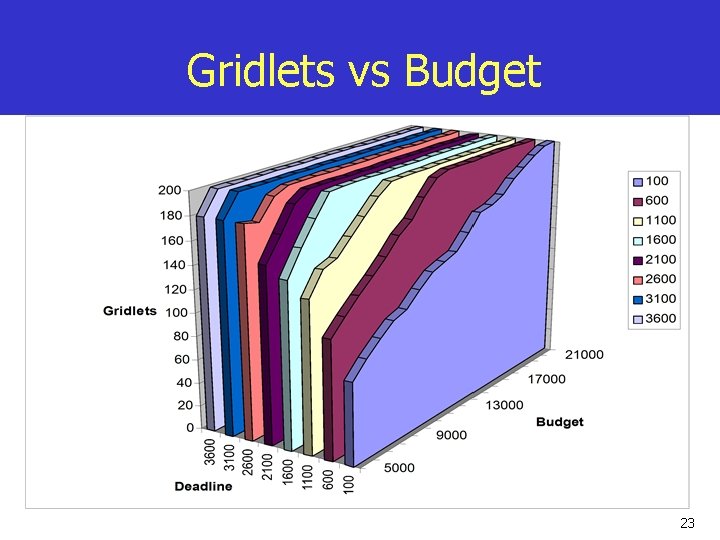
Gridlets vs Budget 23
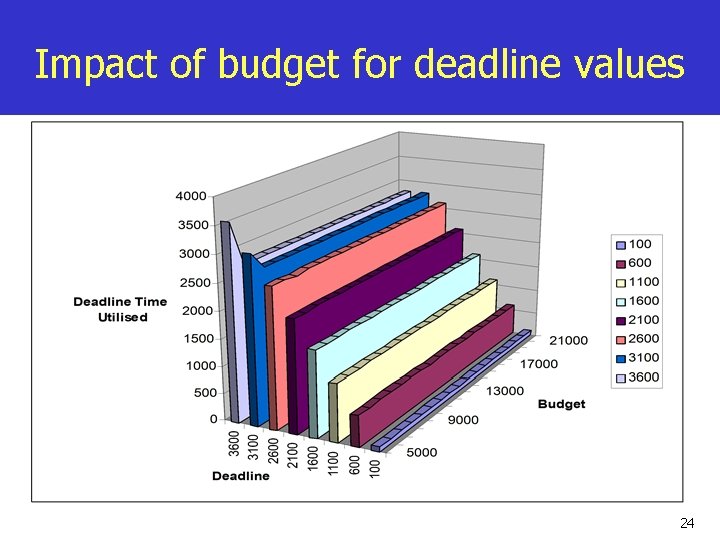
Impact of budget for deadline values 24
Budget spent with deadline values 25
Selected Grid. Sim Users 26
Conclusion • Grid. Sim toolkit is suitable for application scheduling simulations in Grid and P 2 P computing environment. • Grid. Sim 2. 0 is available to download: www. gridbus. org Ø Extending to support Data Grid modelling 27