
Grid Middleware for WLCG Where are we now
- Slides: 23
Grid Middleware for WLCG Where are we now – and where do we go from here? Prague, 24 th March 2009 Ian Bird, James Casey, Oliver Keeble, Markus Schulz & thanks to Pere Mato CERN
Introduction This is a talk about middleware/software § But WLCG is quite a lot more – it is a collaboration and contains many other pieces that allow us to provide a global computing environment: § Policies and frameworks for collaboration § Operations coordination and service procedures (to service providers: sites, networks, etc) § GGUS, user support, . . . § User and VO management § Tools for monitoring, reporting, accounting, etc. § Security coordination and follow up § Complex middleware can make much of these more difficult to manage § The question arises: § Within this framework can we simplify the services in order to make the overall environment more sustainable and easy to use? § Today there are new technologies and ideas that may allow (some of) this to happen Ian. Bird@cern. ch 2
Introduction § We should also remember what our real goal is. . . § To provide the computing resources and environment to enable the LHC experiments § Using the most appropriate technology. . . no matter what its label § Is what we are doing still the most appropriate for the long term? § We have to consider issues of maintainability and ownership (risk management) § And although we use g. Lite as an example here, the lessons apply elsewhere too Ian. Bird@cern. ch 3
Evolution has been § Simplifying grid services § Experiment software has absorbed some of the complexity, § Computing models have removed some of the complexity, § Grid developments have not delivered: § All the functionality asked for § Reliable, fault tolerant services § Ease of use § But requirements surely were overstated in the beginning § And grid software was less real than we had thought. . . § And as Les Robertson said, technology has moved on Ian. Bird@cern. ch 4
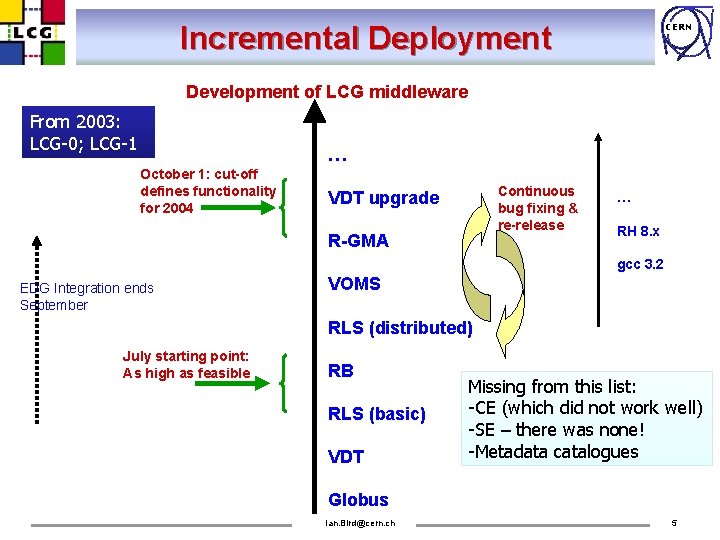
Incremental Deployment CERN Development of LCG middleware From 2003: LCG-0; LCG-1 … October 1: cut-off defines functionality for 2004 Continuous bug fixing & re-release VDT upgrade R-GMA … RH 8. x gcc 3. 2 EDG Integration ends September VOMS RLS (distributed) July starting point: As high as feasible RB RLS (basic) VDT Missing from this list: -CE (which did not work well) -SE – there was none! -Metadata catalogues Globus Ian. Bird@cern. ch 5
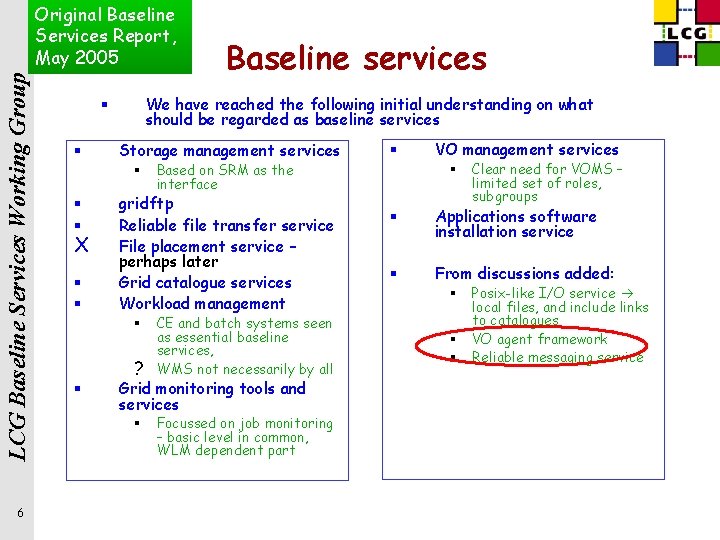
LCG Baseline Services Working Group Original Baseline Services Report, May 2005 6 We have reached the following initial understanding on what should be regarded as baseline services § § Storage management services § § § X § § ? CE and batch systems seen as essential baseline services, WMS not necessarily by all Grid monitoring tools and services § § Based on SRM as the interface gridftp Reliable file transfer service File placement service – perhaps later Grid catalogue services Workload management § § Baseline services Focussed on job monitoring – basic level in common, WLM dependent part VO management services § Clear need for VOMS – limited set of roles, subgroups § Applications software installation service § From discussions added: § § § Posix-like I/O service local files, and include links to catalogues VO agent framework Reliable messaging service
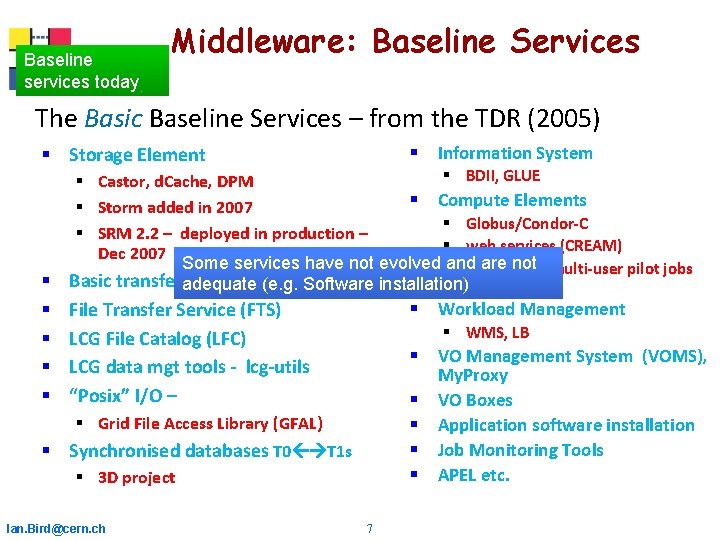
Baseline services today Middleware: Baseline Services The Basic Baseline Services – from the TDR (2005) § Information System § Storage Element § BDII, GLUE § Castor, d. Cache, DPM § Compute Elements § Storm added in 2007 § Globus/Condor-C § SRM 2. 2 – deployed in production – § web services (CREAM) Dec 2007 Some services have not evolved §and are not Support for multi-user pilot jobs Basic transferadequate tools – Gridftp, . . (e. g. Software installation)(glexec, SCAS) § Workload Management File Transfer Service (FTS) § § § LCG File Catalog (LFC) § LCG data mgt tools - lcg-utils § “Posix” I/O – § WMS, LB § VO Management System (VOMS), My. Proxy § VO Boxes § Application software installation § Job Monitoring Tools § APEL etc. § Grid File Access Library (GFAL) § Synchronised databases T 0 T 1 s § 3 D project Ian. Bird@cern. ch 7
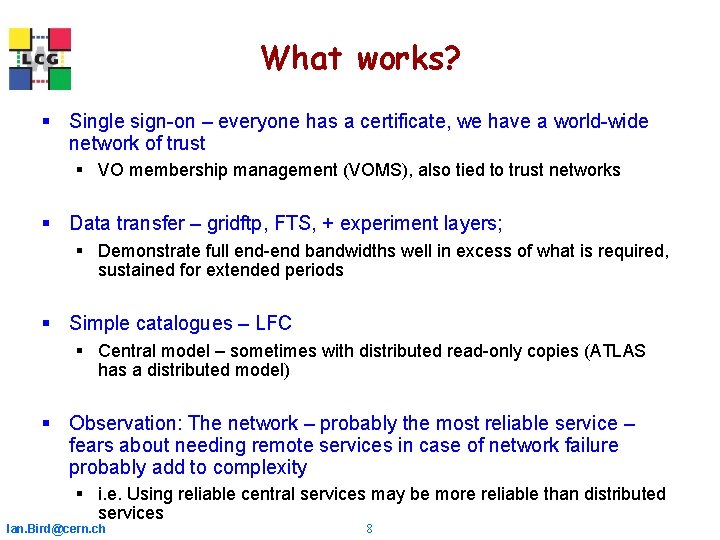
What works? § Single sign-on – everyone has a certificate, we have a world-wide network of trust § VO membership management (VOMS), also tied to trust networks § Data transfer – gridftp, FTS, + experiment layers; § Demonstrate full end-end bandwidths well in excess of what is required, sustained for extended periods § Simple catalogues – LFC § Central model – sometimes with distributed read-only copies (ATLAS has a distributed model) § Observation: The network – probably the most reliable service – fears about needing remote services in case of network failure probably add to complexity § i. e. Using reliable central services may be more reliable than distributed services Ian. Bird@cern. ch 8
What else works § Databases – as long as the layer around them is not too thick § NB Oracle streams works – but do we see limits in performance? § Batch systems and the CE/gateway § After 5 years the lcg-CE is quite robust and (is made to) scales to today’s needs. . . But must be replaced (scaling, maintenance, architecture, . . . ). Essentially a reimplentation of the Globus gateway with add-ons § The information systems – BDII – again a reimplentation of Globus with detailed analysis of bottlenecks etc. § GLUE – is a full repository of experience/knowledge of 5 years of grid work – now accepted as an OGF standard § Monitoring, accounting § Today provides a reasonable view of the infrastructure § Robust messaging systems – now finally coming as a general service (used by monitoring. . . Many other applications) § Not HEP code! Ian. Bird@cern. ch 9
What about. . . § Workload management? § Grand ideas of matchmaking in complex environments, finding data, optimising network transfer etc § Was it ever needed? § Now pilot jobs remove the need for most (all? ) of this § Even today the workload management systems are not fully reliable despite huge efforts § Data Management § Is complex (and has several complex implementations) § SRM suffered from wild requirements creep, and lack of agreement on behaviours/semantics/etc. Ian. Bird@cern. ch 10
And. . . § Disappointment of existing m/w robustness and usability § Consistent logging, error messages, facilities for service management, etc. . § Providers have never been able to fully test own services – rely on certification team (seen as bottleneck) § Plus problems of complexity/interdependencies have taken a long time to address § What if WLCG is forced to have its own m/w distribution – or recommended components? § Can we rely on a g. Lite consortium, “EGI” middleware development, etc? § How can we manage the risk that the developments diverge from what we (WLCG) need? Ian. Bird@cern. ch 11
Other lessons § Generic services providing complex functionality for several user communities are not easy § Performance, scalability, and reliability of basic services are most important (and least worked on? ) § Complex functionality is almost always application specific and should be better managed at the application level § Too many requirements and pressure to deliver NOW; § But lack of prototyping § Wrong thing produced, or too complex, or requirements had changed § Suffered from lack of overall architecture Ian. Bird@cern. ch 12
What could be done today? § A lot of people mention Clouds and Grids. But they solve different problems: § For WLCG: ¨ The resources available to us are in worldwide-distributed locations for many good reasons ¨ How can we make use of those resources effectively? § Elsewhere: ¨ More cost effective to group resources into a single cloud – economies of scale in many areas ¨ Use technologies such as virtualisation to hide underlying hardware ¨ Simpler interfaces – forces simple usage patterns ¨ Does not address data management of the type that WLCG needs § So, while we cannot physically pool the resources into a few “clouds” (yet!); we can use several of the ideas Ian. Bird@cern. ch 13
A view of the future § WLCG could become a grid of cloud-like objects: § Still have many physical sites § But hide the details with virtualisation – § What else is useful? § § § Virtualisation Pilot jobs File systems Scalable/Reliable messaging services Remote access to databases Simplified data management interfaces (is Amazon too simple? ) Ian. Bird@cern. ch 14
The facility. . . § Goal to decouple the complexities and interdependencies: § Ability to run virtual machines § Still need the batch systems – fairshares etc § Need to be able to manage VMs (LSF, VMWare, . . . ) ¨ Tools for debugging (e. g. Halt and retrieve image? ) § Entry point: § CE? – but can now be very simple ¨ Mainly needs to be able to launch pilot factories (may even go away? ) ¨ Need to be able to communicate fully with the batch system – express requirements and allow correct scheduling ¨ Information published by site directly to a messaging system (rather than via 3 rd party service) § Probably need caching for delivery of software environments etc § The complexities of OS/compiler vs middleware vs application environment vs application interdependencies goes away from the site (to the experiment!) Ian. Bird@cern. ch 15
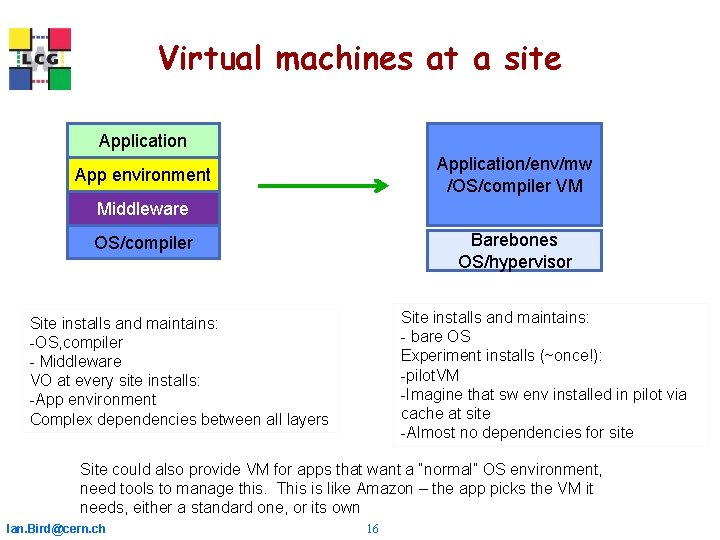
Virtual machines at a site Application/env/mw /OS/compiler VM App environment Middleware Barebones OS/hypervisor OS/compiler Site installs and maintains: - bare OS Experiment installs (~once!): -pilot. VM -Imagine that sw env installed in pilot via cache at site -Almost no dependencies for site Site installs and maintains: -OS, compiler - Middleware VO at every site installs: -App environment Complex dependencies between all layers Site could also provide VM for apps that want a “normal” OS environment, need tools to manage this. This is like Amazon – the app picks the VM it needs, either a standard one, or its own Ian. Bird@cern. ch 16
Data management § Mass storage systems: § Still need gridftp, FTS ¨ FTS can benefit from a messaging system ¨ Is gridftp still the best thing? § Management interface to storage systems ¨ Today SRM what lessons can be learned – to simplify and make more robust? § Would like to be able to access data in the same way no matter where: § Can/should we decouple the tape backends from the disk pools § Can we move to a single access protocol? ¨ E. g. Xrootd § But still missing ACLs, (grid-wide) quotas, . . . § Filesystems § Today large scale mountable filesystems are becoming usable at the scales we need ¨ Lustre, Hadoop, gpfs, NFS 4, etc. Ian. Bird@cern. ch 17
What else is needed? § AAA: § Full environment that we have today (VOMS, Myproxy, etc), support for multi -user pilot jobs, etc. must be kept. . . and developed § No/less need for fine grained policy negotiation with sites (e. g. Changing shares)? § But should probably address cost of using authn/authz – e. g. Session re-use etc. § Information system § But becomes thinner and no need for 2 min updates as no longer needed for matchmaking etc. § Needed mainly for service discovery and reporting/accounting § GLUE is good description based on 5 years experience § Monitoring systems § Are needed – and need to continue to be well developed § Using industrial messaging systems as transport layer § Nagios v. good example of use of Open Source § Databases – with good grid/remote interfaces § Could Ian. Bird@cern. ch mean that e. g. LFC could be directly Oracle etc 18
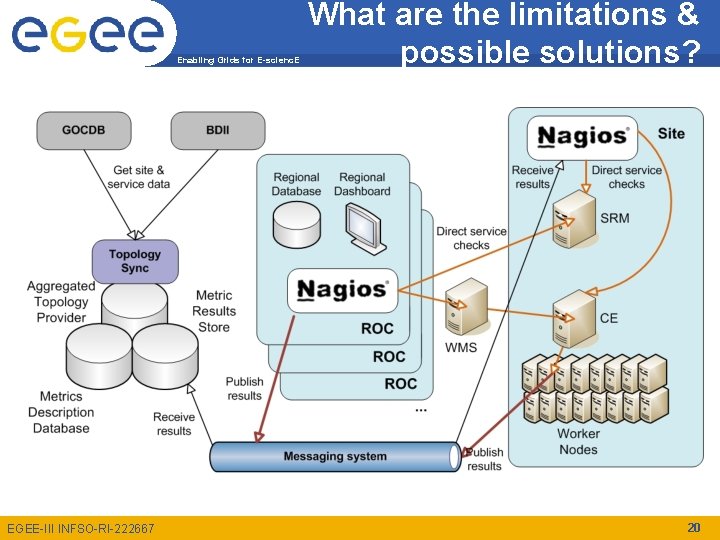
Building distributed systems § Web services have not really delivered what was promised § Unless you use only Microsoft, or only Java, etc. § Tools to support our environment (like gsoap) have not matured (or available) § Interconnecting systems in the real world is done today with messaging systems § Allows to decouple distributed services in a real way § The work done in monitoring with Active. MQ shows that this is a realistic mechanism §. . . And there are many potential applications of such a system § And we don’t have to develop it § It is asynchronous. . . But so is most of what we do Ian. Bird@cern. ch 19
Enabling Grids for E-scienc. E EGEE-III INFSO-RI-222667 What are the limitations & possible solutions? 20
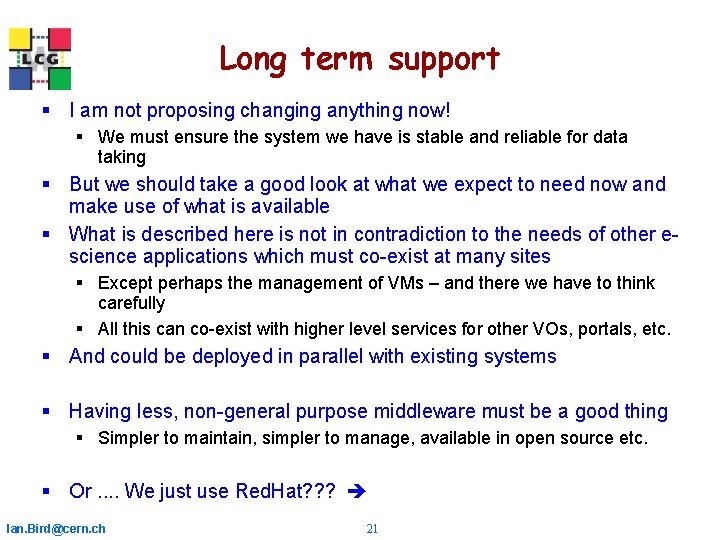
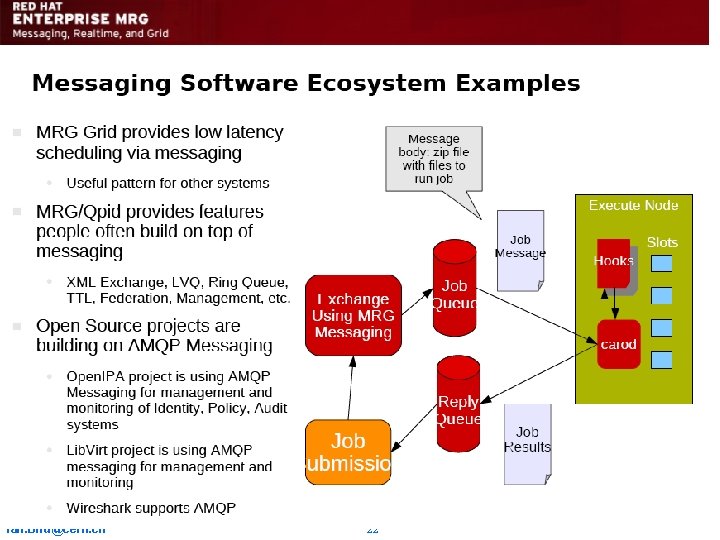
Long term support § I am not proposing changing anything now! § We must ensure the system we have is stable and reliable for data taking § But we should take a good look at what we expect to need now and make use of what is available § What is described here is not in contradiction to the needs of other escience applications which must co-exist at many sites § Except perhaps the management of VMs – and there we have to think carefully § All this can co-exist with higher level services for other VOs, portals, etc. § And could be deployed in parallel with existing systems § Having less, non-general purpose middleware must be a good thing § Simpler to maintain, simpler to manage, available in open source etc. § Or. . We just use Red. Hat? ? ? Ian. Bird@cern. ch 21
Ian. Bird@cern. ch 22
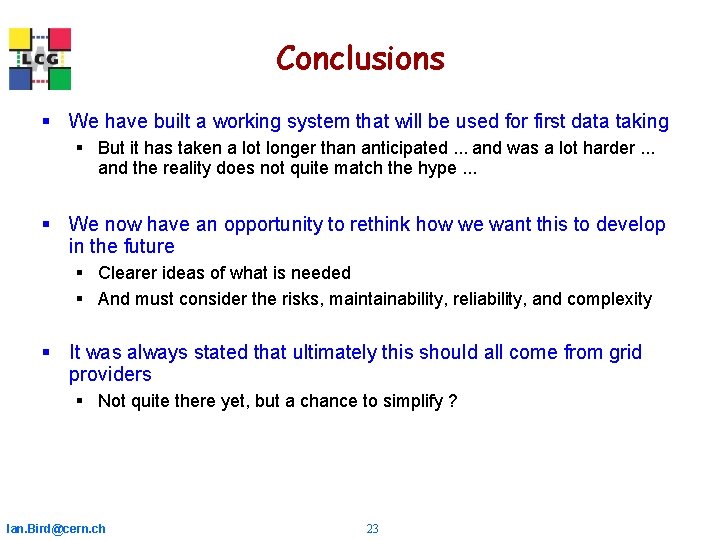
Conclusions § We have built a working system that will be used for first data taking § But it has taken a lot longer than anticipated. . . and was a lot harder. . . and the reality does not quite match the hype. . . § We now have an opportunity to rethink how we want this to develop in the future § Clearer ideas of what is needed § And must consider the risks, maintainability, reliability, and complexity § It was always stated that ultimately this should all come from grid providers § Not quite there yet, but a chance to simplify ? Ian. Bird@cern. ch 23