
GREN Map HighLevel Design Proposal Ryan Davies Software


- Slides: 13
GREN Map: High-Level Design Proposal Ryan Davies, Software Developer | Oct 1, 2019 canarie. ca | @canarie_inc
Objective > Design a system to gather, store, and consolidate data representing the GREN network • …with a minimum of repetitive, onerous work • …for the purpose of visualizing it canarie. ca | @canarie_inc 2
Challenges > Core problem: distributed data from hundreds of sources • highly-variable source formats, e. g. ─ ─ ─ highly-curated databases Ansible configurations spreadsheets human memory etc. • highly-variable source data definitions, classifications, identification, availability • multiple sources may report shared network infrastructure, resulting in duplication • data expiry • data not published > Work to collect and collate is onerous, and repeated by many actors many times. canarie. ca | @canarie_inc 3
Peer Projects > There is no current implementation that captures the entire GREN in a dynamic visualization. > Investigate parallel projects • Collaborate and harmonize efforts • However, the GREN map project has unique needs, as identified by our requirements gathering exercise canarie. ca | @canarie_inc 4
Proposed Solution > Federate data collection and curation via a flexible module that: • ingests from various sources into a common schema • cleans & integrates each import with other sources, if applicable • allows manual curation after ingestion • exports to a common format (GRENML) • registers remote sources, if applicable, and polls routinely for fresh data (“pull” paradigm) • logs all activity, for monitoring, debugging, and security > Once the above has been done, a reference visualization may be built upon any level of data in the hierarchy (most notably the top level). canarie. ca | @canarie_inc 5
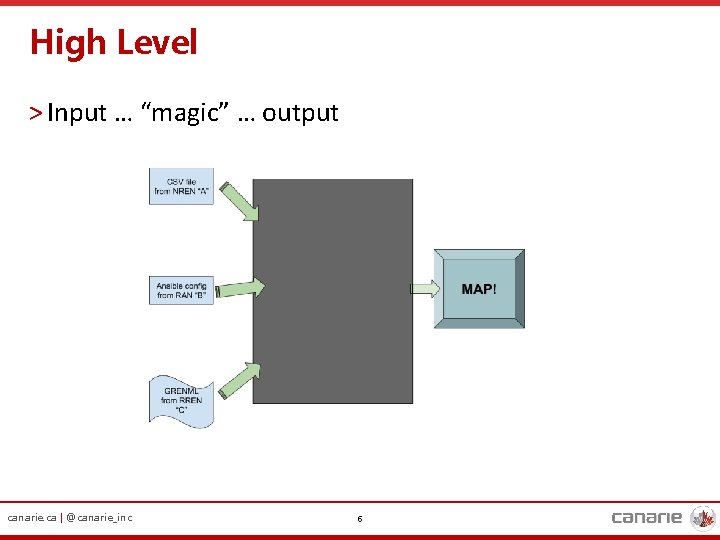
High Level > Input … “magic” … output canarie. ca | @canarie_inc 6
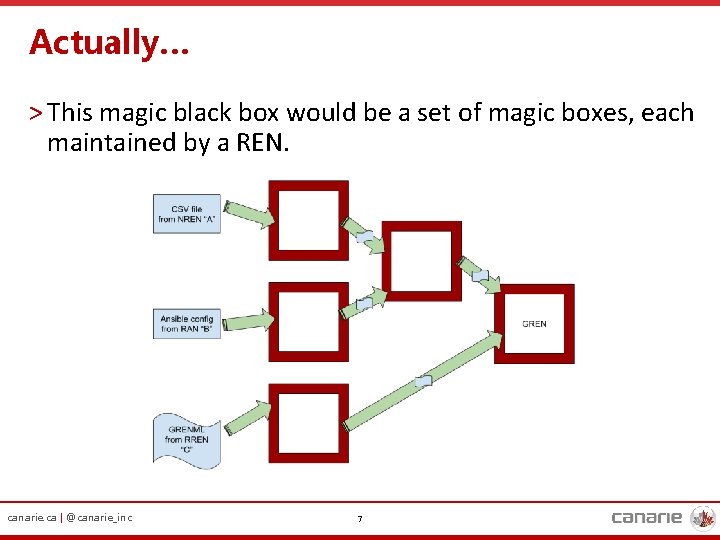
Actually… > This magic black box would be a set of magic boxes, each maintained by a REN. canarie. ca | @canarie_inc 7
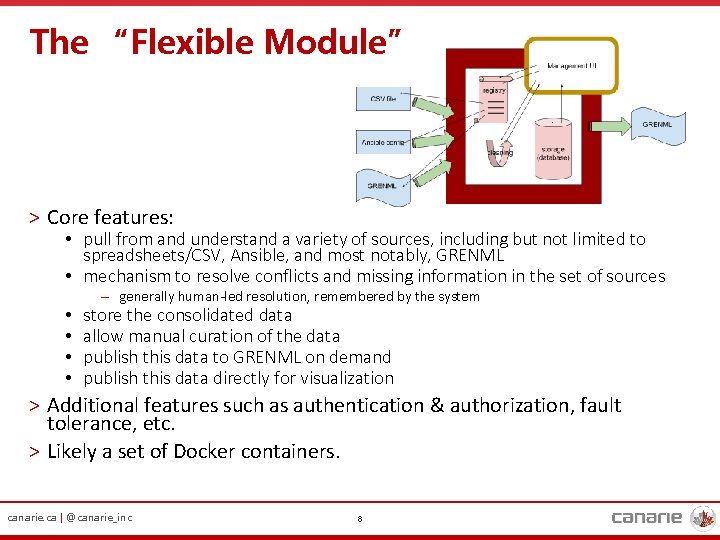
The “Flexible Module” > Core features: • pull from and understand a variety of sources, including but not limited to spreadsheets/CSV, Ansible, and most notably, GRENML • mechanism to resolve conflicts and missing information in the set of sources • • ─ generally human-led resolution, remembered by the system store the consolidated data allow manual curation of the data publish this data to GRENML on demand publish this data directly for visualization > Additional features such as authentication & authorization, fault tolerance, etc. > Likely a set of Docker containers. canarie. ca | @canarie_inc 8
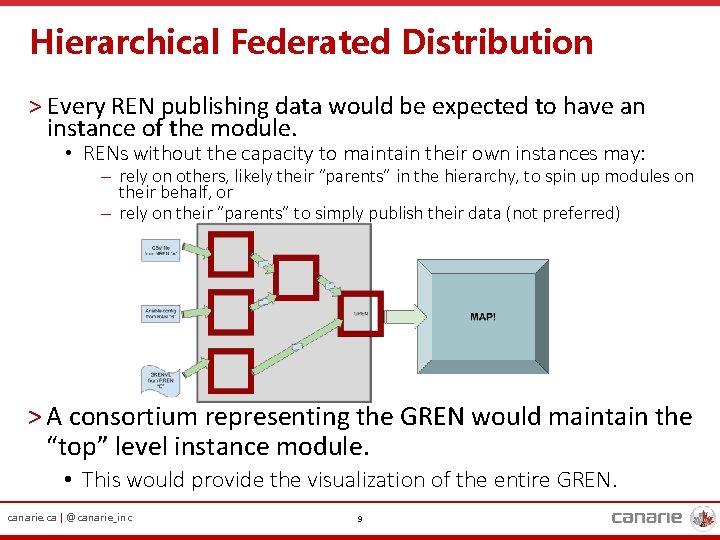
Hierarchical Federated Distribution > Every REN publishing data would be expected to have an instance of the module. • RENs without the capacity to maintain their own instances may: ─ rely on others, likely their “parents” in the hierarchy, to spin up modules on their behalf, or ─ rely on their “parents” to simply publish their data (not preferred) > A consortium representing the GREN would maintain the “top” level instance module. • This would provide the visualization of the entire GREN. canarie. ca | @canarie_inc 9
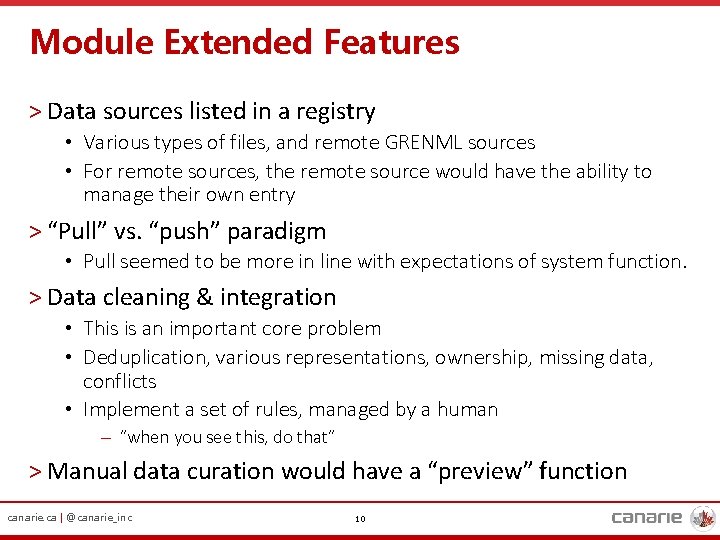
Module Extended Features > Data sources listed in a registry • Various types of files, and remote GRENML sources • For remote sources, the remote source would have the ability to manage their own entry > “Pull” vs. “push” paradigm • Pull seemed to be more in line with expectations of system function. > Data cleaning & integration • This is an important core problem • Deduplication, various representations, ownership, missing data, conflicts • Implement a set of rules, managed by a human ─ “when you see this, do that” > Manual data curation would have a “preview” function canarie. ca | @canarie_inc 10
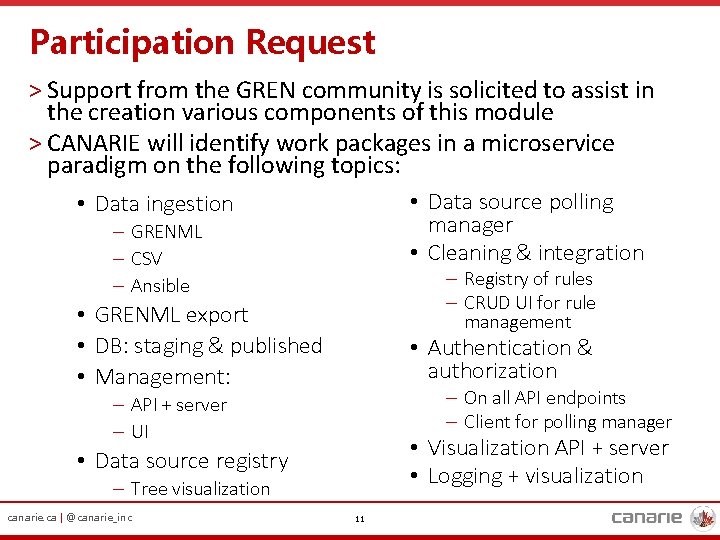
Participation Request > Support from the GREN community is solicited to assist in the creation various components of this module > CANARIE will identify work packages in a microservice paradigm on the following topics: • Data source polling manager • Cleaning & integration • Data ingestion ─ GRENML ─ CSV ─ Ansible ─ Registry of rules ─ CRUD UI for rule management • GRENML export • DB: staging & published • Management: • Authentication & authorization ─ On all API endpoints ─ Client for polling manager ─ API + server ─ UI • Visualization API + server • Logging + visualization • Data source registry ─ Tree visualization canarie. ca | @canarie_inc 11
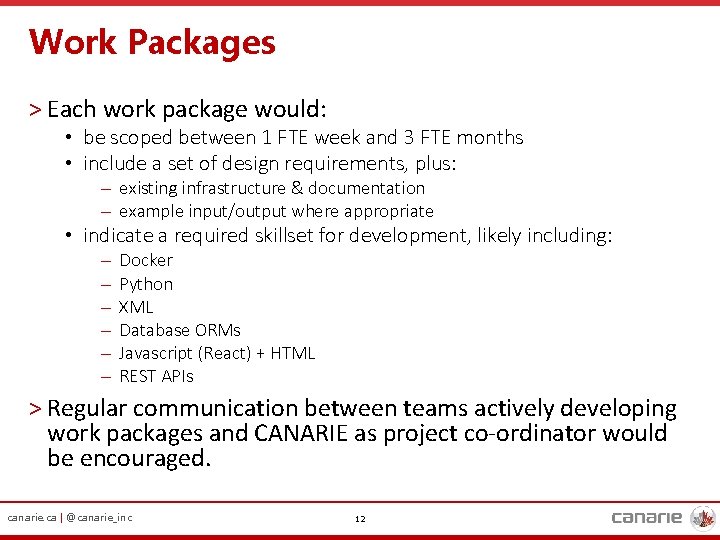
Work Packages > Each work package would: • be scoped between 1 FTE week and 3 FTE months • include a set of design requirements, plus: ─ existing infrastructure & documentation ─ example input/output where appropriate • indicate a required skillset for development, likely including: ─ ─ ─ Docker Python XML Database ORMs Javascript (React) + HTML REST APIs > Regular communication between teams actively developing work packages and CANARIE as project co-ordinator would be encouraged. canarie. ca | @canarie_inc 12
canarie. ca | @canarie_inc