
Greening Plastics Modifying plastics with functional additives based
Greening Plastics: Modifying plastics with functional additives based on condensed tannin esters Warren Grigsby Jamie Bridson, Cole Lomas Carmen Schrade and Jaime-Anne Elliot warren. grigsby@scionresearch. com
Overview ¡ Highlights of a greater study evaluating tannin esters in plastics ¡ Introduction l ¡ Tannins & plastic additives Tannin esters in plastics l l Filler v compatible, active ingredient Providing functional equivalence ¡ Specific performance
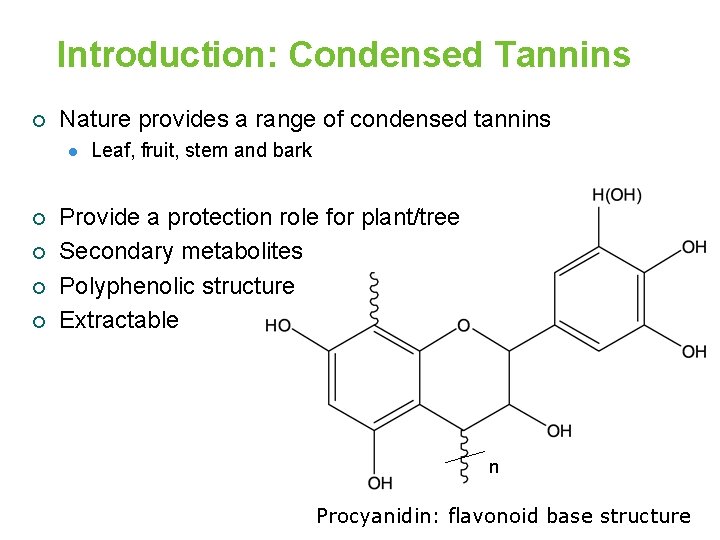
Introduction: Condensed Tannins ¡ Nature provides a range of condensed tannins l ¡ ¡ Leaf, fruit, stem and bark Provide a protection role for plant/tree Secondary metabolites Polyphenolic structure Extractable n Procyanidin: flavonoid base structure
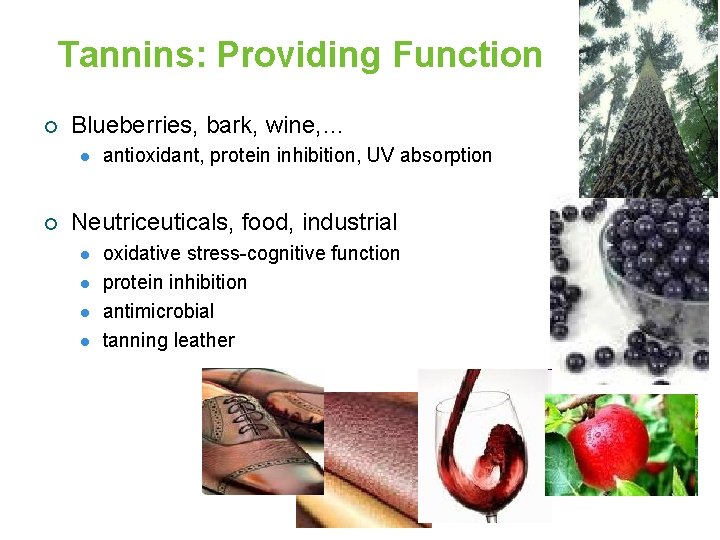
Tannins: Providing Function ¡ Blueberries, bark, wine, … l ¡ antioxidant, protein inhibition, UV absorption Neutriceuticals, food, industrial l l oxidative stress-cognitive function protein inhibition antimicrobial tanning leather
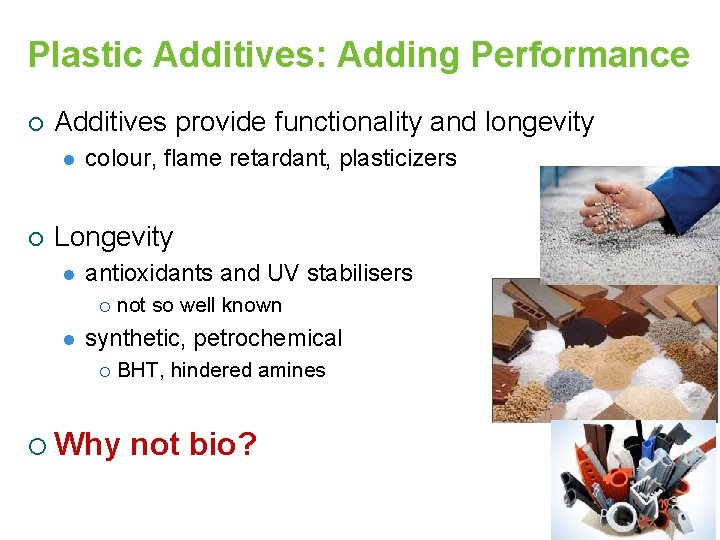
Plastic Additives: Adding Performance ¡ Additives provide functionality and longevity l ¡ colour, flame retardant, plasticizers Longevity l antioxidants and UV stabilisers ¡ l not so well known synthetic, petrochemical ¡ BHT, hindered amines ¡ Why not bio?
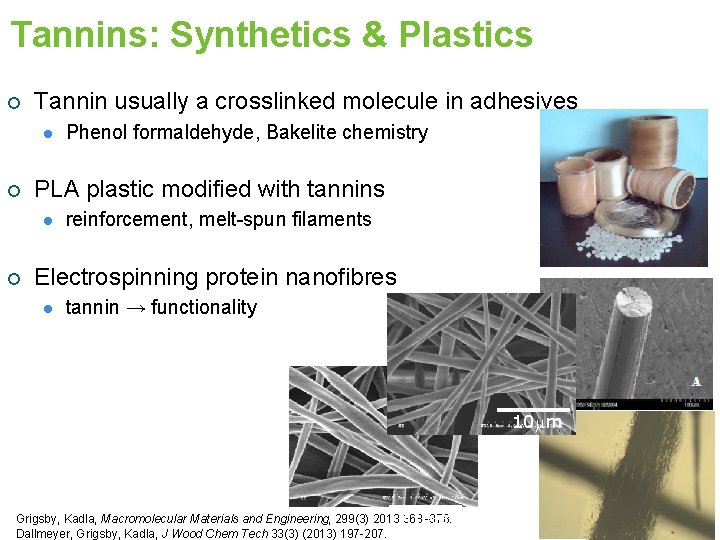
Tannins: Synthetics & Plastics ¡ Tannin usually a crosslinked molecule in adhesives l ¡ PLA plastic modified with tannins l ¡ Phenol formaldehyde, Bakelite chemistry reinforcement, melt-spun filaments Electrospinning protein nanofibres l tannin → functionality 10 m Grigsby, Kadla, Macromolecular Materials and Engineering, 299(3) 2013 368– 378. 10 m Dallmeyer, Grigsby, Kadla, J Wood Chem Tech 33(3) (2013) 197 -207.
Aims & Goals ¡ Can functionality a tree uses be applied to plastics? Hypothesis ¡ Tannin efficacy in bark can be applied to protect plastics from oxidative aging and UV-induced degradation ¡ Evaluate tannins as bio-sourced plastic additives
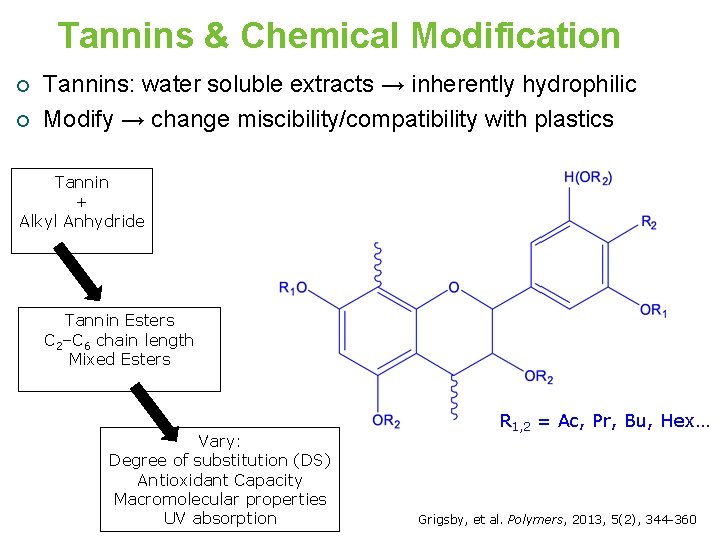
Tannins & Chemical Modification ¡ ¡ Tannins: water soluble extracts → inherently hydrophilic Modify → change miscibility/compatibility with plastics Tannin + Alkyl Anhydride Tannin Esters C 2–C 6 chain length Mixed Esters Vary: Degree of substitution (DS) Antioxidant Capacity Macromolecular properties UV absorption R 1, 2 = Ac, Pr, Bu, Hex… Grigsby, et al. Polymers, 2013, 5(2), 344 -360
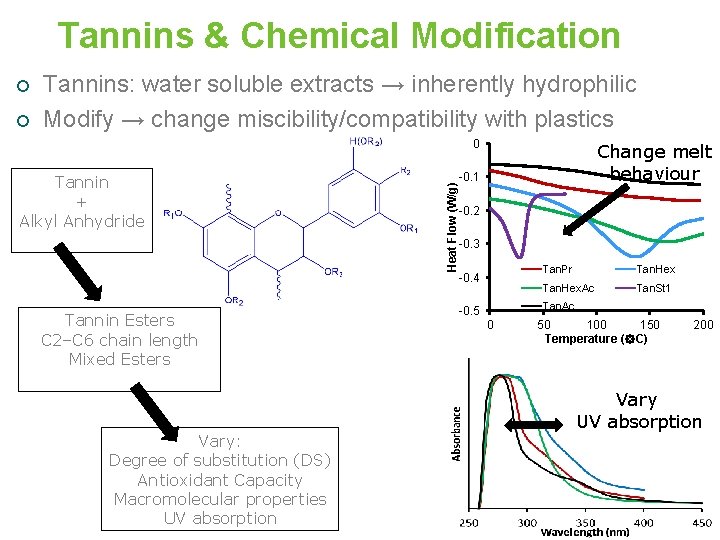
Tannins & Chemical Modification ¡ ¡ Tannins: water soluble extracts → inherently hydrophilic Modify → change miscibility/compatibility with plastics Tannin + Alkyl Anhydride Tannin Esters C 2–C 6 chain length Mixed Esters Vary: Degree of substitution (DS) Antioxidant Capacity Macromolecular properties UV absorption Heat Flow (W/g) 0 Change melt behaviour -0. 1 -0. 2 -0. 3 -0. 4 Tan. Pr Tan. Hex. Ac Tan. St 1 Tan. Ac -0. 5 0 50 100 150 Temperature ( C) 200 Vary UV absorption
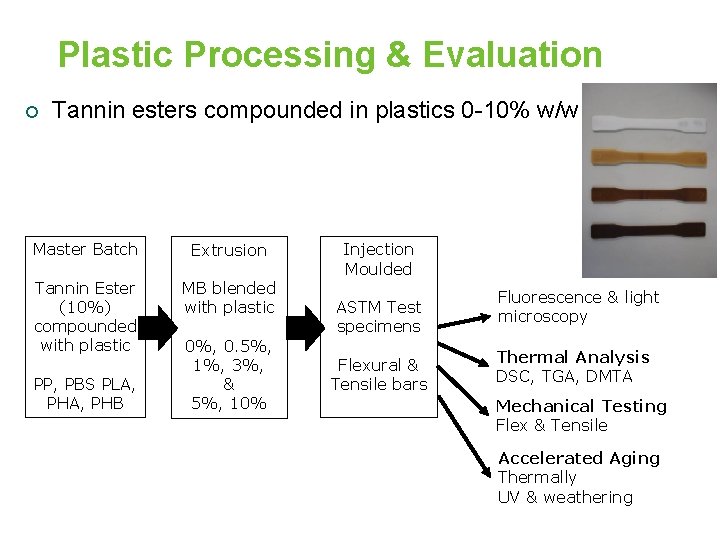
Plastic Processing & Evaluation ¡ Tannin esters compounded in plastics 0 -10% w/w Master Batch Extrusion Tannin Ester (10%) compounded with plastic MB blended with plastic PP, PBS PLA, PHB 0%, 0. 5%, 1%, 3%, & 5%, 10% Injection Moulded ASTM Test specimens Flexural & Tensile bars Fluorescence & light microscopy Thermal Analysis DSC, TGA, DMTA Mechanical Testing Flex & Tensile Accelerated Aging Thermally UV & weathering
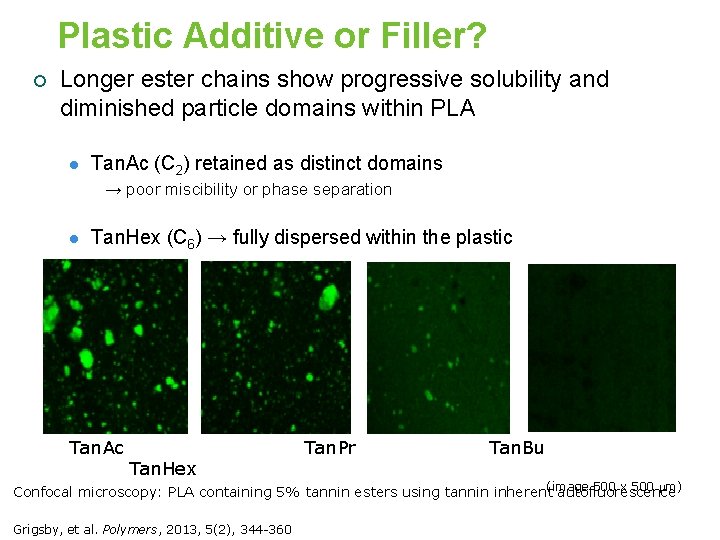
Plastic Additive or Filler? ¡ Longer ester chains show progressive solubility and diminished particle domains within PLA l Tan. Ac (C 2) retained as distinct domains → poor miscibility or phase separation l Tan. Hex (C 6) → fully dispersed within the plastic Tan. Ac Tan. Hex Tan. Pr Tan. Bu 500 x 500 m) Confocal microscopy: PLA containing 5% tannin esters using tannin inherent(image autofluorescence Grigsby, et al. Polymers, 2013, 5(2), 344 -360
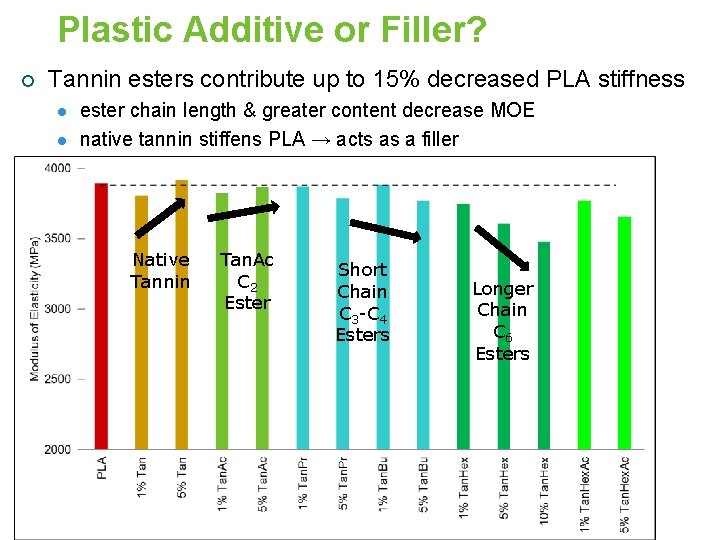
Plastic Additive or Filler? ¡ Tannin esters contribute up to 15% decreased PLA stiffness l l ester chain length & greater content decrease MOE native tannin stiffens PLA → acts as a filler Native Tannin Tan. Ac C 2 Ester Short Chain C 3 -C 4 Esters Longer Chain C 6 Esters
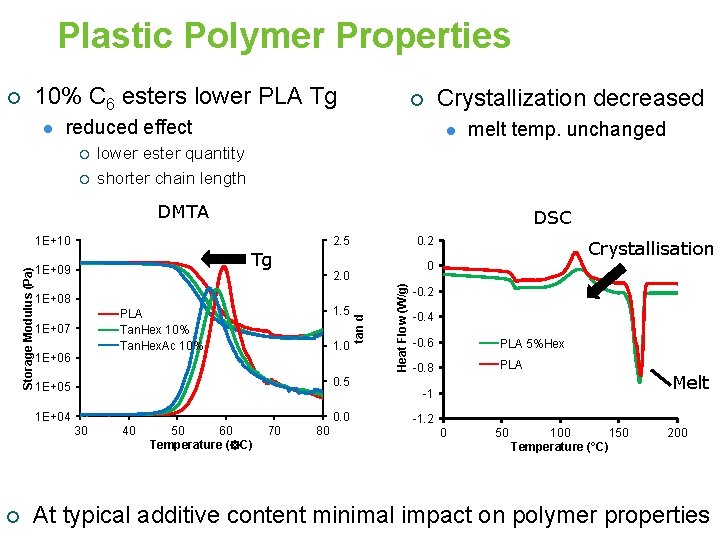
Plastic Polymer Properties ¡ 10% C 6 esters lower PLA Tg l Crystallization decreased ¡ reduced effect ¡ ¡ l melt temp. unchanged lower ester quantity shorter chain length DMTA DSC 2. 5 Tg 1 E+08 1. 5 PLA Tan. Hex 10% Tan. Hex. Ac 10% 1 E+07 1 E+06 1. 0 0. 5 1 E+04 0. 0 30 ¡ 40 50 60 Temperature ( C) 70 80 Crystallisation 0 2. 0 Heat Flow (W/g) 1 E+09 0. 2 tan d Storage Modulus (Pa) 1 E+10 -0. 2 -0. 4 -0. 6 PLA 5%Hex -0. 8 PLA -1 Melt -1. 2 0 50 100 150 Temperature (°C) 200 At typical additive content minimal impact on polymer properties
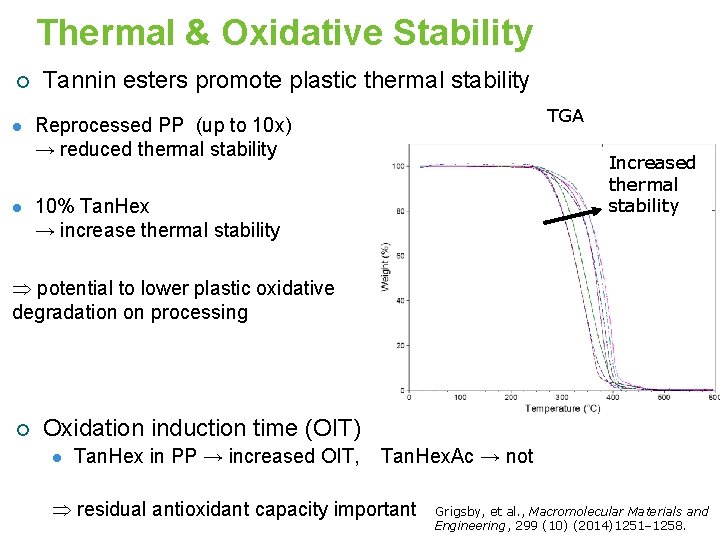
Thermal & Oxidative Stability ¡ l l Tannin esters promote plastic thermal stability TGA Reprocessed PP (up to 10 x) → reduced thermal stability Increased thermal stability 10% Tan. Hex → increase thermal stability potential to lower plastic oxidative degradation on processing ¡ Oxidation induction time (OIT) l Tan. Hex in PP → increased OIT, Tan. Hex. Ac → not residual antioxidant capacity important Grigsby, et al. , Macromolecular Materials and Engineering, 299 (10) (2014)1251– 1258.
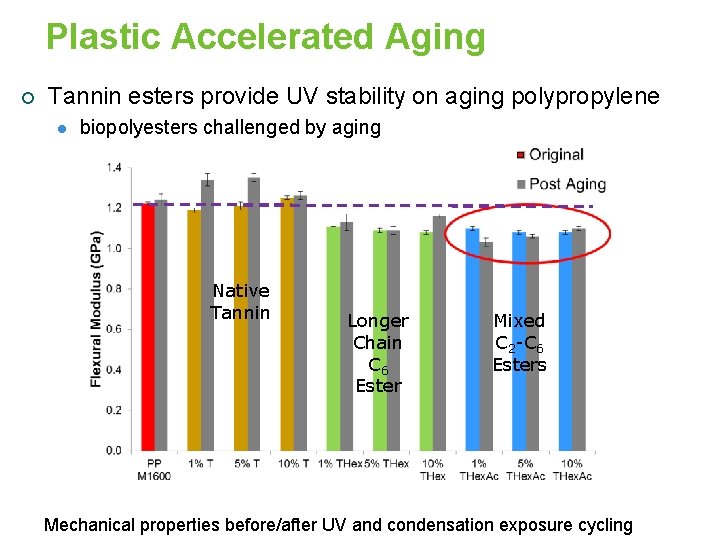
Plastic Accelerated Aging ¡ Tannin esters provide UV stability on aging polypropylene l biopolyesters challenged by aging Native Tannin Longer Chain C 6 Ester Mixed C 2 -C 6 Esters Mechanical properties before/after UV and condensation exposure cycling
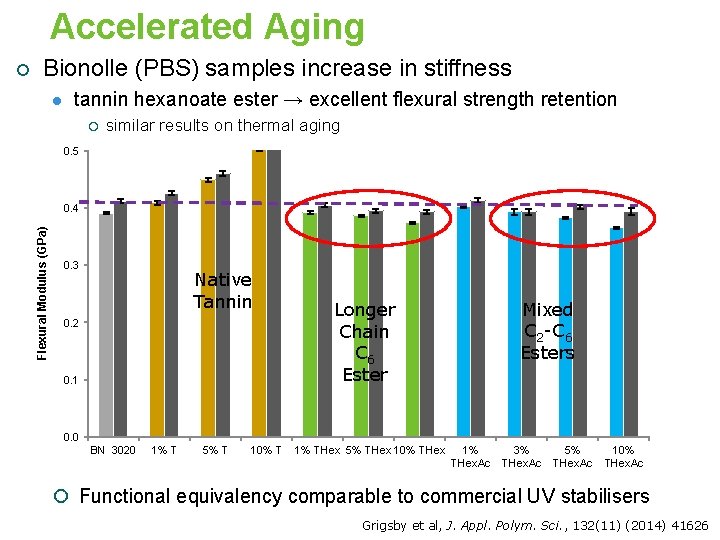
Accelerated Aging Bionolle (PBS) samples increase in stiffness l tannin hexanoate ester → excellent flexural strength retention ¡ similar results on thermal aging 0. 5 0. 4 Flexural Modulus (GPa) ¡ 0. 3 Native Tannin 0. 2 0. 1 Mixed C 2 -C 6 Esters Longer Chain C 6 Ester 0. 0 BN 3020 1% T 5% T 10% T 1% THex 5% THex 10% THex 1% THex. Ac 3% THex. Ac 5% THex. Ac 10% THex. Ac ¡ Functional equivalency comparable to commercial UV stabilisers Grigsby et al, J. Appl. Polym. Sci. , 132(11) (2014) 41626
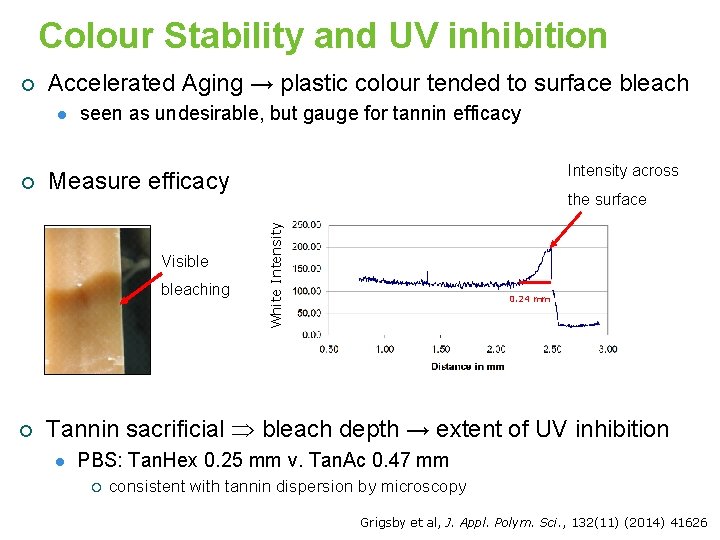
Colour Stability and UV inhibition Accelerated Aging → plastic colour tended to surface bleach l ¡ seen as undesirable, but gauge for tannin efficacy Measure efficacy Visible bleaching ¡ Intensity across the surface White Intensity ¡ 0. 24 mm Tannin sacrificial bleach depth → extent of UV inhibition l PBS: Tan. Hex 0. 25 mm v. Tan. Ac 0. 47 mm ¡ consistent with tannin dispersion by microscopy Grigsby et al, J. Appl. Polym. Sci. , 132(11) (2014) 41626
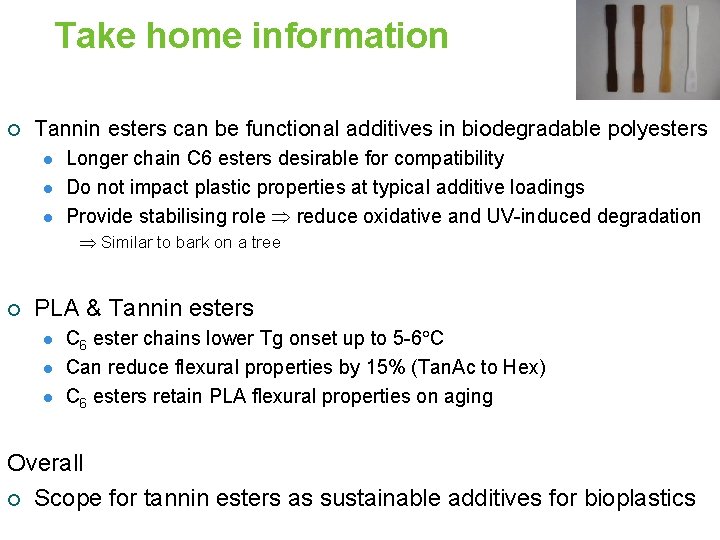
Take home information ¡ Tannin esters can be functional additives in biodegradable polyesters l l l Longer chain C 6 esters desirable for compatibility Do not impact plastic properties at typical additive loadings Provide stabilising role reduce oxidative and UV-induced degradation Similar to bark on a tree ¡ PLA & Tannin esters l l l C 6 ester chains lower Tg onset up to 5 -6 C Can reduce flexural properties by 15% (Tan. Ac to Hex) C 6 esters retain PLA flexural properties on aging Overall ¡ Scope for tannin esters as sustainable additives for bioplastics

Acknowledgements ¡ This work was supported by Biopolymer Network Ltd l Funding through New Zealand Ministry of Business, Innovation and Employment. ¡ Jamie Bridson, Cole Lomas and Jaime Elliot are grateful for studentships provided by Scion through BSc(Tech) placements with the University of Waikato (NZ) ¡ Carmen Schrade (MSc thesis) is grateful to assistance provided by Department of Applied Chemistry, Reutlingen University (Germany)

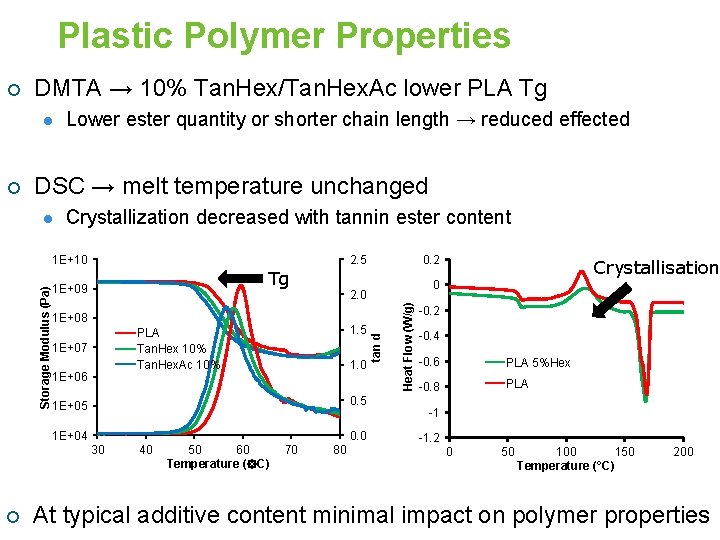
Plastic Polymer Properties DMTA → 10% Tan. Hex/Tan. Hex. Ac lower PLA Tg l DSC → melt temperature unchanged l Crystallization decreased with tannin ester content Storage Modulus (Pa) 1 E+10 2. 5 Tg 1 E+09 1 E+06 1. 0 1 E+05 0. 5 1 E+04 0. 0 30 ¡ 1. 5 PLA Tan. Hex 10% Tan. Hex. Ac 10% 40 50 60 Temperature ( C) 70 80 Crystallisation 0 2. 0 1 E+08 1 E+07 0. 2 Heat Flow (W/g) ¡ Lower ester quantity or shorter chain length → reduced effected tan d ¡ -0. 2 -0. 4 -0. 6 PLA 5%Hex -0. 8 PLA -1 -1. 2 0 50 100 150 Temperature (°C) 200 At typical additive content minimal impact on polymer properties
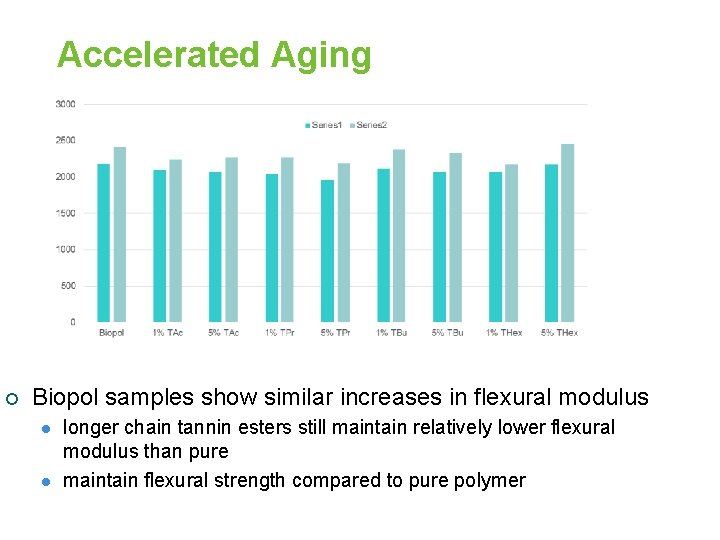
Accelerated Aging ¡ Biopol samples show similar increases in flexural modulus l l longer chain tannin esters still maintain relatively lower flexural modulus than pure maintain flexural strength compared to pure polymer
Tannin Ester Modified Biopolyesters Microscopy: ¡ Hexanoate C 6 chains compatible polyester plastics Mechanical & Polymer Properties ¡ Do not detrimentally impact mechanical properties at loadings up to 5% (w/w) ¡ Do not significantly influence polyester melt or Tg ¡ As plastic additives provide: l l UV stability Antioxidant and thermal stability Dependency on ester chain length, DS and content
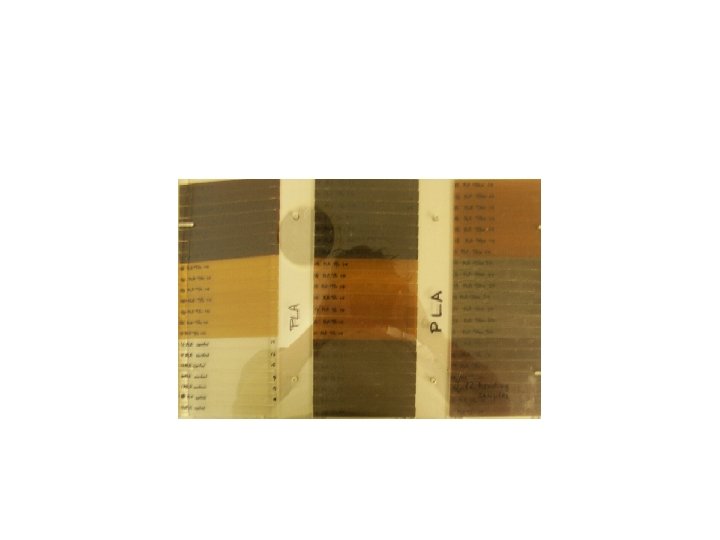
Tannin Ester Modified Biopolyesters ¡ Tannin ester addition contributes colour l l l ¡ white/colourless preferred brown colour → undesirable for some applications ester modification reduces colour Accelerated weathering revealed colour instability surface bleaching by UV light l inherent property of tannins biopolyesters unsuited to exterior conditions l
- Slides: 25