
Greenhouse gasses Solar constant Emissivity Black body radiation
Greenhouse gasses

Solar constant
Emissivity
Black body radiation
Albedo
Greenhouse effect Cause and …
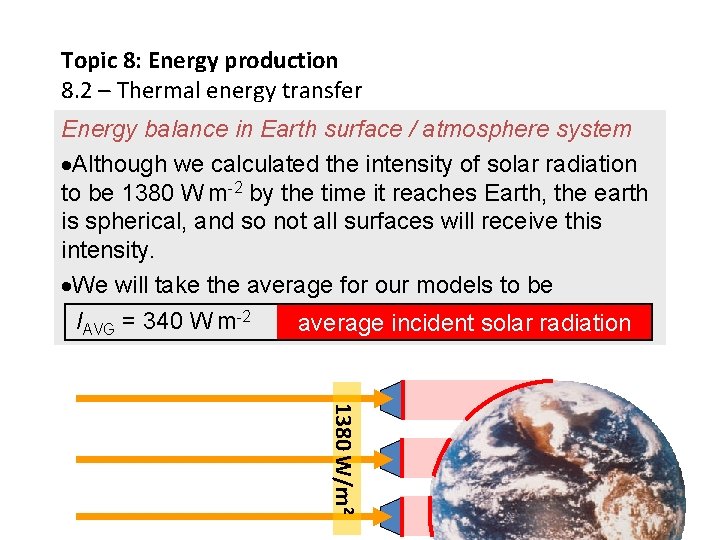
Topic 8: Energy production 8. 2 – Thermal energy transfer Energy balance in Earth surface / atmosphere system Although we calculated the intensity of solar radiation to be 1380 W m-2 by the time it reaches Earth, the earth is spherical, and so not all surfaces will receive this intensity. We will take the average for our models to be IAVG = 340 W m-2 average incident solar radiation 1380 W/m 2
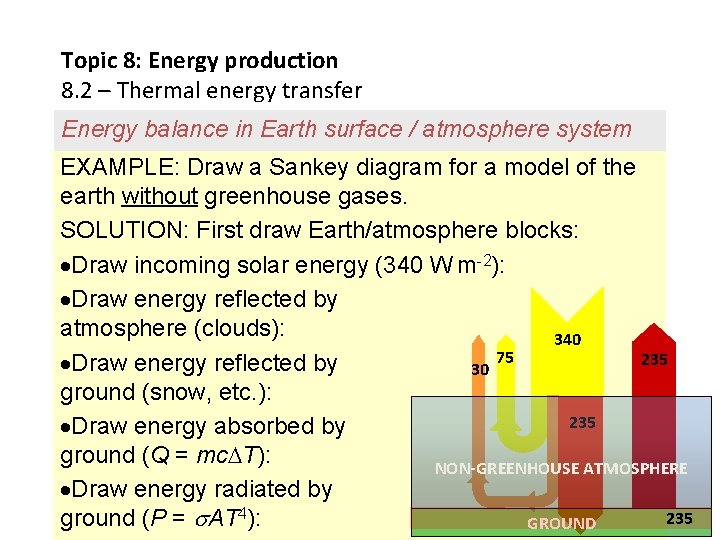
Topic 8: Energy production 8. 2 – Thermal energy transfer Energy balance in Earth surface / atmosphere system EXAMPLE: Draw a Sankey diagram for a model of the earth without greenhouse gases. SOLUTION: First draw Earth/atmosphere blocks: Draw incoming solar energy (340 W m-2): Draw energy reflected by atmosphere (clouds): 340 75 235 Draw energy reflected by 30 ground (snow, etc. ): 235 Draw energy absorbed by ground (Q = mc T): NON-GREENHOUSE ATMOSPHERE Draw energy radiated by 235 ground (P = AT 4): GROUND
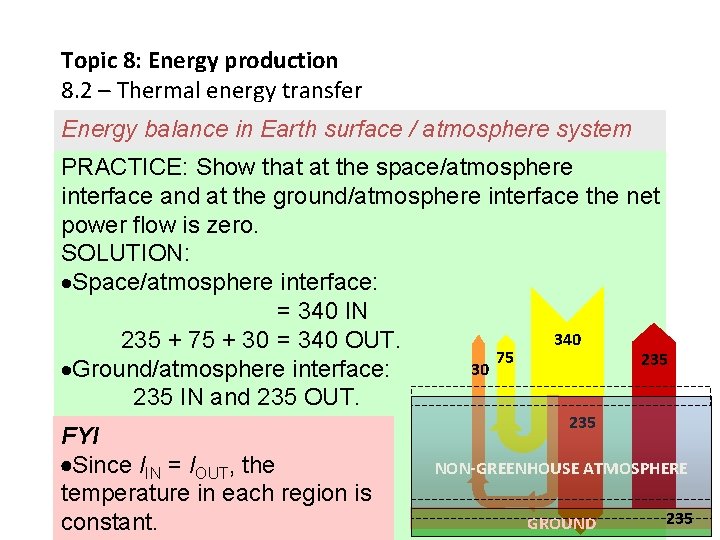
Topic 8: Energy production 8. 2 – Thermal energy transfer Energy balance in Earth surface / atmosphere system PRACTICE: Show that at the space/atmosphere interface and at the ground/atmosphere interface the net power flow is zero. SOLUTION: Space/atmosphere interface: = 340 IN 340 235 + 75 + 30 = 340 OUT. 75 235 30 Ground/atmosphere interface: 235 IN and 235 OUT. FYI Since IIN = IOUT, the temperature in each region is constant. 235 NON-GREENHOUSE ATMOSPHERE GROUND 235
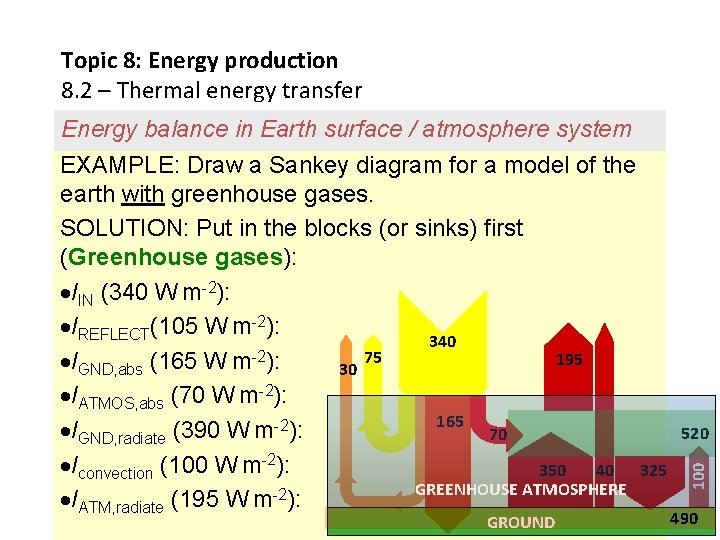
Topic 8: Energy production 8. 2 – Thermal energy transfer GROUND 520 100 Energy balance in Earth surface / atmosphere system EXAMPLE: Draw a Sankey diagram for a model of the earth with greenhouse gases. SOLUTION: Put in the blocks (or sinks) first (Greenhouse gases): IIN (340 W m-2): IREFLECT(105 W m-2): 340 75 195 IGND, abs (165 W m-2): 30 IATMOS, abs (70 W m-2): 165 IGND, radiate (390 W m-2): 70 Iconvection (100 W m-2): 350 40 325 GREENHOUSE ATMOSPHERE IATM, radiate (195 W m-2): 490
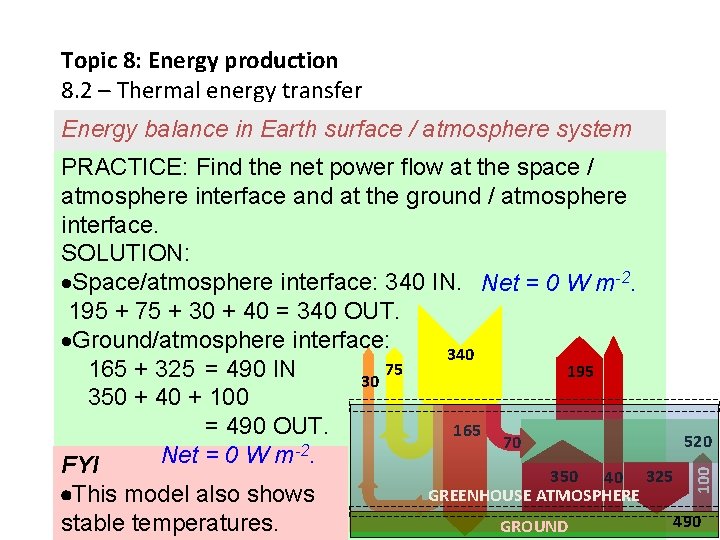
Topic 8: Energy production 8. 2 – Thermal energy transfer Energy balance in Earth surface / atmosphere system This model also shows stable temperatures. 350 40 325 GREENHOUSE ATMOSPHERE GROUND 520 100 PRACTICE: Find the net power flow at the space / atmosphere interface and at the ground / atmosphere interface. SOLUTION: Space/atmosphere interface: 340 IN. Net = 0 W m-2. 195 + 75 + 30 + 40 = 340 OUT. Ground/atmosphere interface: 340 75 165 + 325 = 490 IN 195 30 350 + 40 + 100 = 490 OUT. 165 70 -2. Net = 0 W m FYI 490
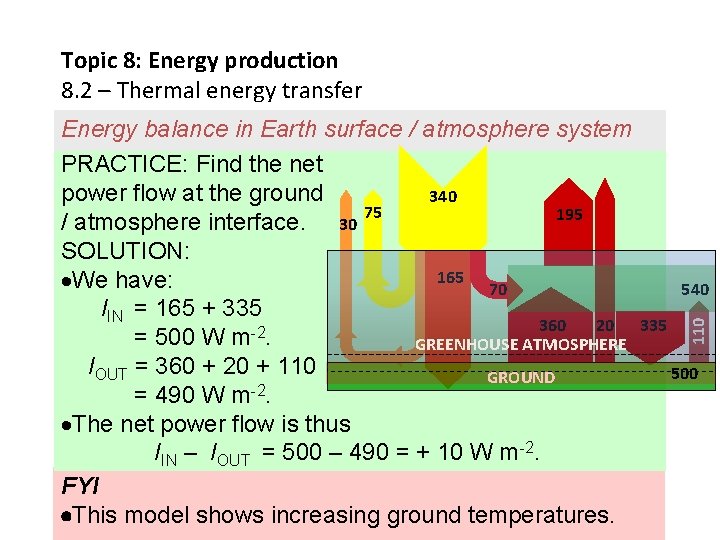
Topic 8: Energy production 8. 2 – Thermal energy transfer 540 335 110 Energy balance in Earth surface / atmosphere system PRACTICE: Find the net power flow at the ground 340 75 195 / atmosphere interface. 30 SOLUTION: 165 We have: 70 IIN = 165 + 335 360 20 -2 = 500 W m. GREENHOUSE ATMOSPHERE IOUT = 360 + 20 + 110 GROUND -2 = 490 W m. The net power flow is thus IIN – IOUT = 500 – 490 = + 10 W m-2. FYI This model shows increasing ground temperatures. 500
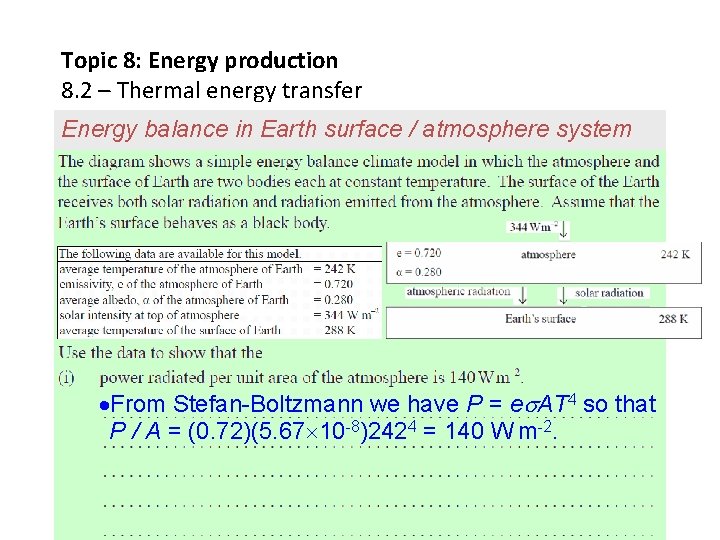
Topic 8: Energy production 8. 2 – Thermal energy transfer Energy balance in Earth surface / atmosphere system From Stefan-Boltzmann we have P = e AT 4 so that P / A = (0. 72)(5. 67 10 -8)2424 = 140 W m-2.
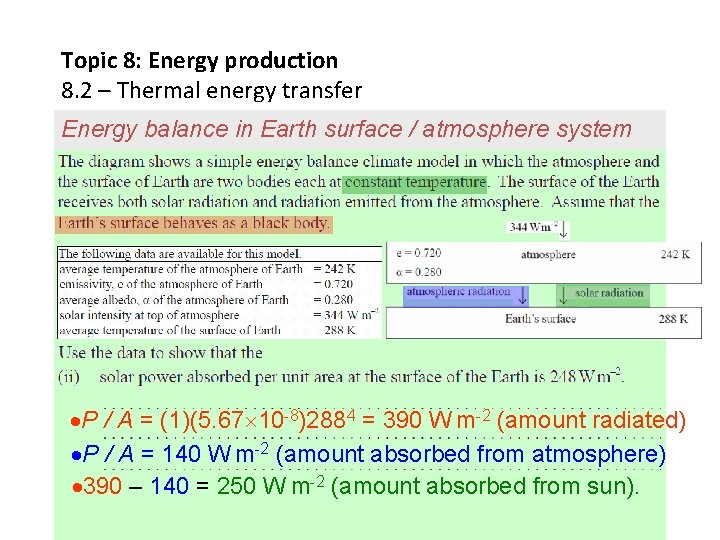
Topic 8: Energy production 8. 2 – Thermal energy transfer Energy balance in Earth surface / atmosphere system P / A = (1)(5. 67 10 -8)2884 = 390 W m-2 (amount radiated) P / A = 140 W m-2 (amount absorbed from atmosphere) 390 – 140 = 250 W m-2 (amount absorbed from sun).
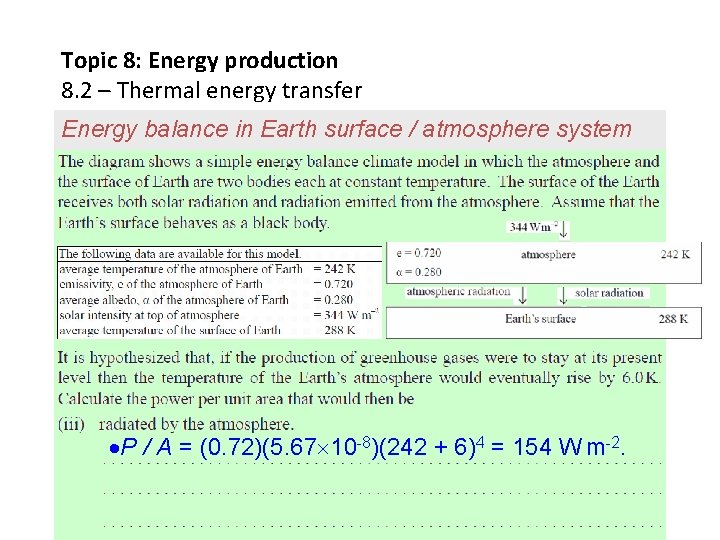
Topic 8: Energy production 8. 2 – Thermal energy transfer Energy balance in Earth surface / atmosphere system P / A = (0. 72)(5. 67 10 -8)(242 + 6)4 = 154 W m-2.
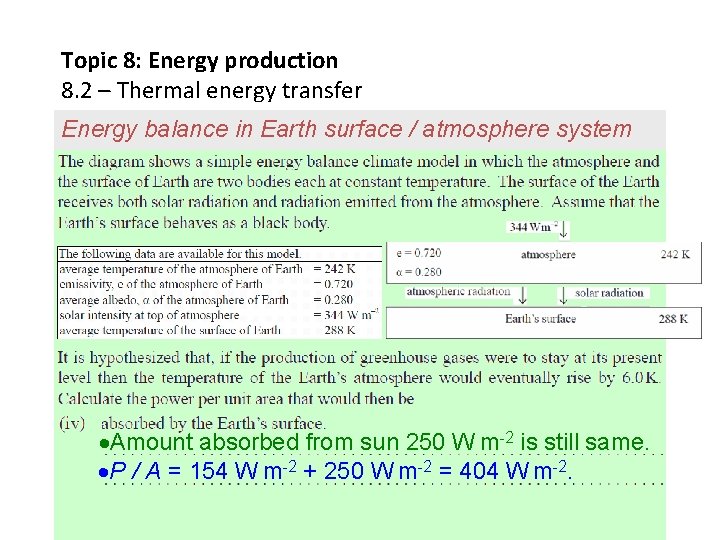
Topic 8: Energy production 8. 2 – Thermal energy transfer Energy balance in Earth surface / atmosphere system Amount absorbed from sun 250 W m-2 is still same. P / A = 154 W m-2 + 250 W m-2 = 404 W m-2.
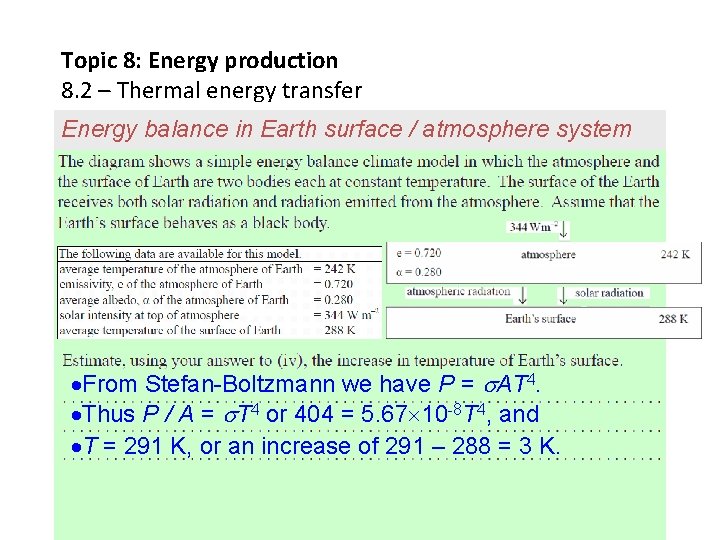
Topic 8: Energy production 8. 2 – Thermal energy transfer Energy balance in Earth surface / atmosphere system From Stefan-Boltzmann we have P = AT 4. Thus P / A = T 4 or 404 = 5. 67 10 -8 T 4, and T = 291 K, or an increase of 291 – 288 = 3 K.
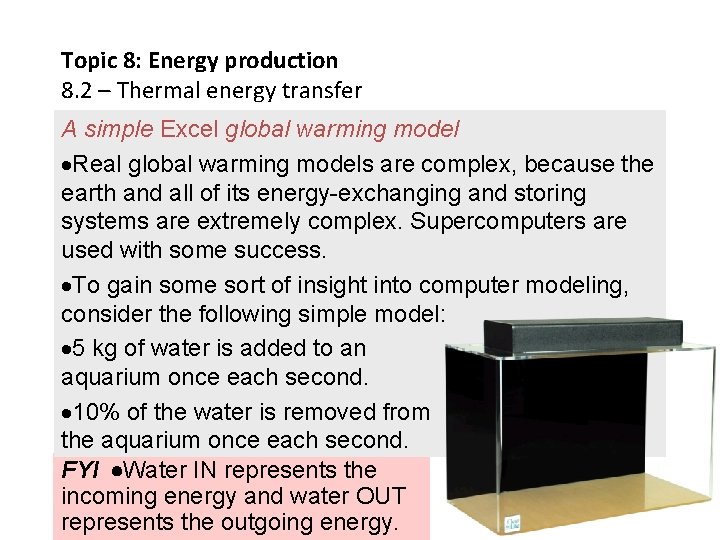
Topic 8: Energy production 8. 2 – Thermal energy transfer A simple Excel global warming model Real global warming models are complex, because the earth and all of its energy-exchanging and storing systems are extremely complex. Supercomputers are used with some success. To gain some sort of insight into computer modeling, consider the following simple model: 5 kg of water is added to an aquarium once each second. 10% of the water is removed from the aquarium once each second. FYI Water IN represents the incoming energy and water OUT represents the outgoing energy.
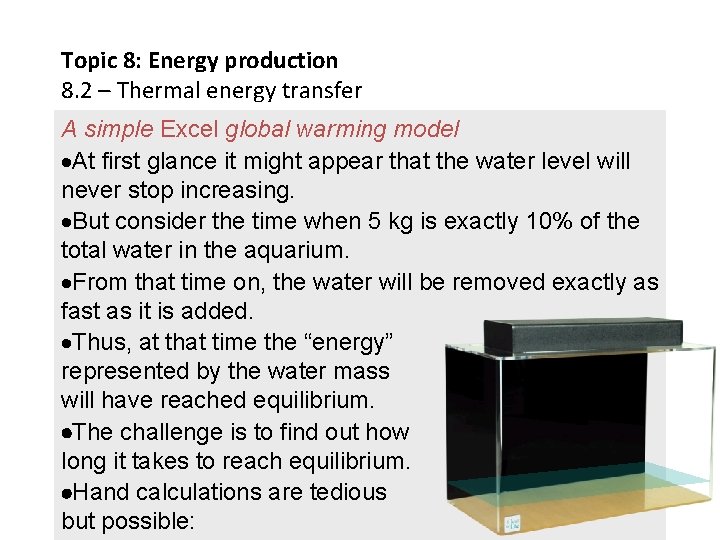
Topic 8: Energy production 8. 2 – Thermal energy transfer A simple Excel global warming model At first glance it might appear that the water level will never stop increasing. But consider the time when 5 kg is exactly 10% of the total water in the aquarium. From that time on, the water will be removed exactly as fast as it is added. Thus, at that time the “energy” represented by the water mass will have reached equilibrium. The challenge is to find out how long it takes to reach equilibrium. Hand calculations are tedious but possible:
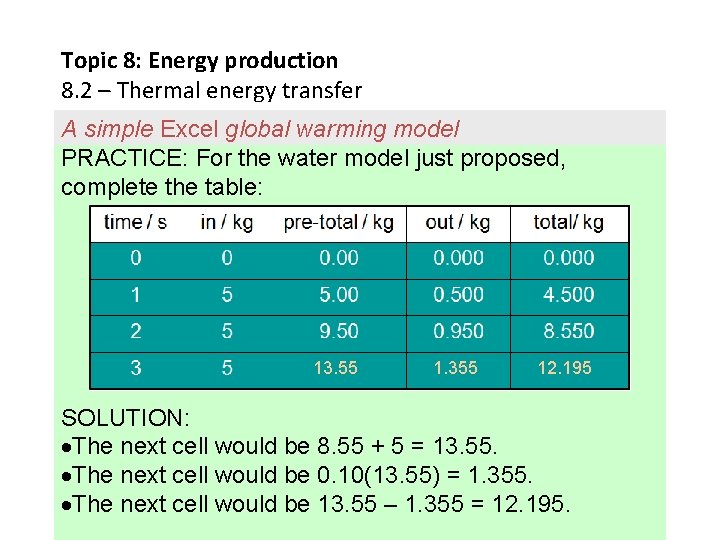
Topic 8: Energy production 8. 2 – Thermal energy transfer A simple Excel global warming model PRACTICE: For the water model just proposed, complete the table: 13. 55 1. 355 12. 195 SOLUTION: The next cell would be 8. 55 + 5 = 13. 55. The next cell would be 0. 10(13. 55) = 1. 355. The next cell would be 13. 55 – 1. 355 = 12. 195.
- Slides: 20