
GREENHOUSE GAS GHG INVENTORY METHODS Terrie Boguski Harmony
GREENHOUSE GAS (GHG) INVENTORY METHODS Terrie Boguski Harmony Environmental, LLC Kansas State University January 2010
What are Greenhouse Gases? �Gases that allow sunlight to enter the atmosphere freely. When sunlight strikes the Earth’s surface, some of it is re-radiated back towards space as infrared radiation (heat). Greenhouse gases absorb this infrared radiation and trap its heat in the atmosphere. �If it were not for naturally occurring greenhouse gases, the Earth would be too cold to support life as we know it.
Greenhouse Gases of Concern �Carbon dioxide (CO 2) �Methane (CH 4) �Nitrous oxide (N 2 O) �Industrial Gases: �Hydrofluorocarbons (HFCs) �Perfluorocarbons (PFCs) �Sulfur hexafluoride (SF 6)
Sources of Greenhouse Gases �United States GHG Inventory � 81% - carbon dioxide from combustion of petroleum, coal, and natural gas � 10% - methane from landfills, coal mines, oil and natural gas operations, and agriculture � 5% - nitrous oxide from use of nitrogen fertilizers, burning fossil fuels, and certain industrial and waste management processes � 2% - hydrofluorocarbons (HFCs), perfluorocarbons (PFCs), and sulfur hexafluoride (SF 6) released as byproducts of industrial processes and through leakage Source: U. S. Energy Information Administration
WHY GHG Inventory? �New EPA regulations requires reporting by certain entities �Some states require reporting by certain entities �Voluntary reduction of GHG emissions �Business advantage or corporate policy
GHG Inventory – the Process �Simple Concept; Complex Execution 1. Decide which Standard or Protocol to follow 2. Set Boundaries 3. Collect Data 4. Perform Calculations 5. Report Results
1. Standards and Protocols �GHG Protocol (WRI/WBCSD) � Corporate Accounting and Reporting Standard � Project Protocol � Product Life Cycle Accounting and Reporting Standard (draft) � Scope 3 Accounting and Reporting Standards (draft) �ISO 14064 (three standards) � Organizational � Projects � Validation and Verification �EPA Climate Leaders Greenhouse Gas (GHG) Inventory Guidance �IPCC National Greenhouse Gas Inventories Programme �Climate Registry Reporting Protocols
1. Standards and Protocols KSU GHG Inventory �American College & University Presidents Climate Commitment (ACUPCC) Reporting Instructions �GHG Protocol Corporate Accounting and Reporting Standard �Climate Registry Reporting Protocols
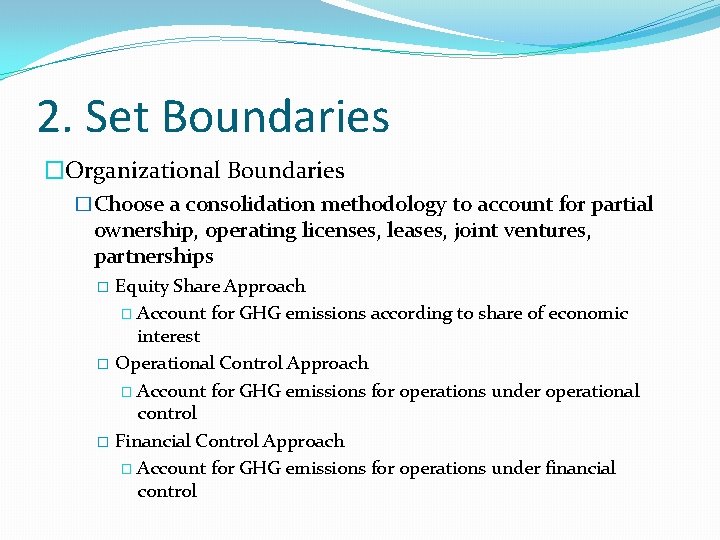
2. Set Boundaries �Organizational Boundaries �Choose a consolidation methodology to account for partial ownership, operating licenses, leases, joint ventures, partnerships Equity Share Approach � Account for GHG emissions according to share of economic interest � Operational Control Approach � Account for GHG emissions for operations under operational control � Financial Control Approach � Account for GHG emissions for operations under financial control �
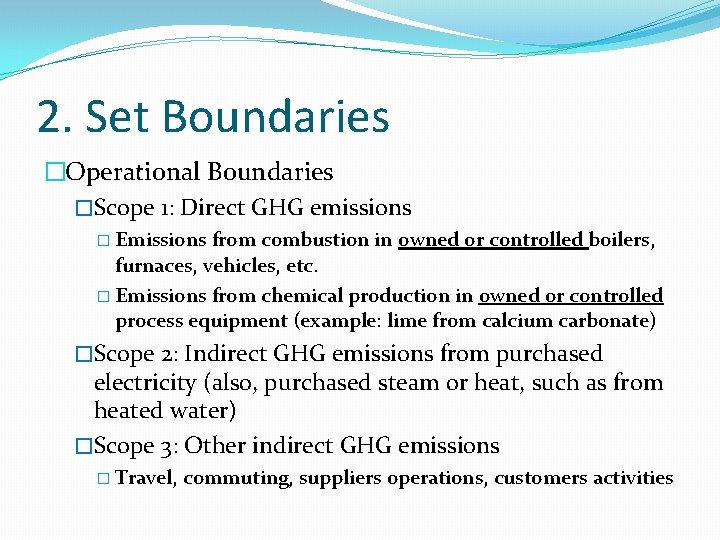
2. Set Boundaries �Operational Boundaries �Scope 1: Direct GHG emissions � Emissions from combustion in owned or controlled boilers, furnaces, vehicles, etc. � Emissions from chemical production in owned or controlled process equipment (example: lime from calcium carbonate) �Scope 2: Indirect GHG emissions from purchased electricity (also, purchased steam or heat, such as from heated water) �Scope 3: Other indirect GHG emissions � Travel, commuting, suppliers operations, customers activities
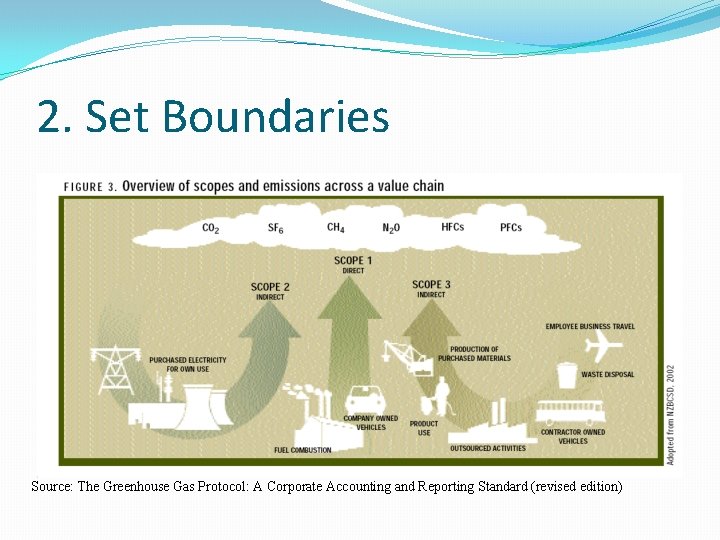
2. Set Boundaries Source: The Greenhouse Gas Protocol: A Corporate Accounting and Reporting Standard (revised edition)
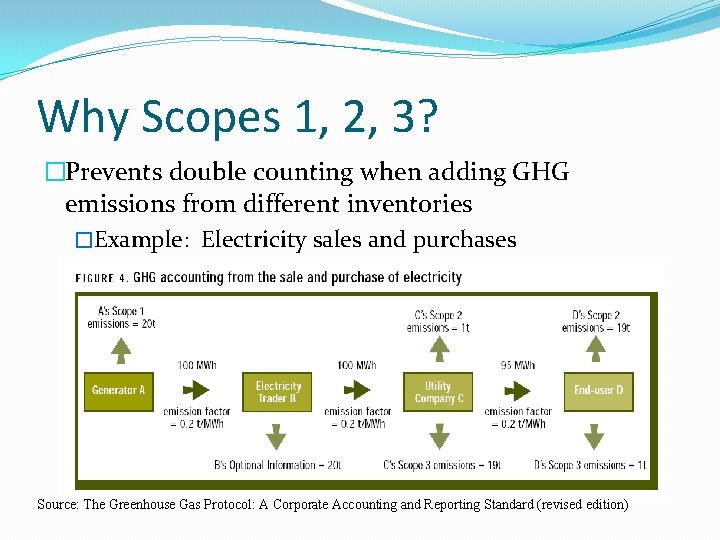
Why Scopes 1, 2, 3? �Prevents double counting when adding GHG emissions from different inventories �Example: Electricity sales and purchases Source: The Greenhouse Gas Protocol: A Corporate Accounting and Reporting Standard (revised edition)
2. Set Boundaries �Temporal Boundaries � 12 -month period is standard practice � Fiscal year is acceptable � Calendar year is required by Climate Registry
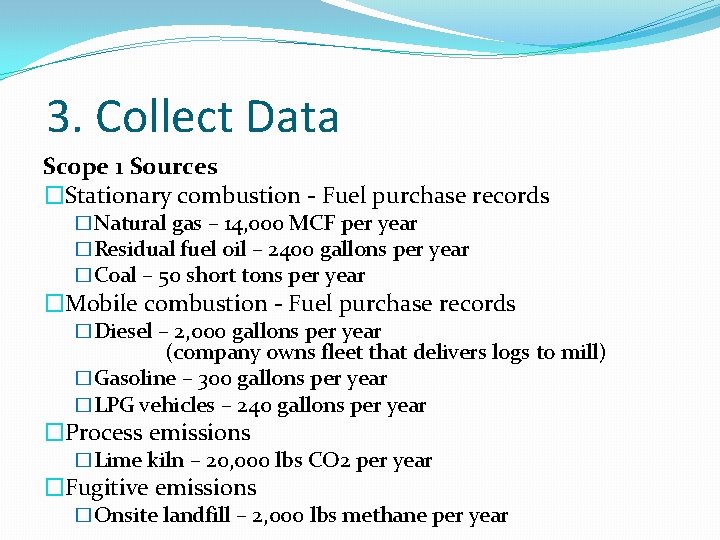
3. Collect Data Scope 1 Sources �Stationary combustion � Boilers, furnaces, heaters, burners, flares, etc. � Fuel purchase records - natural gas, fuel oil, coal �Mobile combustion � Trucks, buses, cars, airplanes, boats, ships, barges, etc. � Fuel purchase records or annual vehicle mileage and type of fuel �Process emissions � Catalytic cracking of petroleum, calcination step in cement manufacture, etc. � Measured or calculated annual emissions; Requires knowledge of process �Fugitive emissions � Equipment leaks, coal piles, onsite wastewater treatment, onsite landfills, etc. � Typically estimated based on knowledge of the source of emissions
3. Collect Data Scope 2 Sources �Purchased electricity, steam, heating, cooling �Utility bills Scope 3 Sources �Air travel �Employee commuting �Solid waste (incineration or decomposition offsite) �Emissions from upstream or downstream of owned or controlled operations (purchased raw materials; use of products sold)

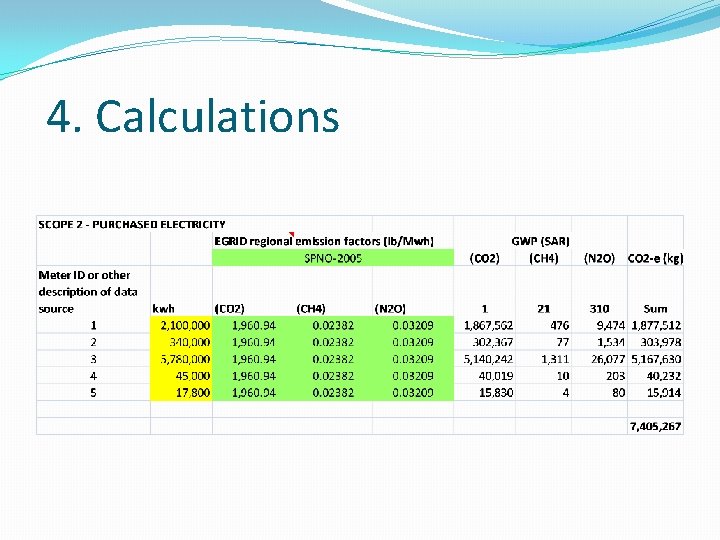
4. Calculations �Goal – calculate total GHG emissions in units of carbon dioxide-equivalents (CO 2 -e) for the processes and activities within the chosen boundaries �CO 2 -e is the measure of the global warming potential (GWP) of a gas compared to carbon dioxide. For example, methane has a GWP of 21. The CO 2 -e measure for 1 kilogram of methane is 21 kg CO 2 -e.
4. Calculations �Choose a Calculation Tool �Clean Air-Cool Planet Campus Carbon Calculator �GHG Protocol Initiative Sector Tool Set �EPA Climate Leaders Tools for Developing an Inventory and Tracking and Reporting Emissions �Proprietary Databases and Models
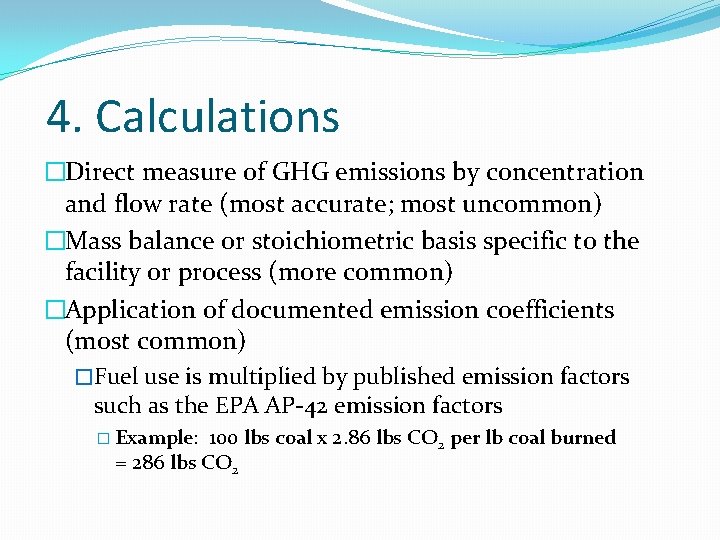
4. Calculations �Direct measure of GHG emissions by concentration and flow rate (most accurate; most uncommon) �Mass balance or stoichiometric basis specific to the facility or process (more common) �Application of documented emission coefficients (most common) �Fuel use is multiplied by published emission factors such as the EPA AP-42 emission factors � Example: 100 lbs coal x 2. 86 lbs CO 2 per lb coal burned = 286 lbs CO 2
4. Calculations �Choose a Source of Emission Coefficients �Emission coefficients are used to calculate the amount of GHG gases produced � Fuel combustion x emission coefficient = quantity of GHG emitted � Industrial processes and fugitive emissions; activity level x emission coefficient = quantity of GHG emitted
4. Calculations �Sources for emissions coefficients �Clean Air-Cool Planet Campus Carbon Calculator contains emission coefficients �The Greenhouse Gas Protocol Initiative Calculation Tools (http: //www. ghgprotocol. org/) �EPA AP-42 emission factors (http: //www. epa. gov/ttn/chief/ap 42/) �Department of Energy – Energy Information Administration (http: //www. eia. doe. gov/)
4. Calculations �Convert all GHG emissions to the units of CO 2 -e and sum for a final total �Results are typically reported in metric units (required by UNFCCC and Kyoto Protocol)
4. Calculations �IPCC Global Warming Potentials (GWPs) �The ratio of radiative forcing (degree of warming the atmosphere) for one unit of a specific GHG compared to one unit of carbon dioxide (CO 2). �Three choices � SAR – IPCC Second Assessment Report � Required by United Nations Framework Convention on Climate Change (UNFCCC) and Kyoto Protocol � TAR – IPCC Third Assessment Report � Already incorporated into the CA-CP calculator � FAR – IPCC Fourth Assessment Report � Most recent estimates
4. Calculations - GWP �Global Warming Potential (GWP) � 1 gram Carbon dioxide (CO 2)= 1 g CO 2 -equivalents � 1 gram methane (CH 4) = 21 g CO 2 -equiv � 1 gram nitrous oxide (N 2 O) = 310 g CO 2 -equiv � 1 gram sulfur hexafluoride (SF 6) = 23, 900 g CO 2 -equiv 100 -year values from IPCC SAR 1996 report. Updated twice, but many still using these numbers. Important to know which report is used when comparing products.
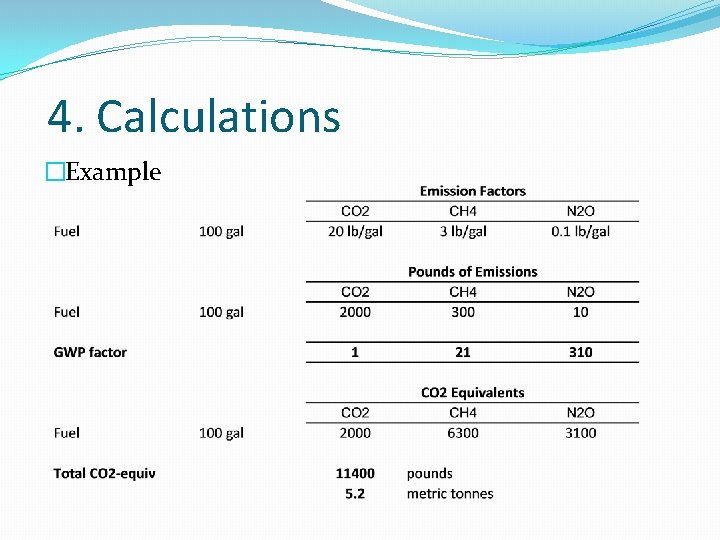
4. Calculations �Example
5. Report Results �Corporate results �Companies may need to gather and summarize data from multiple facilities, possibly in different countries and business divisions
Facility-level Reporting �Document annual GHG emissions �Process energy � Fuels used at facility – natural gas, fuel oil, etc. � Electricity - Source of electricity (emissions from fuels used) �Transportation energy � Vehicles used onsite � Transportation of raw materials to facility (optional) � Transportation of products from facility (optional) � Business travel (optional) � Employee commuting (optional) �Direct process emissions � For example, a facility that manufactures lime from limestone
5. Report Contents �What might be included: �A brief description of the emission sources �A list and justification of specific exclusion or inclusion of sources �Comparative information from previous years �The reporting period covered �Any trends evident in the data �Progress towards any business targets �A discussion of uncertainties �A description of events and changes that have an impact on reported data
5. A University Report �ACUPCC Reporting System �Start date of 12 -month period covered �Consolidation methodology choice � Explain any facilities omitted �Emissions calculation tool used �Version of IPCC GWPs used �Who conducted the emissions inventory �Process of conducting the inventory �Describe any emissions sources classified as de minimis �Describe data limitations �Report Scope 1 GHG emissions by stationary combustion, mobile combustion, process, fugitive,
5. A University Report �ACUPCC Reporting System �Report Scope 2 GHG emissions by purchased electricity, heat, cooling, and/or steam �Report Scope 3 GHG emissions for regular commuting of students and employees, air travel paid for by university, GHG emissions due to incineration or decomposition of solid waste, GHG emissions from up to 3 additional custom sources
5. A University Report �ACUPCC Reporting System �Biogenic emissions: Total CO 2 emissions from the combustion of biomass and biomass-based fuels (wood, biodiesel, ethanol, landfill gas, etc. ) � From stationary combustion � From mobile combustion
5. A University Report �ACUPCC Reporting System �Mitigation Data � Carbon offsets � Renewable Energy Certificates (RECs) � Sequestration and carbon storage � Land use � Composting �Contextual data �Number of students, employees, building space, etc.
Summary �GHG inventory is a beginning step for reducing GHG emissions �Concern about climate change is driving business decisions � In the United States, it seems to be mostly a consumer/stakeholder/stockholder initiative �There is not one standard protocol �Uncertainty exists � Emissions from fuel is typically not measured � Fuel emissions factors may vary depending on entity publishing standards or guidance � GWP factors from IPCC and other sources vary with time � Acquiring “green” electricity can be a major factor in inventory results

Questions?
GHG Inventory – Example �Company A plans to perform a Corporate GHG inventory for all their facilities. They own 2 pulp/paper mills in the United States and lease forested land in Canada from which they supply their mills with wood.
GHG Inventory – the Process �Simple Concept; Complex Execution 1. Decide which Standard or Protocol to follow 2. Set Boundaries 3. Collect Data 4. Perform Calculations 5. Report Results
1. Standards and Protocols Company A GHG Inventory �GHG Protocol Corporate Accounting and Reporting Standard �Why? � Accepted internationally � Most commonly used in the industry � CEO recommendation
2. Set Boundaries �Organizational Boundaries � Equity Share; Operational Control; Financial Control �Operational Boundaries �Required: Scope 1 and Scope 2 �Optional: Scope 3 �Temporal Boundaries �Required: “Base year” � Choose and report a base year for which verifiable emissions data are available and specify why this year was chosen
3. Collect Data Scope 1 Sources �Stationary combustion - Fuel purchase records �Natural gas – 14, 000 MCF per year �Residual fuel oil – 2400 gallons per year �Coal – 50 short tons per year �Mobile combustion - Fuel purchase records �Diesel – 2, 000 gallons per year (company owns fleet that delivers logs to mill) �Gasoline – 300 gallons per year �LPG vehicles – 240 gallons per year �Process emissions �Lime kiln – 20, 000 lbs CO 2 per year �Fugitive emissions �Onsite landfill – 2, 000 lbs methane per year
3. Collect Data Scope 2 Sources �Purchased electricity, steam, heating, cooling �Electricity meters for pulp/paper mill � #1 - 2, 100, 000 kwh � #2 - 340, 000 kwh � #3 - 5, 780, 000 kwh � #4 - 45, 000 kwh � #5 - 17, 800 kwh
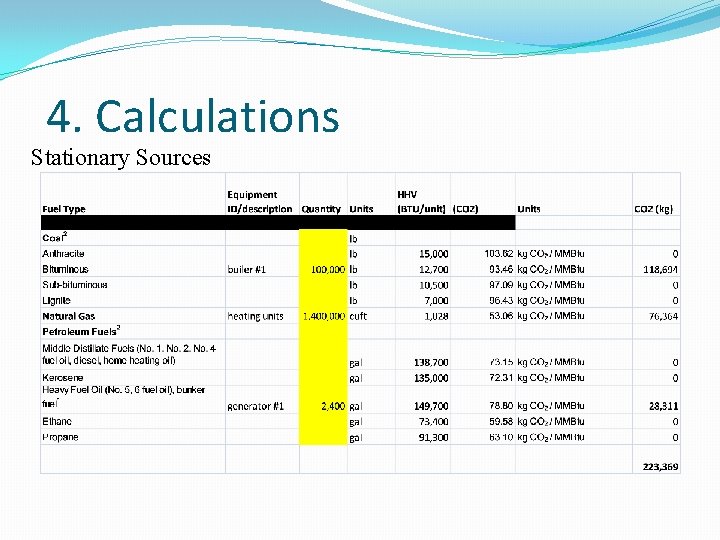
4. Calculations Stationary Sources
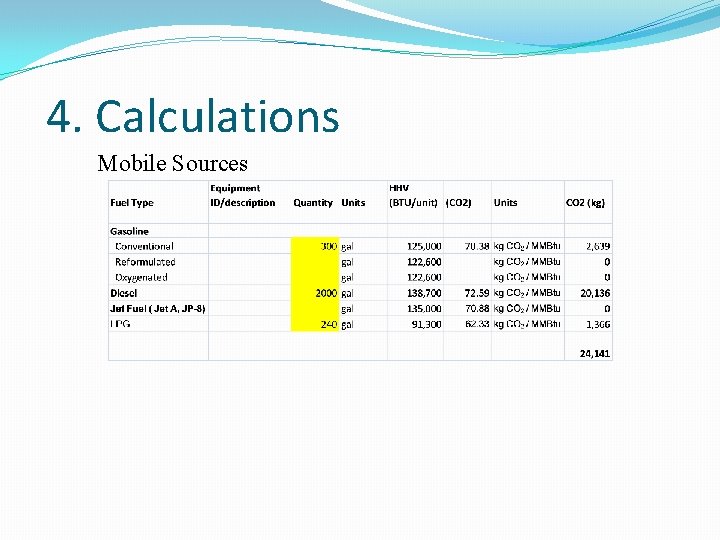
4. Calculations Mobile Sources
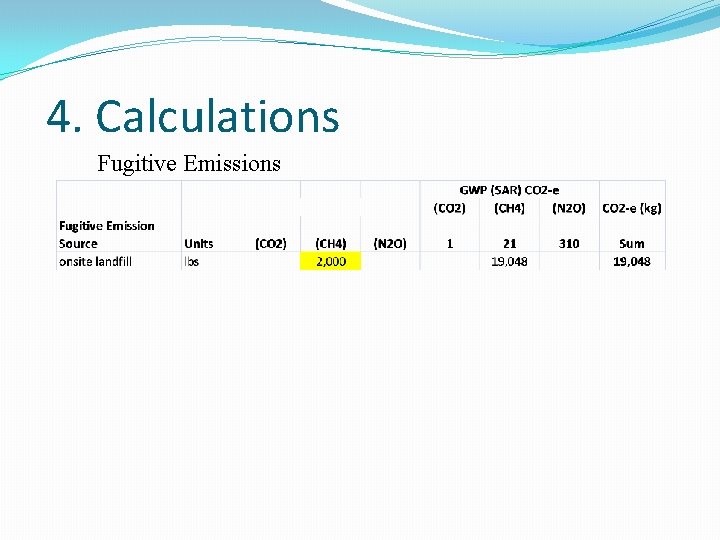
4. Calculations Fugitive Emissions
4. Calculations
5. Report Results �Explain study boundaries �Summarize �Results for each mill �Results for wood harvesting (operational control) �Transparency �Sources of emission coefficients � Stationary and mobile sources fuels – U. S. Energy Information Administration � Electricity – e. Grid 2007 version 1. 1 �Source of GWP – IPCC Second Assessment Report �Reliability of collected data (estimates or measured)
- Slides: 44