
GREENBAG ENERGYEFFICIENT BANDWIDTH AGGREGATION FOR REALTIME STREAMING IN
GREENBAG: ENERGY-EFFICIENT BANDWIDTH AGGREGATION FOR REAL-TIME STREAMING IN HETEROGENEOUS MOBILE WIRELESS NETWORKS STUDENT: BUI, HOANG DUC ADVISOR: PROFESSOR SHIN, INSIK
MOTIVATION • Mobile multimedia streaming is very popular today ‒ Real-time multimedia streaming traffic will take up to 66% of global mobile data traffic by 2017, up from 51% in 2012 [Cisco Systems Forecast] • High quality video streaming needs high bandwidth ‒ Streaming ultra-HD 4 K videos requires around 19 Mbps bandwidth [Youtube] ‒ High definition cameras on modern smartphones are capable of recording 1080 p full-HD videos at 17 -24 Mbps bit rates 2
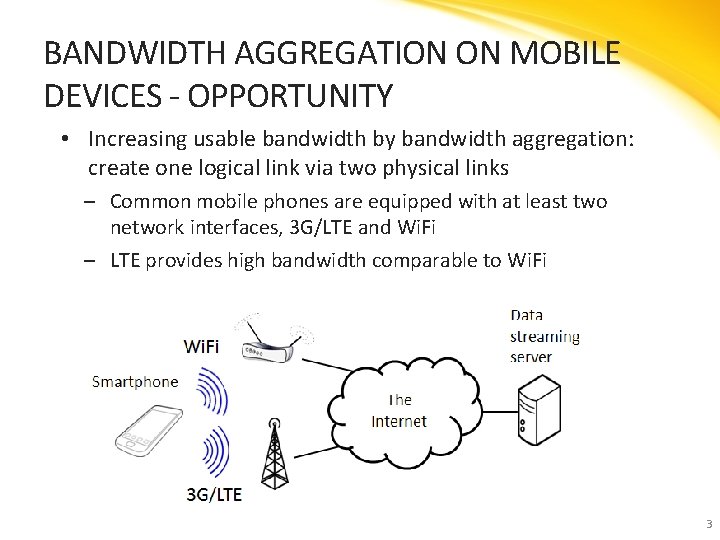
BANDWIDTH AGGREGATION ON MOBILE DEVICES - OPPORTUNITY • Increasing usable bandwidth by bandwidth aggregation: create one logical link via two physical links ‒ Common mobile phones are equipped with at least two network interfaces, 3 G/LTE and Wi. Fi ‒ LTE provides high bandwidth comparable to Wi. Fi 3
BANDWIDTH AGGREGATION • Bandwidth aggregation needs to divide the file downloading into the two different interfaces ‒ Divide the file into small segments and assign each segment to one of the links for downloading 4
BANDWIDTH AGGREGATION • Bandwidth aggregation needs to divide the file downloading into the two different interfaces ‒ Divide the file into small segments and assign each segment to one of the links for downloading File 5
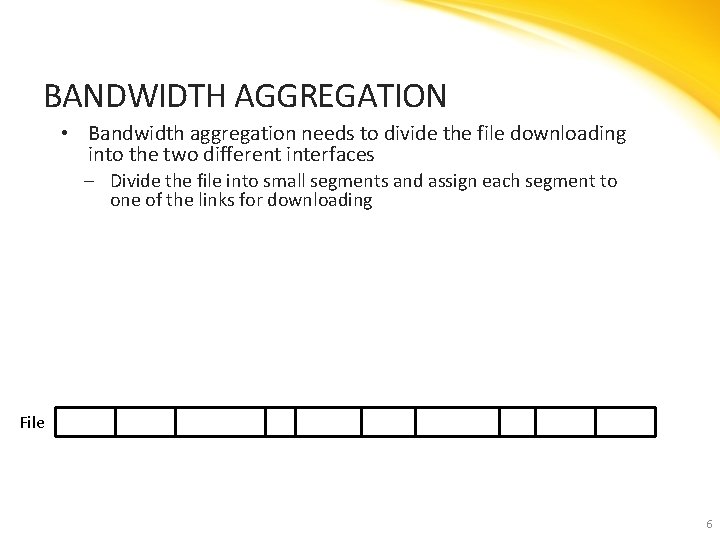
BANDWIDTH AGGREGATION • Bandwidth aggregation needs to divide the file downloading into the two different interfaces ‒ Divide the file into small segments and assign each segment to one of the links for downloading File 6
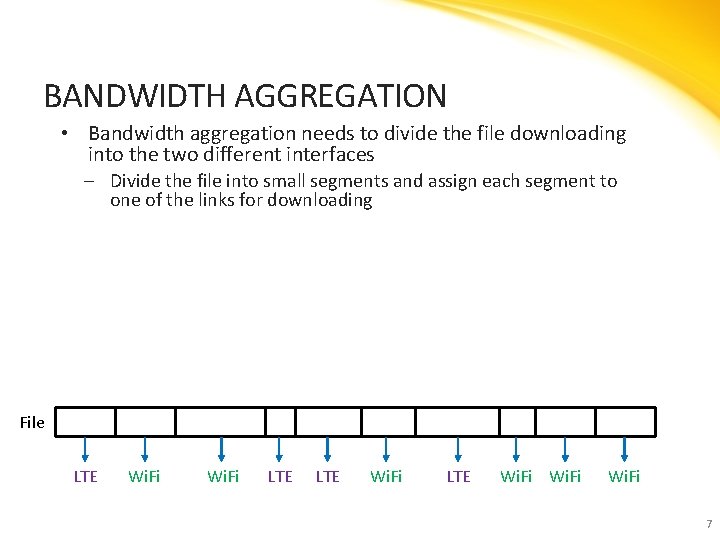
BANDWIDTH AGGREGATION • Bandwidth aggregation needs to divide the file downloading into the two different interfaces ‒ Divide the file into small segments and assign each segment to one of the links for downloading File LTE Wi. Fi Wi. Fi 7
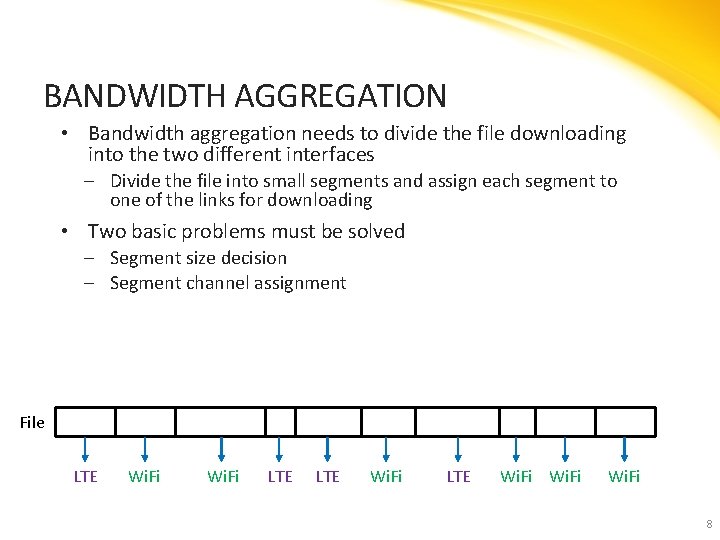
BANDWIDTH AGGREGATION • Bandwidth aggregation needs to divide the file downloading into the two different interfaces ‒ Divide the file into small segments and assign each segment to one of the links for downloading • Two basic problems must be solved ‒ Segment size decision ‒ Segment channel assignment File LTE Wi. Fi Wi. Fi 8
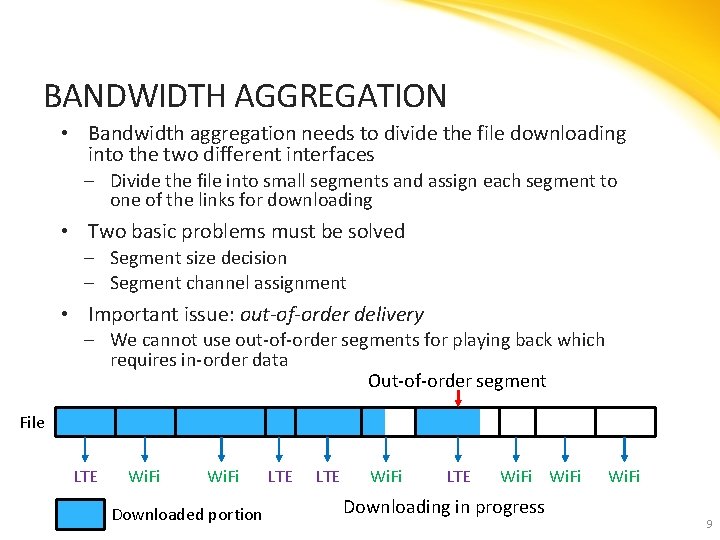
BANDWIDTH AGGREGATION • Bandwidth aggregation needs to divide the file downloading into the two different interfaces ‒ Divide the file into small segments and assign each segment to one of the links for downloading • Two basic problems must be solved ‒ Segment size decision ‒ Segment channel assignment • Important issue: out-of-order delivery ‒ We cannot use out-of-order segments for playing back which requires in-order data Out-of-order segment File LTE Wi. Fi Downloaded portion LTE Wi. Fi Downloading in progress Wi. Fi 9
BANDWIDTH AGGREGATION ON MOBILE DEVICES – REQUIREMENTS • Strict energy saving requirement ‒ Mobile devices are powered by batteries ‒ The use of multiple network interfaces can introduce a significant energy usage ‒ LTE and Wi. Fi have different power management • Ease of deployment ‒ A widely applicable technique should require no change to the Internet infrastructure 10
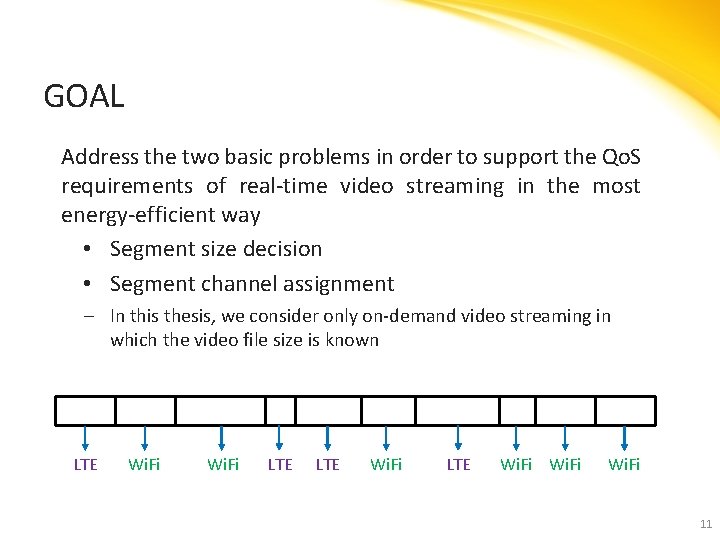
GOAL Address the two basic problems in order to support the Qo. S requirements of real-time video streaming in the most energy-efficient way • Segment size decision • Segment channel assignment ‒ In this thesis, we consider only on-demand video streaming in which the video file size is known LTE Wi. Fi Wi. Fi 11
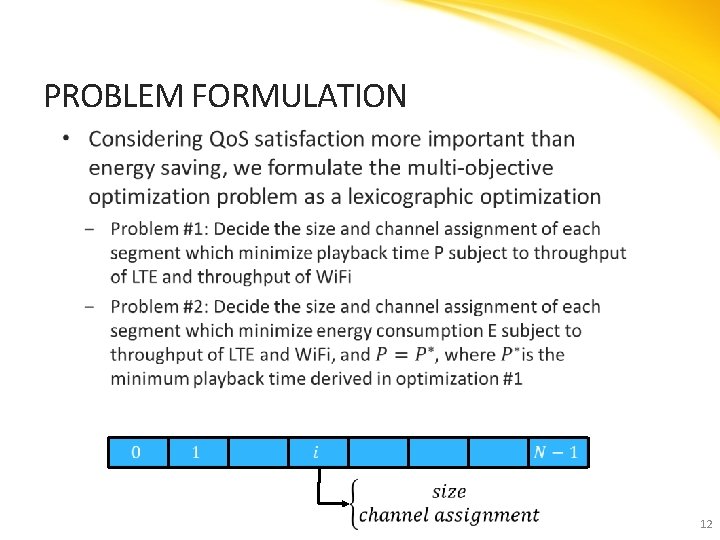
PROBLEM FORMULATION • 12
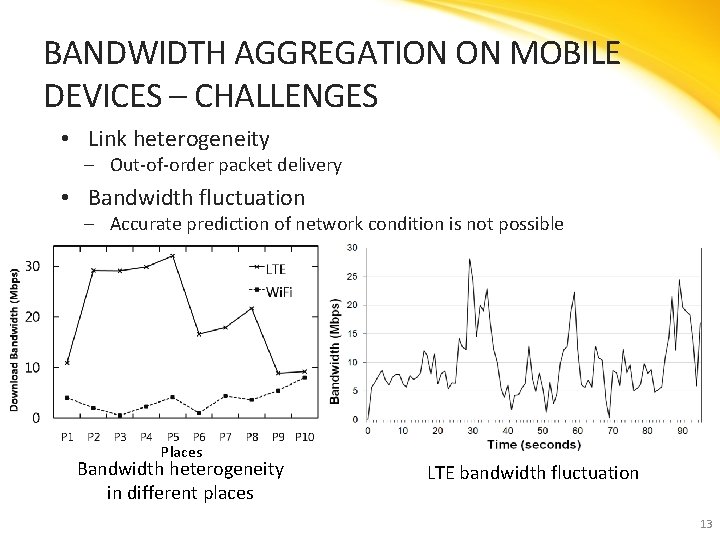
BANDWIDTH AGGREGATION ON MOBILE DEVICES – CHALLENGES • Link heterogeneity ‒ Out-of-order packet delivery • Bandwidth fluctuation ‒ Accurate prediction of network condition is not possible Places Bandwidth heterogeneity in different places LTE bandwidth fluctuation 13
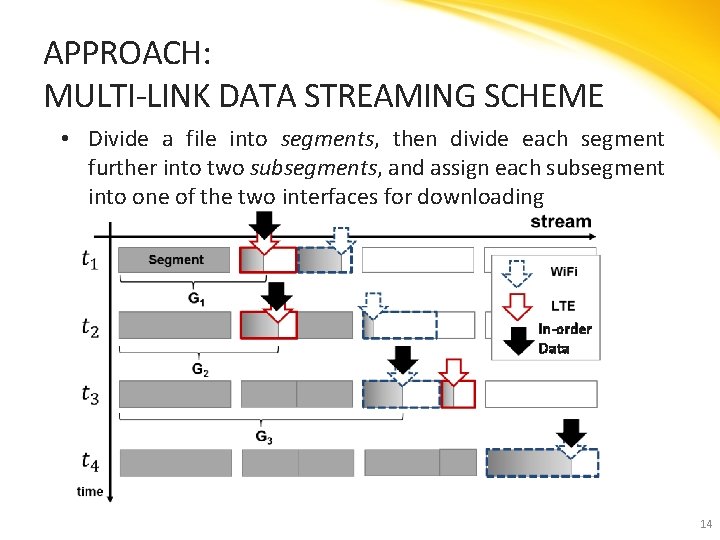
APPROACH: MULTI-LINK DATA STREAMING SCHEME • Divide a file into segments, then divide each segment further into two subsegments, and assign each subsegment into one of the two interfaces for downloading In-order Data 14
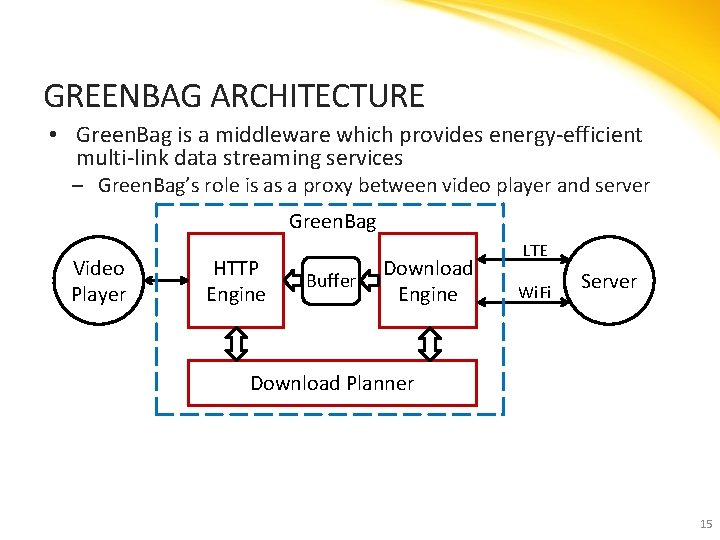
GREENBAG ARCHITECTURE • Green. Bag is a middleware which provides energy-efficient multi-link data streaming services ‒ Green. Bag’s role is as a proxy between video player and server Green. Bag Video Player HTTP Engine Buffer Download Engine LTE Wi. Fi Server Download Planner 15
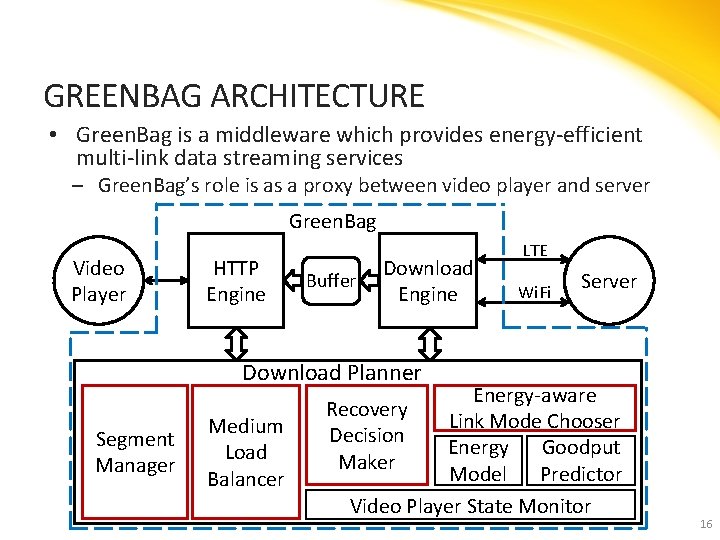
GREENBAG ARCHITECTURE • Green. Bag is a middleware which provides energy-efficient multi-link data streaming services ‒ Green. Bag’s role is as a proxy between video player and server Green. Bag Video Player HTTP Engine Buffer Download Engine LTE Wi. Fi Server Download Planner Segment Manager Medium Load Balancer Energy-aware Link Mode Chooser Energy Goodput Model Predictor Video Player State Monitor Recovery Decision Maker 16
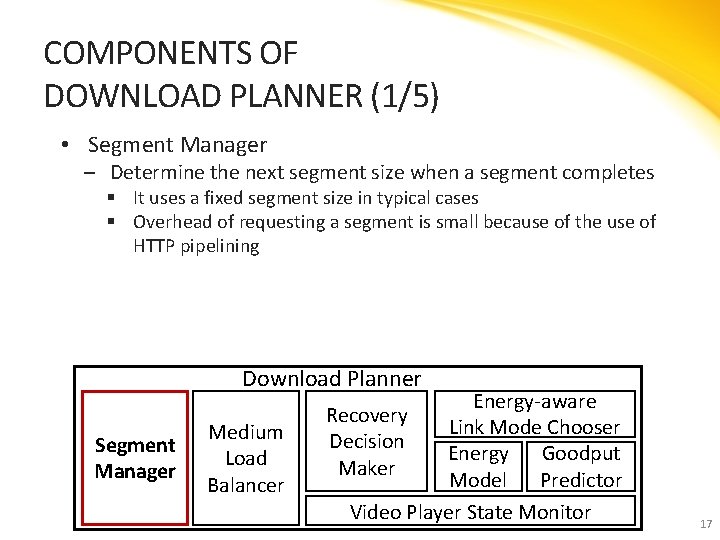
COMPONENTS OF DOWNLOAD PLANNER (1/5) • Segment Manager ‒ Determine the next segment size when a segment completes § It uses a fixed segment size in typical cases § Overhead of requesting a segment is small because of the use of HTTP pipelining Download Planner Segment Manager Medium Load Balancer Energy-aware Link Mode Chooser Energy Goodput Model Predictor Video Player State Monitor Recovery Decision Maker 17
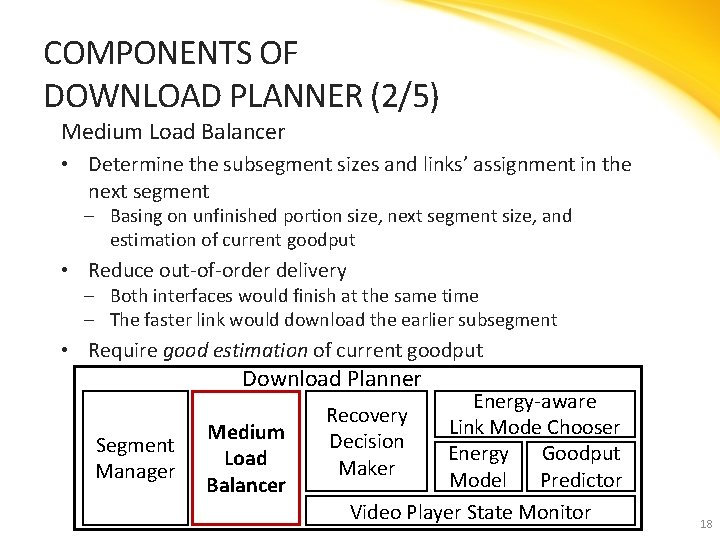
COMPONENTS OF DOWNLOAD PLANNER (2/5) Medium Load Balancer • Determine the subsegment sizes and links’ assignment in the next segment ‒ Basing on unfinished portion size, next segment size, and estimation of current goodput • Reduce out-of-order delivery ‒ Both interfaces would finish at the same time ‒ The faster link would download the earlier subsegment • Require good estimation of current goodput Download Planner Segment Manager Medium Load Balancer Energy-aware Link Mode Chooser Energy Goodput Model Predictor Video Player State Monitor Recovery Decision Maker 18
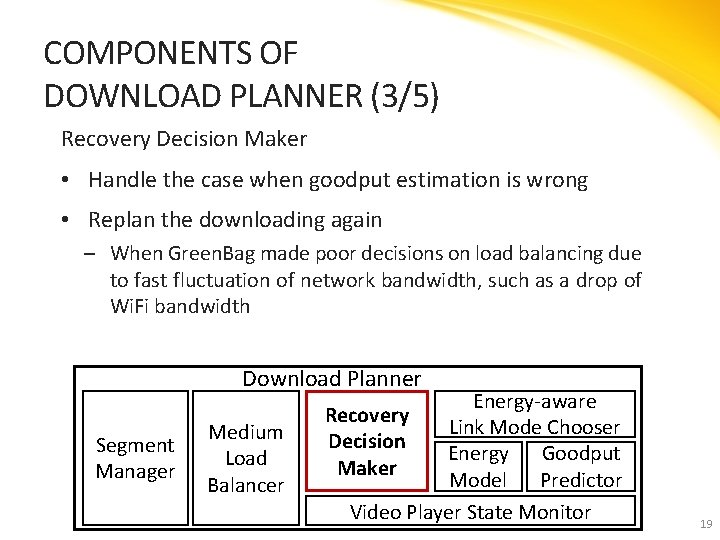
COMPONENTS OF DOWNLOAD PLANNER (3/5) Recovery Decision Maker • Handle the case when goodput estimation is wrong • Replan the downloading again ‒ When Green. Bag made poor decisions on load balancing due to fast fluctuation of network bandwidth, such as a drop of Wi. Fi bandwidth Download Planner Segment Manager Medium Load Balancer Energy-aware Link Mode Chooser Energy Goodput Model Predictor Video Player State Monitor Recovery Decision Maker 19
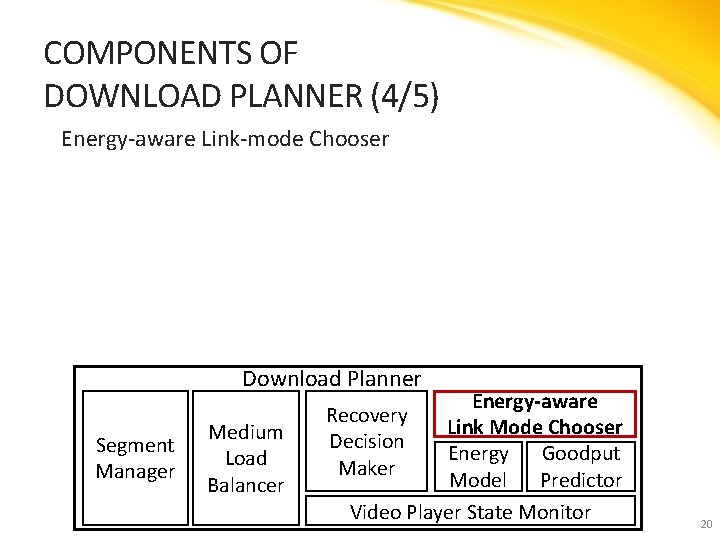
COMPONENTS OF DOWNLOAD PLANNER (4/5) Energy-aware Link-mode Chooser Download Planner Segment Manager Medium Load Balancer Energy-aware Link Mode Chooser Energy Goodput Model Predictor Video Player State Monitor Recovery Decision Maker 20
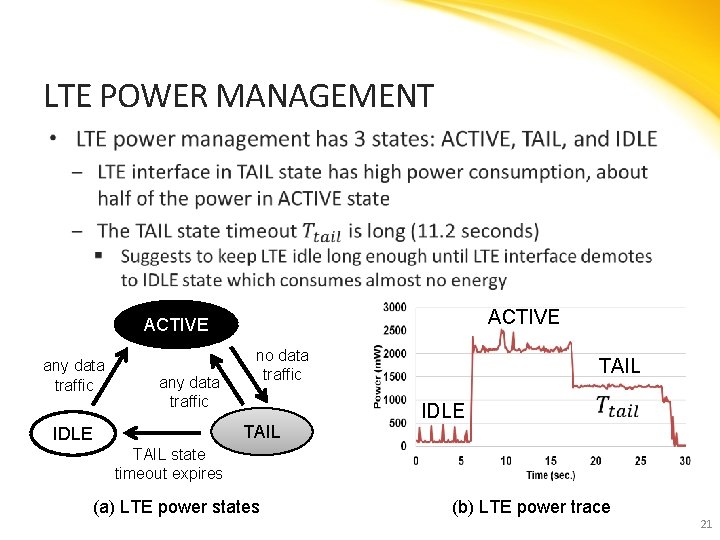
LTE POWER MANAGEMENT • ACTIVE any data traffic no data traffic TAIL IDLE TAIL state timeout expires (a) LTE power states (b) LTE power trace 21
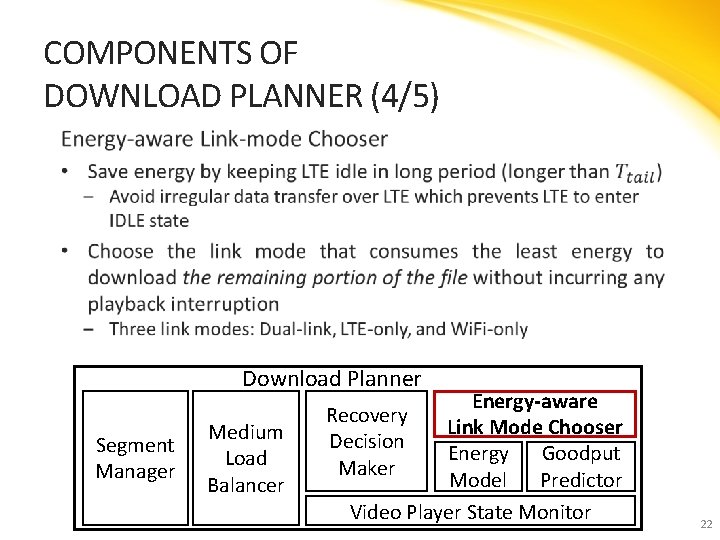
COMPONENTS OF DOWNLOAD PLANNER (4/5) • Download Planner Segment Manager Medium Load Balancer Energy-aware Link Mode Chooser Energy Goodput Model Predictor Video Player State Monitor Recovery Decision Maker 22
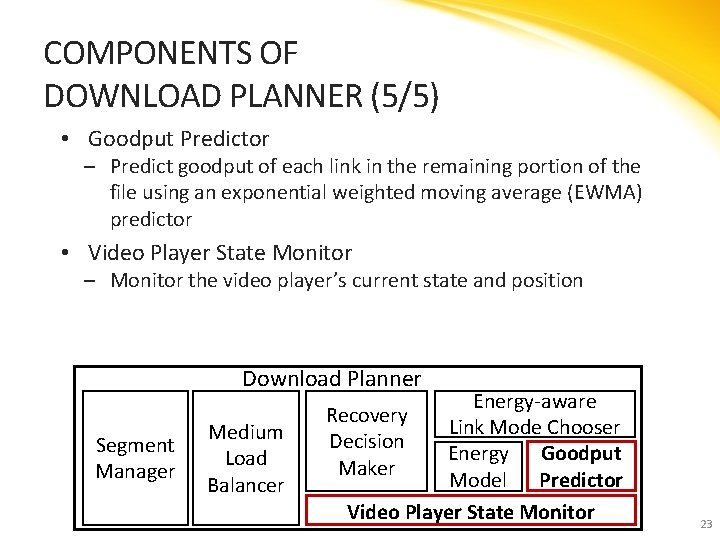
COMPONENTS OF DOWNLOAD PLANNER (5/5) • Goodput Predictor ‒ Predict goodput of each link in the remaining portion of the file using an exponential weighted moving average (EWMA) predictor • Video Player State Monitor ‒ Monitor the video player’s current state and position Download Planner Segment Manager Medium Load Balancer Energy-aware Link Mode Chooser Energy Goodput Model Predictor Video Player State Monitor Recovery Decision Maker 23
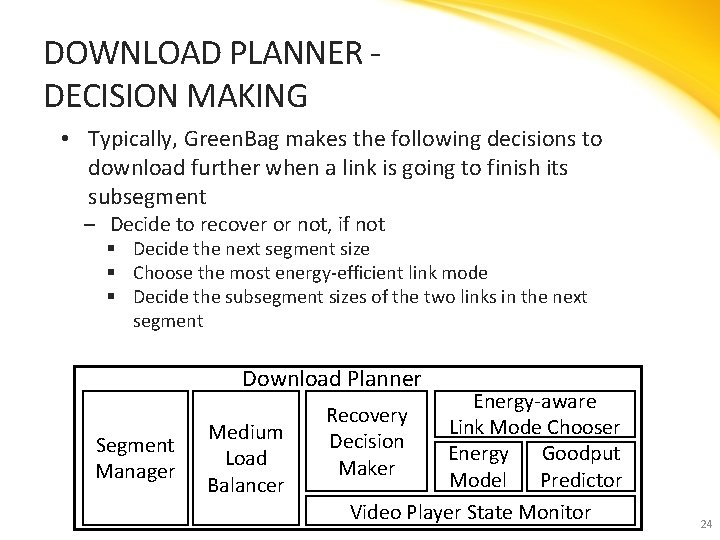
DOWNLOAD PLANNER DECISION MAKING • Typically, Green. Bag makes the following decisions to download further when a link is going to finish its subsegment ‒ Decide to recover or not, if not § Decide the next segment size § Choose the most energy-efficient link mode § Decide the subsegment sizes of the two links in the next segment Download Planner Segment Manager Medium Load Balancer Energy-aware Link Mode Chooser Energy Goodput Model Predictor Video Player State Monitor Recovery Decision Maker 24
EVALUATION • Evaluation in real-world networks • Evaluation in emulated environment 25
EVALUATION IN REAL-WORLD NETWORKS EXPERIMENT SETUP (1/2) • Compare 4 configurations (GB-E, GB-P, LTE-only, and Wi. Fi-only) in 3 scenarios (Stationary #1, Stationary #2, and Mobile) in terms of 2 performance metrics • Two performance metrics ‒ Playback time ‒ Energy consumption • Four configurations ‒ GB-E: Green. Bag-Energy mode, supports Qo. S while saving energy ‒ GB-P: Green. Bag-Performance mode, maximizes throughput without saving energy ‒ LTE-only (Wi. Fi-only): video streaming using only LTE (Wi. Fi) 26
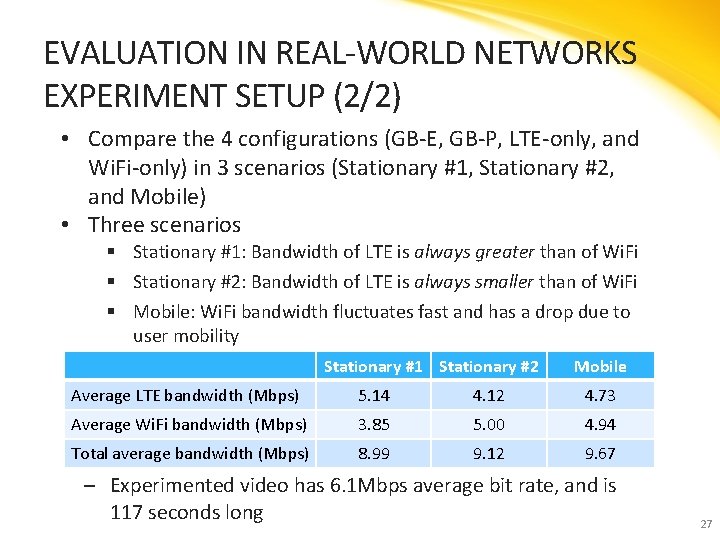
EVALUATION IN REAL-WORLD NETWORKS EXPERIMENT SETUP (2/2) • Compare the 4 configurations (GB-E, GB-P, LTE-only, and Wi. Fi-only) in 3 scenarios (Stationary #1, Stationary #2, and Mobile) • Three scenarios § Stationary #1: Bandwidth of LTE is always greater than of Wi. Fi § Stationary #2: Bandwidth of LTE is always smaller than of Wi. Fi § Mobile: Wi. Fi bandwidth fluctuates fast and has a drop due to user mobility Stationary #1 Stationary #2 Mobile Average LTE bandwidth (Mbps) 5. 14 4. 12 4. 73 Average Wi. Fi bandwidth (Mbps) 3. 85 5. 00 4. 94 Total average bandwidth (Mbps) 8. 99 9. 12 9. 67 ‒ Experimented video has 6. 1 Mbps average bit rate, and is 117 seconds long 27
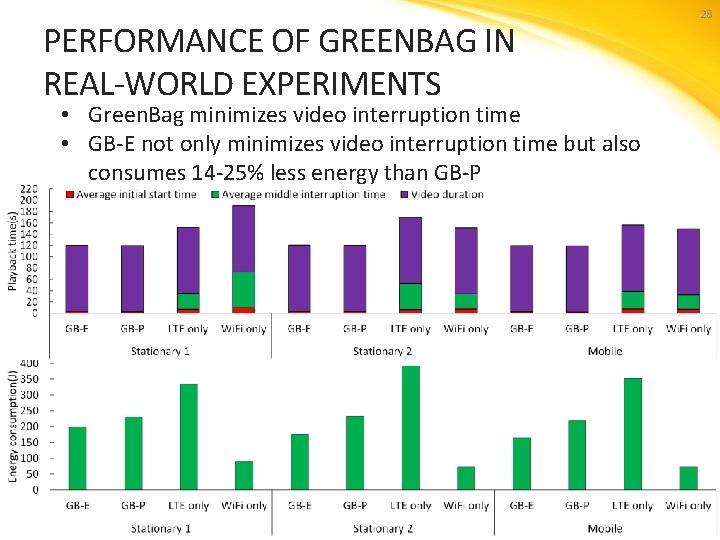
PERFORMANCE OF GREENBAG IN REAL-WORLD EXPERIMENTS • Green. Bag minimizes video interruption time • GB-E not only minimizes video interruption time but also consumes 14 -25% less energy than GB-P 28
DEMONSTRATION PLAYBACK TIME MINIMIZATION • Play. Time. mp 4 • Please visit the following website for the video file http: //cps. kaist. ac. kr/greenbag/ 29
DEMONSTRATION ENERGY SAVING • Energy. Consumption. mp 4 • Please visit the following website for the video file http: //cps. kaist. ac. kr/greenbag/ 30
EVALUATION IN EMULATED ENVIRONMENT • Experiment setup ‒ Emulated network § A client, a server, and an intermediate node equipped with network emulator tools ‒ Emulated player § Implementation of the video player model • Evaluate four aspects of Green. Bag ‒ ‒ Segment size overhead Effectiveness of adaptive load balancing Effectiveness of recovery mechanism Effectiveness of energy-aware link mode switching 31
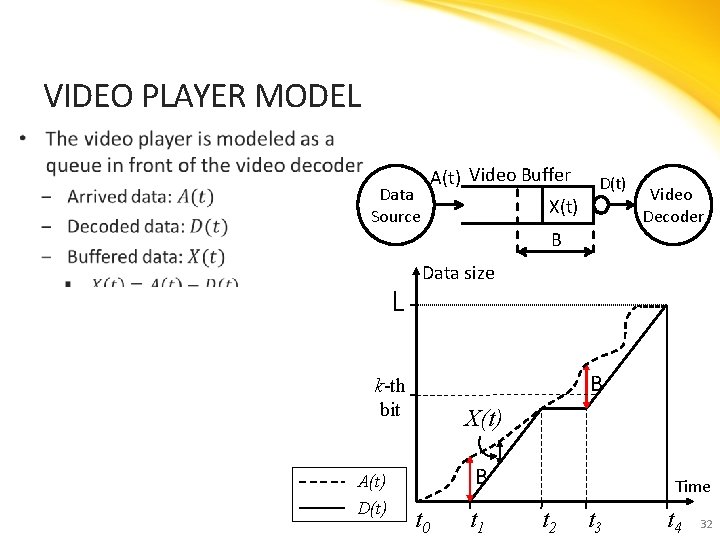
VIDEO PLAYER MODEL • A(t) Video Buffer Data X(t) Source D(t) Video Decoder B L Data size B k-th bit X(t) B A(t) D(t) t 0 t 1 Time t 2 t 3 t 4 32
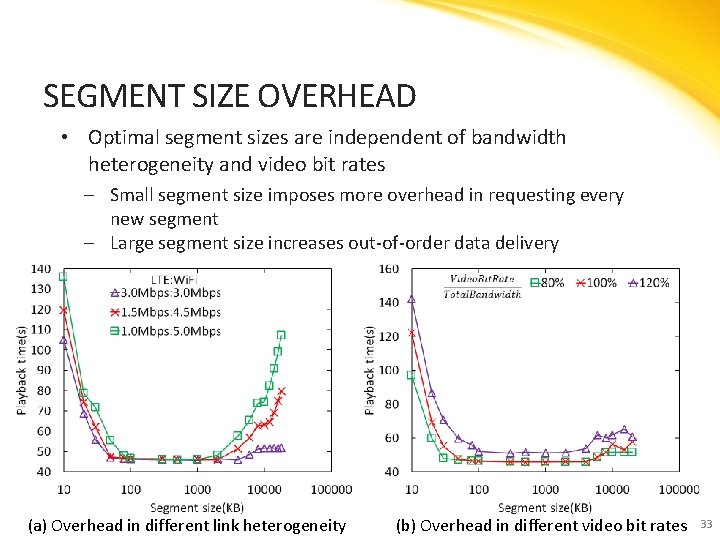
SEGMENT SIZE OVERHEAD • Optimal segment sizes are independent of bandwidth heterogeneity and video bit rates ‒ Small segment size imposes more overhead in requesting every new segment ‒ Large segment size increases out-of-order data delivery (a) Overhead in different link heterogeneity (b) Overhead in different video bit rates 33
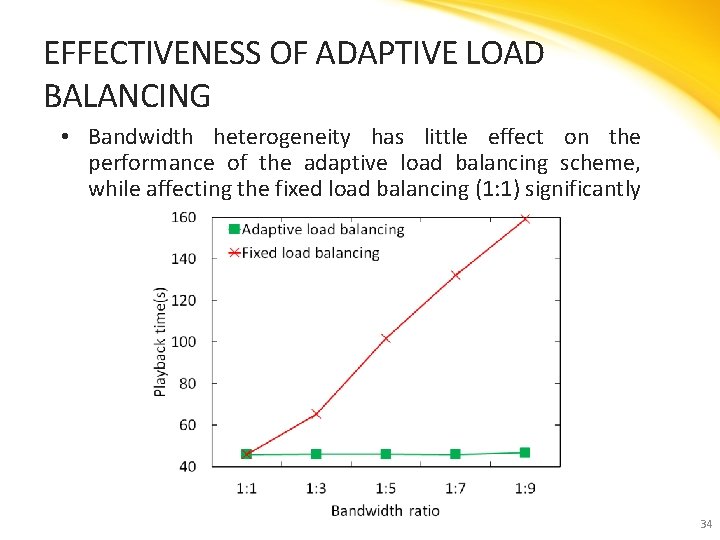
EFFECTIVENESS OF ADAPTIVE LOAD BALANCING • Bandwidth heterogeneity has little effect on the performance of the adaptive load balancing scheme, while affecting the fixed load balancing (1: 1) significantly 34
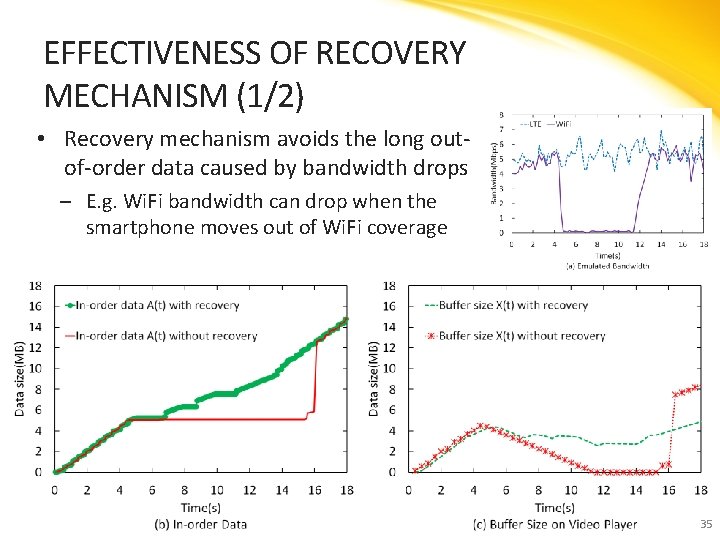
EFFECTIVENESS OF RECOVERY MECHANISM (1/2) • Recovery mechanism avoids the long outof-order data caused by bandwidth drops ‒ E. g. Wi. Fi bandwidth can drop when the smartphone moves out of Wi. Fi coverage 35
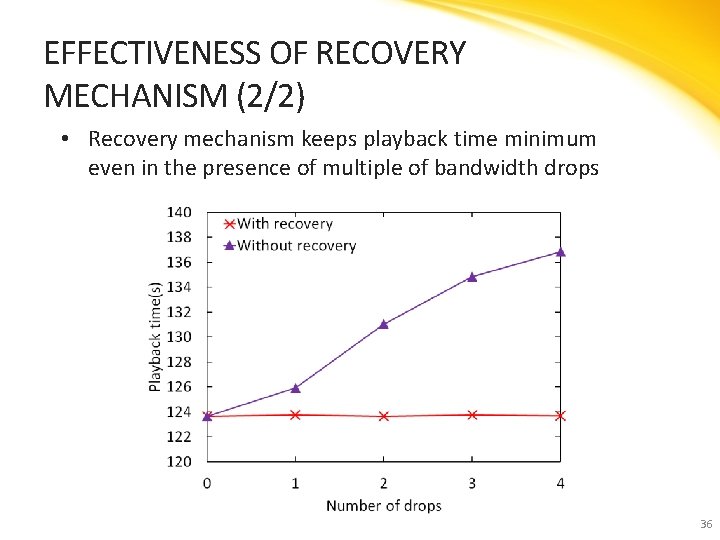
EFFECTIVENESS OF RECOVERY MECHANISM (2/2) • Recovery mechanism keeps playback time minimum even in the presence of multiple of bandwidth drops 36
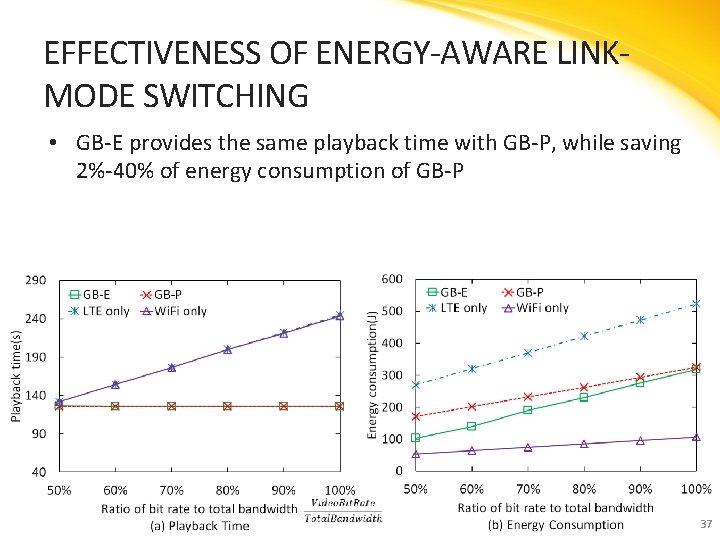
EFFECTIVENESS OF ENERGY-AWARE LINKMODE SWITCHING • GB-E provides the same playback time with GB-P, while saving 2%-40% of energy consumption of GB-P 37
CONCLUSION The thesis has the following contributions 1. Formulate bandwidth aggregation for real-time video streaming as a lexicographic optimization 2. Design a multi-link data streaming middleware to support real-time delivery in the most energy-efficient way 3. Implement a prototype of Green. Bag on Android-based mobile devices equipped with LTE and Wi. Fi interfaces ‒ To the best of our knowledge, this is one of the first LTEenabled prototypes which demonstrates the effectiveness of bandwidth aggregation for energy-efficient real-time delivery on mobile phones 38
ACKNOWLEDGEMENT • I would like to express my special thanks and appreciation to Kilho Lee, Sangeun Oh (Cyber-Physical Systems Lab), Doctor Hyojeong Shin (Mobile SW Platform Center), Doctor Honguk Woo, and Doctor Daehyun Ban (Samsung Electronics) for their great support and collaboration in the research 39

THANK YOU QUESTIONS AND ANSWERS
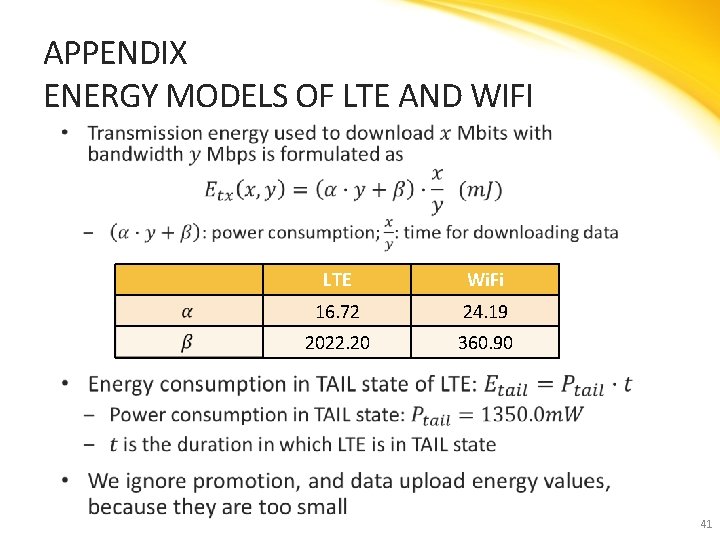
APPENDIX ENERGY MODELS OF LTE AND WIFI • LTE Wi. Fi 16. 72 24. 19 2022. 20 360. 90 41
- Slides: 41