
Green Roof System Design Model Development Optimization Using
- Slides: 1
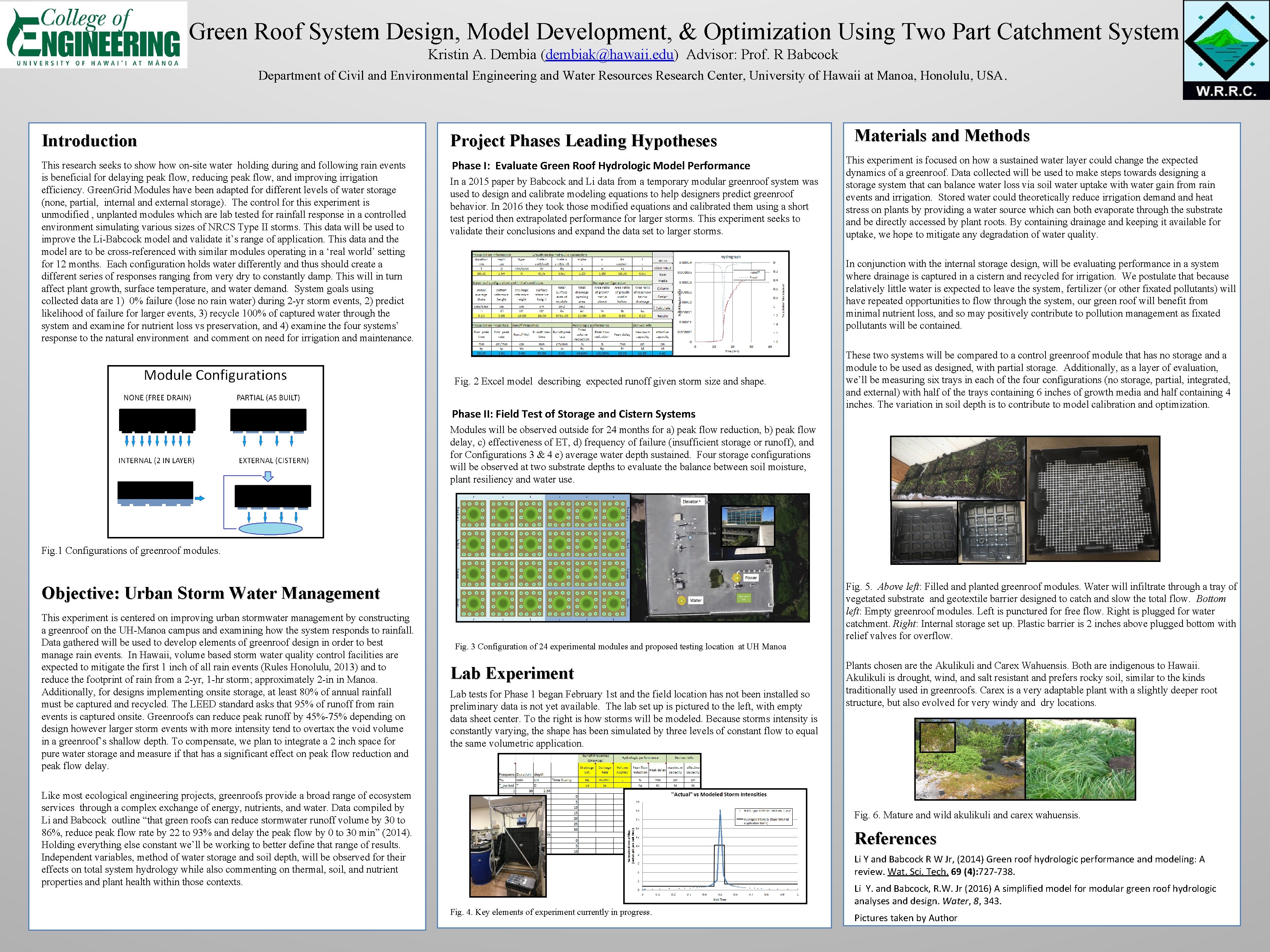
Green Roof System Design, Model Development, & Optimization Using Two Part Catchment System Kristin A. Dembia (dembiak@hawaii. edu) Advisor: Prof. R Babcock Department of Civil and Environmental Engineering and Water Resources Research Center, University of Hawaii at Manoa, Honolulu, USA. Introduction This research seeks to show on-site water holding during and following rain events is beneficial for delaying peak flow, reducing peak flow, and improving irrigation efficiency. Green. Grid Modules have been adapted for different levels of water storage (none, partial, internal and external storage). The control for this experiment is unmodified , unplanted modules which are lab tested for rainfall response in a controlled environment simulating various sizes of NRCS Type II storms. This data will be used to improve the Li-Babcock model and validate it’s range of application. This data and the model are to be cross-referenced with similar modules operating in a ‘real world’ setting for 12 months. Each configuration holds water differently and thus should create a different series of responses ranging from very dry to constantly damp. This will in turn affect plant growth, surface temperature, and water demand. System goals using collected data are 1) 0% failure (lose no rain water) during 2 -yr storm events, 2) predict likelihood of failure for larger events, 3) recycle 100% of captured water through the system and examine for nutrient loss vs preservation, and 4) examine the four systems’ response to the natural environment and comment on need for irrigation and maintenance. Project Phases Leading Hypotheses Phase I: Evaluate Green Roof Hydrologic Model Performance In a 2015 paper by Babcock and Li data from a temporary modular greenroof system was used to design and calibrate modeling equations to help designers predict greenroof behavior. In 2016 they took those modified equations and calibrated them using a short test period then extrapolated performance for larger storms. This experiment seeks to validate their conclusions and expand the data set to larger storms. Materials and Methods This experiment is focused on how a sustained water layer could change the expected dynamics of a greenroof. Data collected will be used to make steps towards designing a storage system that can balance water loss via soil water uptake with water gain from rain events and irrigation. Stored water could theoretically reduce irrigation demand heat stress on plants by providing a water source which can both evaporate through the substrate and be directly accessed by plant roots. By containing drainage and keeping it available for uptake, we hope to mitigate any degradation of water quality. In conjunction with the internal storage design, will be evaluating performance in a system where drainage is captured in a cistern and recycled for irrigation. We postulate that because relatively little water is expected to leave the system, fertilizer (or other fixated pollutants) will have repeated opportunities to flow through the system, our green roof will benefit from minimal nutrient loss, and so may positively contribute to pollution management as fixated pollutants will be contained. Fig. 2 Excel model describing expected runoff given storm size and shape. Phase II: Field Test of Storage and Cistern Systems These two systems will be compared to a control greenroof module that has no storage and a module to be used as designed, with partial storage. Additionally, as a layer of evaluation, we’ll be measuring six trays in each of the four configurations (no storage, partial, integrated, and external) with half of the trays containing 6 inches of growth media and half containing 4 inches. The variation in soil depth is to contribute to model calibration and optimization. Modules will be observed outside for 24 months for a) peak flow reduction, b) peak flow delay, c) effectiveness of ET, d) frequency of failure (insufficient storage or runoff), and for Configurations 3 & 4 e) average water depth sustained. Four storage configurations will be observed at two substrate depths to evaluate the balance between soil moisture, plant resiliency and water use. Fig. 1 Configurations of greenroof modules. Fig. 5. Above left: Filled and planted greenroof modules. Water will infiltrate through a tray of vegetated substrate and geotextile barrier designed to catch and slow the total flow. Bottom left: Empty greenroof modules. Left is punctured for free flow. Right is plugged for water catchment. Right: Internal storage set up. Plastic barrier is 2 inches above plugged bottom with relief valves for overflow. Objective: Urban Storm Water Management This experiment is centered on improving urban stormwater management by constructing a greenroof on the UH-Manoa campus and examining how the system responds to rainfall. Data gathered will be used to develop elements of greenroof design in order to best manage rain events. In Hawaii, volume based storm water quality control facilities are expected to mitigate the first 1 inch of all rain events (Rules Honolulu, 2013) and to reduce the footprint of rain from a 2 -yr, 1 -hr storm; approximately 2 -in in Manoa. Additionally, for designs implementing onsite storage, at least 80% of annual rainfall must be captured and recycled. The LEED standard asks that 95% of runoff from rain events is captured onsite. Greenroofs can reduce peak runoff by 45%-75% depending on design however larger storm events with more intensity tend to overtax the void volume in a greenroof’s shallow depth. To compensate, we plan to integrate a 2 inch space for pure water storage and measure if that has a significant effect on peak flow reduction and peak flow delay. Fig. 3 Configuration of 24 experimental modules and proposed testing location at UH Manoa Lab Experiment Lab tests for Phase 1 began February 1 st and the field location has not been installed so preliminary data is not yet available. The lab set up is pictured to the left, with empty data sheet center. To the right is how storms will be modeled. Because storms intensity is constantly varying, the shape has been simulated by three levels of constant flow to equal the same volumetric application. Like most ecological engineering projects, greenroofs provide a broad range of ecosystem services through a complex exchange of energy, nutrients, and water. Data compiled by Li and Babcock outline “that green roofs can reduce stormwater runoff volume by 30 to 86%, reduce peak flow rate by 22 to 93% and delay the peak flow by 0 to 30 min” (2014). Holding everything else constant we’ll be working to better define that range of results. Independent variables, method of water storage and soil depth, will be observed for their effects on total system hydrology while also commenting on thermal, soil, and nutrient properties and plant health within those contexts. Plants chosen are the Akuli and Carex Wahuensis. Both are indigenous to Hawaii. Akuli is drought, wind, and salt resistant and prefers rocky soil, similar to the kinds traditionally used in greenroofs. Carex is a very adaptable plant with a slightly deeper root structure, but also evolved for very windy and dry locations. Fig. 6. Mature and wild akuli and carex wahuensis. References Li Y and Babcock R W Jr, (2014) Green roof hydrologic performance and modeling: A review. Wat. Sci. Tech. 69 (4): 727 -738. Li Y. and Babcock, R. W. Jr (2016) A simplified model for modular green roof hydrologic analyses and design. Water, 8, 343. Fig. 4. Key elements of experiment currently in progress. Pictures taken by Author