
Green Revolution Began in 1945 in Mexico Purpose

Green Revolution • Began in 1945 in Mexico • Purpose – agricultural research to develop more productive varieties of wheat to feed rapidly growing population • HYV – high yield varieties • Smaller plant – concentrate on growing seeds (part we will eat) vs. stem • Responded better to use of fertilizer and irrigation • HYV’s grow faster – in some instances could harvest more than one crop per year
Green Revolution Success • HYV’s centred around crops such as rice, wheat and corn • Increased food supply meant that countries could develop other social/economic programs (better family planning, education, health care)…helped get them out of demographic traps • 20% increase in food vs population • More global supply meant that prices for wheat and rice declined by 70% - more affordable for people in the developing world
Concerns of Green Revolution • GR needs costly inputs (chemical fertilizers, pesticides, irrigation) which poor farmers couldn’t afford • Focused on areas that could grow food – soils and rainfall – Africa is mostly semiarid and arid land (desert and savannah)
Concerns cont’d • Loss in genetic diversity – rice and wheat HYV’s replaced other varieties (monoculture – specialization of one type of crop) – more susceptible to infestations and disease • Not environmentally sustainable – use of fertilizers, insecticides, herbicides have caused decline in soil fertility, therefore yields are actually falling which creates a cycle of land degredation (ruin one area, move onto the next area) • Who is the GR benefiting? Who is producing fertilizers, farm equipment? How will developing nations pay back their debts if they are in a cycle of poverty and hunger?
Genetic Revolution • Biotechnology is the application of biological processes to agricultural and industrial purposes • Green revolution uses cross-breeding between two varieties with hope that the desirable qualities get passed on to offspring • Gene revolution is where scientists move desirable genes from one organism to another • GMO’s = genetically modified organisms (nickname are Frankenfoods)
Gene Revolution and Hunger • Could manipulate plants and animals… • To grow larger (more quantity of food) • Tolerate specific growing conditions not normal to the plant (drought resistance, disease resistance, pest resistance) = more stable food supply • Could make the food more nutritious by adding specific micronutrients (ex golden rice is modified with Vitamin A – helps prevent blindness)
Concerns of GMO’s • Ethics – Is it right to manipulate nature? • Long-term consequences – We don’t have reliable long-term studies to show what negative health effects GMO’s might have on humans. • Creation of “superbugs” or “superweeds” that are resistant to GMO’s • GMO’s are a business and therefore profit driven (controversy of terminator technology – hybrid seeds that kill their own seeds, therefore farmers become reliant on purchasing them every year) • Loss of genetic diversity
RUTF’s • Until recently, children suffering from severe acute malnutrition (SAM) were treated in intensive-care inpatient facilities known as ‘Therapeutic Feeding Centres. ’ These hospitallike centres required children and their parents or caregivers to remain in residence during their month-long treatment. • The recent development of innovative food products for treating severe acute malnutrition, known as Ready-to-Use Therapeutic Foods (RUTF), now permits treatment to take place in the community at any time and place.

RUTF’s • Ready-to-Use Therapeutic Foods have been developed in the form of peanut-butter based pastes and biscuits that are nutrient-rich and packed with high concentrations of protein and energy. • RUTFs reduce exposure to water-borne bacteria as they contain no water. • They require no refrigeration, and are ready to serve, ensuring that essential nutrients are not lost by the time the products are consumed. • With no water, heating or preparation required, RUTFs avoid all of the major inconveniences of therapeutic milkbased products, which are standard treatment in inpatient care of severe acute malnutrition.
Hunger, Education and Poverty • For a hungry family, children are an extra pair of hands in the fields or at home. School is a luxury. • Every year of missed schooling during childhood cuts deeply into lifetime earnings and continues the poverty cycle. • UNWFP (United Nations World Food Programme) encourages children to go to school by: 1) Providing free school lunches as an incentive for the children of poor families to go to school. 2) Providing take home rations for the family to encourage them to send their children to school. 3) In war-ravaged countries like Angola and Sierra Leone, school feeding encourages child soldiers to swap weapons for books (reducing conflict can help reduce hunger!)
Subsidies and Land reform • Push core countries to stop subsidized food from being donated to poor countries which pushes local farmers out of growing their own food and to eventual poverty • More equitable distribution of land to people within country so they can grow their own food (land reform) • Ex. Guatemala, 10 largest landowners control 93 % of the country’s land, while 85% of farmers have no land at all • Bolivia by end of 2011 wants to redistribute land (20 million hectares) from rich landowners to poor landless farmers
The Role of Women • Women contribute between 60 -80% of the expertise, time and labour of agricultural production in developing nations • Need to involve more women by way of education and project planning in agriculture • Microcredit
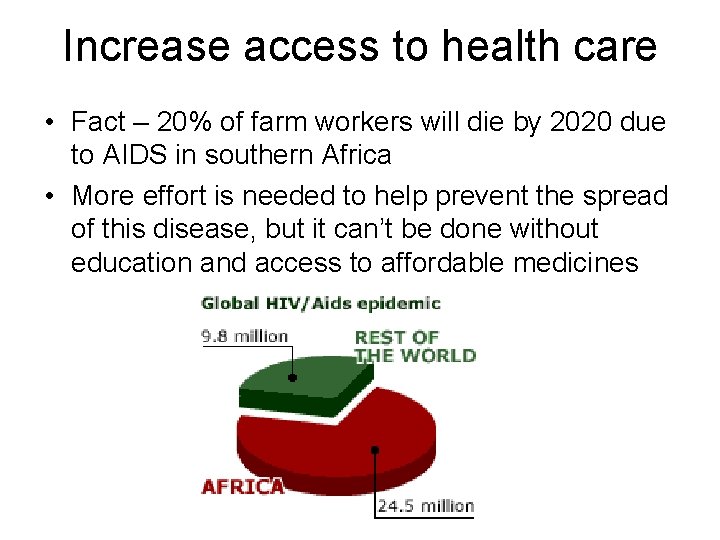
Increase access to health care • Fact – 20% of farm workers will die by 2020 due to AIDS in southern Africa • More effort is needed to help prevent the spread of this disease, but it can’t be done without education and access to affordable medicines
Infrastructure Development • The governments of developing nations need to put more money into developing agricultural infrastructure in rural areas • Better storage facilities (help in times of disaster), better irrigation equipment or even roads to get aid to those that are in need
Land Management • A last effort is for development agencies like CIDA (Canadian International Development Agency) or Engineers Without Borders to help educate and teach local farmers better methods of soil and water conservation to ensure the sustainability of their resources • This “grassroots” bottom-up approach is taken to help the farmers help themselves ex) Replanting trees to stop erosion and desertification
Future of Food • Hydroponics – grow food under artificial environments where you couldn’t normally grow food (Farmscrapers) • Fish is a major source of protein for many people in the developing world…aquaculture or fish farms might be an answer to declining world stock of fish
- Slides: 17