
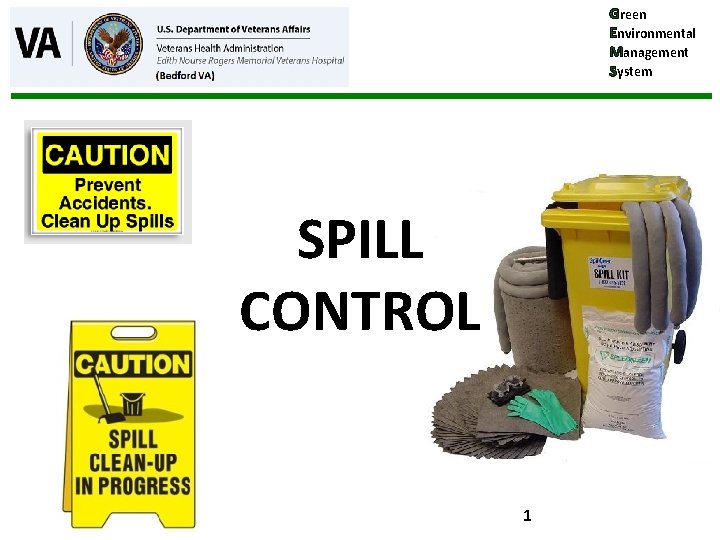
Green Environmental Management System SPILL CONTROL 1 Green
- Slides: 25
Green Environmental Management System SPILL CONTROL 1
Green Environmental Management System What is a Hazardous Substance/Waste? HAZARDOUS SUBSTANCE A hazardous substance is a material such as a liquid, gas, solid, vapor, fume, or mist that may adversely affect the health and safety of humans or the environment. Hazardous substances have the potential to cause serious injury or illness if inhaled, ingested, absorbed through the skin, or injected into the body. HAZARDOUS WASTE Hazardous waste is waste that is dangerous or potentially harmful to our health or the environment. Hazardous wastes can be liquids, solids, gases, or sludges. They can be discarded commercial products, like cleaning fluids or pesticides, or the by-products of manufacturing processes. * Spill/Release clean-up materials are waste products. * 2
Green Environmental Management System CHEMICAL SPILL/RELEASE RESPONSE INTRODUCTION I. Definitions: (Be sure to use the proper PPE when managing any chemical spill/release) i. Satellite Accumulation Area (SAA)– A hazardous waste collection area at or near the point of hazardous waste generation managed by the generator. An SAA is a means of collecting hazardous waste without the time limitation restrictions required by regulations. ii. Personal Protective Equipment (PPE) – Material used as last line of defense to protect human health. (i. e. chemical gloves) iii. Safety Data Sheet (SDS)– Document that contains information on the potential hazards of (health, fire, reactivity, and environmental) and how to work safely with chemical products. 3
Green Environmental Management System CHEMICAL SPILL/RELEASE RESPONSE INTRODUCTION II. Definitions: (Be sure to use the proper PPE when managing any chemical spill/release) i. Small Chemical Spill/Release – A Cup or less of a non-hazardous chemical or hazardous chemical ii. Large Chemical Spill/Release – Greater than a Cup of a non-hazardous chemical, any amount of an extremely hazardous chemical or gaseous release iii. Hazardous Chemical Spill/Release– A chemical that presents a health hazard or physical hazard to personnel iv. Extremely Hazardous Chemical – When a chemical’s SDS requires the use of a respiratory device for emergency handling of an accidental release OR 4 when in doubt, this chemical is considered Extremely Hazardous
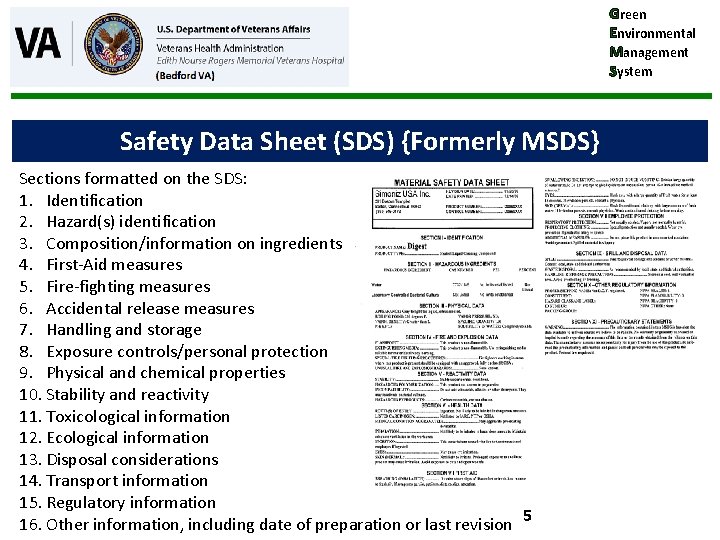
Green Environmental Management System Safety Data Sheet (SDS) {Formerly MSDS} Sections formatted on the SDS: 1. Identification 2. Hazard(s) identification 3. Composition/information on ingredients 4. First-Aid measures 5. Fire-fighting measures 6. Accidental release measures 7. Handling and storage 8. Exposure controls/personal protection 9. Physical and chemical properties 10. Stability and reactivity 11. Toxicological information 12. Ecological information 13. Disposal considerations 14. Transport information 15. Regulatory information 16. Other information, including date of preparation or last revision 5
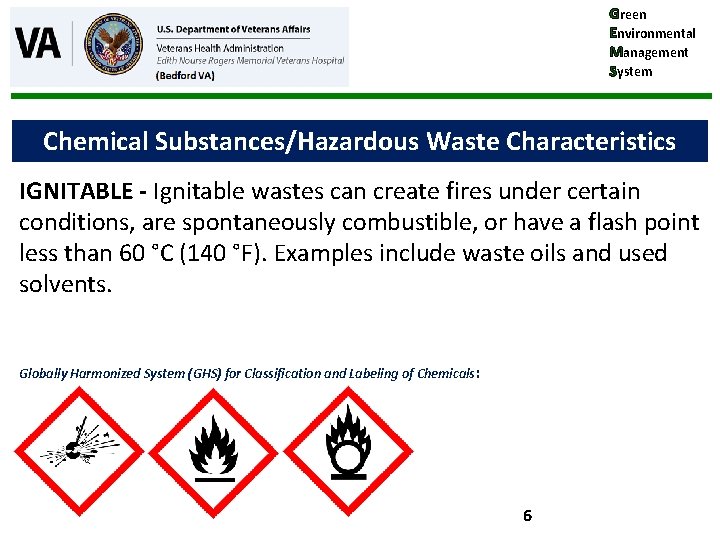
Green Environmental Management System Chemical Substances/Hazardous Waste Characteristics IGNITABLE - Ignitable wastes can create fires under certain conditions, are spontaneously combustible, or have a flash point less than 60 °C (140 °F). Examples include waste oils and used solvents. Globally Harmonized System (GHS) for Classification and Labeling of Chemicals : 6
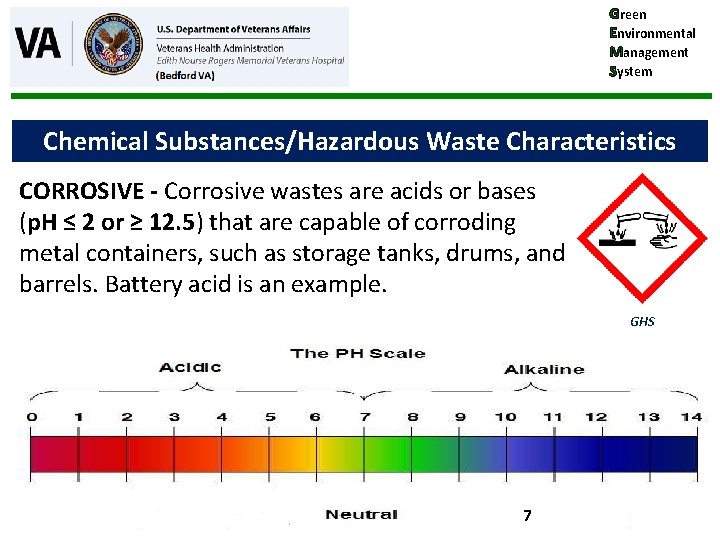
Green Environmental Management System Chemical Substances/Hazardous Waste Characteristics CORROSIVE - Corrosive wastes are acids or bases (p. H ≤ 2 or ≥ 12. 5) that are capable of corroding metal containers, such as storage tanks, drums, and barrels. Battery acid is an example. GHS 7
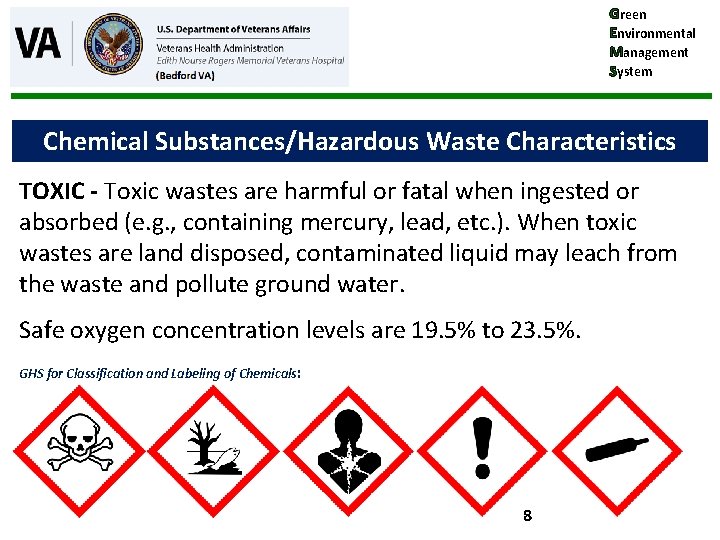
Green Environmental Management System Chemical Substances/Hazardous Waste Characteristics TOXIC - Toxic wastes are harmful or fatal when ingested or absorbed (e. g. , containing mercury, lead, etc. ). When toxic wastes are land disposed, contaminated liquid may leach from the waste and pollute ground water. Safe oxygen concentration levels are 19. 5% to 23. 5%. GHS for Classification and Labeling of Chemicals: 8
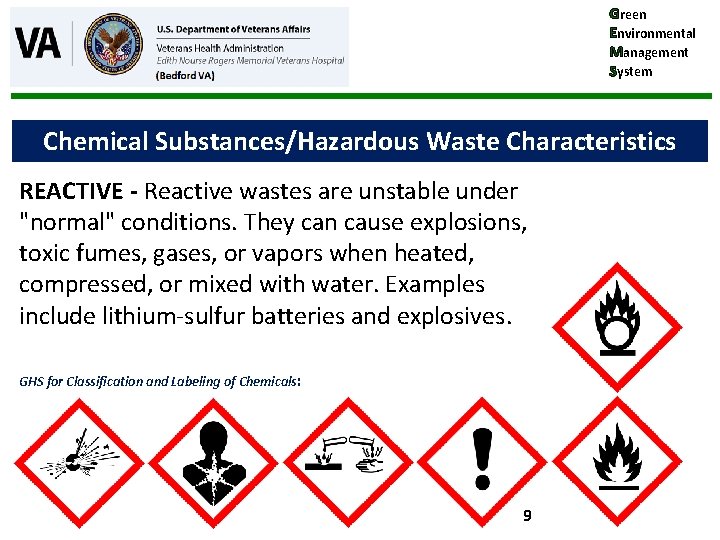
Green Environmental Management System Chemical Substances/Hazardous Waste Characteristics REACTIVE - Reactive wastes are unstable under "normal" conditions. They can cause explosions, toxic fumes, gases, or vapors when heated, compressed, or mixed with water. Examples include lithium-sulfur batteries and explosives. GHS for Classification and Labeling of Chemicals: 9
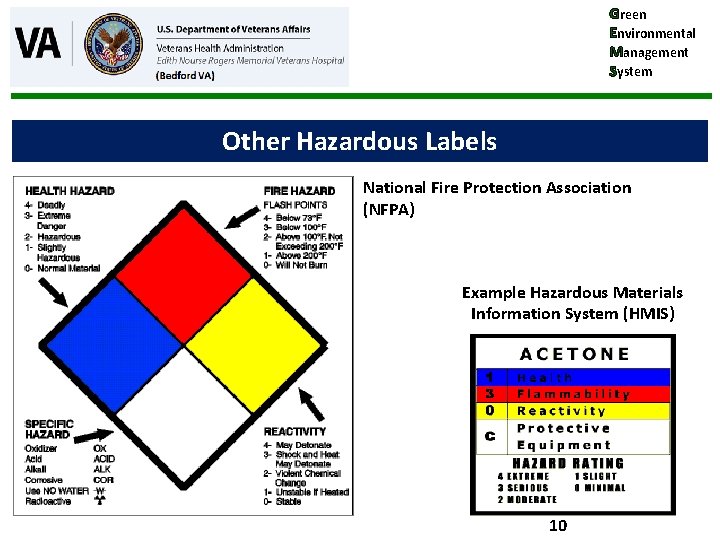
Green Environmental Management System Other Hazardous Labels National Fire Protection Association (NFPA) Example Hazardous Materials Information System (HMIS) 10
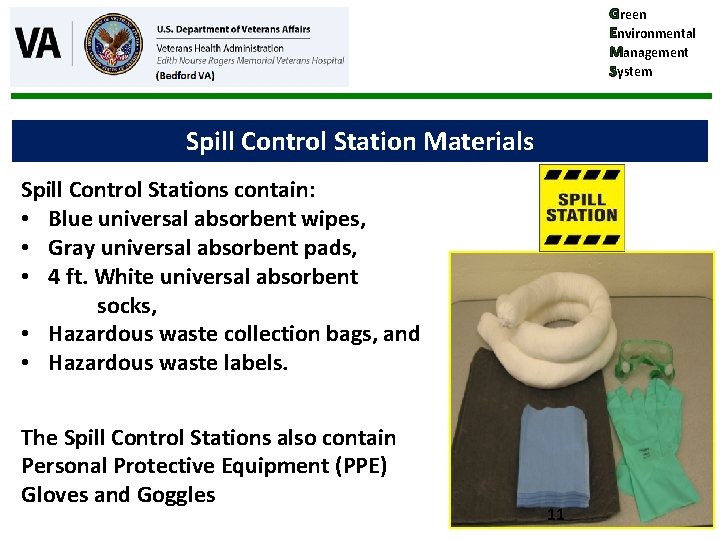
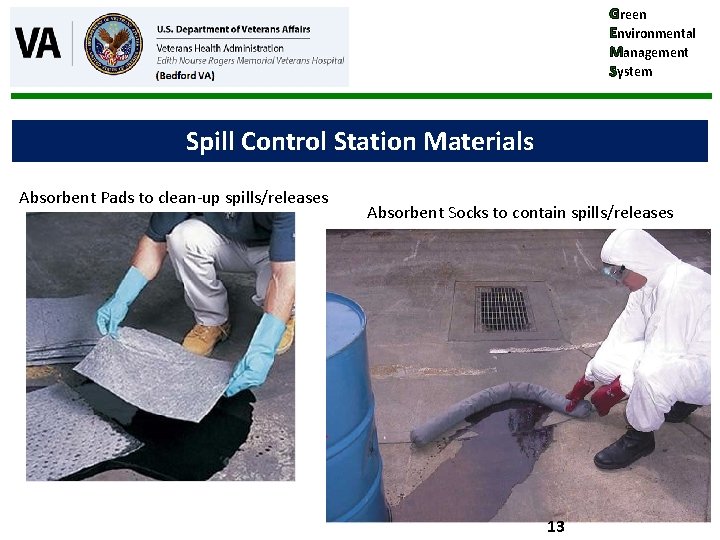
Green Environmental Management System Spill Control Station Materials Spill Control Stations contain: • Blue universal absorbent wipes, • Gray universal absorbent pads, • 4 ft. White universal absorbent socks, • Hazardous waste collection bags, and • Hazardous waste labels. The Spill Control Stations also contain Personal Protective Equipment (PPE) Gloves and Goggles 11
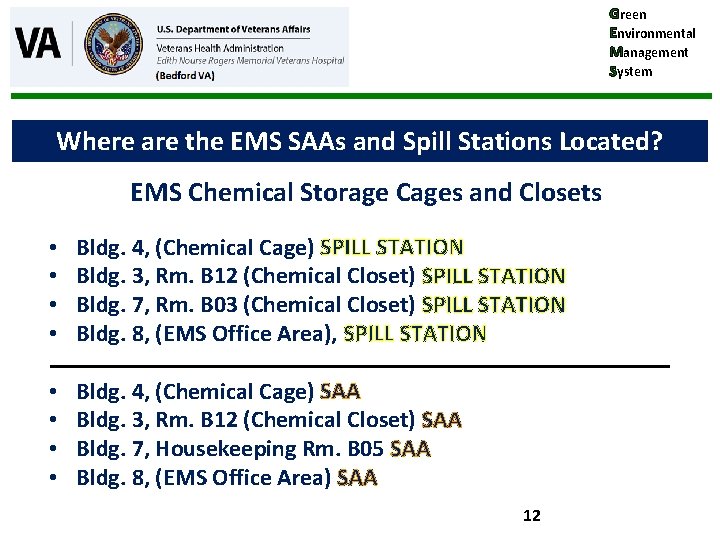
Green Environmental Management System Where are the EMS SAAs and Spill Stations Located? EMS Chemical Storage Cages and Closets • • Bldg. 4, (Chemical Cage) SPILL STATION Bldg. 3, Rm. B 12 (Chemical Closet) SPILL STATION Bldg. 7, Rm. B 03 (Chemical Closet) SPILL STATION Bldg. 8, (EMS Office Area), SPILL STATION • • Bldg. 4, (Chemical Cage) SAA Bldg. 3, Rm. B 12 (Chemical Closet) SAA Bldg. 7, Housekeeping Rm. B 05 SAA Bldg. 8, (EMS Office Area) SAA 12
Green Environmental Management System Spill Control Station Materials Absorbent Pads to clean-up spills/releases Absorbent Socks to contain spills/releases 13
Green Environmental Management System KNOW WHAT AND WHERE Know the location of the following: i. The SDSs for all chemicals in your Cages ii. Your Personal Protective Equipment (PPE) PPE iii. Nearest Eyewash/Shower Station to your Cage iv. Nearest Chemical Spill Control Station to your Cage i. Nearest Satellite Accumulation Area (SAA) SAA 14
Green Environmental Management System SMALL CHEMICAL SPILL/RELEASE i. iii. iv. v. viii. ix. Notify fellow personnel in vicinity of Spill/Release Contact your Supervisor Secure the Spill/Release area by restricting access Remove any ignition sources by shutting down electrical equipment Gather safety data from SDS on appropriate clean-up Gather Chemical Spill Control Station material Don appropriate PPE Confine, contain, and cover Spill with clean-up material Place all contaminated materials into Hazardous Waste bag supplied within the Chemical Spill Control Station, appropriately label the bag with chemical name, and place into nearest SAA Contact GEMS Coordinator for pick up of waste at X 2222 or (781) 983 -1666 (Cell) 15
Green Environmental Management System LARGE CHEMICAL SPILL/RELEASE i. iii. iv. Notify fellow personnel in vicinity of Spill/Release All personnel should assist with Non-Hazardous Spills Shutdown all ignition sources and exhaust fans if possible Secure the Spill/Release and restrict access Call the Emergency number X 2555 (if necessary) - give as much pertinent information of the Spill/Release location as possible and follow all instructions vi. Contact your Supervisor vii. Instruct any assisting personnel when they arrive on the scene viii. Properly collect, store, and label all contaminated waste materials into nearest SAA and contact the GEMS Coordinator at X 2222 or (781) 98316 1666 (Cell) for pick-up v.
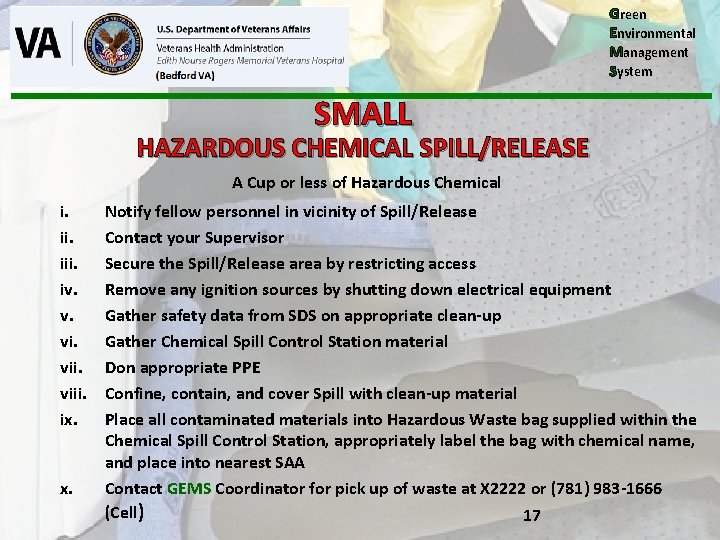
Green Environmental Management System SMALL HAZARDOUS CHEMICAL SPILL/RELEASE A Cup or less of Hazardous Chemical i. iii. iv. v. viii. ix. Notify fellow personnel in vicinity of Spill/Release Contact your Supervisor Secure the Spill/Release area by restricting access Remove any ignition sources by shutting down electrical equipment Gather safety data from SDS on appropriate clean-up Gather Chemical Spill Control Station material Don appropriate PPE Confine, contain, and cover Spill with clean-up material Place all contaminated materials into Hazardous Waste bag supplied within the Chemical Spill Control Station, appropriately label the bag with chemical name, and place into nearest SAA Contact GEMS Coordinator for pick up of waste at X 2222 or (781) 983 -1666 (Cell) 17
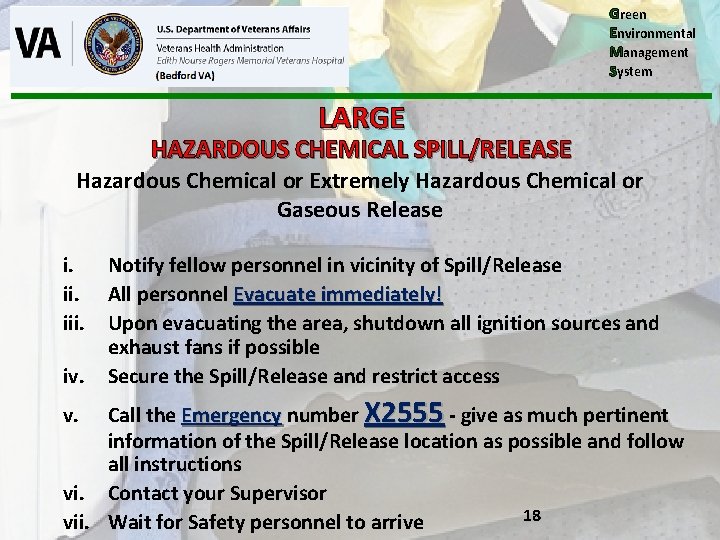
Green Environmental Management System LARGE HAZARDOUS CHEMICAL SPILL/RELEASE Hazardous Chemical or Extremely Hazardous Chemical or Gaseous Release i. Notify fellow personnel in vicinity of Spill/Release ii. All personnel Evacuate immediately! iii. Upon evacuating the area, shutdown all ignition sources and exhaust fans if possible iv. Secure the Spill/Release and restrict access Call the Emergency number X 2555 - give as much pertinent information of the Spill/Release location as possible and follow all instructions vi. Contact your Supervisor 18 vii. Wait for Safety personnel to arrive v.
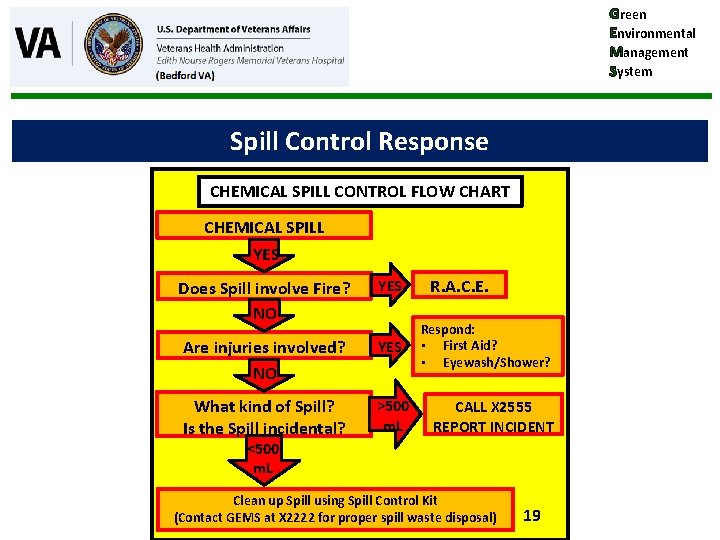
Green Environmental Management System Spill Control Response CHEMICAL SPILL CONTROL FLOW CHART CHEMICAL SPILL YES Does Spill involve Fire? NO YES Are injuries involved? NO YES What kind of Spill? Is the Spill incidental? >500 m. L R. A. C. E. Respond: • First Aid? • Eyewash/Shower? CALL X 2555 REPORT INCIDENT <500 m. L Clean up Spill using Spill Control Kit (Contact GEMS at X 2222 for proper spill waste disposal) 19
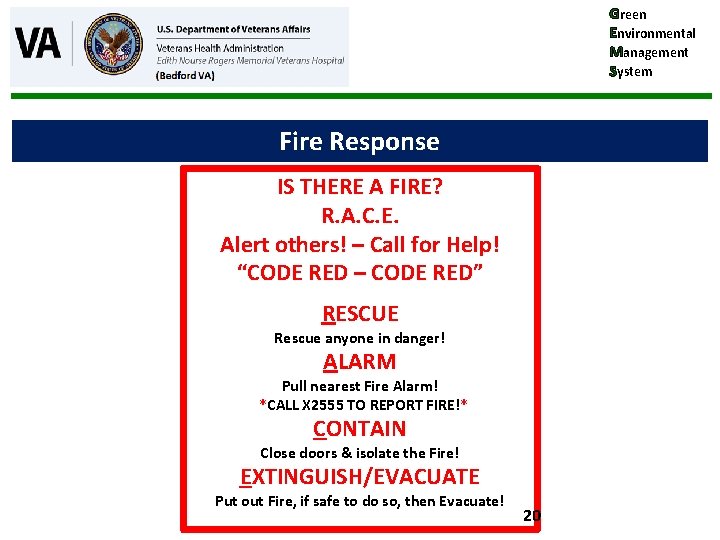
Green Environmental Management System Fire Response IS THERE A FIRE? R. A. C. E. Alert others! – Call for Help! “CODE RED – CODE RED” RESCUE Rescue anyone in danger! ALARM Pull nearest Fire Alarm! *CALL X 2555 TO REPORT FIRE!* CONTAIN Close doors & isolate the Fire! EXTINGUISH/EVACUATE Put out Fire, if safe to do so, then Evacuate! 20
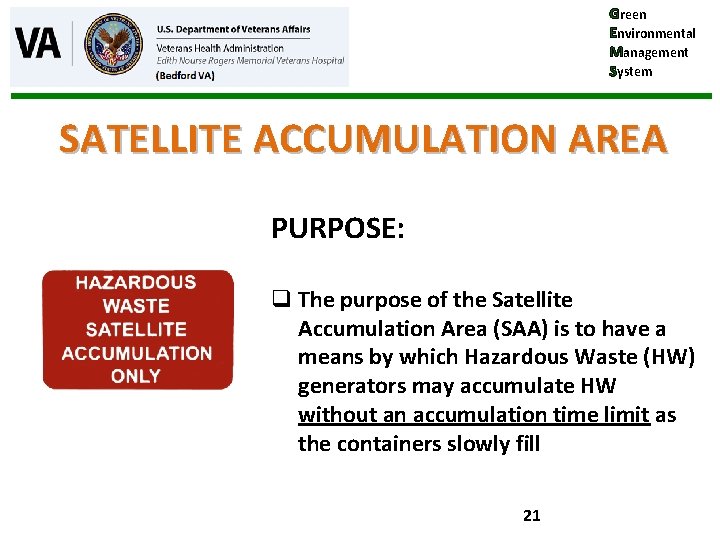
Green Environmental Management System SATELLITE ACCUMULATION AREA PURPOSE: q The purpose of the Satellite Accumulation Area (SAA) is to have a means by which Hazardous Waste (HW) generators may accumulate HW without an accumulation time limit as the containers slowly fill 21
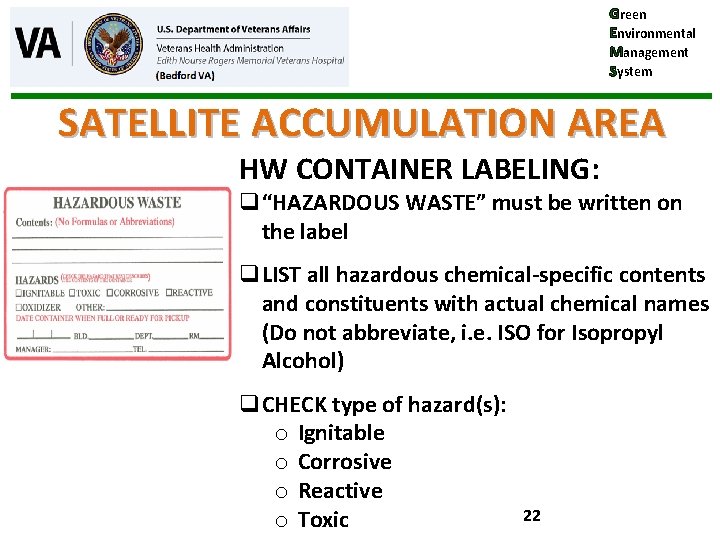
Green Environmental Management System SATELLITE ACCUMULATION AREA HW CONTAINER LABELING: q“HAZARDOUS WASTE” must be written on the label q. LIST all hazardous chemical-specific contents and constituents with actual chemical names (Do not abbreviate, i. e. ISO for Isopropyl Alcohol) q. CHECK type of hazard(s): o Ignitable o Corrosive o Reactive o Toxic 22
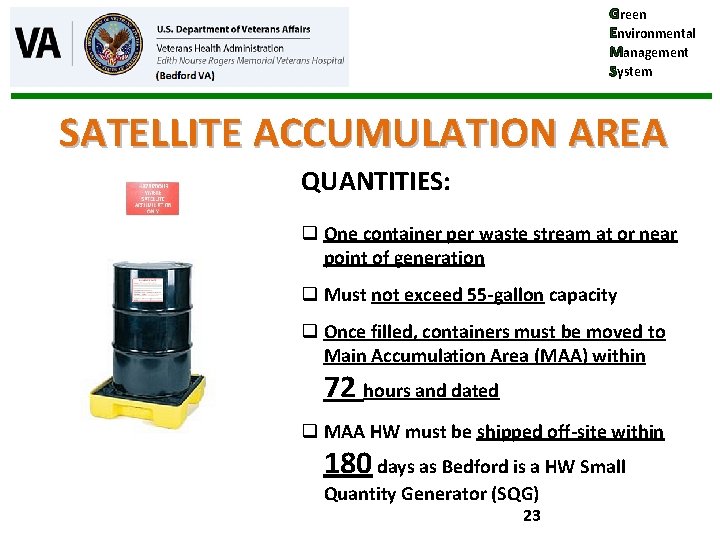
Green Environmental Management System SATELLITE ACCUMULATION AREA QUANTITIES: q One container per waste stream at or near point of generation q Must not exceed 55 -gallon capacity q Once filled, containers must be moved to Main Accumulation Area (MAA) within 72 hours and dated q MAA HW must be shipped off-site within 180 days as Bedford is a HW Small Quantity Generator (SQG) 23
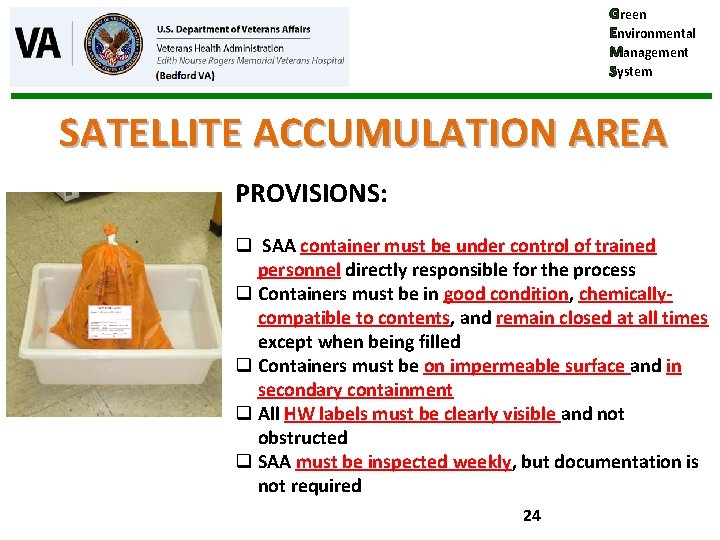
Green Environmental Management System SATELLITE ACCUMULATION AREA PROVISIONS: q SAA container must be under control of trained personnel directly responsible for the process q Containers must be in good condition, chemicallycompatible to contents, and remain closed at all times except when being filled q Containers must be on impermeable surface and in secondary containment q All HW labels must be clearly visible and not obstructed q SAA must be inspected weekly, but documentation is not required 24
Green Environmental Management System SATELLITE ACCUMULATION AREA SAA WEEKLY INSPECTIONS PLEASE NOTE: NO DOCUMENTATION IS REQUIRED I. Container(s) must remain closed when not in use II. Container(s) must have a descriptive label attached and: i. The label must include the words “HAZARDOUS WASTE” ii. The label must indicate a list of contents iii. The label must indicate the appropriate content hazard classification (i. e. - toxic, ignitable, corrosive, etc. ) iv. The label must be clearly visible and legible III. Container(s) must be in good condition, compatible with collected waste, and containers of incompatible chemicals must be segregated (i. e. - no containers of acids shall be stored together with containers of bases) IV. Container(s) must not show evidences of leaking V. Container(s) must be kept unobstructed (>36” clearance on side of container label) VI. Container(s) must not be managed in a manner to cause a leak or rupture VII. Container(s) must be removed from the SAA when full or if not in conformance with the above requirements by contacting the GEMS Coordinator at X 2222 Regulatory References: 310 CMR 30. 342, 30. 351, 30. 682 -30. 686 25