
Green Environmental Management System NURSING PHARMACEUTICAL WASTECS WASTE
- Slides: 16
Green Environmental Management System NURSING PHARMACEUTICAL WASTE-CS WASTE MANAGEMENT INSERVICE REFRESHER OF ANNUAL TRAINING COURSE ON TMS Edith Nourse Rogers Memorial Veterans Hospital
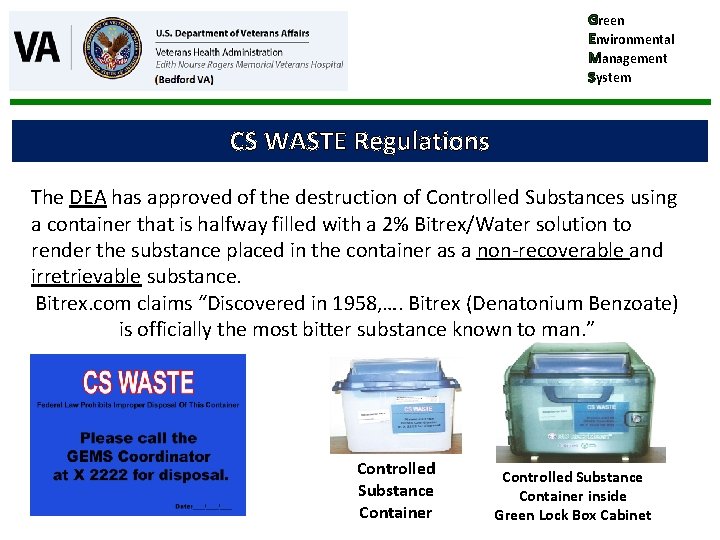
Green Environmental Management System CS WASTE Regulations The DEA has approved of the destruction of Controlled Substances using a container that is halfway filled with a 2% Bitrex/Water solution to render the substance placed in the container as a non-recoverable and irretrievable substance. Bitrex. com claims “Discovered in 1958, …. Bitrex (Denatonium Benzoate) is officially the most bitter substance known to man. ” Controlled Substance Container inside Green Lock Box Cabinet
Green Environmental Management System WHAT IS CS WASTE? CS Waste means Controlled Substances or Narcotics waste. CS Waste includes liquids, patches, and even vials of Narcotics. These are substances in partial doses, like morphine, that are wasted within the nurses’ wards. The DEA has approved this method of disposal. These are actual sharps containers; however, they are a different color to distinguish them from the red sharps/bio-haz containers. No sharps should be placed into these containers. Please empty any waste left over in the syringe into the container and place the syringe into the appropriate sharps container. CS Waste containers have been installed on the walls in the Med rooms and/or at the Nurses’ Stations in the Patient Care Wards throughout the facility. Also, if one must waste a controlled substance, remember to have someone present to witness the waste of the controlled substance at the Omnicell. These containers are swapped out either when full or quarterly by the GEMS Program Manager (x 2222).
Green Environmental Management System COMMON CS WASTE QUESTIONS Where do Fentanyl patches go once they are removed from the patient? When a Fentanyl patch is removed from the patient that is considered to be a controlled substance, the patch should be placed into the CS Waste container. Once the patch has been placed on a patient it is considered to be used for its intended purposes. Therefore, when the patch is removed from the patient it can be properly disposed of in the CS Waste container without another staff witnessing the disposal. Can oral syringes go into the CS Waste Container? Yes, you may dispose of oral syringes (without a needle attached) into the CS Waste container. Oral syringes can be wasted into a gauze or med cup prior to being placed into the CS Waste container. However, it is important that any narcotics inside of the syringe be emptied into the container to make the narcotic irretrievable. Can sharps go into the CS Waste Container? No, any narcotics or controlled substances waste that is left over in a syringe must be emptied into the CS waste container before properly placing the syringe into a sharps container.
Green Environmental Management System Environmental Regulations for Hazardous Waste Certain Pharmaceutical wastes generated in Patient Care areas and in the Pharmacy are considered “Hazardous Wastes” by both the: • U. S. Environmental Protection Agency (EPA) • Massachusetts Department of Environmental Protection (MA DEP) Over the past several years, the proper management of waste Pharmaceuticals meeting the definition of a “Hazardous Waste” has been scrutinized at healthcare facilities. Both the EPA and the MA DEP may perform an unannounced random inspection of the hospital. Strict penalties can be imposed upon hospitals in violation of the Hazardous Waste regulations – up to $37, 500 per violation, per day!
Green Environmental Management System Proper Waste Determination By Federal and State regulation, hospitals are responsible for determining which Pharmaceuticals are considered Hazardous Wastes *Hazardous Waste is either determined to be, or has a characteristic to pose harm to human health or the environment. Pharmaceuticals could be considered Hazardous Waste for several reasons, including: • • • The Pharmaceutical possesses a hazardous property, {i. e. it may be ignitable, reactive, corrosive, and/or toxic} The Pharmaceutical is specifically listed by the Federal or State government as a hazardous compound, {i. e. Nicotine and Warfarin are both acutely toxic compounds} The Pharmaceutical contains a heavy metal which is considered to be toxic in the environment. {i. e. Silvadine Cream (containing Silver) or Gramicidin (containing Mercury)} ?
Green Environmental Management System Proper Waste Determination Pharmaceutical waste comes in many different forms. Waste could be: • • Unused, but not wanted product Expired product Product not fully administered to a patient Packaging once in contact with product that may contain residue Bedford VAMC collects: • • • All Hazardous Pharmaceutical Waste listed within the Pharmacy formulary All bulk Chemotherapy Non-Hazardous Pharmaceutical Waste containing PII
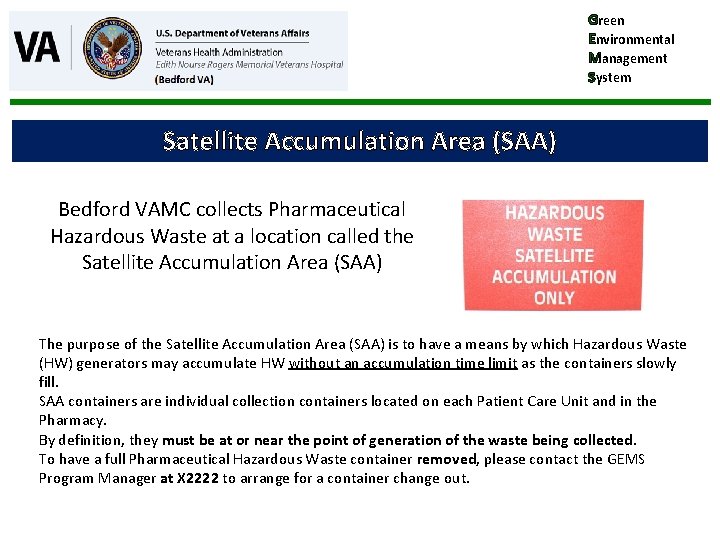
Green Environmental Management System Satellite Accumulation Area (SAA) Bedford VAMC collects Pharmaceutical Hazardous Waste at a location called the Satellite Accumulation Area (SAA) The purpose of the Satellite Accumulation Area (SAA) is to have a means by which Hazardous Waste (HW) generators may accumulate HW without an accumulation time limit as the containers slowly fill. SAA containers are individual collection containers located on each Patient Care Unit and in the Pharmacy. By definition, they must be at or near the point of generation of the waste being collected. To have a full Pharmaceutical Hazardous Waste container removed, please contact the GEMS Program Manager at X 2222 to arrange for a container change out.
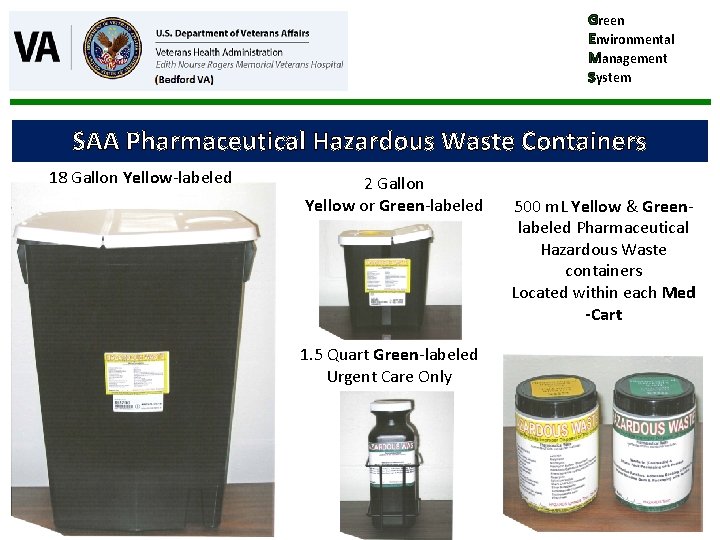
Green Environmental Management System SAA Pharmaceutical Hazardous Waste Containers 18 Gallon Yellow-labeled 2 Gallon Yellow or Green-labeled 1. 5 Quart Green-labeled Urgent Care Only 500 m. L Yellow & Greenlabeled Pharmaceutical Hazardous Waste containers Located within each Med -Cart
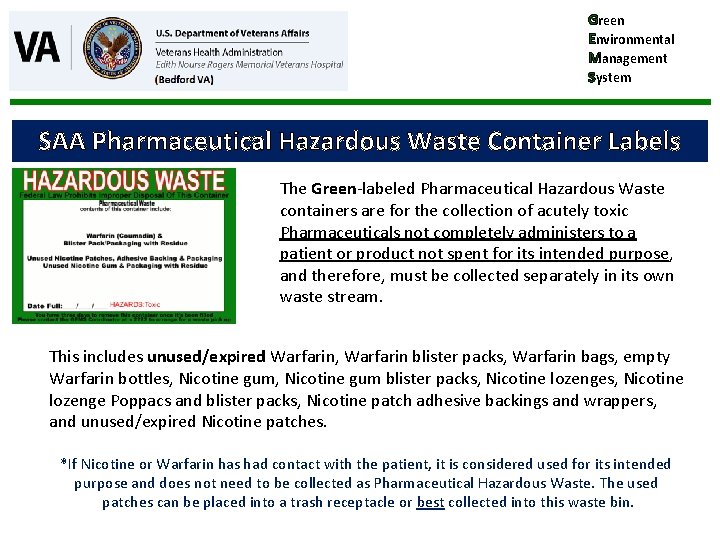
Green Environmental Management System SAA Pharmaceutical Hazardous Waste Container Labels The Green-labeled Pharmaceutical Hazardous Waste containers are for the collection of acutely toxic Pharmaceuticals not completely administers to a patient or product not spent for its intended purpose, and therefore, must be collected separately in its own waste stream. This includes unused/expired Warfarin, Warfarin blister packs, Warfarin bags, empty Warfarin bottles, Nicotine gum blister packs, Nicotine lozenge Poppacs and blister packs, Nicotine patch adhesive backings and wrappers, and unused/expired Nicotine patches. *If Nicotine or Warfarin has had contact with the patient, it is considered used for its intended purpose and does not need to be collected as Pharmaceutical Hazardous Waste. The used patches can be placed into a trash receptacle or best collected into this waste bin.
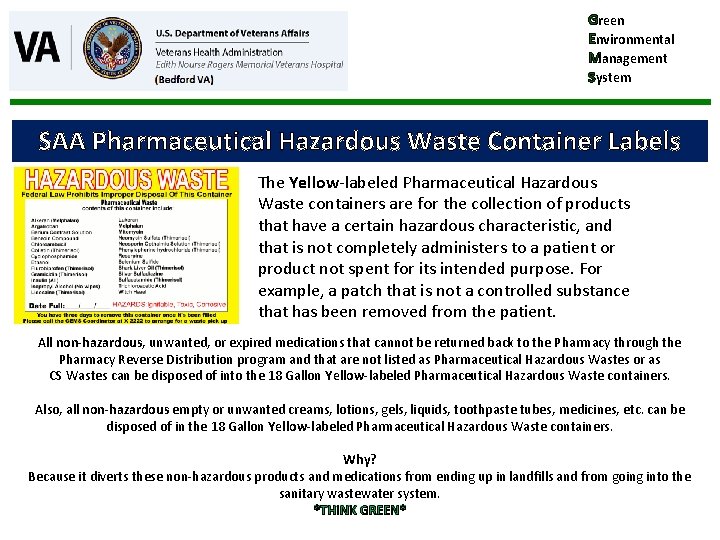
Green Environmental Management System SAA Pharmaceutical Hazardous Waste Container Labels The Yellow-labeled Pharmaceutical Hazardous Waste containers are for the collection of products that have a certain hazardous characteristic, and that is not completely administers to a patient or product not spent for its intended purpose. For example, a patch that is not a controlled substance that has been removed from the patient. All non-hazardous, unwanted, or expired medications that cannot be returned back to the Pharmacy through the Pharmacy Reverse Distribution program and that are not listed as Pharmaceutical Hazardous Wastes or as CS Wastes can be disposed of into the 18 Gallon Yellow-labeled Pharmaceutical Hazardous Waste containers. Also, all non-hazardous empty or unwanted creams, lotions, gels, liquids, toothpaste tubes, medicines, etc. can be disposed of in the 18 Gallon Yellow-labeled Pharmaceutical Hazardous Waste containers. Why? Because it diverts these non-hazardous products and medications from ending up in landfills and from going into the sanitary wastewater system. *THINK GREEN*
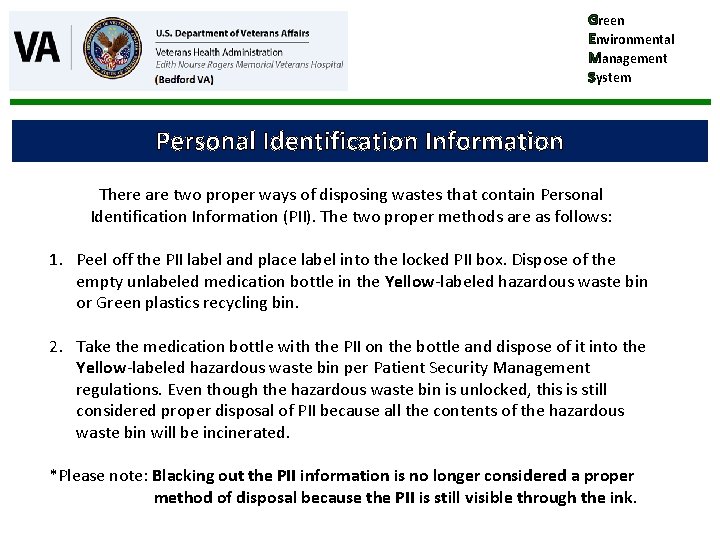
Green Environmental Management System Personal Identification Information There are two proper ways of disposing wastes that contain Personal Identification Information (PII). The two proper methods are as follows: 1. Peel off the PII label and place label into the locked PII box. Dispose of the empty unlabeled medication bottle in the Yellow-labeled hazardous waste bin or Green plastics recycling bin. 2. Take the medication bottle with the PII on the bottle and dispose of it into the Yellow-labeled hazardous waste bin per Patient Security Management regulations. Even though the hazardous waste bin is unlocked, this is still considered proper disposal of PII because all the contents of the hazardous waste bin will be incinerated. *Please note: Blacking out the PII information is no longer considered a proper method of disposal because the PII is still visible through the ink.
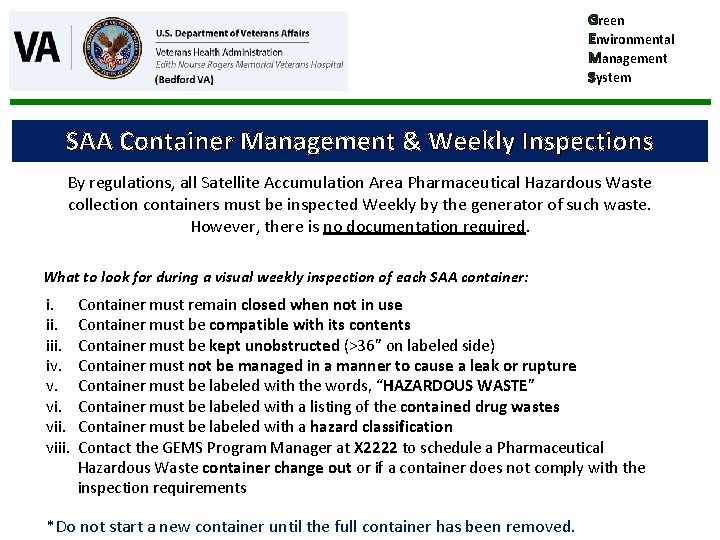
Green Environmental Management System SAA Container Management & Weekly Inspections By regulations, all Satellite Accumulation Area Pharmaceutical Hazardous Waste collection containers must be inspected Weekly by the generator of such waste. However, there is no documentation required. What to look for during a visual weekly inspection of each SAA container: i. iii. iv. v. viii. Container must remain closed when not in use Container must be compatible with its contents Container must be kept unobstructed (>36” on labeled side) Container must not be managed in a manner to cause a leak or rupture Container must be labeled with the words, “HAZARDOUS WASTE” Container must be labeled with a listing of the contained drug wastes Container must be labeled with a hazard classification Contact the GEMS Program Manager at X 2222 to schedule a Pharmaceutical Hazardous Waste container change out or if a container does not comply with the inspection requirements *Do not start a new container until the full container has been removed.
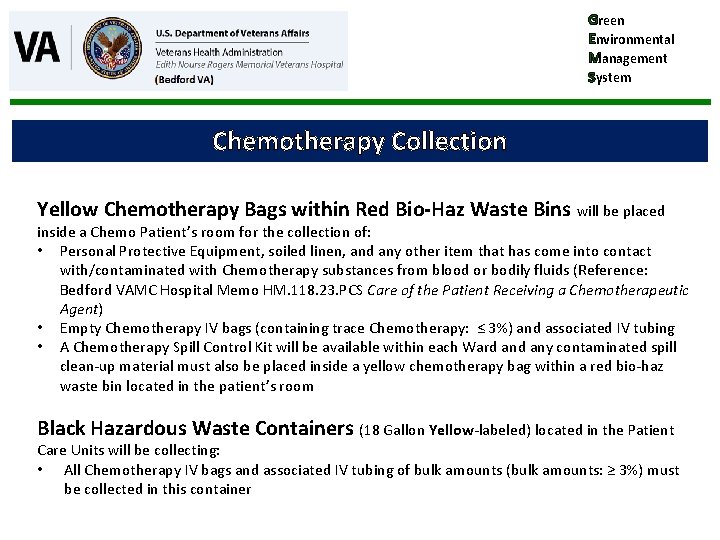
Green Environmental Management System Chemotherapy Collection Yellow Chemotherapy Bags within Red Bio-Haz Waste Bins will be placed inside a Chemo Patient’s room for the collection of: • Personal Protective Equipment, soiled linen, and any other item that has come into contact with/contaminated with Chemotherapy substances from blood or bodily fluids (Reference: Bedford VAMC Hospital Memo HM. 118. 23. PCS Care of the Patient Receiving a Chemotherapeutic Agent) • Empty Chemotherapy IV bags (containing trace Chemotherapy: ≤ 3%) and associated IV tubing • A Chemotherapy Spill Control Kit will be available within each Ward any contaminated spill clean-up material must also be placed inside a yellow chemotherapy bag within a red bio-haz waste bin located in the patient’s room Black Hazardous Waste Containers (18 Gallon Yellow-labeled) located in the Patient Care Units will be collecting: • All Chemotherapy IV bags and associated IV tubing of bulk amounts (bulk amounts: ≥ 3%) must be collected in this container
Green Environmental Management System Important Questions Does the nursing staff know where the SAA is located on the ward? Does the nursing staff know what waste goes into each container? Does the nursing staff know what to do with a used non-narcotic patch vs an unused nonnarcotic patch? Does the nursing staff know what to do with a narcotic patch, used or unused? Does the nursing staff know the difference between the green and yellow containers?
Green Environmental Management System Pharmaceutical Hazardous Waste References • Hazardous Pharmaceutical Waste Collection Policy and associated Appendices – Bedford VAMC Memoranda • Bedford VAMC GEMS Program Manager – (781) 687 -2222 • Bedford VAMC Safety Office – (781) 687 -3394/2714 • Massachusetts Code of Regulations: 310 CMR 30. 000